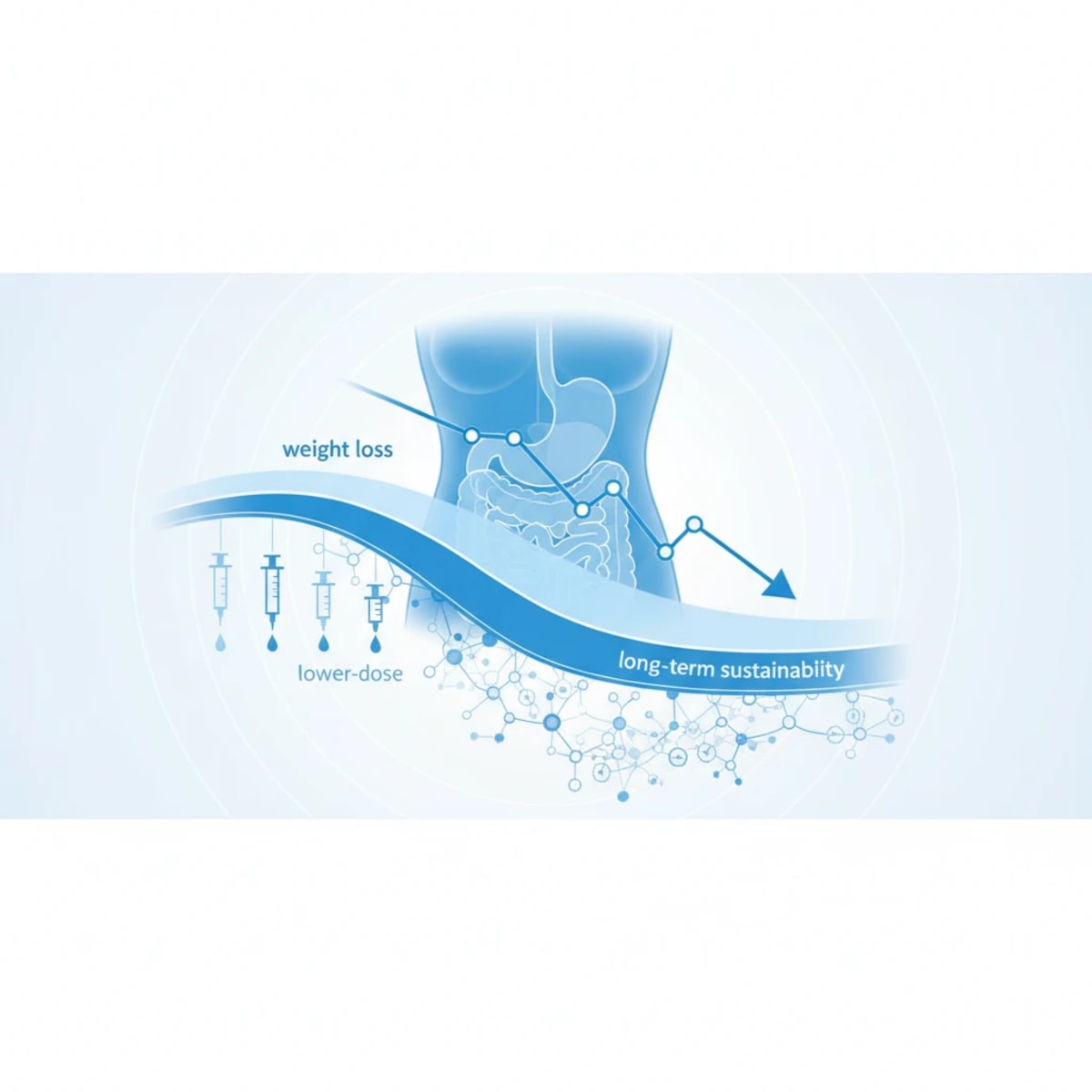


The central question in obesity pharmacotherapy has shifted from induction to maintenance: once a patient has lost weight on a GLP-1/GIP receptor agonist, can a lower dose hold that loss without the drug bill of the induction phase? Tirzepatide (Mounjaro, Eli Lilly) achieved mean weight reductions of around 20% at its maximum approved dose of 15 mg weekly in the SURMOUNT programme, but discontinuation data consistently show rapid weight regain, framing dose reduction as both a clinical and economic pressure point.1 The current evidence does not yet support confident dose de-escalation as a standard strategy, and prescribers should understand why before patient conversations drift in that direction.
- The Pivot Attention has moved from peak weight loss with tirzepatide to whether lower maintenance doses can preserve that loss, driven by cost pressures and tolerability concerns.
- The Data The SURMOUNT-1 trial demonstrated a mean body weight reduction of 20.9% with tirzepatide 15 mg versus 3.1% with placebo at 72 weeks (p < 0.001), but dedicated dose-reduction maintenance data remain limited.1
- The Action Do not routinely de-escalate tirzepatide dose to a lower maintenance level without shared decision-making; the evidence base for this strategy is not established, and regain risk is real and rapid upon dose reduction or cessation.
Tirzepatide is a dual glucose-dependent insulinotropic polypeptide (GIP) and glucagon-like peptide-1 (GLP-1) receptor agonist, approved for chronic weight management in adults with obesity or overweight with at least one weight-related comorbidity. Its efficacy at 15 mg weekly is well-characterised: SURMOUNT-1, a 72-week phase 3 randomised controlled trial of 2,539 adults without diabetes, reported mean body weight reductions of 15.0%, 19.5%, and 20.9% at the 5 mg, 10 mg, and 15 mg doses respectively, versus 3.1% with placebo (all comparisons p < 0.001).1 What SURMOUNT-1 was not designed to answer is whether a patient who reaches maximal weight loss on 15 mg can step down to 5 mg or 10 mg and sustain that outcome.
The biological rationale for dose maintenance is plausible. Weight loss with GLP-1 and GIP receptor agonists depends on sustained receptor engagement to suppress appetite and modify energy homeostasis. Preclinical and clinical withdrawal data show that the neuroendocrine drivers of weight regain, including suppressed leptin and elevated ghrelin, reassert themselves rapidly when the drug is removed or substantially reduced.2 The SURMOUNT-4 trial, which examined the consequences of tirzepatide withdrawal after a 36-week lead-in, found that participants who switched to placebo regained a mean of 14% of body weight over the subsequent 52 weeks, while those who continued tirzepatide lost a further 5.5%.3 This is not a dose-reduction trial, but it illustrates the dependency of maintained weight loss on continued pharmacological support.
What the evidence on lower doses shows
The SURMOUNT programme does provide indirect information. SURMOUNT-1 showed that the 5 mg dose produced a mean weight reduction of 15.0% at 72 weeks, a clinically meaningful result that is meaningfully lower than the 15 mg arm but not trivial.1 Whether a patient who achieves 20% weight loss on 15 mg can then be maintained at 5 mg without reverting toward baseline is mechanistically uncertain and has not been tested in a prospective dose-de-escalation design. The SURMOUNT-5 trial, comparing tirzepatide against semaglutide 2.4 mg, found that tirzepatide produced 47% greater relative weight loss than semaglutide at 72 weeks, but again does not isolate dose-maintenance questions.4
Tolerability is a separate but clinically linked consideration. Gastrointestinal adverse events, primarily nausea, vomiting, and diarrhoea, are dose-dependent and drove discontinuation in a minority of SURMOUNT-1 participants: discontinuation due to adverse events occurred in 4.3%, 7.1%, and 6.2% of participants in the 5 mg, 10 mg, and 15 mg groups respectively, versus 2.6% with placebo.1 For patients who cannot tolerate escalation to 15 mg, lower doses are not a concession but the clinically appropriate ceiling. The prescribing question is different for patients who have tolerated 15 mg and are asking whether they can reduce for cost or convenience reasons. Here, the honest answer is that the evidence to guide that conversation does not yet exist in a rigorous prospective form.
Limitations are substantial. No published randomised trial has specifically evaluated a step-down maintenance protocol for tirzepatide. The available data are inferential, drawn from withdrawal studies, cross-dose comparisons within induction trials, and mechanistic understanding of receptor pharmacology. Real-world dose reduction happens regardless, driven by supply constraints, cost, and patient preference, but this does not constitute evidence. Until a dedicated dose-optimisation trial reports, clinicians are extrapolating.
The most striking implication of where the evidence currently sits is that the dose-maintenance question is being answered in clinics rather than in trials. Patients and prescribers are already making tirzepatide dose adjustments, partly because of the drug's cost (list price in the UK under private prescription runs to several hundred pounds per month), partly because NHS commissioning pathways are still evolving, and partly because patients who have lost 20% of their body weight feel, not unreasonably, that something has worked and perhaps less of it will continue to work. The absence of a well-designed dose-de-escalation trial is a gap that Eli Lilly has a commercial incentive not to fill urgently. A 15 mg maintenance patient is more profitable than a 5 mg maintenance patient, and the withdrawal data from SURMOUNT-4 do the necessary persuasive work without a trial that might show lower doses are adequate.
Prescribers in primary care are left navigating a situation where the clinical guidelines, including NICE TA1026 which conditionally recommends tirzepatide within a specialist weight management context, do not yet address dose optimisation in any granular way. The default is to continue the induction dose indefinitely, which is defensible pharmacologically but creates access and adherence problems in practice. Patients who cannot sustain the cost of 15 mg are effectively being told that partial treatment is not an option, when the 5 mg arm of SURMOUNT-1 suggests it very much is, at least for induction. Whether 5 mg is sufficient to prevent regain after 15 mg-induced loss is the unanswered question that should be driving trial design right now.
For patients, particularly those who have experienced the first meaningful long-term weight loss of their lives on tirzepatide, the regain data from withdrawal studies land as a life sentence of high-dose, high-cost pharmacotherapy. This is not a trivial psychological or financial burden, and it is a conversation that needs to happen proactively at initiation rather than at the point where a patient can no longer afford to continue. The field would be better served by a head-to-head dose-maintenance trial than by another comparison with semaglutide. SURMOUNT-5 was commercially useful. A dose-optimisation trial would be clinically useful. Those are not always the same thing.
ART-2026-017
Cite This Article
Team TLSFE. Lower-dose tirzepatide: can it sustain weight loss long-term?. The Life Science Feed. Published May 17, 2026. Accessed May 18, 2026. https://thelifesciencefeed.com/endocrinology/obesity/lower-dose-tirzepatide-can-it-sustain-weight-loss-long-term.
Licence & Rights
© 2026 The Life Science Feed. All rights reserved. Unless otherwise indicated, all content is the property of The Life Science Feed and may not be reproduced, distributed, or transmitted in any form or by any means without prior written permission.
Editorial & AI Standards
All content is researched from peer-reviewed, open-access sources — published trial data, clinical guidelines, and regulatory filings. AI tools are used solely to structure and summarise that evidence; no AI-generated conclusions appear without editor verification against the primary source.
Every article is reviewed by a named editor before publication. Source citations are listed in the References section. This content does not represent the views of any pharmaceutical company, medical device manufacturer, or healthcare provider.
References
1. Jastreboff AM, Aronne LJ, Ahmad NN, et al. Tirzepatide once weekly for the treatment of obesity. N Engl J Med. 2022;387(3):205-216. doi:10.1056/NEJMoa2206038
2. Sumithran P, Prendergast LA, Delbridge E, et al. Long-term persistence of hormonal adaptations to weight loss. N Engl J Med. 2011;365(17):1597-1604. doi:10.1056/NEJMoa1105816
3. Aronne LJ, Sattar N, Horn DB, et al. Continued treatment with tirzepatide for maintenance of weight reduction in adults with obesity: the SURMOUNT-4 randomized clinical trial. JAMA. 2024;331(1):38-48. doi:10.1001/jama.2023.24948
4. Wadden TA, Chao AM, Machineni S, et al. Tirzepatide versus semaglutide for weight reduction in adults with overweight or obesity: SURMOUNT-5 phase 3b randomized clinical trial. Nat Med. 2025;31:639-648. doi:10.1038/s41591-025-03535-8