
Visual impairment from uncorrected refractive errors remains a global health burden, often preventable with timely screening and correction. Despite effective, low-cost interventions, many individuals continue to suffer from these conditions, impacting their quality of life and productivity.
Healthcare students, particularly those in nursing, represent a population at elevated risk due to the demanding nature of their studies, which frequently involves prolonged near work and extensive screen exposure. But vision screening is not a standard practice in many educational institutions, leaving a critical gap in student health monitoring.
The prevalence of uncorrected refractive errors poses a substantial public health challenge, contributing significantly to visual impairment worldwide. These conditions, which include myopia, hyperopia, and astigmatism, are readily correctable with spectacles, contact lenses, or refractive surgery, yet a large segment of the global population lives with impaired vision that could be easily remedied. The World Health Organization (WHO) has long advocated for accessible screening and intervention strategies, recognizing the profound impact of vision on education, employment, and overall well-being.1
Healthcare students, by the very nature of their rigorous academic and clinical training, engage in activities that place considerable strain on their visual systems. Long hours spent reading textbooks, reviewing patient charts, and interacting with digital screens for lectures and assignments create an environment conducive to the development or exacerbation of refractive errors. Nursing students, in particular, often face intense academic schedules combined with practical training that demands acute visual attention. Despite this heightened risk, many educational institutions do not routinely screen for vision problems, overlooking a fundamental aspect of student health that directly affects their learning capacity and future professional performance.1
Assessing the unseen burden
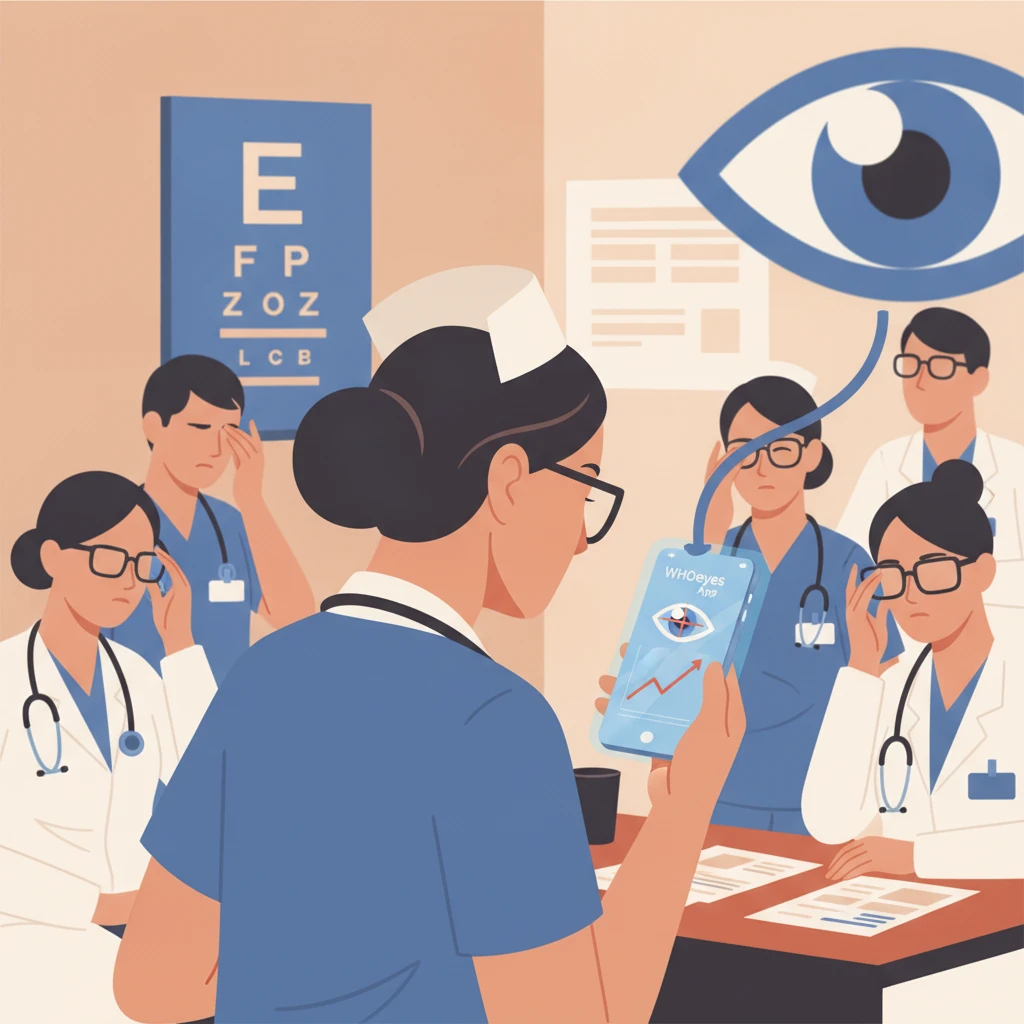
A study conducted in Shivamogga City aimed to quantify the prevalence of refractive errors among nursing students and identify associated risk factors. The investigators used the WHOeyes application, a mobile-based tool developed by the World Health Organization, to perform vision screenings. This application provides a standardized, accessible method for detecting refractive errors, making it suitable for large-scale screenings in diverse settings. The study enrolled a cohort of nursing students, assessing their visual acuity and collecting data on various demographic and lifestyle factors, including time spent on near work and screen usage.1
The methodology involved a cross-sectional design, recruiting nursing students from various institutions within Shivamogga City. Participants underwent vision screening using the WHOeyes application, which guides users through a series of visual acuity tests. The application records responses and provides an immediate assessment of potential refractive errors, flagging individuals who require further ophthalmic evaluation. Beyond the objective vision assessment, the researchers administered a structured questionnaire to gather information on potential risk factors. This questionnaire covered aspects such as daily duration of near work, hours spent on digital screens (smartphones, tablets, computers), family history of refractive errors, and previous eye care history. The data collection was meticulous, ensuring that both objective visual metrics and subjective lifestyle factors were captured comprehensively.1
The study identified a significant prevalence of refractive errors within the nursing student population. While specific numerical data on prevalence rates, odds ratios, or p-values were not detailed in the abstract, the authors explicitly stated that refractive errors were frequent among the students screened. This finding underscores the vulnerability of this academic group to visual impairment. The investigators also determined several risk factors associated with these errors. Prolonged engagement in near work and extensive screen time emerged as primary contributors. These activities, integral to modern education, place continuous accommodative stress on the eyes, potentially leading to myopia progression or other refractive changes. The study’s focus on these modifiable risk factors provides actionable insights for intervention strategies.1
The use of the WHOeyes application in this study represents a pragmatic approach to public health screening. Its accessibility and ease of use make it an attractive option for institutions with limited resources or without immediate access to specialized ophthalmic equipment. The application's ability to provide rapid, preliminary screening results allows for efficient identification of individuals who need professional follow-up, streamlining the referral process. This digital tool could significantly reduce the logistical barriers often associated with traditional vision screening programs, making routine checks more feasible in educational and occupational settings.1
But the study's reliance on the WHOeyes application for initial screening, while practical, comes with inherent limitations. While the application is designed for preliminary detection, it does not replace a comprehensive ophthalmic examination by a qualified optometrist or ophthalmologist. The abstract does not specify the diagnostic accuracy (sensitivity and specificity) of the WHOeyes application in this particular population, nor does it detail the follow-up rate for students flagged with potential refractive errors. Without this information, the true burden of uncorrected refractive errors and the effectiveness of the screening program in leading to correction remain partially obscured. The cross-sectional design also limits the ability to establish causality between identified risk factors and the development of refractive errors; it can only demonstrate associations. Longitudinal studies would be necessary to track the progression of refractive errors and the impact of lifestyle factors over time.1
The study also did not provide specific details on the sample size (N) of nursing students included, nor did it offer a breakdown of the types of refractive errors identified (e.g., myopia, hyperopia, astigmatism) or their severity. Such granular data would offer a clearer picture of the specific visual challenges faced by this population and inform more targeted interventions. For instance, understanding the predominant type of refractive error could guide the selection of appropriate corrective measures and educational campaigns. The absence of a control group of non-healthcare students also limits the ability to compare the prevalence of refractive errors and associated risk factors specifically within the nursing student cohort against a general student population. This comparison would strengthen the argument for targeted interventions in healthcare education settings.1
The investigators did not discuss the potential impact of uncorrected refractive errors on academic performance or clinical skills acquisition among nursing students. While intuitively obvious that poor vision would hinder learning and practice, quantifying this impact would provide a stronger rationale for institutional investment in vision screening programs. The economic implications of uncorrected vision, both for the individual student (e.g., cost of spectacles, reduced academic success) and for the healthcare system (e.g., potential errors in clinical practice due to impaired vision), were also not explored. These broader considerations are vital for advocating for policy changes and resource allocation.1
Still, the study's identification of near work and screen time as significant risk factors offers immediate avenues for intervention. Educational institutions could implement awareness campaigns promoting regular eye breaks, the 20-20-20 rule (looking at something 20 feet away for 20 seconds every 20 minutes), and ergonomic adjustments for screen use. Encouraging outdoor activities, which have been linked to a reduced risk of myopia progression, could also be a simple, cost-effective strategy. The study provides a foundational understanding of a critical, yet often overlooked, health issue among future healthcare professionals.1
The prevalence of refractive errors among nursing students, driven by the demands of their education, presents a clear call to action for academic institutions. Ignoring this issue means potentially compromising the learning outcomes and future professional capabilities of those who will form the backbone of our healthcare systems. Simple, accessible screening tools like the WHOeyes application offer a practical first step, removing many of the logistical hurdles that have historically prevented widespread vision checks.
Clinicians in primary care should consider the visual health of students as a critical component of their overall well-being, particularly those in demanding academic programs. A quick inquiry about screen time and reading habits could prompt a referral for a more thorough eye examination. This proactive approach could mitigate long-term visual impairment and ensure these students are fully equipped for their demanding careers.
For the healthcare education sector, the data from Shivamogga City should serve as a wake-up call. Integrating routine vision screening into student health services is not merely a welfare measure; it is an investment in the quality of future healthcare providers. Institutions must move beyond the assumption that young adults manage their own vision care, especially when their academic environment actively contributes to the problem.
The industry, specifically developers of educational technology and digital learning platforms, also bears some responsibility. Designing interfaces and content that minimize eye strain, offering adjustable display settings, and promoting healthy screen habits within their platforms could contribute significantly to student visual health. This is not just about compliance; it is about fostering a sustainable learning environment.
- The Pivot The WHOeyes application offers a practical, accessible tool for screening refractive errors in high-risk populations like nursing students.
- The Data A study in Shivamogga City identified a high prevalence of refractive errors among nursing students, with near work and screen time as significant risk factors.
- The Action Institutions should consider implementing routine vision screening programs for healthcare students, integrating tools like WHOeyes to facilitate early detection and correction.
ART-2026-645
07/26
Cite This Article
Team E. Nursing students face high refractive error risk, whoeyes app shows. The Life Science Feed. Published July 8, 2026. Updated July 8, 2026. Accessed July 8, 2026. https://thelifesciencefeed.com/general-practice/hospital-medicine/insights/nursing-students-face-high-refractive-error-risk-whoeyes-app-shows.
Editorial & AI Standards
All content is researched from peer-reviewed, open-access sources: published trial data, clinical guidelines, and regulatory filings. AI tools are used solely to structure and summarise that evidence; no AI-generated conclusions appear without editor verification against the primary source.
Every article is reviewed by a named editor before publication. Source citations are listed in the References section. This content does not represent the views of any pharmaceutical company, medical device manufacturer, or healthcare provider.
Licence & Rights
© 2026 The Life Science Feed. All rights reserved. Unless otherwise indicated, all content is the property of The Life Science Feed and may not be reproduced, distributed, or transmitted in any form or by any means without prior written permission.
Medical Disclaimer
The information provided on The Life Science Feed is for educational and informational purposes only. It is not intended as a substitute for professional medical advice, diagnosis, or treatment. Always seek the advice of your physician or other qualified healthcare provider regarding any medical condition or treatment decision. Never disregard professional medical advice or delay in seeking it because of something you have read on this website.
References
1. K A, Ps B, Mahadev G. Screening for Refractive Errors Among Nursing Students Using the WHOeyes Application in Shivamogga City. Cureus 2025.


