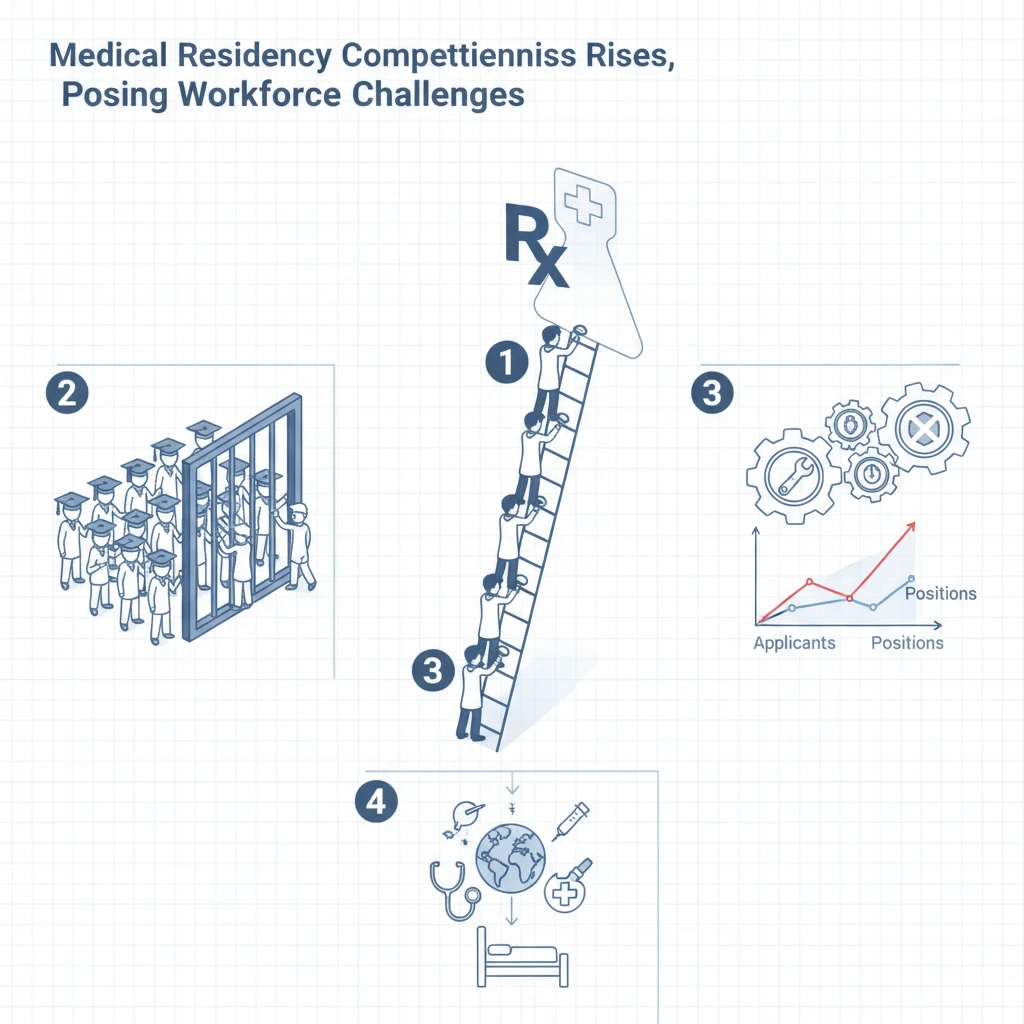

The pathway from medical school graduation to independent practice hinges on securing a residency position, a process that has become increasingly competitive. This escalating competition for limited training slots presents a significant challenge to the future physician workforce, potentially exacerbating existing specialist shortages and impacting healthcare access.
The process of entering a medical residency program in the United States has become progressively more challenging for graduating medical students. This trend is driven by a sustained increase in the number of medical school graduates without a proportional expansion in the number of available residency positions. The Association of American Medical Colleges (AAMC) has documented a consistent rise in medical school enrollment over the last two decades, with the number of US medical school graduates increasing by approximately 30% since 2002.1
For the 2023 Main Residency Match, a total of 42,952 active applicants participated, competing for 40,375 available positions.2 This figure represents the largest Match in history, with an increase of 1,170 positions compared to the previous year. Despite this increase in available positions, the number of applicants also grew, leading to continued high competition. The overall match rate for US MD seniors was 93.7%, while for US DO seniors, it was 91.6%.2 However, the match rate for international medical graduates (IMGs) was lower, at 67.6% for US citizen IMGs and 59.4% for non-US citizen IMGs.2 These statistics illustrate a stratified level of competitiveness based on applicant type.
Factors Contributing to Increased Competition
Several factors contribute to the heightened competition for residency slots. The expansion of medical school class sizes, driven by projections of physician shortages, has increased the pool of eligible applicants. However, the number of federally funded residency positions has remained largely stagnant since the Balanced Budget Act of 1997, which capped Medicare funding for graduate medical education (GME).3 This cap limits the ability of teaching hospitals to create new residency positions, creating a bottleneck in the physician training pipeline. While some states and private institutions have invested in expanding GME, these efforts have not fully offset the federal funding limitations.3
The distribution of available positions also plays a role. Certain specialties, such as plastic surgery, dermatology, and orthopaedic surgery, consistently report match rates below 70% for independent applicants, indicating intense competition.2 Conversely, primary care specialties, including family medicine and internal medicine, often have a higher number of available positions, though these may not always align with applicant preferences. The geographic distribution of residency programs also contributes to disparities, with certain regions having fewer training opportunities.4
The implications of this growing disparity are significant. A substantial number of medical school graduates, particularly IMGs, may not secure a residency position immediately after graduation, leading to delays in their careers or forcing them to pursue alternative paths. This situation represents a loss of potential physician workforce capacity at a time when physician shortages are projected across various specialties. The AAMC projects a shortage of between 37,800 and 124,000 physicians by 2034, underscoring the urgency of addressing the GME bottleneck.5
The persistent imbalance between the number of medical school graduates and available residency positions is not merely an academic concern; it has direct consequences for patient care and the healthcare system's future. When highly qualified individuals cannot secure a residency, it represents a significant underutilization of talent and a failure to capitalize on the substantial investment made in their medical education. This bottleneck directly impedes the growth of the physician workforce, exacerbating projected shortages, particularly in underserved areas and certain specialties.
For clinicians already in practice, this trend means continued pressure on existing resources and potentially longer wait times for patients seeking specialist care. The system is effectively training more physicians than it can integrate, creating a pool of unplaced graduates who may eventually leave the medical field entirely. This situation also influences career choices, potentially pushing graduates towards less competitive specialties, which may not align with their interests or the actual needs of the population. Policymakers must recognize that increasing medical school enrollment without a commensurate expansion of GME funding is an incomplete strategy, akin to filling a pipeline without increasing its outflow capacity.
The long-term impact on patients is clear: delayed access to care, particularly for complex conditions requiring specialist intervention. The current structure, heavily reliant on federal GME funding caps, needs re-evaluation. Initiatives such as the Resident Physician Shortage Reduction Act, which aims to increase federally funded residency positions, represent a necessary step. Without such legislative action, the healthcare system risks a future where the demand for medical services far outstrips the supply of trained professionals, ultimately compromising the quality and accessibility of care for all.
- The Pivot The ratio of residency applicants to available positions has steadily increased over the past decade, particularly for highly competitive specialties.
- The Data In the 2023 Match, 42,952 active applicants competed for 40,375 total positions, representing an applicant-to-position ratio of approximately 1.06:1.
- The Action Medical educators and policymakers must address the growing disparity between medical school output and residency capacity to ensure an adequate supply of trained physicians.
ART-2026-339
Cite This Article
Team TLSFE. Medical residency competitiveness rises, posing workforce challenges. The Life Science Feed. Updated June 13, 2026. Accessed June 13, 2026. https://thelifesciencefeed.com/healthcare-sys-and-biz/health-policy/insights/medical-residency-competitiveness-rises-posing-workforce-challenges.
Editorial & AI Standards
All content is researched from peer-reviewed, open-access sources — published trial data, clinical guidelines, and regulatory filings. AI tools are used solely to structure and summarise that evidence; no AI-generated conclusions appear without editor verification against the primary source.
Every article is reviewed by a named editor before publication. Source citations are listed in the References section. This content does not represent the views of any pharmaceutical company, medical device manufacturer, or healthcare provider.
Licence & Rights
© 2026 The Life Science Feed. All rights reserved. Unless otherwise indicated, all content is the property of The Life Science Feed and may not be reproduced, distributed, or transmitted in any form or by any means without prior written permission.
Medical Disclaimer
The information provided on The Life Science Feed is for educational and informational purposes only. It is not intended as a substitute for professional medical advice, diagnosis, or treatment. Always seek the advice of your physician or other qualified healthcare provider regarding any medical condition or treatment decision. Never disregard professional medical advice or delay in seeking it because of something you have read on this website.
References
1. Association of American Medical Colleges. Physician Supply and Demand Projections. AAMC. Published 2021. Accessed October 26, 2023.
2. National Resident Matching Program. NRMP Main Residency Match: By the Numbers. NRMP. Published 2023. Accessed October 26, 2023.
3. Glickman L. The Resident Physician Shortage Reduction Act of 2023. Am Coll Physicians. Published March 2023. Accessed October 26, 2023.
4. Chen C, et al. Geographic Distribution of the Physician Workforce in the United States. JAMA. 2020;324(12):1169-1179.
5. Association of American Medical Colleges. The Complexities of Physician Supply and Demand: Projections From 2019 to 2034. AAMC. Published 2021. Accessed October 26, 2023.