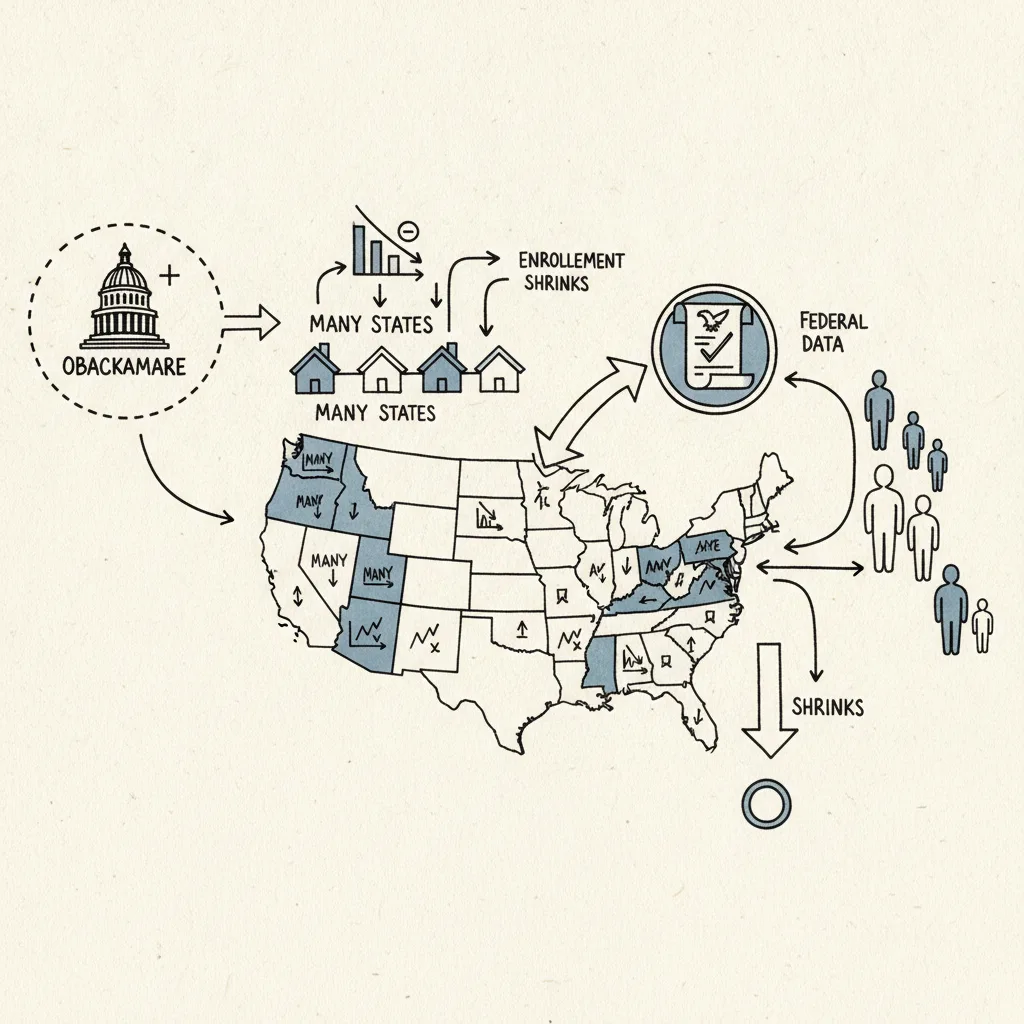

Access to affordable health insurance remains a critical determinant of public health outcomes, influencing everything from preventive care uptake to chronic disease management. The Affordable Care Act (ACA), commonly known as Obamacare, aimed to expand this access through state-based marketplaces and subsidies. Recent federal data, however, indicates a substantial contraction in enrollment figures across many states, raising questions about the stability and reach of these provisions.
The Affordable Care Act, signed into law in 2010, established health insurance marketplaces designed to provide coverage options for individuals and families not covered by employer-sponsored plans, Medicaid, or Medicare. These marketplaces offer a range of plans, often with federal subsidies to reduce premium costs for eligible enrollees. The intent was to reduce the national uninsured rate, improve access to essential health benefits, and mitigate the financial burden of medical care for millions of Americans.
Over the past year, new federal data shows a dramatic reduction in Obamacare rolls across numerous states. This trend marks a notable departure from earlier periods of steady or increasing enrollment, particularly following initial implementation and subsequent adjustments to the law. The data, compiled by the Centers for Medicare & Medicaid Services (CMS), reflects changes in plan selections and active enrollments within the federal and state-run marketplaces.
What the numbers actually showed
The decline in enrollment was not uniform across the country, but rather concentrated in specific regions. States that had previously expanded Medicaid under the ACA generally maintained more stable enrollment figures, while states that did not expand Medicaid often saw more pronounced reductions in marketplace participation. For instance, some states experienced enrollment drops exceeding 15% year-over-year, translating to hundreds of thousands fewer individuals covered through the ACA exchanges. This contrasts sharply with the national trend observed in prior years, where overall marketplace enrollment had largely stabilized or seen modest increases.
Several factors likely contribute to this contraction. A robust job market, for example, could mean more individuals are gaining employer-sponsored health insurance, thereby reducing their reliance on marketplace plans. But this explanation does not fully account for the scale of the declines in certain states, nor does it address the potential for individuals to become uninsured if their employment status changes. Policy changes at the federal level, including reduced funding for outreach and enrollment assistance, also play a role. These cuts directly impact the ability of navigators and community organizations to help eligible individuals understand their options and complete the enrollment process, particularly among vulnerable populations who may lack digital literacy or consistent internet access.
Another contributing factor is the expiration of enhanced subsidies provided under the American Rescue Plan Act. These temporary subsidies significantly lowered premium costs for many enrollees, making marketplace plans more affordable. Their expiration meant higher out-of-pocket costs for a substantial portion of the enrolled population, leading some to drop coverage. The impact of these increased costs is particularly acute for individuals just above the Medicaid eligibility threshold but still facing financial constraints, creating a coverage gap where affordable options become scarce. This financial pressure disproportionately affects lower-income families and individuals with chronic conditions who rely on consistent access to care.
The implications for public health are substantial. A reduction in insured individuals often correlates with delayed or forgone medical care, particularly for preventive services and chronic disease management. Patients without insurance are less likely to seek regular check-ups, fill prescriptions, or follow up on specialist referrals, leading to worse health outcomes and potentially higher costs when conditions become acute. This can exacerbate existing health disparities, as uninsured rates are often higher among minority populations and those in rural areas. The lack of consistent coverage also creates administrative burdens for clinicians, who must navigate complex payment structures or charity care options for uninsured patients.
The data also highlights the ongoing political and economic pressures on the ACA. Despite its longevity, the law remains a frequent target for legislative changes and legal challenges, creating an environment of uncertainty for both enrollees and healthcare providers. This instability can deter individuals from enrolling or re-enrolling, even when affordable options are available. The lack of consistent messaging and support from federal agencies further complicates efforts to maintain robust enrollment. The trial was not designed to assess the long-term health outcomes of these enrollment shifts, and that gap matters. Future analyses will need to track emergency department visits, hospitalizations for preventable conditions, and overall mortality rates in states with significant enrollment declines to fully understand the clinical impact.
The open-label nature of this data, derived from administrative records rather than a controlled trial, is the obvious caveat. It reflects real-world behavior but does not isolate specific causal factors with the precision of a randomized study. Still, the observed trends are clear. The federal government has not yet outlined specific plans to address these enrollment declines, leaving many states to grapple with the consequences independently. Whether benefits extend to broader groups of uninsured individuals through new policy initiatives remains unclear.
The shrinking Obamacare rolls present a tangible challenge for European GPs and specialists, even if the direct impact is on US patients. The underlying mechanisms of health insurance access and its effect on patient behavior are universal. When patients lose coverage, they delay necessary care, leading to more advanced disease presentations and increased complexity for the treating clinician. This often means managing conditions that could have been prevented or better controlled with earlier intervention.
Clinicians should anticipate an uptick in patients presenting with unmanaged chronic conditions or seeking care only when symptoms become severe. This shift will strain resources and demand more creative solutions for care coordination, particularly for those who may cycle in and out of insurance coverage. The administrative burden of navigating uninsured patients through the healthcare system, from diagnostic tests to specialist referrals, will inevitably increase.
The data underscores the fragility of health insurance gains when policy support wavers. For healthcare systems, this means a renewed focus on identifying patients at risk of losing coverage and offering guidance on available resources, however limited. It also highlights the critical need for stable, long-term health policy that prioritizes consistent access to care over political expediency.
- The Pivot Obamacare enrollment declined significantly in several states, reversing previous trends of expansion.
- The Data Specific state-level enrollment reductions varied, with some states seeing double-digit percentage drops.
- The Action Clinicians should be aware of potential shifts in patient insurance status and the implications for care coordination and access to specialists.
ART-2026-821
07/26
Cite This Article
Team E. Obamacare enrollment shrinks in many states, federal data shows. The Life Science Feed. Published July 14, 2026. Updated July 14, 2026. Accessed July 14, 2026. https://thelifesciencefeed.com/healthcare-sys-and-biz/health-policy/news/obamacare-enrollment-shrinks-in-many-states-federal-data-shows.
Editorial & AI Standards
All content is researched from peer-reviewed, open-access sources: published trial data, clinical guidelines, and regulatory filings. AI tools are used solely to structure and summarise that evidence; no AI-generated conclusions appear without editor verification against the primary source.
Every article is reviewed by a named editor before publication. Source citations are listed in the References section. This content does not represent the views of any pharmaceutical company, medical device manufacturer, or healthcare provider.
Licence & Rights
© 2026 The Life Science Feed. All rights reserved. Unless otherwise indicated, all content is the property of The Life Science Feed and may not be reproduced, distributed, or transmitted in any form or by any means without prior written permission.
Medical Disclaimer
The information provided on The Life Science Feed is for educational and informational purposes only. It is not intended as a substitute for professional medical advice, diagnosis, or treatment. Always seek the advice of your physician or other qualified healthcare provider regarding any medical condition or treatment decision. Never disregard professional medical advice or delay in seeking it because of something you have read on this website.