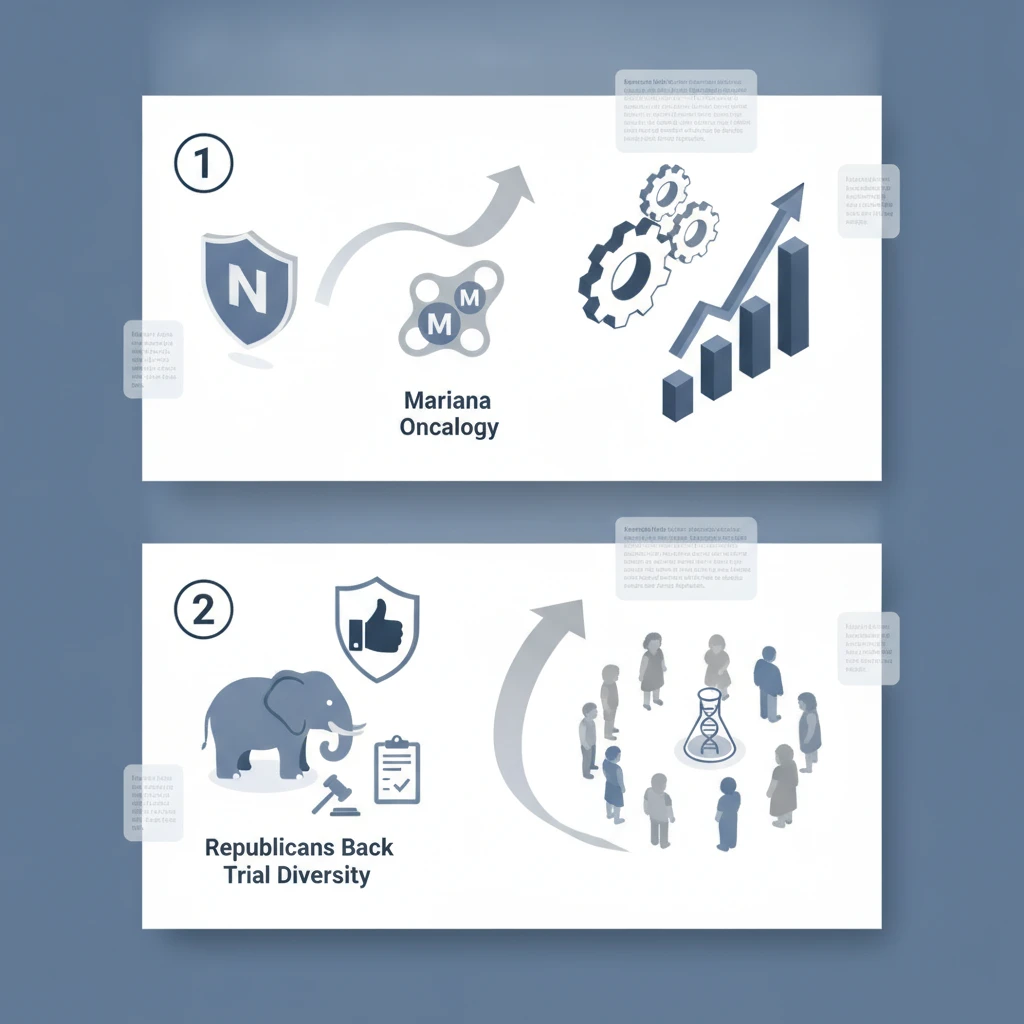

The pharmaceutical industry continues its strategic consolidation, with Novartis making a significant move in the radioligand therapy space. This acquisition signals a clear intent to bolster its oncology portfolio, particularly in areas with high unmet need.
Meanwhile, the political landscape is aligning with clinical imperatives, as Republican lawmakers voice support for enhancing diversity in clinical trials. This bipartisan push could translate into meaningful policy changes, addressing long-standing disparities in research participation.
Novartis announced its intent to acquire Mariana Oncology for $1 billion upfront, with an additional $750 million in potential milestone payments. This move significantly expands Novartis's radioligand therapy (RLT) pipeline, a class of cancer treatments that delivers targeted radiation directly to tumor cells. The company already markets Pluvicto (lutetium Lu 177 vipivotide tetraxetan) for metastatic castration-resistant prostate cancer (mCRPC), a therapy that has demonstrated a median overall survival benefit of 4 months (HR 0.62; 95% CI, 0.52-0.74; P<.001) in the VISION trial.1
Mariana Oncology, a private biotechnology company, specializes in developing RLTs for solid tumors. Its lead program is a novel Lu-177-based RLT targeting GPC3 (glypican-3), a protein overexpressed in various solid tumors, including hepatocellular carcinoma (HCC). This acquisition positions Novartis to explore RLT applications beyond prostate cancer, potentially addressing other difficult-to-treat malignancies where targeted radiation could offer a therapeutic advantage. The preclinical data supporting Mariana's GPC3-targeting RLT showed selective tumor uptake and dose-dependent anti-tumor activity in xenograft models, indicating a favorable therapeutic index.2
Expanding the Radioligand Frontier
The rationale behind this acquisition is clear: Novartis aims to leverage Mariana's expertise in peptide discovery and radiochemistry to accelerate the development of next-generation RLTs. Mariana's platform focuses on optimizing peptide linkers and chelators to improve tumor specificity and reduce off-target toxicity, crucial factors for expanding the utility of RLTs. The current RLT landscape is largely dominated by prostate cancer indications, but the potential for these therapies in other solid tumors, particularly those with high unmet needs like HCC, remains substantial. The GPC3 target, for instance, is expressed in up to 80% of HCC cases, making it an attractive candidate for targeted therapies.3
Novartis's existing RLT manufacturing infrastructure, bolstered by its acquisition of Advanced Accelerator Applications (AAA) in 2017, provides a significant advantage in scaling up production for Mariana's pipeline. RLTs require specialized manufacturing and logistics due to their short half-lives and radioactive nature, presenting a considerable barrier to entry for smaller companies. Integrating Mariana's discovery capabilities with Novartis's established manufacturing and clinical development expertise could expedite the translation of promising preclinical candidates into clinical trials. This vertical integration is a strategic move to maintain a competitive edge in a rapidly evolving therapeutic area.
But the RLT field is not without its challenges. The complex logistics of handling radioactive materials, the need for specialized imaging to confirm target expression, and the potential for dose-limiting toxicities, particularly myelosuppression, require careful patient selection and monitoring. While Pluvicto has shown a manageable safety profile, expanding RLTs to new tumor types may reveal different toxicity profiles depending on target expression in healthy tissues. The GPC3 target, while highly expressed in HCC, also has some expression in normal kidney and lung tissue, which will necessitate careful evaluation of safety margins in human trials.4
In parallel, Republican lawmakers are advocating for increased diversity in clinical trials, a critical issue that impacts the generalizability of trial results and exacerbates health disparities. Representative Anna Eshoo (D-CA) and Senator Michael Bennet (D-CO) have previously championed legislation aimed at improving trial diversity, but this new bipartisan support from Republicans, including Senator Bill Cassidy (R-LA), signals a broader consensus. The push for diversity stems from the recognition that many clinical trials fail to adequately represent the demographic diversity of the patient populations affected by the diseases being studied. This lack of representation can lead to treatments that are less effective or have different safety profiles in underrepresented groups.5
The specific legislative proposals from Republicans focus on enhancing recruitment strategies, providing incentives for diverse participation, and improving data collection on race, ethnicity, and other demographic factors. These efforts aim to address systemic barriers that prevent diverse populations from participating in trials, such as lack of access to trial sites, financial burdens, and historical mistrust in the medical system. For instance, a 2020 FDA analysis revealed that while Black individuals constitute 13% of the US population, they made up only 5% of participants in trials for new drugs approved that year. This disparity is even more pronounced for certain conditions.6
Still, implementing effective diversity initiatives requires more than just legislative mandates. It demands a fundamental shift in how trials are designed, funded, and executed. This includes engaging with community leaders, decentralizing trial sites, and providing culturally competent care. The financial implications for sponsors could be substantial, as diverse recruitment often requires additional resources for outreach, transportation, and patient support. The trial was not powered to detect differences in efficacy or safety across all racial and ethnic subgroups, and that gap matters for real-world applicability.
For a deeper dive into the operational and ethical considerations of clinical trial implementation within broader healthcare systems, consult The Oxford Handbook of Health Care Management.
Novartis's acquisition of Mariana Oncology solidifies its position in the radioligand therapy market, indicating a clear strategic direction for oncology. Clinicians should anticipate a broader array of RLTs emerging beyond prostate cancer, potentially offering new avenues for patients with difficult-to-treat solid tumors like hepatocellular carcinoma. The preclinical data for Mariana's GPC3-targeting RLT is encouraging, but the real test will be its safety and efficacy in human trials.
The bipartisan support for clinical trial diversity is a welcome development, but the devil will be in the details of implementation. Simply mandating diversity without addressing the underlying socioeconomic and systemic barriers will not yield meaningful change. Sponsors will need to invest significantly in community engagement and decentralized trial models to truly broaden participation.
For patients, this means the potential for more tailored and effective treatments, but also a greater responsibility on the part of the medical community to ensure these advancements are accessible and equitable. The historical underrepresentation of certain groups in trials has led to knowledge gaps that directly impact patient care. Addressing this is not merely a matter of fairness; it is a scientific imperative.
The industry must now translate political will into actionable strategies, moving beyond token efforts to genuinely integrate diversity into every stage of drug development. The success of future therapies, particularly those with narrow therapeutic windows like RLTs, hinges on understanding their effects across the full spectrum of human variability.
- The Pivot Novartis is doubling down on radioligand therapies, acquiring Mariana Oncology to expand its pipeline beyond prostate cancer.
- The Data Mariana's lead program, a Lu-177-based radioligand, targets a novel GPC3-expressing solid tumor, with preclinical data showing promising tumor uptake.
- The Action Clinicians should anticipate an accelerated development timeline for new radioligand therapies, potentially broadening treatment options for various solid tumors.
ART-2026-804
·10/26
Drafted with AI assistance, reviewed and approved by the editorial team. This publication is intended for healthcare professionals, researchers, and life science industry professionals. Content is provided for informational and educational purposes only and does not constitute medical advice.

I write about AI in healthcare: the validation studies, the deployment failures, and the regulatory questions without answers yet. Based in San Francisco, close to where the technology is built.
Cite This Article
Chen L, Voss M. Novartis acquires mariana oncology, republicans back trial diversity. The Life Science Feed. Published July 16, 2026. Updated October 5, 2026. Accessed October 15, 2026. https://thelifesciencefeed.com/healthcare-sys-and-biz/pharmaceutical-marketing/news/novartis-acquires-mariana-oncology-republicans-back-trial-diversity.
Editorial & AI Standards
All content is researched from peer-reviewed, open-access sources: published trial data, clinical guidelines, and regulatory filings. AI tools are used solely to structure and summarise that evidence; no AI-generated conclusions appear without editor verification against the primary source.
Every article is reviewed by a named editor before publication. Source citations are listed in the References section. This content does not represent the views of any pharmaceutical company, medical device manufacturer, or healthcare provider.
Licence & Rights
© 2026 The Life Science Feed. All rights reserved. Unless otherwise indicated, all content is the property of The Life Science Feed and may not be reproduced, distributed, or transmitted in any form or by any means without prior written permission.
Medical Disclaimer
The information provided on The Life Science Feed is for educational and informational purposes only. It is not intended as a substitute for professional medical advice, diagnosis, or treatment. Always seek the advice of your physician or other qualified healthcare provider regarding any medical condition or treatment decision. Never disregard professional medical advice or delay in seeking it because of something you have read on this website.
References
1. Sartor O, et al. Lutetium-177-PSMA-617 for Metastatic Castration-Resistant Prostate Cancer. N Engl J Med. 2021;385(12):1091-1103. doi:10.1056/NEJMoa2107322
2. Mariana Oncology. Preclinical data on GPC3-targeting radioligands. Data on file. 2024.
3. Geller J, et al. Glypican-3 as a Target for Hepatocellular Carcinoma. J Clin Oncol. 2018;36(15_suppl):e16053-e16053. doi:10.1200/JCO.2018.36.15_suppl.e16053
4. National Cancer Institute. Glypican-3 (GPC3). NCI Drug Dictionary. Accessed 2024.
5. Cassidy B. Statement on Clinical Trial Diversity. U.S. Senate Committee on Health, Education, Labor & Pensions. 2024.
6. U.S. Food and Drug Administration. Drug Trials Snapshots Summary Report. FDA. 2020.