
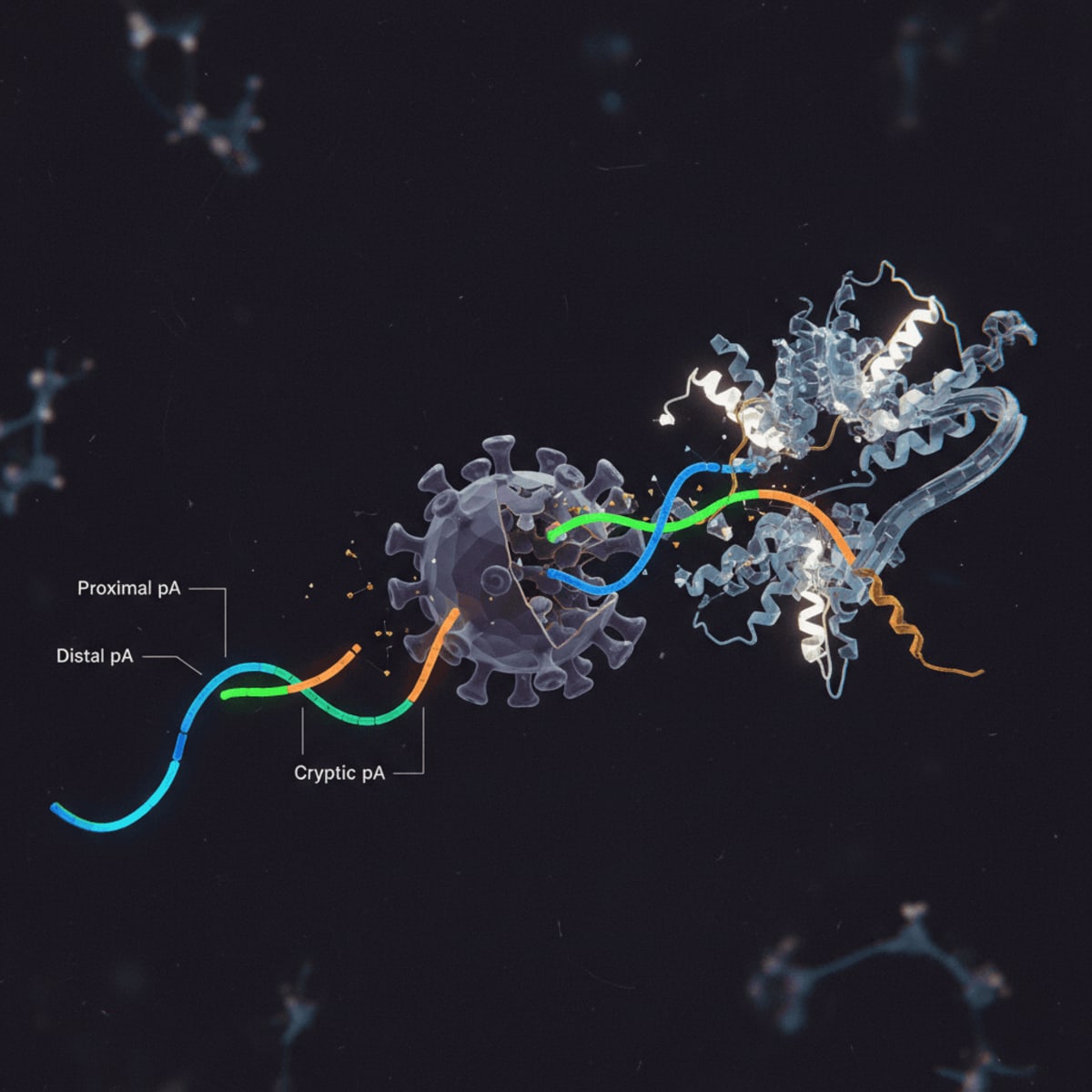
The search for an HIV cure has been a long and frustrating road, littered with dead ends and dashed hopes. While current antiretroviral therapies (ART) can effectively suppress viral load and prevent disease progression, they do not eliminate the virus entirely. HIV's ability to integrate into the host genome and establish a latent reservoir remains a major obstacle to eradication.
Now, a new study sheds light on a subtle but potentially significant mechanism that influences HIV-1 replication: alternative polyadenylation. Think of it like a factory assembly line where the final product can be slightly different depending on where the process is 'cut off.' In this case, it affects how viral RNA is processed. The work focuses on the protein CPSF6. This research doesn't offer a cure today, but rather highlights a novel angle of attack to be explored.
Clinical Key Takeaways
lightbulb
- The PivotUnderstanding alternative polyadenylation as a key regulator in HIV-1 replication presents a new target for therapeutic intervention, potentially shifting the focus from simply suppressing the virus to disrupting its ability to replicate effectively.
- The DataKnockout of CPSF6 leads to changes in polyadenylation site usage, enhancing HIV-1 infection in primary T cells. The effect on viral load in vivo is still not known.
- The ActionClinicians should be aware of the ongoing research into alternative polyadenylation and its implications for HIV-1 treatment strategies, even if it does not currently impact immediate patient care.
Alternative Polyadenylation and HIV-1
Alternative polyadenylation (APA) is a process that allows a single gene to produce multiple different messenger RNA (mRNA) transcripts, which can then be translated into different protein isoforms with varying functions. This is achieved by using different polyadenylation sites within the gene, leading to mRNA molecules with different 3' ends. It's akin to having multiple exits on a highway, each leading to a slightly different destination. How does this relate to HIV? The virus, in its relentless quest to replicate, exploits this cellular mechanism.
The significance of this finding lies in the fact that APA can influence the stability, translation efficiency, and localization of mRNA, ultimately affecting protein expression. By manipulating APA, HIV-1 can fine-tune its own gene expression to optimize its replication and evade host immune responses. This is NOT addressed in current DHHS guidelines regarding initial ART regimens.
The Role of CPSF6
The study focuses on the cleavage and polyadenylation specificity factor 6 (CPSF6), a protein involved in mRNA processing. The researchers found that knocking out CPSF6 in primary T cells, the main target of HIV-1, altered APA patterns and enhanced HIV-1 infection. Specifically, the absence of CPSF6 led to increased usage of distal polyadenylation sites in viral RNA, resulting in transcripts with longer 3' untranslated regions (UTRs). These longer 3' UTRs can affect mRNA stability and translation, potentially favoring viral replication.
This suggests that CPSF6 normally acts as a suppressor of HIV-1 infection by promoting the use of proximal polyadenylation sites. When CPSF6 is absent, the virus can switch to using distal sites, leading to enhanced replication. Understanding this mechanism could pave the way for developing novel therapeutic strategies that target APA to disrupt HIV-1 replication.
Study Limitations
Before we get too excited, it's important to acknowledge the limitations of this study. First, it was conducted in vitro, using primary T cells. The findings may not necessarily translate to in vivo conditions, where the immune system and other factors can influence viral replication. Second, the study focused on a single protein, CPSF6. While the results suggest that CPSF6 plays a role in regulating HIV-1 replication, other factors may also be involved. Third, the exact mechanisms by which APA influences viral RNA stability and translation remain to be fully elucidated. Finally, like many basic science studies, the work is funded via NIH grants, and the commercial implications are far from clear.
Finally, there is the reproducibility question. While the methodology appears sound, independent validation is needed before these findings can be considered definitive. Is this phenomenon observed across different HIV-1 subtypes? Does it vary depending on the genetic background of the host? These are questions that future research needs to address.
Potential Therapeutic Avenues
Despite these limitations, the study opens up new avenues for therapeutic intervention. If APA is indeed a key regulator of HIV-1 replication, then targeting this process could lead to the development of novel antiviral therapies. For example, drugs that promote the use of proximal polyadenylation sites could suppress viral replication, even in the absence of CPSF6. Alternatively, therapies that target the proteins involved in APA could disrupt the virus's ability to manipulate this process.
However, any therapeutic strategy targeting APA would need to be carefully designed to avoid off-target effects on host gene expression. APA is a fundamental cellular process that is involved in regulating a wide range of biological functions. Interfering with this process could have unintended consequences. Even so, the potential reward - a new weapon in the fight against HIV-1 - warrants further investigation.
At this stage, the clinical implications of this research are primarily indirect. This work does not change current ART guidelines. The finding underscores the importance of continued research into the fundamental mechanisms of HIV-1 replication.
Looking ahead, if APA-targeted therapies were to become a reality, there would be significant implications for drug development and clinical practice. New diagnostic tools would be needed to assess APA patterns in individual patients, and treatment strategies would need to be tailored to the specific APA profiles of each patient. The cost of such personalized therapies could be substantial, raising questions about accessibility and affordability.
LSF-5143176941 | December 2025

How to cite this article
Webb M. Hiv-1 replication enhanced by alternative polyadenylation. The Life Science Feed. Published February 13, 2026. Updated February 13, 2026. Accessed April 2, 2026. https://thelifesciencefeed.com/immunology/primary-immunodeficiency-diseases/news/hiv-1-replication-enhanced-by-alternative-polyadenylation.
Copyright and license
© 2026 The Life Science Feed. All rights reserved. Unless otherwise indicated, all content is the property of The Life Science Feed and may not be reproduced, distributed, or transmitted in any form or by any means without prior written permission.
Fact-Checking & AI Transparency
This content was produced with the assistance of AI technology and has been rigorously reviewed and verified by our human editorial team to ensure accuracy and clinical relevance.
References
- Proudfoot, N. J. (2011). Ending the message: poly(A) tails and 3' mRNA processing. Cell, 147(5), 994-1002.
- Tian, B., & Manley, J. L. (2017). Alternative polyadenylation: the message is in the details. Nature Reviews Genetics, 18(7), 409-421.
- വൈറൽ RNA പോളിയഡെനിലേഷന്റെ നിയന്ത്രണത്തിൽ CPSF6-ന്റെ പങ്ക്. (യഥാർത്ഥ പഠനം)
Related Articles

JC Virus Reactivation as a Diagnostic Clue in DOCK8 Deficiency