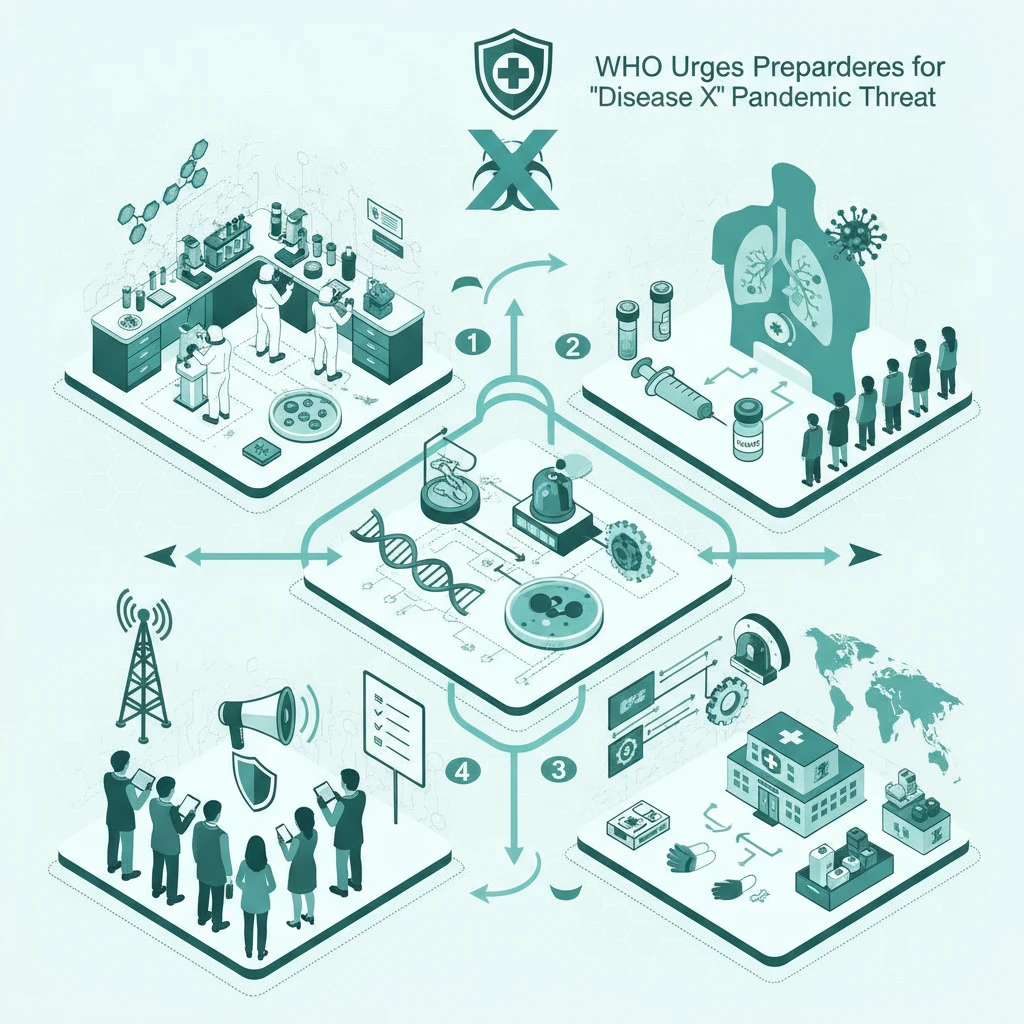

The global health community faces a persistent challenge in anticipating and mitigating novel infectious disease threats. The World Health Organization (WHO) has identified 'Disease X' as a priority pathogen, representing an unknown agent with the potential to cause a severe international epidemic. This designation underscores the immediate need for enhanced surveillance, research, and public health infrastructure to prepare for future pandemics.
The concept of 'Disease X' was introduced by the WHO in 2018 as part of its R&D Blueprint for Epidemics, a strategy designed to accelerate the development of diagnostics, vaccines, and treatments during epidemics. The inclusion of 'Disease X' reflects the understanding that a future severe international epidemic could be caused by a pathogen currently unknown to cause human disease. This framework acknowledges the historical pattern of emerging infectious diseases, many of which have zoonotic origins and cross into human populations unpredictably.
The Rationale for 'Disease X' Preparedness
The WHO's rationale for prioritizing 'Disease X' stems from lessons learned during previous outbreaks, including Ebola, Zika, and more recently, COVID-19. These events highlighted critical gaps in global health security, particularly concerning rapid pathogen identification, vaccine development timelines, and equitable distribution of medical countermeasures. The 'Disease X' initiative aims to foster a preparedness mindset that is not pathogen-specific but rather adaptable to a broad range of potential biological threats. This involves strengthening core capacities across several domains.
Key areas of focus include enhanced surveillance systems capable of detecting unusual disease patterns and novel pathogens early. This requires robust laboratory networks with advanced sequencing capabilities to characterize new agents swiftly. Furthermore, the initiative emphasizes the importance of platform technologies for vaccine and therapeutic development that can be rapidly adapted once a new pathogen is identified. For instance, mRNA vaccine technology, which proved instrumental during the COVID-19 pandemic, represents a type of platform that could be leveraged for 'Disease X'.
Public health infrastructure also forms a critical component of 'Disease X' preparedness. This encompasses strengthening healthcare systems to manage surges in patient numbers, ensuring adequate supplies of personal protective equipment (PPE), and developing clear communication strategies to inform the public and healthcare professionals. Training healthcare workers in infection prevention and control (IPC) measures, as well as in the management of novel respiratory or febrile illnesses, is paramount. The goal is to reduce the time from pathogen emergence to effective public health response, thereby limiting the scale and impact of a potential pandemic.
International collaboration and equitable access to resources are also central to the 'Disease X' strategy. The WHO advocates for global sharing of data, biological samples, and research findings to accelerate understanding of new threats. Mechanisms for fair and rapid distribution of vaccines and treatments, particularly to low- and middle-income countries, are considered essential to prevent health inequities from exacerbating a global crisis. The 'Disease X' framework serves as a call to action for governments, research institutions, pharmaceutical companies, and public health bodies to invest in and coordinate efforts towards a more resilient global health security architecture.
The WHO's emphasis on 'Disease X' is not merely an academic exercise; it carries direct implications for clinical practice and public health policy. For general practitioners and specialists, this means a heightened awareness of unusual clinical presentations, particularly those involving respiratory, neurological, or febrile syndromes without clear etiology. The capacity for rapid differential diagnosis and timely specimen collection for novel pathogen identification will become increasingly critical. Investment in point-of-care diagnostics that are adaptable to unknown agents, rather than solely targeting known pathogens, will be a significant area of development.
From an industry perspective, the 'Disease X' framework signals a shift towards incentivizing platform technologies for vaccine and therapeutic development. Pharmaceutical companies that can demonstrate agility in repurposing existing compounds or rapidly developing new ones based on generic platforms (e.g., mRNA, viral vectors) will be at the forefront of pandemic response. This also implies a need for regulatory bodies like the FDA and EMA to streamline approval processes for emergency use, balancing speed with safety and efficacy data requirements. The financial risks associated with developing countermeasures for an unknown threat will likely require public-private partnerships and advance market commitments to ensure readiness.
For patients, the preparedness for 'Disease X' translates into a more robust and responsive healthcare system during a future pandemic. This includes better access to diagnostics, potentially faster availability of vaccines and treatments, and clearer public health guidance. However, it also places a responsibility on individuals to engage with public health messaging, adhere to recommended preventive measures, and participate in vaccination campaigns when available. The success of 'Disease X' preparedness hinges not only on scientific advancements but also on societal trust and collective action, a lesson painfully reinforced by recent global health crises.
- The Pivot The WHO's explicit focus on 'Disease X' shifts preparedness from known threats to a proactive, adaptable framework for emergent pathogens.
- The Data While no specific pathogen is identified, the WHO's R&D Blueprint for Epidemics lists 'Disease X' alongside known high-priority diseases, indicating a comparable level of concern.
- The Action Clinicians should be aware of evolving public health advisories and participate in local and national pandemic preparedness exercises, focusing on rapid diagnostic capabilities and surge capacity planning.
ART-2026-435
06/26
Cite This Article
Team TLSFE. Who urges preparedness for 'disease x' pandemic threat. The Life Science Feed. Updated June 19, 2026. Accessed June 19, 2026. https://thelifesciencefeed.com/infectious-diseases/covid19/news/who-urges-preparedness-for-disease-x-pandemic-threat.
Editorial & AI Standards
All content is researched from peer-reviewed, open-access sources — published trial data, clinical guidelines, and regulatory filings. AI tools are used solely to structure and summarise that evidence; no AI-generated conclusions appear without editor verification against the primary source.
Every article is reviewed by a named editor before publication. Source citations are listed in the References section. This content does not represent the views of any pharmaceutical company, medical device manufacturer, or healthcare provider.
Licence & Rights
© 2026 The Life Science Feed. All rights reserved. Unless otherwise indicated, all content is the property of The Life Science Feed and may not be reproduced, distributed, or transmitted in any form or by any means without prior written permission.
Medical Disclaimer
The information provided on The Life Science Feed is for educational and informational purposes only. It is not intended as a substitute for professional medical advice, diagnosis, or treatment. Always seek the advice of your physician or other qualified healthcare provider regarding any medical condition or treatment decision. Never disregard professional medical advice or delay in seeking it because of something you have read on this website.