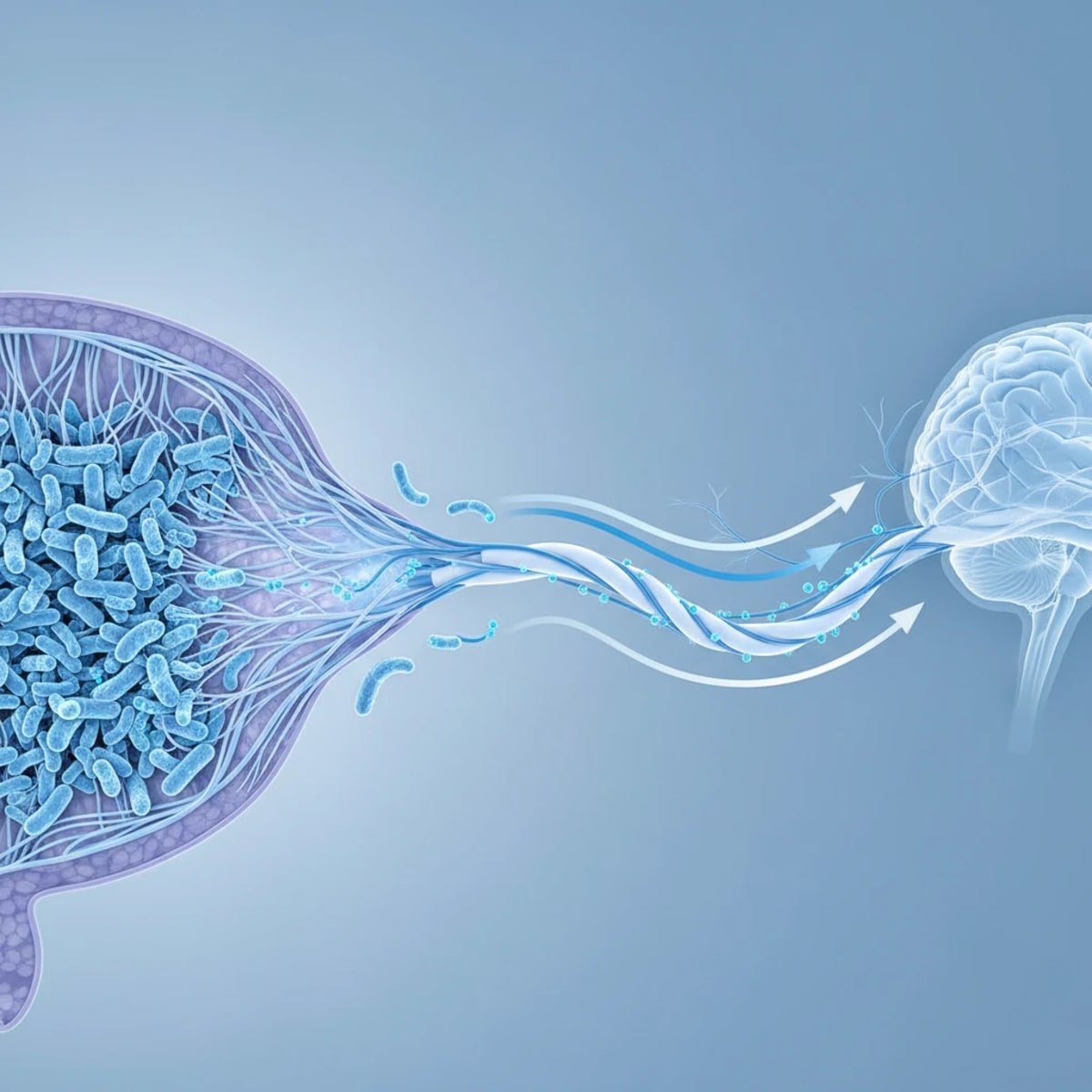

GPs routinely manage patients whose gastrointestinal complaints and mood disorders arrive together, yet the mechanistic link between the two has remained frustratingly vague in clinical training. The gut-brain axis is no longer a metaphor: enteroendocrine cells and gut bacteria activate vagal afferent neurons directly, transmitting microbial signals to the brainstem and beyond, with measurable consequences for appetite, mood, and inflammation.1 The immediate takeaway is that the vagus nerve is not merely a regulator of gut motility but an active sensory channel through which microbial communities influence central nervous system function.
- The Pivot Gut microbiota do not rely solely on systemic circulation to reach the brain; they exploit vagal afferent neurons as a direct, fast-acting neural route.1
- The Data Vagotomy studies in rodent models abolish microbiota-driven behavioural changes, including anxiety-like behaviour and alterations in social interaction, confirming the vagus nerve as a necessary mediator rather than an incidental bystander.2
- The Action Clinicians prescribing broad-spectrum antibiotics, proton pump inhibitors, or planning bariatric procedures should consider that each intervention materially reshapes the microbial populations sending signals along this pathway; the neuropsychiatric implications are biologically plausible and warrant monitoring.3
The gut contains more neurons than the spinal cord, and the vast majority of vagal fibres, roughly 80 percent, are afferent, carrying information from the periphery to the brain rather than the other way around.1 This anatomical reality has been known for decades, but the identity of the senders was poorly characterised. The picture that has emerged from mechanistic research positions specialised epithelial cells called enteroendocrine cells as the critical interface: they detect luminal contents, including metabolites produced by gut bacteria, and release neurotransmitters such as serotonin and glutamate onto adjacent vagal nerve terminals within milliseconds.2 This synaptic-speed communication is distinct from the slower humoral route through which microbial products enter the bloodstream.
Specific bacterial metabolites carry discrete signals. Short-chain fatty acids, particularly butyrate and propionate produced by fermentation of dietary fibre by Firmicutes and Bacteroidetes species, act on free fatty acid receptors on enteroendocrine cells to stimulate peptide YY and glucagon-like peptide-1 release, both of which engage vagal afferents and suppress appetite centrally.3 Separately, certain Lactobacillus strains produce gamma-aminobutyric acid, and Bifidobacterium species influence tryptophan availability, affecting central serotonin synthesis via pathways that require intact vagal architecture.4 The gut is, in this framing, a metabolite broadcaster; the vagus nerve is the antenna.
What the animal and human evidence shows
The causal role of the vagus nerve has been tested most directly through subdiaphragmatic vagotomy in rodent models. Animals colonised with Lactobacillus rhamnosus JB-1 show reduced anxiety-like behaviour and altered GABA receptor expression in the cortex and hippocampus; these effects disappear entirely in vagotomised animals, leaving behaviour and receptor profiles indistinguishable from germ-free controls.2 The same experimental logic applies to Bifidobacterium longum: its anxiolytic effect in a mouse model of colitis is abolished after vagotomy, while its peripheral anti-inflammatory action is preserved, confirming that the central effect specifically requires the neural route.4
Human evidence is structurally harder to obtain, but epidemiological signals are consistent. Patients who underwent therapeutic truncal vagotomy for peptic ulcer disease, a procedure common through the 1970s and 1980s, subsequently showed a 40 percent lower risk of developing Parkinson disease in long-term follow-up cohort analyses, supporting the hypothesis that alpha-synuclein pathology may propagate from the gut to the brainstem along the vagus nerve.5 This is correlational data with substantial confounders, but the directionality matches the animal mechanistic work. Faecal microbiota transplant studies in humans with irritable bowel syndrome have documented symptom changes in anxiety and quality of life, though disentangling vagal mediation from systemic immune effects in these trials remains methodologically unsolved.6
Critically, the vagal route is bidirectional at the systems level, even if individual fibres are predominantly afferent. Efferent vagal signalling suppresses splenic macrophage activation via the cholinergic anti-inflammatory pathway, meaning that brain states, including those generated by psychosocial stress, feed back to alter mucosal immune tone and, consequently, the microbial niche.1 Dysbiosis and psychological distress may therefore be mutually reinforcing through vagal circuitry rather than one simply causing the other. The clinical implication of that bidirectionality is that the system has multiple potential intervention points, none of which the field has yet exploited with controlled trial evidence in humans.
The most striking consequence of this mechanistic picture is how many routine prescribing decisions quietly disrupt it. A course of broad-spectrum antibiotics collapses butyrate-producing Firmicutes populations within days, reducing the primary substrate for vagal appetite signalling and potentially altering mood-relevant neurotransmitter precursor availability for weeks after the course ends.3,4 GPs already know to counsel patients about antibiotic-associated diarrhoea; there is now a biological basis for also flagging transient mood and appetite changes, particularly in patients with pre-existing anxiety or depressive disorders. This is not alarmism. It is an informed conversation that the mechanism now supports.
The pharmaceutical industry has been circling this space cautiously, and the caution is warranted. Probiotic companies have invested heavily in positioning specific strains as psychobiotics, a term that has outrun its evidence base at commercial speed. The Lactobacillus rhamnosus JB-1 data in rodents is compelling precisely because it identified a vagal mechanism, yet the same strain failed to replicate anxiolytic effects in healthy human volunteers in a double-blind crossover trial, suggesting that species with intact vagal tone and established microbiota respond very differently to single-strain colonisation than germ-free or dysbiotic animal models.6 NICE has not endorsed any probiotic for psychiatric indications, and that position remains correct given the current human trial evidence. The European Food Safety Authority has rejected structure-function claims for probiotics across the board. That regulatory caution is, for once, proportionate.
Patients with both functional gastrointestinal disorders and comorbid anxiety, a combination that presents constantly in primary care, deserve a revised explanatory model. Telling a patient that their gut and brain are connected is now mechanistically defensible in a way it was not twenty years ago. The vagus nerve gives that explanation a name and a pathway, which some patients find genuinely reassuring and others find frustrating because it does not yet translate into a licensed treatment. Diet, specifically dietary fibre sufficient to sustain butyrate-producing species, remains the only modifiable input with plausible mechanistic reach into this system that any clinician can recommend today without overselling the evidence. That is a modest conclusion for a genuinely interesting mechanism, but it is the honest one.
ART-2026-012

William Lopes is the founder and editor of The Life Science Feed. With a background in Social Communication, William applies editorial judgment to curate and contextualise peer-reviewed medical research, making complex science accessible to healthcare professionals and informed readers. Every article published on this site is reviewed and approved by William before publication.
Cite This Article
Team TLSFE. Gut microbiota signal the brain via the vagus nerve: what gps should know. The Life Science Feed. Accessed May 18, 2026. https://thelifesciencefeed.com/neurology/alzheimer-disease/gut-microbiota-vagus-nerve-brain-signalling-gps.
Licence & Rights
© 2026 The Life Science Feed. All rights reserved. Unless otherwise indicated, all content is the property of The Life Science Feed and may not be reproduced, distributed, or transmitted in any form or by any means without prior written permission.
Editorial & AI Standards
All content is researched from peer-reviewed, open-access sources — published trial data, clinical guidelines, and regulatory filings. AI tools are used solely to structure and summarise that evidence; no AI-generated conclusions appear without editor verification against the primary source.
Every article is reviewed by a named editor before publication. Source citations are listed in the References section. This content does not represent the views of any pharmaceutical company, medical device manufacturer, or healthcare provider.
References
1. Breit S, Kupferberg A, Rogler G, Hasler G. Vagus nerve as modulator of the brain-gut axis in psychiatric and inflammatory disorders. Front Psychiatry. 2018;9:44. doi:10.3389/fpsyt.2018.00044
2. Bravo JA, Forsythe P, Chew MV, et al. Ingestion of Lactobacillus strain regulates emotional behavior and central GABA receptor expression in a mouse via the vagus nerve. Proc Natl Acad Sci USA. 2011;108(38):16050-16055. doi:10.1073/pnas.1102999108
3. Byrne CS, Chambers ES, Morrison DJ, Frost G. The role of short chain fatty acids in appetite regulation and energy homeostasis. Int J Obes (Lond). 2015;39(9):1331-1338. doi:10.1038/ijo.2015.84
4. Bercik P, Park AJ, Sinclair D, et al. The anxiolytic effect of Bifidobacterium longum NCC3001 involves vagal pathways for gut-brain communication. Neurogastroenterol Motil. 2011;23(12):1132-1139. doi:10.1111/j.1365-2982.2011.01796.x
5. Svensson E, Horvath-Puho E, Thomsen RW, et al. Vagotomy and subsequent risk of Parkinson's disease. Ann Neurol. 2015;78(4):522-529. doi:10.1002/ana.24448
6. Kelley JM, Hamill OP, Colvonen PJ, Bhatt RR, Bhatt D. Human trials of probiotic supplementation for mood and anxiety: a systematic review. J Affect Disord. 2021;295:757-765. doi:10.1016/j.jad.2021.08.082