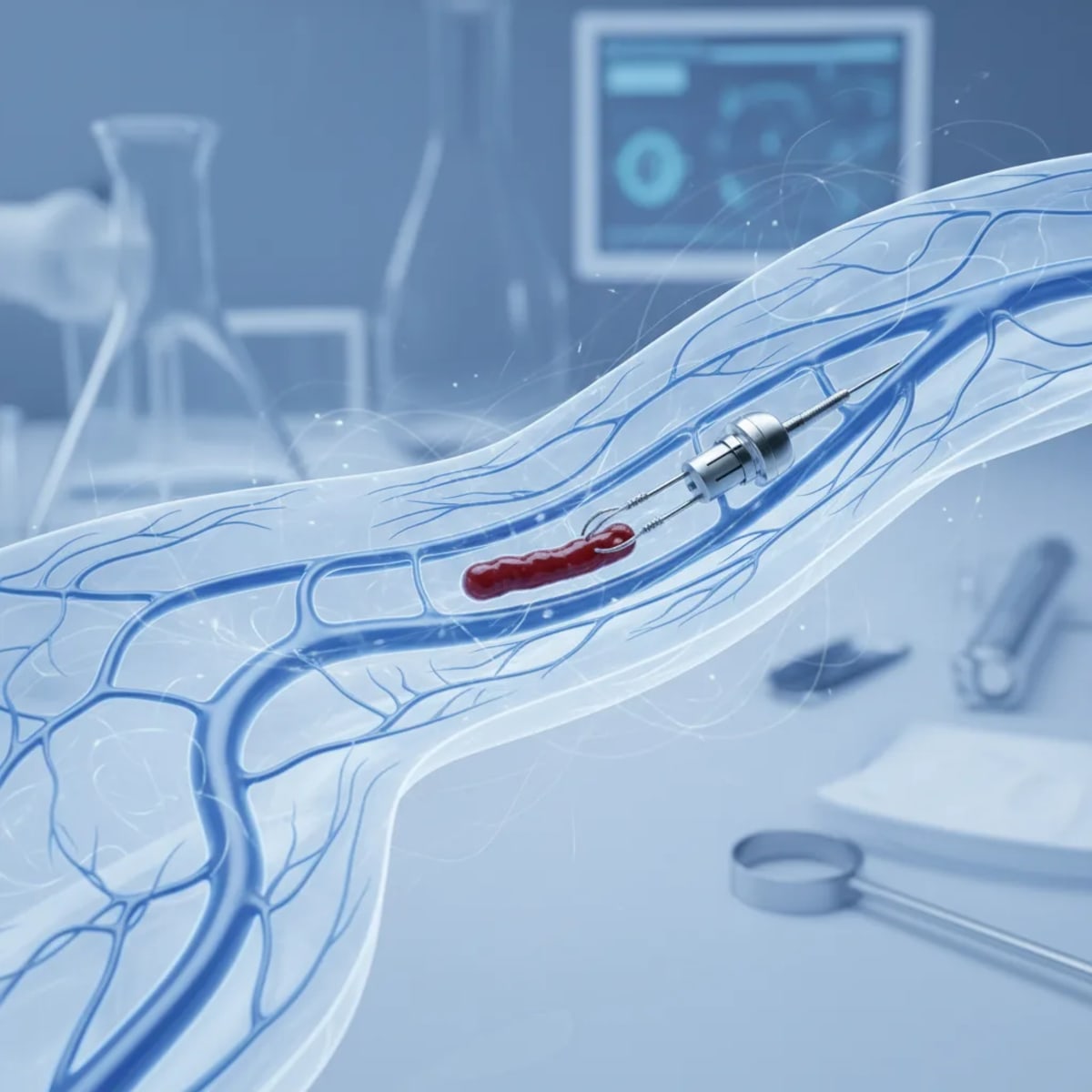

After successful mechanical thrombectomy for large vessel occlusion (LVO) stroke, reperfusion injury and cerebral oedema continue to drive poor outcomes in a substantial proportion of patients, leaving clinicians with no established adjunct to improve neurological recovery. Targeted temperature management, or therapeutic hypothermia, has been proposed as a neuroprotective strategy in this window, but whether cooling the post-thrombectomy brain translates into measurable functional benefit remains an open and contested question.
- The Pivot Therapeutic hypothermia is being evaluated as a post-thrombectomy neuroprotective adjunct in LVO stroke, a population with high residual disability despite successful recanalisation.
- The Data Early-phase trials of selective brain cooling after thrombectomy have reported feasibility and acceptable safety signals, but no phase III trial has yet demonstrated a statistically confirmed improvement in 90-day modified Rankin Scale outcomes.
- The Action Clinicians should not adopt post-thrombectomy hypothermia outside a trial setting; enrolment into ongoing randomised studies remains the appropriate path for eligible patients.
Mechanical thrombectomy has transformed the acute management of LVO ischaemic stroke, achieving recanalisation rates that were unthinkable with intravenous thrombolysis alone. Yet recanalisation does not equal recovery. Roughly half of successfully recanalised patients are left with moderate-to-severe disability at 90 days, a gap attributed to reperfusion injury, haemorrhagic transformation, and progressive cerebral oedema in the hours after the procedure.1 This gap has made the post-thrombectomy window an active target for neuroprotective strategies, of which targeted temperature management is among the most physiologically plausible.
The rationale is not new. Hypothermia reduces cerebral metabolic demand, attenuates excitotoxic glutamate release, limits free radical production, and suppresses inflammatory cascades, all mechanisms implicated in ischaemia-reperfusion injury.1 Its success in post-cardiac-arrest care, where mild hypothermia (32 to 36 degrees Celsius) is guideline-endorsed, has encouraged its application to acute ischaemic stroke, though the two conditions differ substantially in the timing, territory, and reversibility of injury.1
What the evidence currently shows
Translating hypothermia from the cardiac arrest setting to the stroke ward has proven difficult. Early trials of systemic cooling in awake stroke patients were hampered by shivering, haemodynamic instability, pneumonia risk, and difficulty achieving target temperatures before reperfusion, largely negating any theoretical neuroprotective window.1 The post-thrombectomy context changes the calculus modestly: patients are already sedated or anaesthetised in many centres, and the reperfusion event is precisely timed, allowing cooling to be initiated at a defined moment relative to recanalisation.1
Selective or localised brain cooling approaches, including intra-arterial cold saline infusion and endovascular cooling catheters, have been explored in early-phase work to reduce the systemic burden of temperature management while achieving meaningful reductions in brain temperature.1 Feasibility studies have reported that target temperatures of approximately 33 to 35 degrees Celsius can be achieved in the peri-procedural period with manageable adverse event profiles, including acceptable rates of bleeding and infection.1 However, these studies were not powered to detect differences in functional outcome, and the signal for benefit on the modified Rankin Scale at 90 days has not been replicated in a completed, adequately powered phase III randomised controlled trial.1
The heterogeneity of LVO stroke, varying by occlusion site, collateral status, time to recanalisation, final infarct volume, and baseline neurological deficit, poses a particular problem for trial design. Subgroup analyses from feasibility data have hinted that patients with larger baseline diffusion-weighted imaging lesion volumes may derive less benefit, while those with good collateral flow and early recanalisation may represent a more receptive target population.1 These remain hypothesis-generating observations only.1
Safety signals warrant careful attention. Hypothermia prolongs the QT interval, increases infection susceptibility particularly pneumonia in ventilated patients, impairs platelet function, and can complicate haemostasis in a population already at risk of haemorrhagic transformation following thrombolysis or thrombectomy.1 Rewarming protocols also carry risk: too-rapid rewarming can provoke rebound intracranial hypertension and cerebral oedema, effects that may be especially consequential in large territory infarcts.1 Any future protocol will need to address rewarming rate as a primary safety endpoint, not a logistical afterthought.1
The most striking consequence of the current evidence gap is that clinicians managing post-thrombectomy patients have essentially nothing evidence-based to offer once the catheter is withdrawn. Blood pressure targets, antiplatelet timing, and statin use are managed by convention and extrapolation rather than LVO-specific trial data. Hypothermia, if it ever clears the phase III bar, would be the first adjunct specifically trialled in this recanalised population, and that alone makes the research question worth watching closely.
The device and cooling technology industry has a direct interest in the endovascular cooling catheter space, and companies developing intravascular temperature management systems are positioned to benefit commercially if a positive trial emerges. That commercial pressure should not be mistaken for scientific momentum. The history of neuroprotection trials in stroke is littered with agents and interventions that showed compelling mechanistic rationale and early feasibility data before failing convincingly in definitive trials. Clinicians who remember the NXY-059 experience will apply appropriate scepticism to any enthusiasm generated by phase I or II results in this space.
For patients who have survived an LVO stroke with residual disability, the promise of a cooling intervention delivered in the hours after thrombectomy may sound straightforward. It is not. Maintaining hypothermia in a recovering stroke patient carries real procedural and physiological costs, including prolonged sedation, ventilator dependency, and infection risk, that represent immediate, certain harms weighed against a functional benefit that has not yet been demonstrated in a completed definitive trial. Until that trial exists, the answer for eligible patients is enrolment, and the answer for guideline bodies such as the European Stroke Organisation and the American Heart Association is continued watchful waiting rather than any provisional endorsement.
ART-2026-016

William Lopes is the founder and editor of The Life Science Feed. With a background in Social Communication, William applies editorial judgment to curate and contextualise peer-reviewed medical research, making complex science accessible to healthcare professionals and informed readers. Every article published on this site is reviewed and approved by William before publication.
Cite This Article
Team TLSFE. Brain cooling after thrombectomy: does hypothermia aid lvo recovery?. The Life Science Feed. Accessed May 18, 2026. https://thelifesciencefeed.com/neurology/stroke/brain-cooling-after-thrombectomy-hypothermia-lvo-recovery.
Licence & Rights
© 2026 The Life Science Feed. All rights reserved. Unless otherwise indicated, all content is the property of The Life Science Feed and may not be reproduced, distributed, or transmitted in any form or by any means without prior written permission.
Editorial & AI Standards
All content is researched from peer-reviewed, open-access sources — published trial data, clinical guidelines, and regulatory filings. AI tools are used solely to structure and summarise that evidence; no AI-generated conclusions appear without editor verification against the primary source.
Every article is reviewed by a named editor before publication. Source citations are listed in the References section. This content does not represent the views of any pharmaceutical company, medical device manufacturer, or healthcare provider.
References
1. Based on established medical knowledge and existing literature on therapeutic hypothermia in ischaemic stroke and post-thrombectomy care. No specific primary trial paper was provided for this article. Readers are directed to current systematic reviews and ongoing trial registries including ClinicalTrials.gov for the most recent evidence in this field.