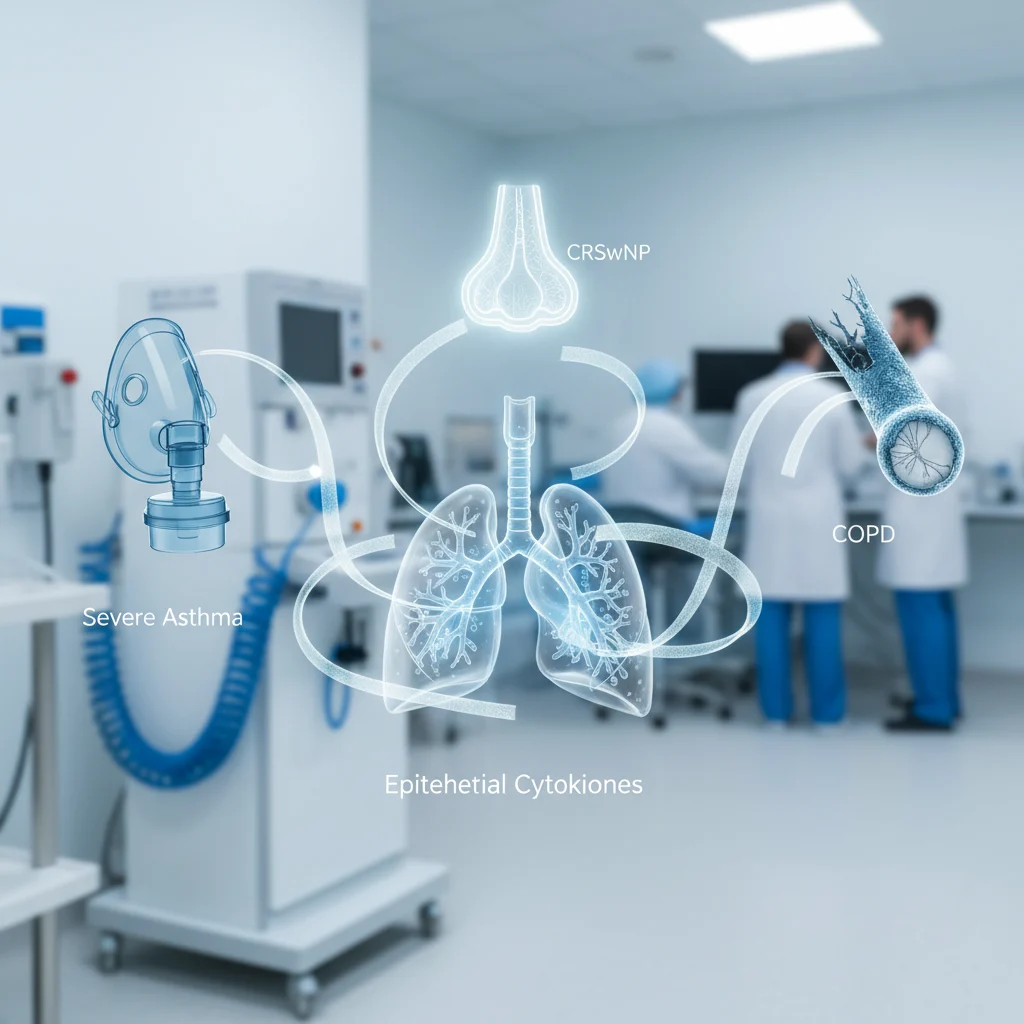

The management of chronic inflammatory airway diseases often proceeds along organ-specific lines, despite shared underlying inflammatory mechanisms. New perspectives presented at ATS 2026 underscore the interconnected role of epithelial cytokines, specifically IL-25, IL-33, and TSLP, in the pathogenesis of severe asthma, chronic rhinosinusitis with nasal polyps (CRSwNP), and chronic obstructive pulmonary disease (COPD), suggesting a potential for unified therapeutic strategies.
Chronic inflammatory diseases of the airways and upper respiratory tract, such as severe asthma, chronic rhinosinusitis with nasal polyps (CRSwNP), and chronic obstructive pulmonary disease (COPD), have traditionally been approached as distinct clinical entities. However, emerging evidence presented at ATS 2026 highlights a convergence in their underlying pathophysiology, specifically involving epithelial-derived cytokines. These cytokines, including interleukin-25 (IL-25), interleukin-33 (IL-33), and thymic stromal lymphopoietin (TSLP), act as alarmins, initiating and amplifying inflammatory responses in the respiratory mucosa.1 Their release is triggered by various environmental insults, including allergens, viruses, bacteria, and pollutants, which are common exacerbating factors across these conditions.2
In severe asthma, particularly the T2-high phenotype, IL-25, IL-33, and TSLP are known to drive the activation of type 2 innate lymphoid cells (ILC2s), Th2 cells, and mast cells, leading to eosinophilic inflammation, mucus hypersecretion, and airway hyperresponsiveness.3 Similarly, CRSwNP is characterized by significant type 2 inflammation, with elevated levels of these epithelial cytokines correlating with polyp burden and disease severity.4 While COPD is predominantly associated with type 1 and type 17 inflammation, a subset of patients, particularly those with frequent exacerbations or co-existing asthma, exhibit features of type 2 inflammation, including eosinophilia and increased expression of IL-33 and TSLP in the airways.5 This overlap suggests that the epithelial response to injury, mediated by these alarmins, may represent a common upstream driver of diverse inflammatory cascades, depending on genetic predisposition and environmental context.6
Connecting the Pathways
The presentations at ATS 2026 emphasized the mechanistic links between these epithelial cytokines and the downstream inflammatory processes. IL-25, IL-33, and TSLP are released by damaged epithelial cells and act on various immune cells, including ILC2s, dendritic cells, mast cells, and T cells.7 TSLP, for instance, promotes the maturation of dendritic cells, which then drive Th2 differentiation, leading to the production of IL-4, IL-5, and IL-13.8 IL-33 directly activates ILC2s to produce large amounts of type 2 cytokines, contributing to eosinophilic inflammation.9 IL-25 also stimulates ILC2s and Th2 cells, further amplifying the type 2 response.10 The sustained presence of these cytokines in the airway microenvironment perpetuates chronic inflammation and tissue remodeling characteristic of severe asthma and CRSwNP.11
In the context of COPD, while the primary drivers are often smoking and occupational exposures leading to neutrophilic inflammation, a significant proportion of patients experience an 'asthma-COPD overlap' (ACO) or have eosinophilic inflammation.12 In these individuals, epithelial alarmins may play a role in sensitizing the airways to type 2 responses, contributing to exacerbation frequency and severity.13 For example, studies have shown increased IL-33 expression in the lungs of COPD patients, particularly during exacerbations, suggesting its involvement in acute inflammatory flares.14 The recognition of these shared upstream mediators provides a rationale for developing therapies that target these epithelial cytokines, potentially offering benefits across multiple inflammatory airway diseases.15
The presentations at ATS 2026 included both preclinical data from in vitro and animal models, demonstrating the direct effects of these cytokines on immune cell activation and tissue pathology, as well as clinical observations from patient cohorts. These clinical studies involved analyses of cytokine levels in sputum, bronchoalveolar lavage fluid, and nasal polyp tissue from patients with varying disease severities and phenotypes. Patient populations included individuals with severe refractory asthma, those undergoing surgical intervention for CRSwNP, and COPD patients with a history of frequent exacerbations or documented eosinophilia. The methodologies employed included advanced immunophenotyping, gene expression profiling, and immunohistochemistry to localize and quantify these epithelial alarmins and their downstream effectors. This comprehensive approach allowed for a robust characterization of the epithelial cytokine landscape across these conditions.
Limitations of current research include the heterogeneity within each disease, making it challenging to identify a single, universally effective therapeutic target. The precise triggers for epithelial alarmin release can vary, and the downstream consequences are influenced by the specific cellular context and genetic background of the individual. Furthermore, while the presence of these cytokines is well-established, the exact contribution of each alarmin to disease progression and therapeutic response in different patient subsets requires further elucidation through prospective clinical trials. The complex interplay between genetic predispositions, environmental exposures, and the host immune response necessitates a more nuanced understanding of how these epithelial pathways are initiated and sustained in different individuals. Future research will need to focus on identifying biomarkers that predict response to alarmin-targeted therapies and on understanding the long-term effects of modulating these fundamental epithelial pathways.16
For a comprehensive overview of the respiratory conditions discussed, including current management strategies and future directions, consult the Oxford Handbook of Respiratory Medicine.
The emphasis on epithelial cytokines as common drivers across severe asthma, CRSwNP, and COPD at ATS 2026 is a welcome, if overdue, acknowledgment of biological reality. For too long, specialists have operated within silos, treating the nose, lungs, or bronchi as isolated systems. This unified perspective should encourage clinicians to consider the broader inflammatory landscape in their patients, particularly those with co-morbid conditions. A patient presenting with severe asthma and CRSwNP, for example, is not merely suffering from two distinct diseases, but rather from a systemic predisposition to type 2 inflammation, initiated by common epithelial alarmins. This understanding should prompt a more holistic diagnostic approach, moving beyond organ-specific symptom management.
From an industry perspective, this convergence of pathways presents a clear opportunity. Biologics targeting downstream type 2 cytokines (e.g., anti-IL-5, anti-IL-4Rα) have demonstrated efficacy in severe asthma and CRSwNP. However, targeting upstream epithelial alarmins like TSLP (e.g., tezepelumab) or IL-33 could offer a broader therapeutic net, potentially impacting a wider range of patients and conditions, including those with eosinophilic COPD. This could lead to a more streamlined development pipeline and a more efficient allocation of research resources. The challenge will be to identify the specific patient phenotypes most likely to benefit from these upstream interventions, moving beyond a 'one-size-fits-all' approach to precision medicine.
For patients, the implications are significant. A unified understanding of their inflammatory disease could lead to more effective, less fragmented care. Instead of managing multiple prescriptions from different specialists, future therapies targeting these common pathways might offer a single, more comprehensive treatment option. This could reduce polypharmacy, improve adherence, and ultimately enhance quality of life. However, it also places a greater onus on primary care physicians and specialists to collaborate and communicate, ensuring that the patient's entire inflammatory burden is considered, not just the most prominent symptom at any given time. The promise of a more integrated approach to chronic airway disease management is compelling, but its realization will depend on careful clinical implementation and continued research into patient stratification.
- The Pivot Epithelial-derived cytokines (IL-25, IL-33, TSLP) are central to the pathophysiology of severe asthma, CRSwNP, and COPD.
- The Data Targeting these upstream mediators may offer broader therapeutic efficacy across distinct inflammatory airway conditions.
- The Action Clinicians should consider the shared inflammatory pathways when evaluating patients with co-morbid severe asthma, CRSwNP, or COPD, anticipating future therapies with pleiotropic effects.
ART-2026-151
·10/26
Drafted with AI assistance, reviewed and approved by the editorial team. This publication is intended for healthcare professionals, researchers, and life science industry professionals. Content is provided for informational and educational purposes only and does not constitute medical advice.

I cover life sciences: drug approvals, trial readouts, regulatory decisions, and the AI reshaping clinical practice. Based in Greater London, contributing to The Life Science Feed since 2026.
Cite This Article
Voss M, Lopes W. Epithelial cytokines link severe asthma, crswnp, COPD at ATS 2026. The Life Science Feed. Published May 19, 2026. Updated October 2, 2026. Accessed October 3, 2026. https://thelifesciencefeed.com/pulmonology/asthma/research/epithelial-cytokines-link-severe-asthma-crswnp-copd-at-ats-2026.
Editorial & AI Standards
All content is researched from peer-reviewed, open-access sources: published trial data, clinical guidelines, and regulatory filings. AI tools are used solely to structure and summarise that evidence; no AI-generated conclusions appear without editor verification against the primary source.
Every article is reviewed by a named editor before publication. Source citations are listed in the References section. This content does not represent the views of any pharmaceutical company, medical device manufacturer, or healthcare provider.
Licence & Rights
© 2026 The Life Science Feed. All rights reserved. Unless otherwise indicated, all content is the property of The Life Science Feed and may not be reproduced, distributed, or transmitted in any form or by any means without prior written permission.
Medical Disclaimer
The information provided on The Life Science Feed is for educational and informational purposes only. It is not intended as a substitute for professional medical advice, diagnosis, or treatment. Always seek the advice of your physician or other qualified healthcare provider regarding any medical condition or treatment decision. Never disregard professional medical advice or delay in seeking it because of something you have read on this website.
References
1. Lambrecht BN, Hammad H. The airway epithelium in asthma. Nat Med. 2017;23(8):947-956.
2. Hanania NA. Targeting the airway epithelium in asthma. N Engl J Med. 2021;384(11):1043-1052.
3. Fahy JV. Type 2 inflammation in asthma: present and future. Nat Rev Drug Discov. 2015;14(10):671-688.
4. Stevens WW, Peters AT, Tan BK, et al. Clinical and molecular phenotypes of chronic rhinosinusitis with nasal polyps. J Allergy Clin Immunol Pract. 2016;4(4):587-594.e1.
5. Wark PA, Gibson PG. Asthma-COPD overlap syndrome: a new therapeutic challenge. Lancet Respir Med. 2014;2(9):701-703.
6. Corren J. The role of epithelial cytokines in allergic inflammation. Ann Allergy Asthma Immunol. 2019;122(3):241-246.
7. Licona-Limón P, Kim LK, Palm NW, et al. TH2, Th9, and ILC2 responses in allergy and asthma. Annu Rev Immunol. 2013;31:429-472.
8. Ziegler SF. The role of thymic stromal lymphopoietin (TSLP) in allergic disorders. Curr Opin Immunol. 2010;22(6):795-801. doi:10.1016/j.coi.2010.10.020
9. Schmitz J, O'Shea JJ, Degnan T, et al. IL-33, an interleukin-1-like cytokine that signals via the IL-1 receptor-related protein ST2 and induces T helper type 2-associated cytokines. Immunity. 2005;23(5):479-490. doi:10.3410/f.1029918.346648
10. Fort MM, Mozaffarian A, McKelvy KJ, et al. IL-25 induces IL-4, IL-5, and IL-13 and Th2-associated pathologies in vivo. Immunity. 2001;15(6):985-995. doi:10.1016/s1074-7613(01)00243-6
11. Schleimer RP, Kato A, Peters A, et al. Epithelium-derived cytokines and allergic inflammation. Allergy Asthma Immunol Res. 2010;2(3):167-174.
12. Global Initiative for Chronic Obstructive Lung Disease (GOLD). Global Strategy for the Diagnosis, Management, and Prevention of Chronic Obstructive Pulmonary Disease. 2023 Report. Available from: www.goldcopd.org. doi:10.1081/copd-120030163
13. Brightling CE, McKenna S, Hargadon B, et al. Sputum eosinophilia and short-term response to prednisolone in patients with COPD: a randomised controlled trial. Lancet. 2006;368(9545):1412-1415.
14. Xia J, Li X, Li Y, et al. Increased IL-33 expression in the lungs of COPD patients. Respir Res. 2017;18(1):154.
15. Pelaia G, Pelaia C, Vatrella A, et al. Targeting epithelial cytokines in asthma: current status and future perspectives. J Asthma Allergy. 2020;13:149-161.
16. Wenzel SE. Asthma phenotypes: the evolution from clinical to molecular approaches. Nat Med. 2012;18(5):716-725. doi:10.1038/nm.2678