

Hosted by James Carter & Sarah Mitchell
Show Notes
By the time CAR-T arrived in CLL, the disease had already been transformed by BTK inhibitors and venetoclax. TRANSCEND CLL 004 showed 18% CR in BTKi/venetoclax-refractory disease. Sarah Mitchell and James Carter explore why CLL is harder for CAR-T, where it still has a role - especially in Richter's transformation - and why timing of T cell collection matters.
Transcription
Welcome to the debate. Over the last decade or so, we've developed these these cellular therapies that are so powerful they can essentially cure certain aggressive blood cancers.
CO-HOST: Right. It's honestly been nothing short of a miracle to witness.
It really has, but, you know, why does this miracle technology seem to just hit a brick wall when we try to deploy it against chronic lymphocytic leukemia or CLL?
CO-HOST: Yeah, that is the defining tension right now.
Exactly. Today we're unpacking a really crucial question in modern oncology. With the rapid advent of highly successful, targeted, small molecule therapies, therapies that achieve incredibly deep remissions, is there still a viable, substantive role for car T-cell therapy in core CLL management?
CO-HOST: Or, to put it bluntly, is cellular engineering simply outmatched by chemistry in this specific disease?
Car T, to a minor, very niche role, mainly due to the inherent biological barriers and, frankly, the modest efficacy we've seen.
CO-HOST: And I hold the contrasting position. I argue that car T's current modest results are basically an artifact of bad sequencing. If we use early intervention and combination strategies, we unlock its true potential as an absolutely essential pillar of CLL treatment.
So, to really understand why the landscape of this disease has shifted so radically, we have to look at the mechanisms we're using now compared to say, 10 years ago.
CO-HOST: Yeah, it's night and day.
It is. We used to treat CLL with blunt, highly cytotoxic chemotherapy, fludarabine, cyclophosphamide. It was a sledgehammer. But then, the small molecule revolution came along and gave us precision instruments.
CO-HOST: Right. We finally started targeting the actual biological drivers of the cancer instead of just, you know, poisoning everything in the body that divides quickly.
Exactly. Think of the B-cell receptor pathway as a constant, blaring radio signal, telling the leukemia cell to survive and multiply. In 2013, we introduced Ibrutinib, which was the first BTK inhibitor.
CO-HOST: The first true targeted agent for this.
Yeah, and by binding to Bruten's tyrosine kinase, it essentially jammed that radio frequency. The cancer cells just stopped getting the survival signal.
CO-HOST: Mm, and it wasn't just a slight pause in the disease. Patients with incredibly high risk genetic features, people who would have rapidly failed chemotherapy were suddenly living for years. And all they were doing was taking a daily pill.
I come at it from a slightly different way because while I absolutely do not dispute the historical magnitude of jamming that signal, we cannot pretend that the first generation of small molecules offered a perfect permanent solution.
CO-HOST: Well, no, of course not perfect, but
Because a daily pill that suppresses the disease indefinitely is ultimately a management strategy, right? It's not a cure.
CO-HOST: True, it was the first step, but the field didn't stop there. We realized pretty quickly that just jamming the growth signal wasn't enough. We had to force the cancer cells to actually die.
Right.
CO-HOST: And that's where the BCL2 inhibitor Venetaclax comes in.
The apotosis restore.
CO-HOST: Precisely. BCL2 is essentially a biological shield. It prevents the cancer cell from undergoing programmed cell death. So Venetaclax strips that shield away.
Yeah, it basically forces the cell to recognize it should be dead.
CO-HOST: Exactly, and when we combine Venetoclax with an anti-CD20 antibody like we saw in landmark trials like Mono and CLL 14, we aren't just managing the disease indefinitely anymore.
We're talking about fixed duration.
CO-HOST: We are running a 12-month fixed duration regimen. We hit the cancer so precisely and so hard that 50 to 70% of fit first line patients achieve measurable residual disease or MRD negative remissions.
Meaning for the listeners, we can't find a single cancer cell in 10,000 leucocytes.
CO-HOST: Exactly. We clear the disease entirely below the threshold of detection, and then, this is the crazy part. The patients stop therapy. They just go live their lives for years completely treatment free.
It is a massive achievement. Yes.
CO-HOST: It's a towering achievement of targeted chemistry. Now, compare that with the data we have for Car T in CLL. When we look at the transcend CLL 004 trial, which utilized Lisocaptibegene Toxcel, it yielded a complete response rate of only 18%.
Well, hold on a second.
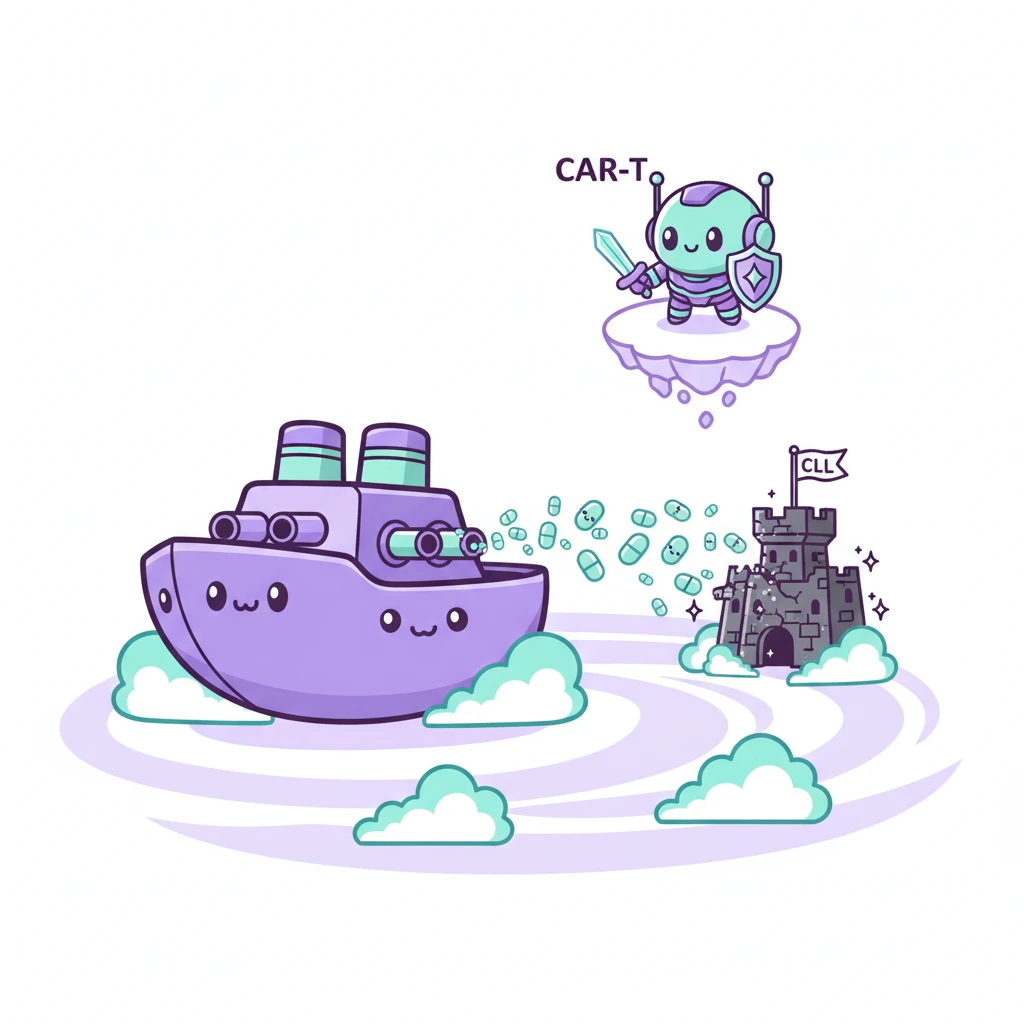
CO-HOST: I mean, the precision, the safety profile, and the depth of response with small molecules have simply outpaced cellular therapy here. Why build a complex experimental bridge like Car T when the ferry system of small molecules safely gets 50 to 70% of passengers across and lets them disembark entirely?
Okay, but comparing frontline, highly optimized small molecule success to last line Car T data is a massive analytical flaw. You just can't do it.
CO-HOST: How is it a flaw? We're looking at the best data for both.
Because you are contrasting the efficacy of small molecules given to patients at the very beginning of their journey, when their immune systems are relatively intact and robust, with Car T therapy administered to patients who have literally run out of options.
CO-HOST: But those patients ran out of options because their disease was uniquely aggressive. Which is exactly the population you'd hope a miracle cellular therapy could rescue.
They ran out of options because continuous targeted therapy exerts immense selective pressure on the leukemia. It's just basic evolutionary biology.
CO-HOST: You mean the resistance mutations?
Yes. You jam the radio signal by having the BTK inhibitor bind to a highly specific lock, right? A system protein at position 481 on the kinase. But eventually, the cancer mutates.
CO-HOST: Right, the C481S mutation.
Exactly. It swaps that cysteine for a serine. The lock literally changes shape. The drug is the key and suddenly the key no longer fits. The inhibitor becomes entirely useless. Your ferry system eventually breaks down for many of these patients.
CO-HOST: I see why you think that, but let me give you a different perspective on how we handle that exact evolutionary pressure. The small molecule toolkit iterates so rapidly.
It does, but
CO-HOST: When the lock changed shape, we didn't just give up. We developed non-covalent BTK inhibitors like Purtobrutinib that don't even rely on that specific binding site. We literally adapt the chemistry to chase the evolution of the tumor.
Even with next generation adaptations, you are missing the physiological state of the patient in that transcend trial. These were patients who were refractory to both BTK inhibitors and Venetoclax.
CO-HOST: Right, double refractory.
Their median number of prior therapies was five. Five. We are talking about a historically dire, heavily pre-treated population with essentially no conventional off ramps left. For a patient in that specific desperate biological state, achieving a 45% overall response rate with Car T is not a modest outcome. It is a lifeline.
CO-HOST: I don't deny it's a lifeline for those who respond, but we have to ask why the complete response rate is still so low, that 18%, compared to how Car T performs in say other lymphomas.
Because we are judging a developing technology by its performance in the absolute hardest clinical scenario imaginable. The lower complete response rates aren't a permanent biological roadblock.
CO-HOST: Then what are they?
They are an artifact of T-cell dysfunction caused by years of prior therapies plus the chronic nature of the disease itself.
CO-HOST: Okay, let's dig right into that underlying mechanism, because this is where the biology gets really difficult for Car T. It's not just that the patients have had prior therapies. CLL is uniquely intrinsically hostile to the immune system.
It is a difficult environment. Yes, I agree.
CO-HOST: It's way worse than difficult. If small molecules are like jamming radio signals, Car T is like deploying highly trained special ops team into the body to hunt the cancer.
Sure. I like that analogy.
CO-HOST: But the CLL micro environment is a battlefield covered in toxic smoke. The disease actively upregulates inhibitory ligands. It forces the patient's own T-cells into a state of profound exhaustion.
Right.
CO-HOST: And because autologous Car T relies on harvesting a patient's own T-cells to engineer that special ops team, you are starting with compromised, exhausted raw materials from day one.
They are exhausted. But again, why are they so physically degraded by the time they reach the manufacturing lab?
CO-HOST: Because of the cancer.
Yes, the cancer itself drives some of that exhaustion, but it is heavily compounded by the cumulative burden of the very treatments you are championing.
CO-HOST: Decades of chronic disease and continuous therapies shorten the telomeres of those T-cells. They plaster them with exhaustion markers like PD-1.
So wait, your argument is that our highly effective, life-saving frontline treatments are to blame for Car T failing later?
CO-HOST: I'm saying it's a solvable logistical issue, not an insurmountable biological failure. And this is exactly why the field is actively investigating a leukopheresis first strategy.
Ah, the early collection idea.
CO-HOST: Yes, we collect the patient's T-cells early in the disease course before they even begin their first line of a BTK inhibitor. We bank those healthy, functional, completely unexhausted T-cells.
Okay.
CO-HOST: Then, years down the line, if the small molecules fail and the patient develops that C481S mutation, we already have a pristine cellular product ready to be engineered and deployed. We bypass the exhausted raw materials entirely through superior sequencing.
That's an interesting point. Though, I would frame it differently. Aren't we just moving the logistical goalposts to obscure the therapy's limitations?
CO-HOST: How is anticipatory medicine obscuring a limitation? I mean, we bank stem cells, we freeze embryos.
Because of the scale and the burden. We are talking about subjecting a newly diagnosed, perhaps entirely asymptomatic patient, someone who might just be on watch and wait, to a leukopheresis cell collection procedure?
CO-HOST: It's a standard blood filtering procedure.
But you have to freeze and store those cells indefinitely for a wildly complex therapy they might never actually need because as we discussed, the Venetoclax combinations might cure them functionally.
CO-HOST: Or they might not.
It just feels like an implicit admission that Car T simply cannot survive the real world biological progression of CLL. If a therapy requires us to essentially time travel to a patient's past to harvest cells before our primary treatments, quote, ruin them, that therapy is a fragile instrument.
CO-HOST: I'm sorry, but I just don't buy that. Let me tell you why. You are defining the entire CLL landscape by the 50 to 70% of passengers who get safely across on your ferry.
Because it's the majority.
CO-HOST: But what about the 30 to 50% who never achieve MRD negativity? What happens when their disease inevitably returns? For them, the small molecule approach eventually hits a wall.
Yes, they relapse.
CO-HOST: And when that happens, cellular therapy is not some experimental luxury or a fragile instrument. It is an absolute biological necessity. Collecting cells early isn't a sign of fragility. It's a strategic insurance policy.
But, let's look at what it takes to actually make that insurance policy pay out. The logistical infrastructure required to bank T-cells for every single CLL patient globally, maintain those cryo-preserved samples for potentially a decade, and then engineer them, it's astronomical.
CO-HOST: It's a challenge, yes.
Meanwhile, the small molecule side is perfecting its approach without needing all that. Earlier, you mentioned the cardiovascular toxicities of early Ibrutinib.
CO-HOST: Right, the atrial fibrillation, the hypertension, the bleeding risks, they were very significant in early trials.
They were, but the chemistry iterates faster than cellular manufacturing does. Just look at the Alpine trial. It compared Ibrutinib directly against a second generation BTK inhibitor, Zanobrutinib.
CO-HOST: Yeah, the head-to-head data.
Zanobrutinib is far more selective. It doesn't hit the off-target kinases that cause those heart issues, and the trial proved Zanobrutinib dramatically reduced those cardiovascular risks while actually showing superior progression-free survival.
CO-HOST: It's a better drug, absolutely.
Exactly. We are refining the precision of the chemical jammers so thoroughly that building an entirely new cellular special ops team is becoming structurally unnecessary.
CO-HOST: It is never structurally unnecessary as long as clonal evolution exists. But, uh, let's look at the intersection of these two modalities, because you keep painting them as mutually exclusive.
Well, they operate very differently.
CO-HOST: They do, but you're arguing that small molecules are the elegant solution and Car T is the clumsy backup. But the evidence actually shows they can be remarkably synergistic at a mechanical level.
Synergistic how? You just argued a minute ago that continuous small molecule therapy exhausts the T-cells.
CO-HOST: Ah, but that's the fascinating paradox of Ibrutinib specifically. While it binds to BTK to kill the leukemia, it also has off-target effects. It inhibits a kinase in T-cells called ITK.
Right, Interleukin 2 inducible T-cell kinase.
CO-HOST: Inhibiting ITK actually shifts the patient's T-cell population from a heavily exhausted state to a much more potent, functional effector state. It alters the TH1 TH2 balance in favor of a stronger immune response.
Wait, so the drug is rehabilitating the immune system?
CO-HOST: Yes, preclinical data strongly demonstrates that giving a patient Ibrutinib before harvesting their T-cells or even concurrent with Car T infusion actively improves Car T persistence and anti-tumor function in vivo.
So you're saying, the drug we designed to kill B-cells inadvertently acts as a performance enhancer for the T-cells we want to engineer.
CO-HOST: Precisely. In fact, that transcend CLL 004 trial we discussed earlier, it intelligently utilized Ibrutinib as a maintenance therapy after the Car T infusion in some cohorts, just to sustain that cellular expansion.
Right, to keep the cells active.
CO-HOST: We are not choosing between chemistry and cellular engineering. We are learning how the targeted chemistry can literally fertilize the micro environment for the Car T-cells to thrive.
It's an incredibly elegant piece of biology. I will admit that. Using a cancer drug to rehabilitate the patient's immune system is brilliant. But stepping back.
CO-HOST: There's always a butt.
Relying on a highly targeted, expensive cancer drug purely as a biological adjuvant to nurse a struggling Car T product along, I mean, it really speaks volumes about the intrinsic vulnerability of Car T in this specific disease.
CO-HOST: I don't see it as vulnerability, I see it as teamwork.
If the special ops team needs constant chemical cover fire just to survive the deployment, maybe they are the wrong tool for this particular battlefield.
CO-HOST: That's a compelling argument, but have you considered Richter's transformation? Because if we really want to talk about the right tool for the battlefield, we have to look at the extremes of this disease.
Ah, right. The 5 to 10% of cases where the indolent CLL suddenly transforms into an aggressive lymphoma.
CO-HOST: Right. Usually, diffuse large B-cell lymphoma or DLBCL. Historically, a Richter's diagnosis was accompanied by a devastatingly grim prognosis.
It was a death sentence.
CO-HOST: The biology radically shifts. The cells start proliferating out of control and our conventional small molecules fail rapidly. The chemical jammer simply gets overrun. But here, CD19 directed Car T has an undeniably clear, intensely impactful role.
Because it behaves like a different cancer.
CO-HOST: Is the disease has altered its biological behavior so drastically, it suddenly responds beautifully to the exact same Car T products we already use to cure primary DLBCL. Car T steps in and rescues patients from the absolute deadliest manifestation of CLL progression.
I'm not convinced by that line of reasoning. Not because the clinical data is wrong. The data for Car T and Richter's is fantastic. It's a vital intervention.
CO-HOST: Then why aren't you convinced?
Because treating Richter's transformation is fundamentally treating a different disease. When CLL transforms into DLBCL, it adopts the aggressive, rapid proliferation characteristics of a large cell lymphoma. Car T naturally thrives against rapidly dividing cells.
CO-HOST: Yes, it does.
So using Car T to cure Richter's essentially proves that Car T is an excellent DLBCL drug. It does not prove its utility in standard slow-moving chronic lymphocytic leukemia.
CO-HOST: But you can't just draw a hard line and pretend they aren't fundamentally connected.
Biologically, they behave entirely differently at that stage. Pointing to Richter's as a triumph for Car T in CLL is like claiming a massive industrial fire-fighting foam is the perfect tool for putting out a smoldering campfire.
CO-HOST: Okay.
I mean, in reality, you're only deploying it because the campfire suddenly ignited a neighboring chemical plant. Yes, it works brilliantly on the chemical fire, but it remains a vast overreaction for the campfire, which we can easily extinguish with a bucket of water, or in this case, a daily pill.
CO-HOST: That analogy minimizes the continuous, underlying clonal relationship between the CLL and the transformed lymphoma.
We can track the genetics. It is the exact same patient fighting a rapidly evolving version of the exact same original cellular error.
CO-HOST: But the mechanism of growth has changed.
Even so, you can't separate the chemical plant from the campfire when they share the exact same genetic root. If Car T provides the only meaningful salvage mechanism for the deadliest consequence of this disease, then its role is not a niche as you described it earlier.
CO-HOST: I still think it's niche compared to the broader population.
It is an indispensable safety net. And if we combine that safety net with the strategic early collection of T-cells we talked about and the synergistic use of BTK inhibitors to maintain T-cell effector status, we are looking at a comprehensive multimodal strategy. Car T covers the exact blind spots left behind by the small molecule revolution.
CO-HOST: Well, if we pull back and look at the entirety of what we've covered, the perspective I hold is that while Car T is a staggering technological achievement with profound implications across the wider field of hematology, its application in core CLL is hampered by fundamental biological realities.
The micro environment you mean?
CO-HOST: Right. The profoundly immunosuppressive micro environment, the intrinsic exhaustion of the T-cells, and the sheer logistical hurdles of early cellular collection, make it a highly friction laden pathway.
Mhm.
CO-HOST: In contrast, the precision, the highly favorable safety profile of second generation agents like Zanobrutinib, and the profound ability to achieve deep MRD negative remissions with fixed duration Venetoclax regimens, these make small molecules the undisputed champions of the CLL space. They are highly effective, they are mechanistically elegant, and most importantly, they offer patients years of normal, treatment-free living without the grueling logistics of cellular extraction and engineering.
And my perspective remains that presenting small molecules as a total, complete solution ignores the unavoidable biological reality of clonal evolution. The cancer mutates, resistance develops.
CO-HOST: It does happen.
We have a critical, growing population of double refractory patients for whom another pill is simply not going to work. Car T's seemingly modest data in this space is largely an artifact of treating the most depleted patients at the very end of their biological rope.
CO-HOST: The sequencing argument.
Exactly. By adjusting our logistics, specifically by utilizing leukopheresis first strategies to bank healthy cells, and by leaning into the proven biological synergy between ITK inhibiting small molecules and Car T expansion, we will secure cellular therapy's vital position. It is the ultimate safeguard against the inevitable failures of targeted chemistry.
CO-HOST: You know, if there is one overarching point of absolute convergence between us, it is a shared marvel at how profoundly this field has transformed.
Oh, absolutely. It's breathtaking.
CO-HOST: It is genuinely incredible to reflect on the fact that CLL has transitioned from a disease treated bluntly and uniformly with highly toxic chemotherapy, to a landscape where we are debating the biological nuances of competing targeted miracles.
Yeah. We are mapping out the precise shape of mutated kinase receptors and engineering personalized immune responses.
CO-HOST: We are no longer debating whether we can manage the disease, but rather which astonishing innovation manages it best.
It's an incredible problem to have.
CO-HOST: We are literally debating the optimal sequencing of therapies that just 15 years ago would have sounded like absolute science fiction.
It is one of the greatest intellectual puzzles in modern oncology, and it leaves us contemplating a much larger frontier. The ongoing evolution of CLL treatment forces us to ask a defining question about the future of medicine.
CO-HOST: What's that?
Does the ultimate solution to complex, evolving malignancies lie in perfecting the targeted chemical jammer, finding the exact molecule to block the exact mutated pathway? Or does it lie in optimizing cellular engineering, building a better, smarter special ops team out of the patient's own immune system to hunt the cancer dynamically?
CO-HOST: That's the core of it, really.
It is. We leave it to you to weigh the evidence. Thank you for joining us on the debate.
Free Clinical Resources
Episode Infographic
Key data, mechanisms, and clinical takeaways distilled into a single shareable page. Save it for reference or use it in your next team discussion.
Clinical Flashcards
Core concepts from this episode in flashcard format, structured for spaced repetition, pre-consultation review, or CPD reflection with your team.
ART-2026-249
·08/26
This podcast episode is produced with AI assistance, reviewed and approved by the editorial team. This publication is intended for healthcare professionals, researchers, and life science industry professionals. Content is provided for informational and educational purposes only and does not constitute medical advice.
Thirty years in health journalism, the last fifteen in life sciences. I have reported from every major medical congress and watched blockbuster drugs get revised after approval. I cover what the data says.
Cite This Podcast
Carter J, Mitchell S. Small molecules VS CAR-T in CLL. The Life Science Feed. Published June 1, 2026. Updated August 3, 2026. Accessed September 1, 2026. https://thelifesciencefeed.com/podcast/2026-06-01/small-molecules-vs-car-t-in-cll.
Editorial & AI Standards
All content is researched from peer-reviewed, open-access sources: published trial data, clinical guidelines, and regulatory filings. AI tools are used solely to structure and summarise that evidence; no AI-generated conclusions appear without editor verification against the primary source.
Every article is reviewed by a named editor before publication. Source citations are listed in the References section. This content does not represent the views of any pharmaceutical company, medical device manufacturer, or healthcare provider.
Licence & Rights
© 2026 The Life Science Feed. All rights reserved. Unless otherwise indicated, all content is the property of The Life Science Feed and may not be reproduced, distributed, or transmitted in any form or by any means without prior written permission.
Podcast Disclaimer
This podcast is produced for educational and informational purposes only. The conversation between hosts represents a discussion of published clinical evidence and is not intended as clinical advice, a substitute for professional medical judgment, or a recommendation for any specific treatment. Healthcare professionals should rely on their own clinical training, current guidelines, and individual patient assessment when making treatment decisions. The views expressed are those of the hosts and do not constitute endorsement of any specific therapy, product, or manufacturer.
References
Al-Sawaf O et al. CLL14. N Engl J Med. 2024
Brown JR et al. ALPINE. N Engl J Med. 2023;388:319-332
Nat Med. 2022;28:735-744
Sharman JP et al. ELEVATE-RR. Blood. 2021;138:46-53
Siddiqi T et al. TRANSCEND CLL
Melanoma: Why early detection is harder than it seems
Melanoma detection relies heavily on primary care vigilance. GPs must recognize subtle signs and risk factors to improve early diagnosis.

Melanoma: Are you missing the subtle clues in your skin exams?
Early detection of melanoma hinges on primary care physicians recognizing subtle skin changes and risk factors, improving patient outcomes.
More from: CAR-T & the Future of Blood Cancer Debate Series

In 2012, a 6-year-old with relapsed ALL became the first child successfully treated with CAR-T cell therapy. That case launched a revolution. Sarah Mitchell and James Carter explain how chimeric antigen receptor T cells are engineered, why CD19 was the first target, and why CRS and ICANS are the price of their potency.
James Carter & Sarah Mitchell

Ciltacabtagene autoleucel achieved a 97% overall response rate and 67% complete response in triple-class refractory multiple myeloma - numbers not thought achievable a decade ago. CARTITUDE-4 has now moved it to the second line. Sarah Mitchell and James Carter cover the BCMA story, the new targets, and the resistance mechanisms driving the next generation.
James Carter & Sarah Mitchell

The next phase of CAR-T addresses its biggest limitations: off-the-shelf allogeneic products, in vivo gene delivery, and bispecific antibodies that redirect T cells without any gene engineering. Sarah Mitchell and James Carter explore where the technology is going - and what blood cancer management looks like by 2030.
James Carter & Sarah Mitchell







