

Hosted by James Carter & Sarah Mitchell

Show Notes
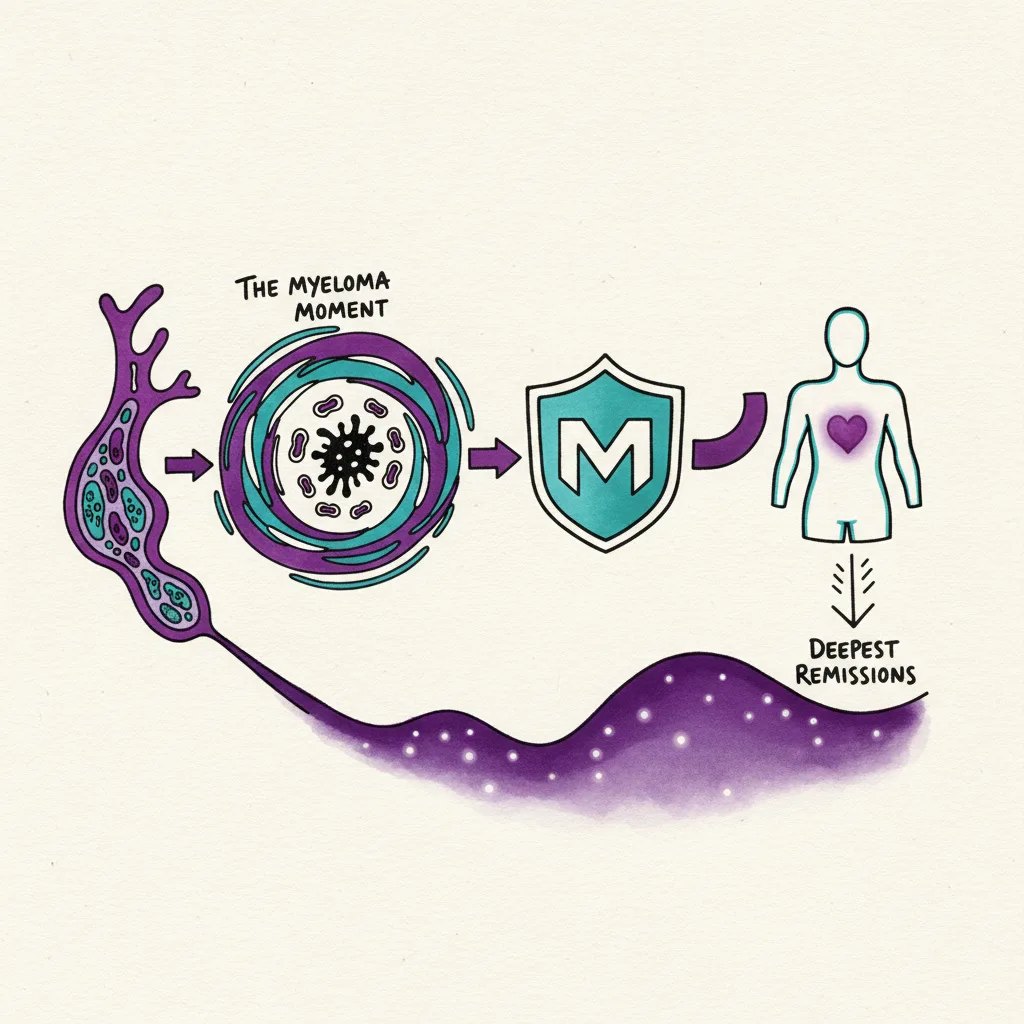
Ciltacabtagene autoleucel achieved a 97% overall response rate and 67% complete response in triple-class refractory multiple myeloma - numbers not thought achievable a decade ago. CARTITUDE-4 has now moved it to the second line. Sarah Mitchell and James Carter cover the BCMA story, the new targets, and the resistance mechanisms driving the next generation.
Transcription
Welcome to the debate. Um, you know, in the architecture of cancer treatment, we generally build our therapeutic strategies the way a Mason builds a wall.
CO-HOST: Yeah. Brick by brick.
Exactly. Brick by brick. First line, second line, third line. And the traditional logic is that you use your foundational, broad acting materials first. You uh carefully save your highly specialized, complex interventions for the inevitable structural gaps that appear years down the line.
CO-HOST: Right. You don't bring out the heavy artillery until the basic defenses fail.
Precisely.
CO-HOST: It's well, it's a fundamental principle of preservation in oncology. You just don't deploy your absolute last line of defense when the outer wall is still holding strong.
Right.
CO-HOST: Because in an incurable disease, you want to maintain a sequence. You know, you want to know you always have a next step.
But what if the hammer you've been saving for last is actually the only tool that could have prevented the wall from falling in the first place?
CO-HOST: Ooh, that's a bold claim.
Well, today we are looking at a monumental shift in how we approach multiple myeloma. And for context, this is a historically incurable cancer of the plasma cells. So, those are the white blood cells in your bone marrow that make antibodies.
CO-HOST: Right. And when they turn malignant, they just completely crowd out the healthy cells.
Exactly. For decades, treatments might buy a patient, you know, two, maybe three or five years of remission, but the cancer almost always figured out a way around it. They relapsed.
CO-HOST: Yeah, and with each relapse, the remissions got shorter and we just had fewer tools to offer.
Right. But now that entire foundational logic is being totally upended by CAR T-cell therapies targeting a protein called BCMA.
CO-HOST: And I mean, upended is the right word here. CAR T where we literally harvest a patient's own immune cells, engineer them with a new GPS to hunt down the cancer and infuse them back in, it's been an absolute revelation.
It really has.
CO-HOST: We're seeing complete response rates and depths of remission in relapse myeloma that frankly, we didn't think were biologically possible a decade ago.
Yeah, it's a thrilling moment in hematology, but uh it forces a very difficult, very real conversation about timing and clinical strategy, which brings us to the exact core of our discussion today.
CO-HOST: Let's lay it out.
So, the central question we are debating is this. Should these highly effective CAR T therapies be aggressively moved up to the earlier lines of treatment, effectively challenging the traditional standard of care?
CO-HOST: Or conversely, do the harsh biological and logistical limitations of CAR T dictate that we have to reserve them for later use and focus on a meticulous sequenced strategy?
Right. So, my perspective on this is pretty clear. I argue that the unprecedented efficacy data we are seeing from recent clinical trials absolutely demands that we move CAR T's to earlier lines of treatment. We need to maximize patient outcomes by intervening while their immune system, their T-cells, specifically, are still healthy enough to really fight.
CO-HOST: And my perspective is that we just cannot ignore the biology. I argue that the inevitability of the cancer mutating, what we call antigen escape, combined with the massive logistical complexities of manufacturing these cells, requires a more cautious sequential approach. We shouldn't be prematurely dismantling the current standard of care.
Well, let's ground this in the clinical reality we're facing right now because we can't just talk about the theory, right? We have to look at what just happened with the CAR TITUDE 4 trial.
CO-HOST: Okay, let's go there.
So, this trial evaluated the CAR T product ciltacell, comparing it to the standard of care regimens in patients who had already become refractory to lenalidomide, which is a foundational drug.
CO-HOST: Right.
We're talking about moving CAR T into the second or third line of treatment, much, much earlier than we traditionally use it. And the results, a staggering 74% reduction in the risk of progression or death.
CO-HOST: It's an impressive number, no doubt.
If you're a clinician listening to this, or, you know, just someone trying to understand the magnitude, let's put that into perspective. Historically, when patients become triple class refractory, meaning the disease simply laughs off a proteasome inhibitor, an immunomodulatory drug and an anti-CD38 antibody, their median overall survival was about 13 months.
CO-HOST: Yeah, it's a grim reality.
13 months. Withholding our most potent, curative intent weapon until a patient's body reaches that dire, biologically exhausted stage is, to me, no longer medically justifiable.
CO-HOST: Look, I hear you, and I am not dismissing the CAR TITUDE 4 data. A 74% reduction in the risk of progression is an undeniable triumph for those patients. But-
But what?
CO-HOST: But we have to look past the initial fireworks of that response and analyze the limitations of CAR T over the long term, because my concern is heavily grounded in the mechanics of the tumor microenvironment, and specifically T-cell exhaustion.
Well, walk us through what you mean by that, mechanically.
CO-HOST: Okay, well, multiple myeloma doesn't exist in a vacuum, right? It lives in the bone marrow, and it creates this highly immunosuppressive neighborhood, the tumor microenvironment.
Right.
CO-HOST: It's essentially like trying to fight a fire in a swamp filled with toxic gas. The CAR T cells go in highly active, but over time, constantly battling in that toxic environment, they get exhausted.
They get tired.
CO-HOST: They literally up regulate stop signs on their own surface, receptors that shut down their aggressive functions. And while the T-cells are getting exhausted, the cancer is actively adapting. We are seeing a significant proportion of relapses driven by BCMA downregulation.
Meaning the cancer cells stop expressing the protein that CAR T is looking for.
CO-HOST: Exactly. It's called antigen escape. The CAR T cells are programmed to hunt the BCMA flag. If the cancer cell drops the flag, the T-cell just floats right past it.
Sure, but-
CO-HOST: Wait, let me finish this thought. Because myeloma inevitably finds a way to mutate around our targeted therapies. We have to prioritize sequential strategies. We need to be able to follow BCMA therapies with treatments targeting other flags like GPRC5D or FCRH5. If we recklessly burn our best bridges early in the disease course, we leave the patient highly vulnerable when the disease eventually mutates and returns.
I see why you think that. But let me give you a different perspective. When you talk about the inevitability of relapse and the cancer, you know, dropping the flag, I think we have to look much closer at the physical design of the therapies we're discussing.
CO-HOST: Okay.
You're treating all CAR T's as if they are exactly the same. But ciltacell is not just a standard CAR T.
CO-HOST: It's a different construct, yes, I'll give you that.
It uses a unique dual domain nanobody design. Instead of grabbing the cancer cell with one hand, which is how the traditional single chain variable fragment works, this dual domain design is essentially like a claw machine grabbing the target with two hooks.
CO-HOST: A claw machine, really?
Yeah, it's a good visual. The cancer cell simply cannot slip away as easily, which is why we see a massive spike in avidity or binding strength. Because of this mechanical grip, if we look at the CAR TITUDE 1 trial, which was in that highly vulnerable, heavily pre-treated population, 97% of patients responded.
CO-HOST: Yes, the initial responses are deep.
67% achieved a stringent complete response. And crucially, at the 27-month follow-up, 74% were still progression-free. These aren't just good numbers. They are structural shifts in the disease.
CO-HOST: But they aren't cures.
Delaying CAR T because of potential relapse is like refusing to use your best elite firefighters when the house first catches fire, just in case there's a second fire later. Why would we let the tumor microenvironment become irreversibly suppressive before we act?
CO-HOST: I'm sorry, but I just don't buy that. Let me tell you why.
Go ahead.
CO-HOST: The firefighter analogy assumes that once the massive fire is out, the house is safe forever. But in myeloma, a deep remission is not synonymous with a cure. We have to look at the underlying biology of BCMA itself.
Right.
CO-HOST: Why did we pick it as a target? It's ideal precisely because it is expressed on virtually all myeloma plasma cells, and importantly, it is not expressed on hematopoietic stem cells.
Right, the root stem cells in the marrow.
CO-HOST: Exactly. Because it's absent on those stem cells, the patient's normal immune system can eventually reconstitute after the therapy wipes out the plasma cells.
Which is a good thing. We want the immune system to rebuild.
CO-HOST: It is a good thing, but that reconstitution phase is exactly where the problem lies. The CAR T cells themselves are living drugs. Over months, as they sit in the patient's body, they lose their effector function. They get tired.
Yeah.
CO-HOST: Meanwhile, the myeloma cells that survive the initial two hook claw machine strike, perhaps because they naturally express very low levels of BCMA to begin with, begin to slowly proliferate.
Okay, so the disease creeps back.
CO-HOST: Right. So, your elite firefighters haven't actually extinguished the fire. They've just suppressed the massive flames. Now, they are completely exhausted, their tanks are empty, and they are powerless to fight the embers that are reigniting in the basement.
Wow. Okay, but you're literally proving my point for me.
CO-HOST: How do you figure?
If T-cell exhaustion is your primary concern, if you are genuinely worried about the firefighters having empty tanks, then that is precisely the mechanical argument for moving CAR T to earlier lines of therapy.
CO-HOST: What? Explain that.
Because we have to ask ourselves, when is the optimal time to harvest these cells from the patient if we want them to survive, expand, and fight a durable long-term war against the cancer?
CO-HOST: Well, obviously when they are healthier, but-
Exactly. Heavy prior therapy inherently damages the patient's own T-cell quality. For years, we've treated myeloma with alkylating agents and immunomodulatory drugs. These drugs are essentially systemic weed killers.
CO-HOST: They are toxic, yes.
They are highly effective at killing cancer, but they completely ravage the soil, the patient's immune system. By the time a patient has had four or five lines of therapy, their T-cells are battered veterans. They are structurally degraded.
CO-HOST: Sure.
If we harvest those cells to make a CAR T product, we are starting with inferior material. Collecting T-cells earlier in the disease course, when the immune system hasn't been subjected to years of toxic chemotherapy, leads to vastly better CAR T expansion and persistence inside the body. Mechanically, the therapy is fundamentally superior in the second line because the starting material is healthier.
CO-HOST: Look, I come at it from a different way. You are isolating the cellular fitness in a petri dish from the actual clinical reality the patient is experiencing in the hospital.
How so?
CO-HOST: That healthy T-cell argument assumes the logistics of delivering CAR T early are as seamless as prescribing standard therapy, and they absolutely are not.
Well, they are complex, I'll grant you that.
CO-HOST: They are immense hurdles. CAR T is a bespoke living product. Manufacturing currently takes anywhere from two to five weeks. Imagine telling a patient whose cancer is aggressively multiplying, oh, we have a miracle drug, but you have to wait a month while we grow it in a lab?
We use bridging therapy for that.
CO-HOST: Yes, but during this critical waiting window, they require that bridging therapy, often more chemo, just to keep the rapidly progressing disease at bay. You're talking about introducing severe logistical bottlenecks and risks into a phase of the disease where we currently have manageable off-the-shelf standard options that work extremely well.
But those off-the-shelf options don't offer a 74% reduction in progression.
CO-HOST: Maybe not in a single strike. No. But they are immediate. And furthermore, we cannot just brush past the toxicities of the CAR T itself. We are managing cytokine release syndrome, or CRS.
Right, the inflammatory response.
CO-HOST: Exactly. And for listeners who might not be in the clinic, CRS is not just a mild fever. When these engineered T-cells see the cancer, they multiply rapidly and release massive amounts of inflammatory cytokines. It is a systemic firestorm.
True.
CO-HOST: Blood pressure can bottom out, patients can end up in the ICU requiring vasopressors, then there is ICANS, a severe neurotoxicity where patients can temporarily lose the ability to speak or become comatose.
Yeah, it's serious.
CO-HOST: These are intensive life-threatening complications. To introduce a month-long delay, followed by a high risk of neurotoxicity into the second line of treatment, when a patient could simply receive a readily available, highly effective triplet therapy, seems unnecessarily precarious.
The risks of CRS and ICANS are very real. I'm not minimizing them. But as our experience with CAR T has grown, our clinical management of these toxicities has improved dramatically.
CO-HOST: We are getting better at it.
We know how to use drugs like tocilizumab to calm that systemic firestorm much earlier now. And if we look at the regulatory environment, the FDA agrees that the benefit clearly outweighs the risk. They've approved ciltacell in the second line based on the CAR TITUDE 4 data.
CO-HOST: Right.
This means the field has to actively challenge the long-standing elephant in the room, the traditional autologous stem cell transplant.
CO-HOST: It is the undisputed standard of care for eligible patients.
It is, but look at what it actually entails. Historically, we push patients through high-dose melphalan, which is incredibly toxic. It essentially wipes out the bone marrow entirely, and then we rescue them with their own stem cells. It is grueling.
CO-HOST: It's hard on the body, yes.
And then we just wait for their performance status and their organ function to steadily decline over successive lines of therapy before we finally say, okay, now you qualify for CAR T. That is a fundamental flaw in the old paradigm.
CO-HOST: But-
If we have a therapy that deeply clears the disease, keeping it on the reserve bench while forcing patients through highly toxic, non-targeted chemotherapy is doing a massive disservice to their long-term survival trajectory.
CO-HOST: That's a compelling argument, but have you considered the full roadmap of the patient's life? Because myeloma is a marathon, not a sprint. What happens when the disease progresses after that early CAR T intervention?
Well, you use the next available therapy.
CO-HOST: But if you replace the foundational autologous transplant entirely, you are leaving clinicians with fewer total tools in the arsenal over a 10 or 15-year lifespan.
I don't see it as having fewer tools.
CO-HOST: But you do. If a patient receives a BCMA CAR T in the second line and they relapse a year or two later via BCMA downregulation, which again, we know happens frequently, they must now immediately rely on the newer emerging pipeline.
Which is a remarkably robust pipeline right now.
CO-HOST: It is robust, but it comes with entirely new complications. Let's look at the bispecific antibodies you're talking about, the ones targeting GPRC5D like talquetamab.
The data there is fantastic.
CO-HOST: The data is excellent, yes. The MonumenALL-1 trial showed a 73% overall response rate even in patients who had received a median of five prior lines of therapy. We also have drugs targeting FCRH5. But my point is about the architecture of care. We sequence these drugs because of their unique profiles. For example, GPRC5D is heavily expressed on myeloma cells, but do you know where else it's highly expressed?
Um, on highly keratinized tissues.
CO-HOST: Exactly. Hair follicles, the skin, the nail beds, and the tongue.
Wait, hair follicles? So you're saying we are trading bone marrow toxicity for what? Skin and nail issues?
CO-HOST: Exactly. Patients on talquetamab experience severe dysgeusia. They literally lose their sense of taste. They have skin peeling off their hands, their nails weaken.
Right, quality of life issues.
CO-HOST: It is an entirely different, incredibly frustrating toxicity profile that affects their daily quality of life in profound ways. By moving CAR T into the second line and displacing the standard stem cell transplant, you are not adding to the arsenal. You are prematurely replacing the foundation.
I hear that.
CO-HOST: A robust sequential paradigm, using the transplant, utilizing our targeted triplet therapies, then deploying the BCMA CAR T and eventually moving to the GPRC5D bispecifics, maximizes the total duration of disease control. Sequencing should be about extending the roadmap, stretching out those years of life, not taking a shortcut that burns through our most potent agents up front.
I see why you think that, but let me give you a different perspective on the biology. You're viewing BCMA as just a surface marker, you know, like a license plate we use to find the cancer cell.
CO-HOST: Well, it is a marker.
But it's not just a paint job, it's the engine. BCMA is a functional node.
CO-HOST: Expand on that. What do you mean?
BCMA catches survival signals in the body. Specifically, it binds to ligands called APRIL and BAFF.
CO-HOST: Right.
When APRIL and B-proth hit the BCMA receptor, they send a signal into the cancer cell that actively drives its survival and proliferation. It is the fuel line.
CO-HOST: Okay.
By hitting that exact receptor with a dual domain CAR T, early, when the patient's T-cells are robust, not battered veterans, and are capable of massive expansion, we are striking at the very engine of the cancer survival mechanism.
CO-HOST: But the antigen escape.
You just mentioned the MonumenALL-1 trial in talquetamab. That actually proves my point. We do have highly effective salvage therapies for those who experience antigen escape. We can rescue them with GPRC5D therapies later.
CO-HOST: It's not always a perfect rescue.
Why restrict the absolute best therapy to the last line just to preserve a theoretical sequence? The new sequence should be, hit the functional engine of the cancer with your healthiest immune cells first, achieve a massive, deep remission, and use the bispecifics as the backup plan.
CO-HOST: Because the backup plan is not guaranteed to work as well in a patient whose immune system has already been fundamentally modulated by engineered T-cells.
We don't know that for sure.
CO-HOST: Exactly. We don't fully understand the long-term immunosuppressive effects of having a CAR T-cell population living in your body for years. And quite frankly, we have to talk about reality here.
Okay, let's talk about reality.
CO-HOST: The capacity to manufacture CAR T for every single myeloma patient in the second line simply does not exist globally right now. That two to five-week wait time we discussed, that is a best-case scenario in elite, specialized academic centers.
Yeah, that's fair.
CO-HOST: If we shift the entire standard of care away from transplant, which is universally accessible, highly standardized, and can be done at most major hospitals, and move toward a bespoke, highly complex cellular product for early line patients, we are going to create a massive bottleneck. Patients will literally progress and die while waiting for a manufacturing slot at a factory.
Look, access and manufacturing scale are massive challenges, and I completely concede that point. We absolutely cannot ignore the logistical burden.
CO-HOST: It's the reality on the ground.
However, clinical strategy should drive manufacturing innovation, not the other way around. If we, as a medical community, agree that early intervention with healthier T-cells produces superior clinical outcomes, then the mandate for the pharmaceutical industry is to solve the manufacturing bottleneck.
CO-HOST: That's a big if.
The solution is not for clinicians to artificially delay a superior treatment just because the supply chain is clunky.
CO-HOST: That's fair. The supply chain shouldn't dictate the science, but we have to treat the patients in front of us today with the reality we have today.
Agreed. And looking at where we are today, it's clear we've established something fundamental in this conversation. We both recognize that BCMA targeted therapies represent a monumental historic breakthrough in myeloma biology.
CO-HOST: Unquestionably.
The sheer fact that we are sitting here rigorously debating the nuances of complete response rates of 60 to 70% in patients who previously had no options, I mean, it shows just how incredibly far this field has come.
CO-HOST: I completely agree with that baseline. The discovery that targeting this specific node yields these kinds of unprecedented responses is a watershed moment for oncology. We converge entirely on the reality that BCMA is the key to modern myeloma therapy.
Right.
CO-HOST: The efficacy we've seen across the board from the KarMMa trials to the CAR TITUDE trials has just changed the calculus of this disease forever.
Yet, we remain clearly divergent on the implementation of that calculus.
CO-HOST: Definitely.
I stand firmly by the staggering progression-free survival data in earlier lines. I believe the data we're seeing justifies a true paradigm shift. We need to move away from the blind broad toxicities of autologous stem cell transplants and move toward early targeted CAR T intervention. We must capitalize on the fitness of healthy T-cells and hit the disease as hard as possible when the immune system is most capable of fighting.
CO-HOST: And I remain convinced that the harsh realities of biology and logistics cannot simply be wished away. Antigen escape is a real evolutionary survival mechanism of the cancer.
Yeah.
CO-HOST: T-cell exhaustion is a profound mechanical limiting factor. When you combine that with a multi-week manufacturing time in a rapidly progressing disease, it dictates that CAR T is best utilized as a highly potent, meticulously timed part of a sequential chain. We have to respect the complexity of myeloma by preserving our standard of care and layering in our newer targets sequentially, rather than hoping a single early strike will somehow bypass the fundamental nature of the disease.
As the landscape of targetable antigens in myeloma expands, you know, from BCMA to GPRC5D, FCRH5 and beyond, this tension is only going to grow more complex. We are truly moving from a world of just managing a patient's decline to a world of actively engineering their immune responses.
CO-HOST: It's an incredible shift.
It really is. And it leaves us with a profound question for the future of oncology as a whole. Does the path to curing complex cancers lie in abandoning the traditional brick by brick approach to strike as hard as possible at the very beginning, or does long-term survival depend on meticulously managing a sequence of targeted strikes over a lifetime? We will leave that for you to weigh. Thank you for joining us on the debate.
Free Clinical Resources
Episode Infographic
Key data, mechanisms, and clinical takeaways distilled into a single shareable page. Save it for reference or use it in your next team discussion.
Clinical Flashcards
Core concepts from this episode in flashcard format, structured for spaced repetition, pre-consultation review, or CPD reflection with your team.
ART-2026-248
·09/26
This podcast episode is produced with AI assistance, reviewed and approved by the editorial team. This publication is intended for healthcare professionals, researchers, and life science industry professionals. Content is provided for informational and educational purposes only and does not constitute medical advice.
Thirty years in health journalism, the last fifteen in life sciences. I have reported from every major medical congress and watched blockbuster drugs get revised after approval. I cover what the data says.
Cite This Podcast
Carter J, Mitchell S. Moving CAR-T to earlier myeloma lines. The Life Science Feed. Published June 1, 2026. Updated September 15, 2026. Accessed October 15, 2026. https://thelifesciencefeed.com/podcast/2026-06-01/moving-car-t-to-earlier-myeloma-lines.
Editorial & AI Standards
All content is researched from peer-reviewed, open-access sources: published trial data, clinical guidelines, and regulatory filings. AI tools are used solely to structure and summarise that evidence; no AI-generated conclusions appear without editor verification against the primary source.
Every article is reviewed by a named editor before publication. Source citations are listed in the References section. This content does not represent the views of any pharmaceutical company, medical device manufacturer, or healthcare provider.
Licence & Rights
© 2026 The Life Science Feed. All rights reserved. Unless otherwise indicated, all content is the property of The Life Science Feed and may not be reproduced, distributed, or transmitted in any form or by any means without prior written permission.
Podcast Disclaimer
This podcast is produced for educational and informational purposes only. The conversation between hosts represents a discussion of published clinical evidence and is not intended as clinical advice, a substitute for professional medical judgment, or a recommendation for any specific treatment. Healthcare professionals should rely on their own clinical training, current guidelines, and individual patient assessment when making treatment decisions. The views expressed are those of the hosts and do not constitute endorsement of any specific therapy, product, or manufacturer.
References
Berdeja JG et al. CARTITUDE-1. Lancet. 2021;398:314-324
Moreau P et al. MonumenTAL-1. N Engl J Med. 2022;387:495-505
Munshi NC et al. KarMMa. N Engl J Med. 2021;384:705-716
San-Miguel J et al. CARTITUDE-4. N Engl J Med. 2023;388:1002-1014
Melanoma: Why early detection is harder than it seems
Melanoma detection relies heavily on primary care vigilance. GPs must recognize subtle signs and risk factors to improve early diagnosis.

Melanoma: Are you missing the subtle clues in your skin exams?
Early detection of melanoma hinges on primary care physicians recognizing subtle skin changes and risk factors, improving patient outcomes.
More from: CAR-T & the Future of Blood Cancer Debate Series

In 2012, a 6-year-old with relapsed ALL became the first child successfully treated with CAR-T cell therapy. That case launched a revolution. Sarah Mitchell and James Carter explain how chimeric antigen receptor T cells are engineered, why CD19 was the first target, and why CRS and ICANS are the price of their potency.
James Carter & Sarah Mitchell

By the time CAR-T arrived in CLL, the disease had already been transformed by BTK inhibitors and venetoclax. TRANSCEND CLL 004 showed 18% CR in BTKi/venetoclax-refractory disease. Sarah Mitchell and James Carter explore why CLL is harder for CAR-T, where it still has a role - especially in Richter's transformation - and why timing of T cell collection matters.
James Carter & Sarah Mitchell

The next phase of CAR-T addresses its biggest limitations: off-the-shelf allogeneic products, in vivo gene delivery, and bispecific antibodies that redirect T cells without any gene engineering. Sarah Mitchell and James Carter explore where the technology is going - and what blood cancer management looks like by 2030.
James Carter & Sarah Mitchell





