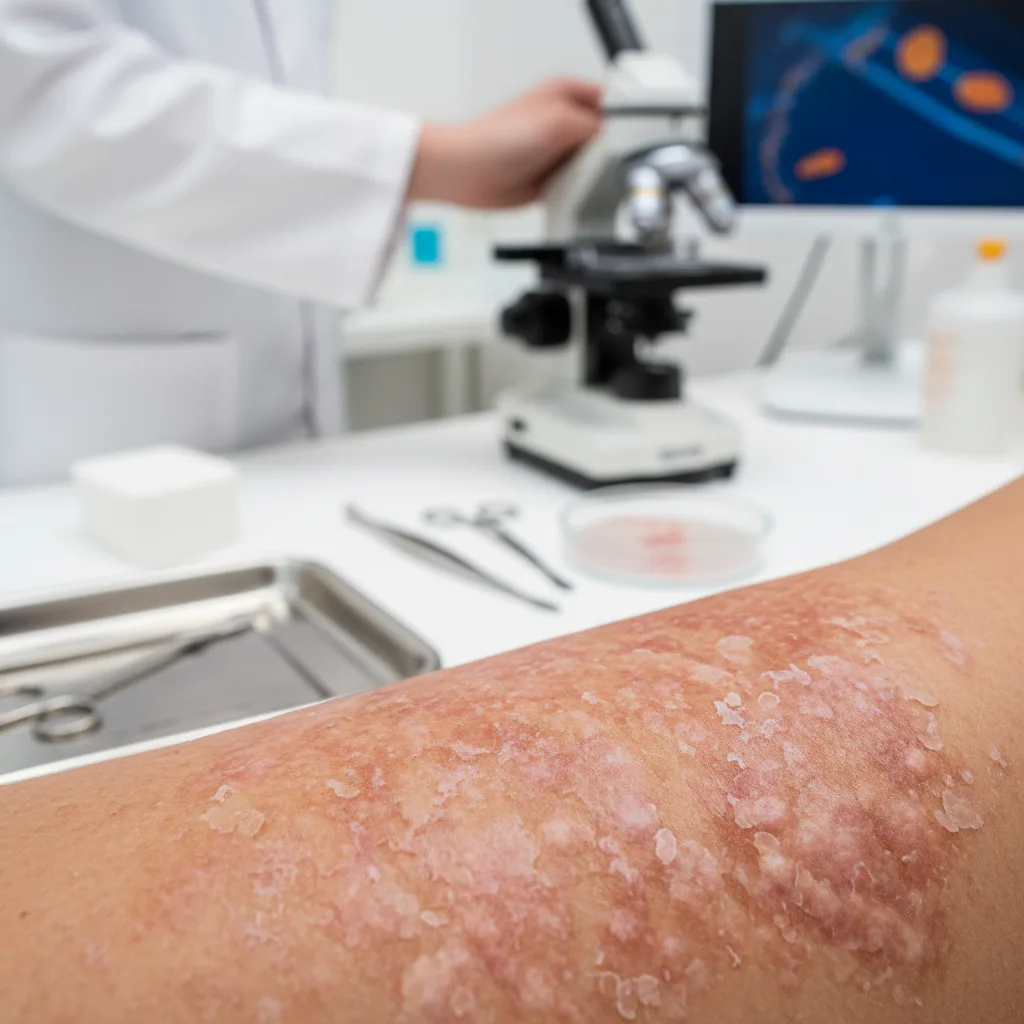


Hosted by Sarah Mitchell & James Carter

Follow the show while you are there, and new episodes turn up on their own.Listen on Spotify
Show Notes
Up to half of psoriasis patients discontinue their treatment within a year. The reasons are complex: side effect fear, injection fatigue, visible improvement masking ongoing disease. The solutions require as much psychology as pharmacology. Sarah Mitchell and James Carter examine the adherence crisis and what works.
Transcription
Right, yeah. Like a very clear-cut answer.
CO-HOST: Exactly. It feels almost like engineering. Like you break your arm, the x-ray shows that jagged white line, and the doctor just points and says, "There it is."
Yeah, broken or not broken.
CO-HOST: Right. It's incredibly clean.
We really gravitate toward that binary, I think. A visible, easily categorized problem gives us, well, it gives everyone immense psychological comfort.
CO-HOST: Yeah, for the doctor and the patient.
Exactly. It creates this linear path. You identify the broken thing, you apply the fix, and you walk away.
CO-HOST: But then, you know, you step into the world of chronic conditions, specifically dermatology and all the hidden human behavior surrounding it.
Oh, absolutely. That's where it gets complicated.
CO-HOST: Yeah, suddenly that x-ray machine is just broken. We're looking at a diagnostic landscape that is, well, honestly, it's murky.
Very murky.
CO-HOST: And that murky landscape is exactly what we are wading into today.
Welcome to the Deep Dive, by the way.
CO-HOST: Glad to be here. Dig into this. Because we are unpacking a massive stack of sources today. Real world clinical insights, medical commentary, behavioral research, and it's all about a hidden crisis in dermatology.
Right. Specifically, psoriasis management and medication adherence.
CO-HOST: Yeah, because the clinical data shows this profound gap between, you know, the prescription pad and the patient's actual life.
We operate under this foundational assumption that modern medicine is primarily a biological challenge, right? Like if we just engineer the perfect molecule, the disease is conquered.
CO-HOST: Right. But the real bottleneck is behavioral.
Exactly, the human element.
CO-HOST: Because there's this simple equation we all just kind of accept. You get sick, you go to the doctor, they give you medicine, you take it, and you get better.
Which is largely a myth.
CO-HOST: Looking at these sources, it is a complete myth. And the mission of this deep dive is to figure out why.
And this isn't just a niche conversation about skin conditions, either.
CO-HOST: No, not at all. It's a profound look at human behavioral psychology. It's about this massive silent disconnect between clinicians and patients.
And ultimately, it's about the surprising, sometimes wildly simple interventions that actually change human habits.
CO-HOST: Right. Because the underlying mechanisms dictating why we, uh, why we resist the very things designed to help us, they're universal.
We're really examining the architecture of human decision-making under stress here.
CO-HOST: Exactly. So, even if you, the listener, don't have psoriasis, even if you've never stepped foot inside a dermatology clinic, the psychology we're exploring today applies to you.
The reasons why we abandon good habits, the way fear dictates our actions.
CO-HOST: How our brains calculate risk, all of it. It applies directly to your everyday life. So, okay, let's unpack this.
Let's do it.
CO-HOST: Because the baseline data in our sources doesn't just show a small crack in the medical system, it shows a systemic collapse.
It really does. It's pretty staggering.
CO-HOST: When we talk about people not taking their medication, what kind of scale are we actually dealing with here?
So, the numbers consistently demonstrate that at any given time, 40 to 60% of patients with psoriasis are non-adherent to their prescribed treatments.
CO-HOST: Wow. 40 to 60%.
Right. To put that in perspective, if you walk into a waiting room with 10 psoriasis patients, statistically, five of them are not following the medical intervention.
CO-HOST: The intervention designed to keep their disease in check. That's almost half the population.
Almost half, yeah.
CO-HOST: I mean, if half the people in the aviation industry decided to just skip their pre-flight checks, planes would literally fall out of the sky.
The whole industry would halt immediately.
CO-HOST: Exactly. But in medicine, this 50% failure rate just quietly hums along in secret.
And the sources point out that this isn't isolated to like one annoying type of medicine, either.
CO-HOST: Right, it's across the board.
The non-adherence spans the entire therapeutic spectrum. It applies to topicals, so, the creams, the ointments.
CO-HOST: Which are notoriously messy.
Very. And it applies to phototherapy, where patients have to physically travel to a clinic for light treatments.
CO-HOST: That's a huge time commitment.
Yeah. It applies to oral systemic medications, pills taken daily or weekly. And perhaps most surprisingly, it applies to biologics.
CO-HOST: The really intense ones.
Right. Highly intensive, incredibly expensive injectable therapies. The 40 to 60% drop-off rate is entirely agnostic to the type of treatment.
CO-HOST: So, with topical treatments specifically, the sources note that non-adherence isn't the exception. It's the statistical norm.
It's literally what a clinician should mathematically expect to happen.
CO-HOST: Yeah, there's this total disconnect in the clinic room, right?
Yeah. What's fascinating here is the illusion of the clinical encounter.
CO-HOST: Break that down for us.
Well, a patient arrives for a follow-up visit. Their psoriasis is flaring, right? The plaques are thick, they're red, they're inflamed.
CO-HOST: Okay.
The clinician observes the skin and immediately funnels that visual data through a biological framework. They assume the treatment they prescribed months ago has encountered secondary failure.
CO-HOST: Secondary failure. I want to break that term down for a second. Secondary failure implies that the drug was doing its job, but the disease mutated or like overpowered it.
That's the assumption.
CO-HOST: The doctor is thinking, the biology of this patient's immune system has outsmarted my chemistry.
Exactly. The clinician believes the molecular pathway targeted by the drug is just no longer responsive.
CO-HOST: So what do they do?
Consequently, they escalate the therapy. They prescribe a stronger topical steroid or they graduate the patient to systemic pills, or jump straight to a biologic.
CO-HOST: But the clinical blind spot here is massive.
It is. Because in a huge percentage of these cases, the failure wasn't secondary. It was primary failure.
CO-HOST: Meaning the drug didn't fail the biology, the patient simply failed to open the tube.
Precisely. The medication remains perfectly capable of suppressing the inflammation. The failure occurred entirely in the behavioral realm.
CO-HOST: The patient just stopped applying it.
Right. So, the clinician is essentially trying to solve a complex behavioral puzzle using advanced pharmacology.
CO-HOST: Which leads to rampant overprescribing, right?
Rampant overprescribing and unnecessary exposure to stronger drugs with much heavier side effect profiles.
CO-HOST: So the medicine works perfectly fine in a controlled clinical trial where a nurse is standing over you with a clipboard.
But it fails spectacularly in the chaotic reality of a Tuesday morning in someone's bathroom.
CO-HOST: That's the reality gap.
And the sources highlight a specific phenomenon that proves this. Something they call the Weekend Warrior.
CO-HOST: Ah, yes. The Weekend Warrior. So, to capture accurate adherence data, researchers utilize medication event monitoring systems.
CO-HOST: They call them MEMS caps, right?
MEMS caps, exactly. These are specialized microchips embedded right in the lids of the medication tubes or pill bottles.
CO-HOST: Okay, that's clever.
Every time the patient twists the cap off, the microchip records a time and date stamp.
CO-HOST: So they aren't just relying on patients filling out a survey and, you know, lying about how good they are?
No self-reporting bias here.
CO-HOST: They have the hard digital timestamp of every single application.
And the data shows people are basically cramming for their doctor's appointment.
CO-HOST: Like a college student cramming for a final exam.
Exactly like that. They go weeks without touching the cream.
CO-HOST: And then,
Then, three days before they have to sit on that crinkly paper in the doctor's office, they unleash a flurry of medical activity.
CO-HOST: The MEMS data reveals a sharp spike, right?
A huge spike occurring 48 to 72 hours prior to the clinic visit. They apply the medication aggressively, attend the appointment, present themselves to the clinician.
CO-HOST: And then what happens?
Within 24 hours of leaving the clinic, the usage drops right back down to zero.
CO-HOST: It is exactly like flossing.
The dentist analogy is perfect.
CO-HOST: You have a dentist appointment on Thursday, so on Tuesday night, you're suddenly in front of the mirror flossing with the intensity of an absolute madman.
Your gums are bleeding.
CO-HOST: You're stressed, and it's all because you want to perform good patient behavior for the authority figure with the sharp tools. We're doing this just to avoid a scolding.
The performative aspect of healthcare is a massive driver of this behavior. The clinic visit is perceived not as a collaborative health review, but as a judgment.
CO-HOST: Right. A pass or fail grade.
The patient just wants to maintain their status as a compliant, good individual in the eyes of the medical authority.
CO-HOST: But I mean, I have to push back on this on behalf of the patient for a second.
Let's look at it logically. The sources note that one of the main reasons people stop using topicals isn't just laziness, it's because the skin actually gets better.
CO-HOST: That is a very common trigger, yes.
The cream does its job, the plaques flatten out, the redness fades, so the patient stops putting the greasy ointment on.
CO-HOST: Right. I mean, if I have a pounding headache, I take ibuprofen. When the headache vanishes, I don't keep taking the ibuprofen for another three weeks.
No, you wouldn't.
CO-HOST: So, isn't stopping the cream a deeply rational human response to feeling better?
The logic holds perfectly if you apply an acute illness mental model to a chronic condition.
CO-HOST: Ah.
Our biological programming dictates that we apply resources, whether that's resting, seeking warmth, or taking a pill, only in the presence of acute distress.
CO-HOST: Makes sense.
When the threat signal diminishes, we conserve energy and stop the intervention. But the critical misunderstanding here is the very nature of psoriasis itself.
CO-HOST: Because it's not acute.
It is not an acute, localized rash. It is a systemic, chronic autoimmune disease driven by overactive T-cells.
CO-HOST: So, the skin clearing up is an illusion.
It is. The fire is still raging underground. You just put a very nice rug over the floorboards so you can't see the smoke.
CO-HOST: That's a great way to visualize it.
The underlying systemic inflammation remains entirely active. The topical medication is really suppressing the localized manifestation of that inflammation.
CO-HOST: So, they have to keep using it.
To maintain clearance, maintenance therapy is absolutely required. However, the human brain struggles immensely with preventative maintenance when there is no visible, immediate threat.
CO-HOST: Out of sight, out of mind.
Exactly. The moment the visual trigger, the plaque, is removed, the perceived necessity of the daily, burdensome habit just plummets.
CO-HOST: That makes intuitive sense for a topical cream, you know? It's annoying, the skin looks fine, you drop the habit.
Right.
CO-HOST: But the sources revealed that patients are doing this exact same thing with the intense high-stakes treatments. We are talking about biologics here.
Yes. And that is where the danger really escalates.
CO-HOST: These aren't just tubes of hydrocortisone, these are massive medical interventions.
The stakes elevate dramatically when we transition to biologic therapies. Biologics are genetically engineered proteins designed to target very specific parts of the immune system.
CO-HOST: And they aren't creams.
No. They're typically administered via injection or intravenous infusion.
CO-HOST: And they're expensive.
The financial cost is staggering, often tens of thousands of dollars a year. And the mechanism of action is profound. Yet, even within this intensive treatment class, persistence at the two-year mark frequently falls below 70%.
CO-HOST: People are literally giving themselves an injection. You have significant skin in the game at that point.
You are highly invested.
CO-HOST: And yet, almost a third of them just quietly drop the needle. They stop injecting, and crucially, they do it without telling their doctor.
Which is the most dangerous part.
CO-HOST: Because the biological consequence of stopping a biologic isn't just a temporary flare-up. The sources dive into a concept called immunogenicity, which honestly sounds terrifying.
Let's unpack the biological mechanism of immunogenicity because it really is the most critical hidden danger of non-adherence here.
CO-HOST: Walk us through it.
To understand it, we first have to understand how a biologic, like an anti-TNF drug operates. TNF, or tumor necrosis factor, is an inflammatory cytokine.
CO-HOST: Okay.
In a healthy immune system, it acts as an alarm bell, recruiting immune cells to fight off infections. But in a psoriasis patient, that alarm bell is broken.
CO-HOST: It's just constantly ringing.
Constantly ringing, telling the body to rapidly overproduce skin cells, which results in those thick scaly plaques.
CO-HOST: It's like a fire alarm that won't shut off. And the body keeps sending fire trucks to a building that isn't actually burning, causing a massive traffic jam on the skin.
That's exactly it. So, the biologic drug acts as a targeted interceptor. It circulates in the bloodstream, binds to the TNF proteins, and neutralizes them.
CO-HOST: Effectively silencing the alarm.
Right. But to do this successfully, the drug must maintain a specific concentration in the blood, a therapeutic threshold.
CO-HOST: So they have to keep taking it on schedule.
When a patient adheres to their injection schedule, they maintain that steady state.
CO-HOST: But when they become a Weekend Warrior with their injections?
Or, you know, they stretch a two-week dose into a four-week dose because they feel fine, that steady state collapses.
CO-HOST: The experience is what the sources call subtherapeutic exposure.
Subtherapeutic exposure.
CO-HOST: The concentration of the biologic drops below the necessary threshold. And this is where the body's natural defense mechanisms turn against the patient.
How so?
CO-HOST: The immune system is constantly surveilling the bloodstream for foreign proteins. When the biologic was maintained at a high steady level, it essentially overwhelmed the surveillance system or was just recognized as part of the environment.
CO-HOST: Because there was so much of it?
Right. But when the levels drop drastically, the immune system gets a clear look at this genetically engineered molecule.
CO-HOST: Here's where it gets really interesting. It's like a facial recognition security system getting a software update.
Exactly. The immune system scans this biologic, realizes it's an artificial foreign protein, and suddenly tags it as a threat.
CO-HOST: The immune system mounts a specific, targeted attack against the life-saving drug. It creates anti-drug antibodies, or ADAs.
CO-HOST: Anti-drug antibodies.
These antibodies are designed to hunt down and destroy the biologic before it can ever reach the TNF proteins.
CO-HOST: Wait, so the body's immune system actually learns to fight off the cure?
It permanently neutralizes the therapy. Once the body has developed a high titer of these anti-drug antibodies, injecting that specific biologic becomes entirely useless.
CO-HOST: It just destroys it immediately.
The antibodies will destroy it instantly, yes. The patient has permanently removed a highly effective, advanced medical tool from their lifelong treatment arsenal.
CO-HOST: By skipping a few doses because they were, you know, tired of the needle, or because their skin looked okay that month?
They haven't just paused their healing.
CO-HOST: No. They've triggered a permanent biological lockout. You're basically burning a bridge while you're still standing on it.
That's the reality of it.
CO-HOST: And because they don't tell the doctor they skipped doses, the systemic waste begins. The psoriasis flares back up because the drug is being destroyed by the body's new antibodies. So the patient goes to the clinic.
And the clinician observes a severe relapse. Unaware of the missed doses, the clinician diagnoses secondary failure.
CO-HOST: They assume the disease has just outpaced the drug.
Exactly. The standard protocol in this scenario is to cycle the patient onto an entirely different biologic.
CO-HOST: Which means starting from scratch. New insurance authorizations, new terrifying side effect profiles to worry about, and tens of thousands of dollars billed to the healthcare system.
All to solve a biological problem that was entirely manufactured by a behavioral choice.
CO-HOST: It is a catastrophic cycle of systemic waste.
If we connect this to the bigger picture, the financial burden on global healthcare systems caused by this unnecessary treatment, cycling, cycling driven by hidden non-adherence, is staggering.
CO-HOST: We're just burning through options.
We are burning through our most advanced therapeutic options because we are failing to support the human behavior required to utilize them properly.
CO-HOST: So we know the physical cost is severe, you lose the miracle drug. And we know the systemic cost is massive. So we have to ask the hard question. Why do patients risk this?
We can't rely on the lazy assumption that patients are just forgetful or difficult.
CO-HOST: Right. No one actively wants their skin to crack and bleed, and no one wants to wreck their own immune system.
No, they don't.
CO-HOST: So, to figure out what's actually happening in their heads, the sources provide this brilliant behavioral science framework. They divide this crisis into two distinct camps: unintentional and intentional non-adherence.
Unintentional non-adherence encompasses the mechanical and logistical failures of taking medication.
CO-HOST: The "Oops" category.
Exactly. The patient possesses the genuine desire to comply, but external or cognitive barriers prevent it. This includes simple memory decay, forgetting a dose.
CO-HOST: Happens to everyone.
It includes poor comprehension of the medical instructions, and crucially, it includes structural barriers.
CO-HOST: Like what?
Like a lack of transportation to the pharmacy, sudden changes in health insurance, or an inability to afford the co-pay.
CO-HOST: So the spirit is willing but the logistics are weak.
Well said.
CO-HOST: But intentional non-adherence. That is where the psychology gets incredibly dense. Because this isn't forgetting.
No. This is a deliberate, conscious decision made by the patient to actively not take the medication.
CO-HOST: And they're making this choice based on their own internal algorithms of belief, fear, and daily reality.
To understand intentional non-adherence with topical treatments, we really have to analyze the concept of treatment burden.
CO-HOST: Treatment burden.
The clinical sources emphasize that for a patient with moderate to severe psoriasis, applying topical medication is not a trivial task.
CO-HOST: No.
It frequently takes 15 to 20 minutes, every single day.
CO-HOST: Let's really map out this 20 minutes, because if you hear 20 minutes in a sterile doctor's office, it sounds completely reasonable.
Just rub this on, it takes 20 minutes.
CO-HOST: Right. But put that into the reality of a Tuesday morning. You're trying to get the kids fed, the coffee made, and commute to a job. 20 minutes is an eternity.
It is a massive disruption.
CO-HOST: Over a year, that is more than 120 hours dedicated exclusively to smearing ointment on yourself.
Furthermore, the sensory experience of traditional ointments is profoundly negative.
CO-HOST: They feel awful.
They are formulated with heavy, lipid-rich bases, like petroleum jelly, to trap moisture in the stratum corneum. This makes them highly greasy. They do not absorb quickly.
CO-HOST: They ruin your clothes, they stain your sheets.
Yes. You apply this thick grease and then you have to stand half-naked in your bathroom, shivering, waiting for it to dry enough so you can put your work shirt on without ruining it.
CO-HOST: It's a terrible user experience.
It makes your skin feel sticky and unpleasant. It disrupts physical intimacy with a partner. You're asking a human being to adopt a daily, deeply unpleasant sensory burden that actively interferes with their quality of life.
The friction of the habit is simply too high. Eventually, the psychological and logistical toll of the treatment burden rivals the burden of the disease itself.
CO-HOST: Wow.
When the cure feels as socially and physically disruptive as the illness, the patient intentionally abandons the cure.
CO-HOST: Okay, that perfectly explains the burden of a messy cream. But what about the systemics and the biologics? Swallowing a pill or clicking an auto-injector pen doesn't take 20 minutes.
No, it takes 10 seconds.
CO-HOST: And there's no grease. So what is driving intentional non-adherence when the physical burden is practically zero?
The primary driver shifts from physical burden to profound psychological fear.
CO-HOST: Fear.
With systemic treatments, particularly classic immunosuppressants like methotrexate and modern biologics, patients are confronted with the terrifying reality of what the drug might do to their internal organs.
CO-HOST: Right.
And this fear is catalyzed by the package insert.
CO-HOST: Oh, man, the dreaded, tightly folded piece of tissue paper stuffed inside every medication box.
Exactly. From a regulatory and legal standpoint, pharmaceutical companies are mandated to list every single adverse event that occurred during clinical trials and post-market surveillance.
CO-HOST: Every single one.
They must list them regardless of how statistically rare they are, or whether direct causation was even definitively proven.
CO-HOST: It's like reading the terms of service on a new app, except instead of agreeing to let the app access your microphone, the terms include the word malignancy.
That's a very accurate comparison.
CO-HOST: You unfold this paper, the font is microscopic, and you see warnings for severe, life-threatening systemic infections. You see tuberculosis, you see liver toxicity. And you see cancer warnings.
You are holding a pill that a doctor told you would heal your skin, but the documentation provided by the manufacturer states it could cause organ failure.
CO-HOST: It's terrifying.
The psychological impact of reading that document in the isolation of your own home cannot be overstated.
CO-HOST: And we have to remember the history of some of these drugs, too. The sources mentioned methotrexate.
Yes.
CO-HOST: If a patient does a five-minute Google search on methotrexate, they find out it was originally developed and is still used as a chemotherapy drug.
It is a folic acid antagonist.
CO-HOST: It interferes with cell growth. So now, the patient isn't just taking a skin pill, they feel like they are subjecting themselves to mild chemotherapy.
The clinical reality is that the dosage of methotrexate used for psoriasis is a tiny fraction of the oncological dose. And the safety profile at that microdose is well-established and heavily monitored. But a patient doesn't intuitively understand dose-dependent pharmacology.
CO-HOST: No, why would they?
They see the word chemotherapy and the word liver damage, and their survival instincts just activate.
CO-HOST: If I'm standing in my kitchen holding a pill, and my psoriasis is currently just, you know, a bit itchy on my elbows.
Oh, yeah.
CO-HOST: But the paper in my hand says the pill might give me a fatal infection, my brain is screaming at me to avoid the poison. It feels like rational self-preservation to just throw the pill in the trash.
It is an entirely rational response based on evolutionary threat detection. The patient is evaluating an immediate, terrifying, abstract threat, the potential for cancer or a severe infection, against the familiar, known, and currently manageable state of their skin disease.
CO-HOST: So how do patients ever take these drugs? I mean, if the fear is that profound, what is the internal math they're doing to actually follow through?
The sources point to a specific psychological model for this, called the Necessity Concerns framework.
CO-HOST: The Necessity Concerns framework.
Developed by behavioral researcher Rob Horn, it operates exactly like a set of internal scales.
CO-HOST: Okay, scales.
Every time a patient is prescribed a medication, they weigh two opposing cognitive forces. On one side of the scale is their perceived necessity.
CO-HOST: Meaning?
Their core belief about how crucial this specific medication is to maintain their health, preserve their mobility, or save their life.
CO-HOST: Okay.
On the opposing side are their concerns. The amalgamation of their fears regarding side effects, toxicity, dependency, and those daily disruptions we discussed.
CO-HOST: So it's basically, how badly do I need this to survive versus how much damage is this going to do to me?
Precisely. And the clinical data validating this framework is robust. Adherence is highly predictable based on the tilt of those scales.
CO-HOST: Meaning if the fear is heavier.
Patients who possess high concerns about adverse effects and a low perceived necessity for the drug exhibit the lowest adherence rates. Conversely, if the perceived necessity outweighs the concerns, adherence improves.
CO-HOST: Okay. But the counter-intuitive part of the sources, the part that really forces you to rethink how we communicate, is that you can't just fix the scale with raw data.
No, you cannot.
CO-HOST: If a patient's concerns are too high, the logical medical response is to sit them down and say, let's look at the statistics.
The risk of malignancy is 0.001%.
CO-HOST: But the risk of your psoriasis developing into psoriatic arthritis and permanently destroying your joints is 30%. You give them this statistical math.
Right.
CO-HOST: But the sources stated explicitly that explaining rational risk does not efficiently shift these deeply held beliefs.
This raises an important question. Why does a beautifully constructed, peer-reviewed statistical argument fail to change a patient's mind?
CO-HOST: Why are human beings completely immune to facts when we're scared?
Because the human brain does not process risk mathematically. It processes risk emotionally, relying heavily on cognitive heuristics.
CO-HOST: Heuristics like mental shortcuts.
Exactly. We utilize the availability heuristic, meaning we judge the likelihood of an event by how easily we can recall a vivid example of it.
CO-HOST: Oh, wow.
The word cancer carries an immense, visceral, emotional weight. It conjures immediate images of suffering and mortality.
CO-HOST: So, a tiny fraction doesn't matter.
A 0.001% chance of cancer doesn't feel like a fraction of a percent to the amygdala. It feels like an imminent catastrophic threat.
CO-HOST: Meanwhile, the threat of joint damage 10 years down the line, or the slow creep of systemic inflammation, that feels vague.
It lacks the explosive emotional trigger of the word malignancy.
CO-HOST: Our brains drastically over-weight the scary abstract words on the package insert, and heavily under-weight the slow, insidious reality of the disease we already live with.
Furthermore, reciting statistics often invalidates the patient's emotional reality.
CO-HOST: How so?
If a patient expresses profound fear of liver toxicity and the clinician responds by merely quoting a low probability percentage, the patient feels dismissed.
CO-HOST: Ah, you're not listening to me.
Exactly. You cannot logic someone out of a belief structure that was forged by primal fear. The emotional concern will overpower the rational necessity almost every time, unless the emotional root of that fear is directly addressed.
CO-HOST: And the forces tipping those scales aren't just internal psychological quirks, either.
No, they're external, too.
CO-HOST: The sources dive deep into the external systemic realities of society. They bring up stigma, the psychological toll of romantic rejection due to skin lesions, and severe financial stress.
Yes.
CO-HOST: They highlight a specific factor that changes everything. Socioeconomic deprivation. The data shows that socioeconomic deprivation leads to far poorer adherence, even in healthcare models where the medication is provided entirely for free.
We must move past the naive assumption that financial cost is the sole barrier to adherence in low-income populations.
CO-HOST: Right.
The reality of socioeconomic deprivation is that it generates an overwhelming allostatic load.
CO-HOST: Okay, what is allostatic load?
Allostatic load is the cumulative physiological wear and tear on the body and brain caused by chronic, unrelenting stress.
CO-HOST: Okay.
When an individual lives in poverty, they are subjected to a constant barrage of stressors: unstable housing, food insecurity, unpredictable shift work, neighborhood safety threats.
CO-HOST: And the constant micro-calculations required just to survive the week financially.
Exactly. Biologically, this means their HPA axis, the body's stress response system, is continuously pumping out cortisol and adrenaline.
CO-HOST: Their nervous system is pinned in the red zone? Like the check engine light is constantly on.
Over time, this chronic cortisol exposure actually alters the architecture of the brain. It specifically impairs the prefrontal cortex, which is the region responsible for executive function, long-term planning, and habit formation.
CO-HOST: It's a literal bandwidth issue. The hardware is being degraded by stress.
Precisely. Establishing a new daily 20-minute medical routine or organizing the logistics of injectable schedule requires a high degree of executive function.
CO-HOST: It requires stability.
It requires stability and cognitive surplus. When poverty generates a massive allostatic load, that cognitive surplus is entirely depleted just managing daily survival.
CO-HOST: The hard drive is completely full.
So, when the medical system demands that this person also perfectly execute a complex treatment plan, their brain just drops the task.
CO-HOST: Not because they don't value their health.
And not because they are non-compliant, but because they literally lack the neurological bandwidth to process one more long-term demand amidst the immediate chaos of their environment.
CO-HOST: And this chronic stress and repeated failure frequently culminates in another devastating psychological state identified in the sources.
Yes. Therapeutic nihilism.
CO-HOST: Therapeutic nihilism. The absolute, ingrained belief that nothing is ever going to work.
It's just a devastating mindset.
CO-HOST: It is the ultimate manifestation of learned helplessness in a medical context. The patient has perhaps cycled through multiple treatments in the past, experienced side effects, or failed to adhere due to overwhelming burden.
CO-HOST: So they just give up.
They arrive at the conclusion that their disease is intractable and that all medical interventions are futile.
CO-HOST: It creates a perfect vicious cycle of despair. Because the patient fundamentally believes the treatment is useless, their perceived necessity on the Horn scale drops to zero.
Consequently, they do not take the medication.
CO-HOST: And because they don't take the medication, their skin continues to flare.
They observe their worsening skin. And the biological reality confirms their psychological bias. They say, look,
CO-HOST: I knew this drug wouldn't work.
The non-adherence guarantees the failure, and the failure entrenches the nihilism.
CO-HOST: They have manufactured the exact outcome they predicted.
Sealing themselves inside a closed loop of hopelessness.
CO-HOST: So mapping out this landscape, it looks incredibly bleak. We have patients drowning in the messy, time-consuming burden of topical ointments.
Yes.
CO-HOST: We have people terrified by the chemical realities of systemic drugs, fighting a losing battle against their own cognitive biases. We have individuals crushed under the allostatic load of poverty.
And patients locked in the self-fulfilling prophecy of therapeutic nihilism.
CO-HOST: If this is where the diagnostic x-ray leads us, how on earth do we fix it?
Well, the sources do not just admire the problem.
CO-HOST: Right, they have solutions.
They outline a vast arsenal of tactical interventions designed to bridge this exact behavioral gap.
CO-HOST: The transition from understanding the barriers to actively dismantling them is where modern medicine is seeing its most exciting innovations.
The interventions range from elegant adjustments in pharmaceutical chemistry to leveraging digital infrastructure, and finally to rethinking the very linguistics of the clinical encounter.
CO-HOST: Let's start with the topicals, the creams. If the primary driver of intentional non-adherence is that they are a greasy, 20-minute daily nightmare, how do we solve that?
The sources state that vehicle formulation is vital.
CO-HOST: Let's explain what a vehicle is.
In dermatological pharmacology, the vehicle is the inactive substance, the delivery system that carries the active medicinal ingredient into the skin.
CO-HOST: Okay.
Vehicles can be heavy ointments, lighter creams, liquid lotions, gels, or aerated foams. Historically, dermatologists heavily favored ointments because their high lipid content creates an occlusive barrier, trapping water in the stratum corneum and increasing the penetration of the active drug.
CO-HOST: It works perfectly on a cellular level, but it ruins your clothes and feels terrible.
Exactly. The chemical intervention is to develop advanced vehicles that deliver the drug effectively without the sensory nightmare.
CO-HOST: And the sources highlight what?
The sources strongly highlight the shift toward foams and gels. These vehicles contain alcohol or water bases that evaporate rapidly upon contact with the skin's heat.
CO-HOST: It's the difference between covering yourself in industrial axle grease versus applying a modern high-end hair mousse.
Very different experiences.
CO-HOST: A foam rubs in instantly, dries in seconds, and leaves no residue. You can put your clothes on immediately.
By altering the vehicle, you directly attack the treatment burden. You reduce the application time from 20 minutes to three minutes. You eliminate the physical discomfort.
CO-HOST: You radically lowered the logistical friction required to complete the habit.
The sources also emphasize the efficacy of fixed dose combinations.
CO-HOST: Combining multiple drugs into one bottle.
Yes. For example, a common treatment protocol involves a topical corticosteroid to reduce inflammation and a vitamin D analog, like calcipotriol, to slow down the hyperproliferation of skin cells.
CO-HOST: Okay.
Previously, a patient was instructed to apply the steroid in the morning, wait several hours, and apply the vitamin D in the evening.
CO-HOST: Which doubles the friction and doubles the chance of memory failure.
Exactly. So the pharmaceutical industry figured out how to stabilize both of those active ingredients into a single foam.
CO-HOST: A single daily application that attacks the disease through two different mechanisms simultaneously.
CO-HOST: So what does this all mean? It means the medical field is finally starting to learn the core lessons of user experience design from the tech industry.
Tech is a great parallel here.
CO-HOST: Think about Amazon's one-click checkout. Before that, if you wanted to buy a book online, you had to navigate through four different pages, enter your billing address, your shipping address, your credit card number, and verify your email.
The friction was massive.
CO-HOST: The friction was so high that millions of people abandoned their digital shopping carts. Amazon patented the one-click button, removed all the friction, and revolutionized commerce.
A fast-drying, fixed-dose combination foam is the one-click checkout of dermatology.
CO-HOST: It removes the barrier so the user actually completes the transaction.
It is an elegant reduction of cognitive and physical load. Now, when we escalate to systemic interventions, the pills and the biologics, the primary barrier is no longer physical friction.
CO-HOST: It's fear.
It is fear. To combat this, the most robust, evidence-backed intervention is a clinical shift toward shared decision-making.
CO-HOST: Shared decision-making. That term sounds incredibly obvious, you know? You would think that deciding on a treatment with your doctor is always shared, but historically, that isn't how medicine works, right?
Historically, the medical model has been deeply paternalistic. The clinician acts as the sole arbiter of knowledge.
CO-HOST: They just tell you what to do.
They diagnose the disease, select the optimal therapy based on clinical guidelines, and issue a directive. The patient is expected to comply.
CO-HOST: And shared decision-making changes that.
Shared decision-making dismantles that hierarchy. It is a collaborative process where the clinician and the patient sit as equals.
CO-HOST: How does that actually look in the room?
The clinician lays out all viable options. We have methotrexate, which is a pill, requires blood monitoring, and might cause nausea. We have this biologic, which is an injection once a month, has a very high clearance rate, but requires navigating specialized insurance.
CO-HOST: Or we can utilize phototherapy, which requires you to come to the clinic three times a week.
Exactly. The clinician transparently discusses the trade-offs, the side effects, and the statistical realities. Then, crucially, they solicit the patient's values, fears, and lifestyle constraints.
CO-HOST: So they might say, you travel for work every week, so coming to the clinic for light therapy is going to fail. You are terrified of needles, so the biologic injection might cause too much anxiety. Let's look closer at the pill.
The clinician acts as a navigator, but the patient holds the steering wheel. The sources acknowledge that this process requires significantly more time up front.
CO-HOST: It slows down the clinic workflow.
It does. But the psychological payoff is massive.
CO-HOST: Because it completely shifts the patient's internal Necessity Concerns scale. When a drug is dictated to you, it feels like an external threat being forced upon your body.
Your instinct is to resist.
CO-HOST: But when you actively choose the drug, when you weigh the options and say, yes, this specific injection fits my life best, you gain autonomy. You own the plan.
It transforms the patient from a passive, fearful recipient into an active, invested partner in their own health.
CO-HOST: Autonomy is a powerful antidote to fear and therapeutic nihilism.
However, once that decision is made, the execution of the plan is immediately threatened by memory decay.
CO-HOST: Right.
The sources are incredibly blunt about this. Verbal medical instructions are woefully inadequate.
CO-HOST: They point out that the half-life of a doctor's spoken instruction is embarrassingly short.
Very short.
CO-HOST: By the time a patient navigates out of the exam room, schedules their next appointment at the front desk, and reaches their car in the parking lot, they have forgotten nearly everything the doctor said, or they have fundamentally misunderstood the dosing schedule.
Stress, fear, and sheer information overload wipe their short-term memory clean.
CO-HOST: The clinical intervention here is deceptively simple: written treatment plans.
A physical or digital document that clearly states exactly what the medication is, precisely how and when to apply it, what specific side effects to look for, and what timeline to expect for clinical improvement.
CO-HOST: It's an external hard drive for their memory. Three days later, when they are standing in their bathroom holding a foam canister, completely blanking on whether the doctor said once a day or twice a day.
They don't have to guess or give up.
CO-HOST: They have a tangible anchor.
It entirely eliminates the unintentional non-adherence caused by confusion. Furthermore, the sources emphasize the profound impact of nurse-led education.
CO-HOST: Yes, this was fascinating.
They highlight specialized programs where a dedicated dermatology nurse spends 30 continuous minutes with a newly prescribed patient.
CO-HOST: 30 uninterrupted minutes in modern healthcare is practically a unicorn. What is happening in those 30 minutes that makes such a massive difference in whether a patient takes their medicine?
The nurse utilizes that time to bridge the gap between clinical theory and daily reality. They perform physical demonstrations.
CO-HOST: Yeah, she will show them.
Showing the patient exactly how to hold the auto-injector pen, how much pressure to apply, or how to measure a fingertip unit of cream.
CO-HOST: And managing expectations.
Aggressively managing expectations. Explicitly warning the patient that they might not see results for six to eight weeks.
CO-HOST: Which directly neutralizes the Weekend Warrior urge to quit early when the skin doesn't clear in three days.
Exactly. And vitally, they provide a direct line of contact.
CO-HOST: But why is a nurse so much more effective at this than the doctor? The doctor has the medical degree. Why does the patient absorb the information better from the nurse?
It comes down to power dynamics and the psychology of vulnerability. Doctors are often perceived as hurried, unapproachable authority figures. Patients feel intimidated.
CO-HOST: They do not want to waste the doctor's valuable time asking what they perceive to be stupid questions like, does this cream stain my couch or, I'm genuinely terrified of putting this needle in my leg.
They just want to perform the role of the capable, compliant patient.
CO-HOST: So the nurse is different.
A dedicated nurse, however, often acts as an empathetic translator. The power dynamic is softer. The nurse is perceived as a coach rather than a judge.
CO-HOST: Patients are far more willing to express their true fears, their logistical barriers, and their cognitive gaps to the nurse.
The nurse can then troubleshoot those specific, highly personalized barriers before the patient ever leaves the building.
CO-HOST: It's having a guide to help you swim through the muddy waters. Now, we also need to look at how technology is trying to solve this behavioral crisis.
Ah, technology.
CO-HOST: The sources dive into teledermoscopy, patient-reported outcome tools, and smartphone apps.
The technological frontier is expanding rapidly, but the sources make a critical distinction regarding the utility of smartphone apps.
CO-HOST: What's the distinction?
Early adherence apps function simply as glorified alarm clocks. They pinged at 8:20 AM with a generic message, take your medication.
CO-HOST: Which is completely useless long-term. It's exactly like the alarm you set for 5:30 AM to go running.
The first three days, it works.
CO-HOST: But by day four.
It's just digital noise, and you snooze it without even opening your eyes. A generic reminder doesn't address fear. It doesn't address the burden. It just adds to the cognitive load.
CO-HOST: The data confirms that generic reminders suffer from rapid habituation. What actually moves the needle are apps that utilize personalized feedback loops.
CO-HOST: How does a personalized feedback loop work in this context?
These advanced platforms require the patient to input specific data points: their daily medication usage, a rating of their current itch severity, their sleep quality, and perhaps a photo of a target plaque.
CO-HOST: Okay, so active participation.
The application's algorithm then synthesizes this data and reflects it back to the patient in a clear visual trend line.
CO-HOST: And what does it show them?
The app might show them, over the last 14 days, when your adherence to the biologic was 100%, your reported sleep quality improved by 40%, and the visual redness of your plaque decreased.
CO-HOST: Oh, that is absolutely brilliant. It solves the timeline problem.
It does. Chronic diseases heal so slowly that the human eye can't detect the daily progress. You take a pill, you look in the mirror, and you still have psoriasis. Your brain assumes the effort is pointless.
The app acts as a time-lapse camera.
CO-HOST: It proves to the patient's brain that the invisible work they are doing is actively yielding a biological reward. It constantly reinforces the necessity side of their internal scale.
It transforms invisible, long-term maintenance into visible, short-term reinforcement. The sources also highlight a more clinical technological intervention. Therapeutic drug monitoring, or TDM, particularly for patients on biologics.
CO-HOST: This is where they draw blood to check the actual drug levels, right?
Correct. TDM involves analyzing a patient's serum to measure two precise metrics: the trough concentration of the biologic drug currently circulating in their system and the presence of any anti-drug antibodies.
CO-HOST: It's a biological lie detector test. You can't fake a blood draw.
While it does reveal non-adherence, its primary utility is acting as a highly sensitive clinical safety net.
CO-HOST: How so?
If a clinician detects that the drug levels are dropping to subtherapeutic levels but anti-drug antibodies have not yet fully formed, they have a narrow window to intervene.
CO-HOST: They can adjust the dosage.
Or they can initiate an honest, targeted conversation about adherence before the immune system permanently destroys the viability of the drug.
CO-HOST: They catch the behavioral failure before it becomes an irreversible biological failure.
Exactly. So, synthesizing all of this, the medical field has developed incredible multi-disciplinary tools to fight this gap. We have advanced foam chemistry to eliminate physical friction.
We have the psychological framework of shared decision-making to build deep patient autonomy.
CO-HOST: We have written plans and dedicated nursing to combat memory decay, and we have personalized data loops and serum monitoring to make the invisible visible.
It is an impressive technological and systemic arsenal. But looking at the very conclusion of our sources, they emphasize that the absolute most powerful transformative intervention requires zero technology, zero new chemistry, and costs exactly zero dollars.
CO-HOST: It comes down entirely to linguistics.
It is about how human beings talk to one another in that tiny clinic room. The single most critical instruction provided in these clinical guidelines is the mandate to ask about adherence at every single follow-up visit.
CO-HOST: But the revelation is not that the clinician should ask. It is the highly specific, carefully engineered way they are instructed to ask.
The phrasing must be incredibly specific, and it must be fundamentally, structurally non-judgmental.
CO-HOST: The exact recommended phrase in the source material is, how often do you manage to use the treatment as prescribed?
Let's deeply deconstruct the psychology of that specific sentence, because it serves as a master class in behavioral communication.
CO-HOST: Okay, let's compare it to the standard question.
To understand its power, we must compare it to the default question nearly every doctor asks, "Are you taking your medication?"
CO-HOST: Are you taking your medication? is an interrogation. It is a closed-loop, yes-or-no question delivered by a high-status authority figure to a vulnerable person in a paper gown.
It instantly puts the patient on trial.
CO-HOST: And human nature dictates that when we are put on trial, our immediate, instinctual response is defensive self-protection. We lie.
We say, "Yes, absolutely, every day," even if the pill bottle is collecting dust in a drawer.
CO-HOST: It practically begs the patient to provide inaccurate data to avoid shame. It establishes a dynamic of judgment and guaranteed failure.
Now, analyze the recommended phrasing. How often do you manage to use the treatment as prescribed?
CO-HOST: How often do you manage it? It completely changes the temperature of the room.
The linguistic architecture of that question accomplishes three profound psychological shifts. First, it assumes non-adherence as the baseline default.
CO-HOST: By asking how often, the clinician signals that they already know the patient is not doing it perfectly, and that this imperfection is medical normal.
Second, the inclusion of the word manage fundamentally validates the patient's struggle.
CO-HOST: It acknowledges that the treatment is an onerous burden, that the patient's life is complex and chaotic, and that integrating this routine is genuinely difficult.
It gives them explicit, spoken permission to be imperfect. It says, "I know this is hard."
CO-HOST: And third.
And third, it opens a quantitative, collaborative dialogue. It is not a binary trap of yes or no. The patient feels safe to provide an honest, fractional answer.
CO-HOST: They can say, you know, honestly, doctor, by the time I get home from my second job, I only managed to put the foam on about three days a week.
By actively normalizing the struggle and systematically dismantling the threat of shame, the clinician finally gains access to accurate, honest data.
CO-HOST: And without accurate data, no medical intervention, no matter how advanced, can possibly succeed.
Exactly.
CO-HOST: I was reflecting on this concept, and this brilliant piece of communication architecture applies so far beyond the walls of a dermatology clinic.
It really does.
CO-HOST: Think about the dynamics of managing a team at a corporation. If a massive project is falling behind and you walk up to your employee and ask, did you finish the financial report?
Hmm.
CO-HOST: That employee is going to instantly activate their defensive shields.
They will make excuses, deflect blame, or hide the severity of the delay.
CO-HOST: But if you approach them and ask, how often are you managing to find uninterrupted, focused time to work on the financial report?
You have completely changed the dynamic.
CO-HOST: You acknowledge the chaos of the open-plan office. You remove the implicit threat of punishment, and you uncover the actual structural road blocks preventing the work.
CO-HOST: The underlying principle is universal. Shame is the absolute enemy of data.
In any interpersonal dynamic characterized by an imbalance of power, whether it is a doctor and a patient, a manager and an employee, or a parent and a child, introducing shame or the threat of judgment guarantees that the subordinate individual will hide the truth.
CO-HOST: By consciously removing judgment from your linguistics, you restore psychological safety, which is the prerequisite for collaboration and problem solving.
Shame is the enemy of data. That is an incredible distillation.
CO-HOST: And that specific truth really brings us full circle on our entire journey through these sources today. Because this entire deep dive has ultimately been about uncovering the profound, complex human truths that shame, fear, and systemic oversight keep buried in the dark.
We began by illuminating the staggering, hidden scale of the crisis, discovering that 40 to 60% of patients across all classes of life-altering therapies are simply abandoning their treatments.
CO-HOST: Recognizing that non-adherence is not a statistical anomaly. It is the fundamental reality of how humans interact with healthcare.
We looked at the terrifying, hidden biological consequences of that behavior. The way quietly dropping the needle on an advanced biologic can trigger immunogenicity.
CO-HOST: Causing your own immune system to update its facial recognition software, build anti-drug antibodies, and permanently destroy a miracle drug, creating a massive cycle of systemic waste.
We dissected the intricate behavioral science driving those choices. We moved past the superficial idea of unintentional logistical forgetfulness to fully understand the gravity of intentional non-adherence.
CO-HOST: We explored the crushing, daily, sensory burden of messy topical creams that ruin clothes and intimacy.
And the profound, primal fear induced by package inserts warning of malignancies and toxicities.
CO-HOST: We looked at how every single patient balances precariously on that Necessity Concerns framework, weighing their fear against their disease.
And we saw how the brutal reality of socioeconomic deprivation creates an allostatic load that physically degrades the brain's ability to maintain a habit.
CO-HOST: Proving that simply handing someone a free drug does not solve the chaos of their environment.
And finally, we explored the innovative fixes, utilizing advanced foam chemistry to drastically reduce physical friction.
CO-HOST: Deploying shared decision-making to restore patient autonomy and combat therapeutic nihilism.
Relying on tangible, written plans and dedicated nurses to circumvent the decay of human memory.
CO-HOST: Leveraging personalized digital feedback loops to make slow healing visible. And most importantly, wielding the immense power of a single non-judgmental question to remove shame and finally access the truth.
It's a comprehensive roadmap.
CO-HOST: So, as you go through your week, I want you to actively remember this dynamic. The next time you walk out of a doctor's office with a new prescription, or honestly, the next time you were just trying to implement any new difficult habit in your own life.
Whether that's a new nutritional plan, a gym routine, or a different workflow at your job.
CO-HOST: I want you to pause and evaluate your own internal Necessity versus Concerns scale. Ask yourself, what is creating the friction? Are you trying to force yourself to use a messy, difficult ointment when a faster, simpler foam alternative exists?
Are you battling your own therapeutic nihilism, secretly believing the effort won't matter?
CO-HOST: Look for actionable ways to reduce your own friction, set up external memory drives, and above all, forgive your own inevitable imperfections.
It is vital to understand and map your own behavioral blind spots and environmental stressors before you pass judgment on your own lack of progress.
CO-HOST: And I want to leave you with one final provocative thought to ponder, building on everything we have explored in the murky waters today.
What thought?
CO-HOST: If our entire multi-trillion dollar modern healthcare system, built on decades of peer-reviewed research, miraculous biological engineering, and life-saving science, if the ultimate success of that massive system relies on the foundational assumption of 100% perfect human adherence.
Which we know is a myth.
CO-HOST: Right. But actual human nature predictably, repeatedly defaults to a 40 to 60% failure rate. What other massive societal systems out there are currently failing for the exact same reason?
That's a huge question.
CO-HOST: Our educational structures, our complex financial regulations, our public health guidelines, and our dietary models completely failing us right now because they were architected for ideal, hyper-rational, frictionless robots, rather than the complicated, easily exhausted, emotionally driven, perfectly imperfect human beings we actually are.
It fundamentally questions whether we are designing the infrastructure of our society for the flawless species we wish we were, or for the deeply flawed species we actually are.
CO-HOST: Exactly. When you look at the x-ray, you want to see the clean, binary break. You want the comforting engineering of a perfect rational system. But human behavior will never be an x-ray.
It will always be the murky waters.
CO-HOST: And maybe it is finally time we stop pretending the water is clear and start building systems that actually know how to swim in the mud. Thank you so much for joining us on this deep dive. We will catch you next time.
Free Clinical Resources
Episode Infographic
Key data, mechanisms, and clinical takeaways distilled into a single shareable page. Save it for reference or use it in your next team discussion.
Clinical Flashcards
Core concepts from this episode in flashcard format, structured for spaced repetition, pre-consultation review, or CPD reflection with your team.
ART-2026-187
·08/26
This podcast episode is produced with AI assistance, reviewed and approved by the editorial team. This publication is intended for healthcare professionals, researchers, and life science industry professionals. Content is provided for informational and educational purposes only and does not constitute medical advice.
I cover women's health, reproductive medicine, and the persistent gaps in how conditions that primarily affect women get studied and funded. The evidence base is thinner than it should be. I write about why.
Cite This Podcast
Mitchell S, Carter J. Why half of psoriasis patients quit. The Life Science Feed. Published May 28, 2026. Updated August 21, 2026. Accessed August 27, 2026. https://thelifesciencefeed.com/podcast/2026-05-28/why-half-of-psoriasis-patients-quit.
Editorial & AI Standards
All content is researched from peer-reviewed, open-access sources: published trial data, clinical guidelines, and regulatory filings. AI tools are used solely to structure and summarise that evidence; no AI-generated conclusions appear without editor verification against the primary source.
Every article is reviewed by a named editor before publication. Source citations are listed in the References section. This content does not represent the views of any pharmaceutical company, medical device manufacturer, or healthcare provider.
Licence & Rights
© 2026 The Life Science Feed. All rights reserved. Unless otherwise indicated, all content is the property of The Life Science Feed and may not be reproduced, distributed, or transmitted in any form or by any means without prior written permission.
Podcast Disclaimer
This podcast is produced for educational and informational purposes only. The conversation between hosts represents a discussion of published clinical evidence and is not intended as clinical advice, a substitute for professional medical judgment, or a recommendation for any specific treatment. Healthcare professionals should rely on their own clinical training, current guidelines, and individual patient assessment when making treatment decisions. The views expressed are those of the hosts and do not constitute endorsement of any specific therapy, product, or manufacturer.
References
Bewley A, Burrage DM, Ersser SJ, et al. Identifying individual psychosocial and adherence support needs in patients with psoriasis: a multinational qualitative and quantitative study. J Eur Acad Dermatol Venereol. 2014;28(6):763–770. https://doi.org/10.1111/jdv.12174
Callis Duffin K, Mason MA, Goren A, et al. Characterization of patients who self-discontinue systemic psoriasis treatments. J Dermatolog Treat. 2017;28(5):385–392. https://doi.org/10.1080/09546634.2016.1255307
Feldman SR, Camacho FT, Krejci-Manwaring J, Carroll CL, Balkrishnan R. Adherence to topical therapy increases around the time of office visits. J Am Acad Dermatol. 2007;57(1):81–83. https://doi.org/10.1016/j.jaad.2007.02.011
Reich K, Wozel G, Zheng H, van Kerrebroeck PE, Armstrong AW, Augustin M. Efficacy and safety of apremilast, methotrexate and placebo in patients with moderate-to-severe plaque psoriasis (LIBERATE). Br J Dermatol. 2017;176(6):1483–1493. https://doi.org/10.1111/bjd.15232
Simpson E, Stein Gold L, Vender R, et al. Fixed-combination halobetasol propionate/tazarotene lotion for moderate-to-severe plaque psoriasis. Clin Drug Investig. 2019;39(2):191–200. https://doi.org/10.1007/s40261-018-0737-8
Thorneloe RJ, Bundy C, Griffiths CE, Ashcroft DM, Cordingley L. Adherence to medication in patients with psoriasis: a systematic literature review. Br J Dermatol. 2013;168(1):20–31. https://doi.org/10.1111/bjd.12040

Closing the gap: a 5-step plan for psoriasis and metabolic disease
A new framework outlines a five-step action plan to improve screening and management of metabolic comorbidities in patients with psoriasis.

Patient-Reported Factors Redefine Alopecia Areata Severity
New research characterizes patient-reported factors beyond scalp hair loss that contribute to alopecia areata severity.
More from: Psoriasis Deep Dive Series
Deucravacitinib (the first approved TYK2 inhibitor) offers a new oral option for moderate-to-severe psoriasis without the cardiovascular safety concerns attached to pan-JAK inhibitors. Sarah Mitchell and James Carter examine how the oral therapy landscape is evolving and what it means for patients who refuse injections.
James Carter & Sarah Mitchell

Monitoring for methotrexate-related liver toxicity dominated psoriasis practice for decades, but now the PIIINP blood test has replaced routine liver biopsies in most guidelines. Sarah Mitchell and James Carter walk through the current monitoring framework for systemic and biologic therapies in psoriasis.
James Carter & Sarah Mitchell
The NOR-SWITCH trial established that switching from reference infliximab to a biosimilar is safe. Multiple subsequent studies have confirmed this across adalimumab and other biologics. Sarah Mitchell and James Carter examine the switching evidence, the nocebo effect, and how the biosimilar dividend is reshaping access to care.
Sarah Mitchell & James Carter





