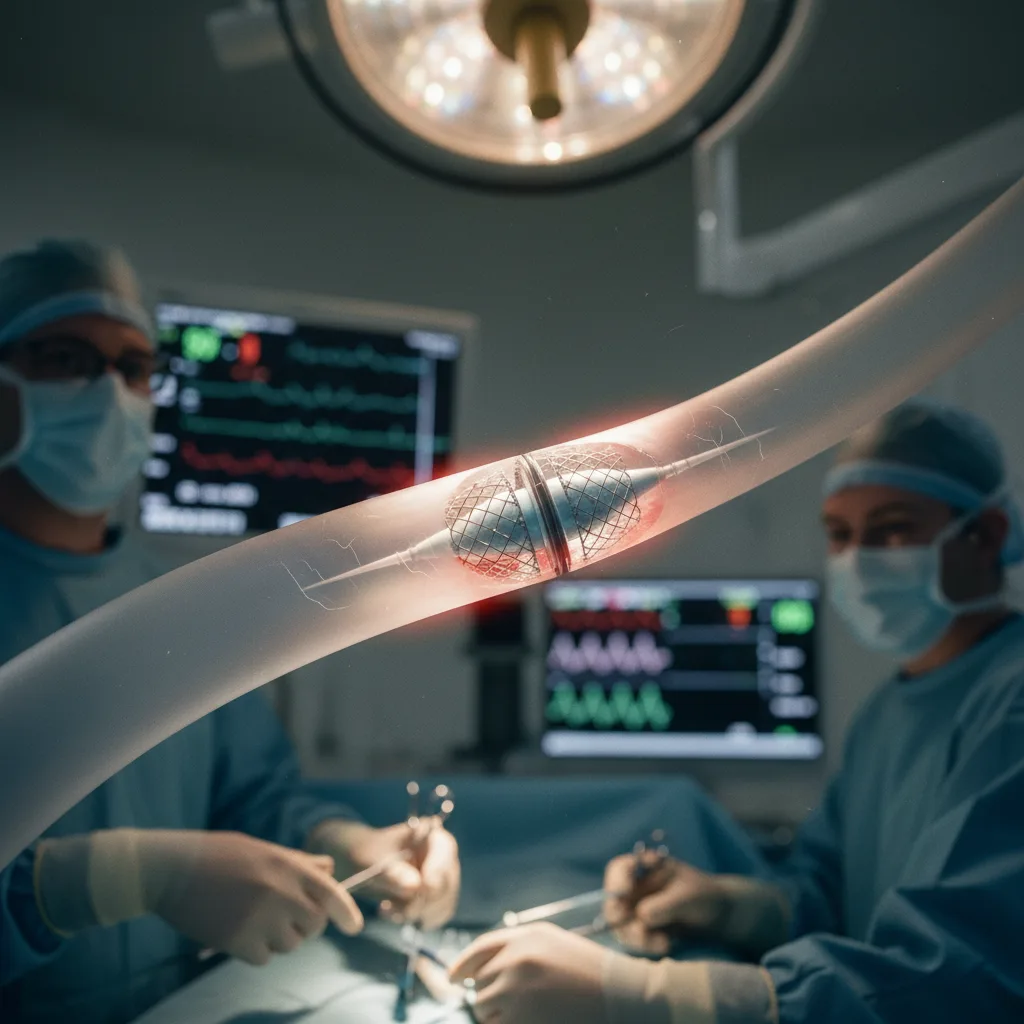

A rare but devastating complication, delayed aortic dissection after TAVI, raises concerns about valve type. A recent case report details a patient who developed a Stanford type A aortic dissection weeks after receiving a balloon-expandable valve.1 This raises questions about potential biomechanical risks associated with different valve designs.
A patient had a Stanford type A aortic dissection weeks after TAVI with a balloon-expandable valve. The case report details presentation, diagnosis, and surgical management. This raises questions about valve mechanics and rare complications. Delayed onset suggests insidious aortic injury. Subtle trauma could progress over time.
Deployment mechanism and radial force distinguish balloon-expandable and self-expanding valves. Balloon-expandable valves use forceful expansion against the aortic annulus. This might stress the aortic wall, especially in patients with existing aortic stenosis or other risk factors. Self-expanding valves expand gradually, possibly lessening acute stress.
But chronic outward force from self-expanding valves might also cause long-term aortic fatigue. Dissection could follow in susceptible patients. Is there a 'sweet spot' in valve design that minimizes both acute and chronic aortic stress? Computational modeling and long-term follow-up are needed.
ACC/AHA and ESC guidelines stress pre-procedural imaging. This helps assess aortic anatomy and identify high-risk TAVI patients. But these guidelines miss delayed aortic dissection risk. Device selection based on this risk also goes unaddressed. The case report points to refining risk stratification. Valve-specific risk assessments need a place in planning. Routine post-TAVI surveillance imaging for delayed complications isn't recommended. That needs re-evaluation, particularly for high-risk patients.
The single case report is an obvious caveat. Drawing definitive conclusions about a causal link between balloon-expandable valves and delayed aortic dissection from one patient is impossible. Details on the patient's pre-existing aortic condition are also missing. This makes it hard to pinpoint if prior disease played a role. Who funded this TAVI case? That remains unspecified. Without more cases and detailed imaging, any link between valve type and dissection risk stays speculative. Larger studies are needed.
Observational studies and randomized controlled trials must compare long-term outcomes of different valve types. These trials also need to identify potential risk factors for aortic dissection post-TAVI. A true prospective trial would be ideal, but hard to do given the rarity of the event. The patient population is just one individual. This inherently limits generalizability. Future research must use larger cohorts. Registries or multi-center studies could identify patterns across diverse patients. No control group exists here. This prevents comparing outcomes between different valve types or no TAVI at all. Isolating the specific impact of valve type on dissection risk remains a challenge.
Do we need to tailor device selection? Given biomechanical differences, perhaps. In patients with borderline aortic dimensions or known aortic disease, a self-expanding valve might be preferred. It could minimize acute aortic stress. Conversely, heavily calcified aortic valves might require a balloon-expandable valve. This would ensure adequate expansion and prevent paravalvular leak.
Individualized, patient-centered TAVI decisions are key. We must weigh immediate success against long-term complications. Intraoperative imaging, like transesophageal echocardiography (TEE) and fluoroscopy, also needs more study. It guides valve deployment and minimizes aortic trauma. Are we aggressive enough in our assessment?
Aortic dissection post-TAVI is likely multifactorial. Direct mechanical injury, pre-existing aortic wall pathology, and hemodynamic stress all play a part. Understanding these interactions is crucial for risk mitigation. Research into valve biomechanics and aortic wall characteristics could optimize devices and patient selection. The next trial must address whether individualized valve selection can reduce delayed aortic dissection.
Furthermore, the role of post-procedural hemodynamic changes cannot be overlooked. TAVI alters aortic flow dynamics, which could impose new stresses on a previously compromised aortic wall. This is particularly relevant in patients with pre-existing hypertension or other cardiovascular comorbidities. Long-term monitoring of blood pressure control and aortic remodeling post-TAVI may offer additional insights into risk mitigation strategies.
The development of advanced imaging techniques, such as 4D flow MRI, could provide a more comprehensive understanding of aortic hemodynamics after TAVI. Such tools could potentially identify subtle changes in shear stress or flow patterns that precede overt dissection, allowing for earlier intervention. Integrating these sophisticated imaging modalities into future research protocols would be invaluable.
Ultimately, while a single case report cannot establish causality, it serves as a critical signal for further investigation. The medical community must remain vigilant for rare but severe complications and continuously refine clinical practice based on emerging evidence, even from isolated cases.
Deeper insights into valvular heart disease and surgical considerations, including complex cases, are available in the comprehensive Oxford Handbook of Cardiology.
Delayed aortic dissection demands a closer look. A single case report raises alarms for balloon-expandable valve use. Clinicians must reconsider pre-procedural planning. Current guidelines are silent on device-specific dissection risk. That needs to change.
Pre-procedural imaging is paramount. It assesses aortic anatomy. But subtle injury might go undetected. Tailoring device selection based on individual aortic characteristics could mitigate risk. This isn't just about immediate success anymore.
Long-term surveillance post-TAVI warrants evaluation. Especially for high-risk patients. The insidious nature of aortic injury means follow-up can't stop at discharge. This complication, though rare, is devastating. Proactive monitoring is essential.
The lack of a robust evidence base remains a problem. Clinicians are left navigating uncertainties. Registries and multi-center studies are needed to inform better device selection. Patient safety depends on it.
lightbulb
- The PivotThe possibility of delayed aortic dissection post-TAVI, particularly with balloon-expandable valves, demands a re-evaluation of risk stratification and long-term surveillance protocols.
- The DataA single case report underscores the potential; further investigation is needed to quantify the actual risk difference between valve types.
- The ActionMaintain a high index of suspicion for aortic dissection in TAVI patients presenting with chest pain or unexplained symptoms, even weeks or months after the procedure.
ART-2025-10
·10/26
Drafted with AI assistance, reviewed and approved by the editorial team. This publication is intended for healthcare professionals, researchers, and life science industry professionals. Content is provided for informational and educational purposes only and does not constitute medical advice.

Digital health and patient experience are my beat: the apps, the wearables, the real-world evidence claims, and whether any of it changes outcomes. Sceptical by training and optimistic by instinct.
Cite This Article
Ward S, Voss M. TAVI and aortic dissection risk: is valve type a factor?. The Life Science Feed. Published December 1, 2025. Updated October 6, 2026. Accessed October 16, 2026. https://thelifesciencefeed.com/cardiology/aortic-valve-stenosis/research/tavi-and-aortic-dissection-risk-is-valve-type-a-factor.
Editorial & AI Standards
All content is researched from peer-reviewed, open-access sources: published trial data, clinical guidelines, and regulatory filings. AI tools are used solely to structure and summarise that evidence; no AI-generated conclusions appear without editor verification against the primary source.
Every article is reviewed by a named editor before publication. Source citations are listed in the References section. This content does not represent the views of any pharmaceutical company, medical device manufacturer, or healthcare provider.
Licence & Rights
© 2026 The Life Science Feed. All rights reserved. Unless otherwise indicated, all content is the property of The Life Science Feed and may not be reproduced, distributed, or transmitted in any form or by any means without prior written permission.
Medical Disclaimer
The information provided on The Life Science Feed is for educational and informational purposes only. It is not intended as a substitute for professional medical advice, diagnosis, or treatment. Always seek the advice of your physician or other qualified healthcare provider regarding any medical condition or treatment decision. Never disregard professional medical advice or delay in seeking it because of something you have read on this website.
References
- Erkut, B., et al. (2021). Delayed Aortic Dissection After Transcatheter Aortic Valve Implantation: A Systematic Review. Structural Heart, 5(6), 547-554.
- Otto, C. M., et al. (2020). 2020 ACC/AHA Guideline for the Management of Patients With Valvular Heart Disease: A Report of the American College of Cardiology/American Heart Association Joint Committee on Clinical Practice Guidelines. Journal of the American College of Cardiology, 77(4), e25-e197. doi:10.1161/cir.0000000000001190
- Vahanian, A., et al. (2021). 2021 ESC/EACTS Guidelines for the management of valvular heart disease. European Heart Journal, 43(7), 561-632. doi:10.1093/eurheartj/ehab626