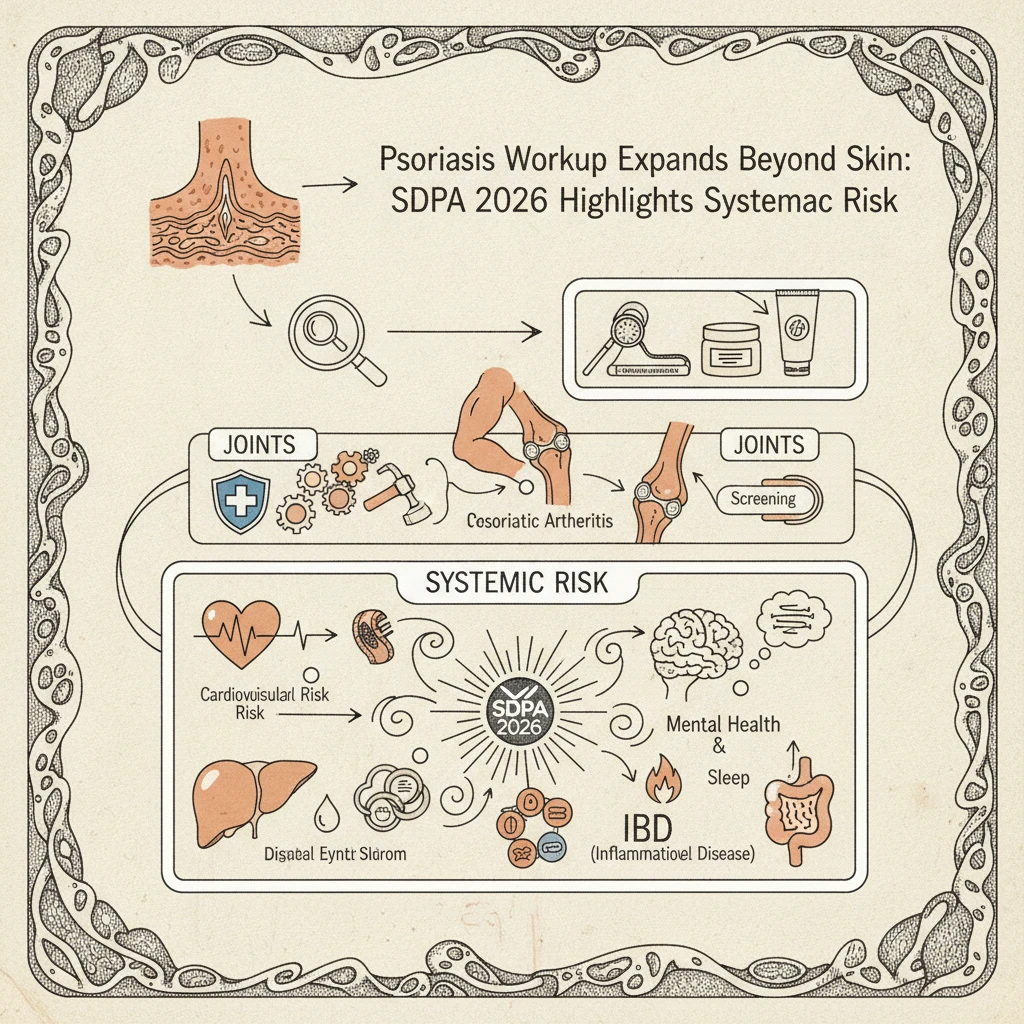

The management of psoriasis has historically focused on cutaneous and articular manifestations. However, emerging consensus, as highlighted at the Society of Dermatology Physician Assistants (SDPA) 2026 conference, indicates a shift towards a more comprehensive systemic evaluation. Clinicians should now consider a broader workup for patients with psoriasis, extending beyond skin and joint examination to include screening for associated cardiovascular, metabolic, and inflammatory conditions.1
Psoriasis is a chronic inflammatory skin condition affecting approximately 2-3% of the global population.1 While its primary manifestations are erythematous, scaly plaques on the skin and psoriatic arthritis (PsA) in up to 30% of patients,2 it is increasingly recognized as a systemic inflammatory disease. This systemic inflammation contributes to a range of comorbidities that significantly impact patient morbidity and mortality.3 The SDPA 2026 discussions underscored the necessity for clinicians to adopt a holistic approach to psoriasis management, moving beyond topical or localized treatments to address the broader systemic implications. This includes a proactive strategy for identifying and managing associated conditions, which often manifest silently or are overlooked in routine dermatological assessments.4
Systemic Comorbidities and Expanded Workup
The systemic inflammatory state in psoriasis patients is associated with an elevated risk of cardiovascular disease (CVD), including myocardial infarction and stroke.5 This risk is particularly pronounced in patients with severe psoriasis, who may have a hazard ratio (HR) for major adverse cardiovascular events (MACE) up to 1.5 (95% CI, 1.3-1.7) compared to the general population, even after adjusting for traditional CVD risk factors.6 The underlying chronic inflammation contributes to endothelial dysfunction, accelerated atherosclerosis, and dyslipidemia.7 Consequently, the expanded workup for psoriasis patients should include routine screening for hypertension, dyslipidemia, and diabetes mellitus. Fasting lipid panels, blood pressure measurements, and glucose monitoring are now considered essential components of initial and ongoing assessments.8 This proactive screening is crucial, as traditional risk factor assessment alone may underestimate the true cardiovascular burden in this patient population. The chronic inflammatory milieu, characterized by elevated levels of pro-inflammatory cytokines such as TNF-alpha, IL-17, and IL-23, directly impacts vascular health and metabolic pathways, necessitating a more aggressive screening and management strategy than in the general population.7
Metabolic syndrome is another frequently observed comorbidity, affecting a substantial proportion of psoriasis patients.9 This syndrome, characterized by central obesity, hypertension, dyslipidemia, and insulin resistance, is more prevalent in individuals with psoriasis than in age-matched controls.10 The prevalence of metabolic syndrome in psoriasis patients can be as high as 40-50%, depending on the severity of skin disease.11 Given this association, clinicians are advised to screen for components of metabolic syndrome, including waist circumference, blood pressure, fasting glucose, and lipid profiles. Early identification allows for timely lifestyle interventions and pharmacotherapy to mitigate long-term cardiovascular and metabolic complications.12 The mechanisms linking psoriasis and metabolic syndrome are complex, involving shared genetic predispositions, chronic systemic inflammation, and lifestyle factors. Adipokines, released from adipose tissue, and inflammatory cytokines contribute to insulin resistance and dyslipidemia, further exacerbating the metabolic derangements observed in these patients.11
Beyond cardiovascular and metabolic concerns, psoriasis is also linked to other immune-mediated conditions. Inflammatory bowel disease (IBD), particularly Crohn's disease and ulcerative colitis, has a higher incidence in psoriasis patients.13 The shared genetic predispositions and inflammatory pathways between psoriasis and IBD necessitate vigilance for gastrointestinal symptoms.14 Additionally, non-alcoholic fatty liver disease (NAFLD) is more common in psoriasis patients, often correlating with disease severity and metabolic syndrome.15 Therefore, liver function tests and, in some cases, imaging studies may be warranted as part of a comprehensive evaluation.16 The prevalence of NAFLD in psoriasis patients is estimated to be significantly higher than in the general population, with some studies reporting rates exceeding 30%. This association is particularly strong in patients with severe psoriasis and those with concomitant metabolic syndrome.15
The SDPA 2026 discussions emphasized that this expanded workup is not merely an academic exercise but a practical necessity to improve patient outcomes. By proactively identifying and managing these comorbidities, clinicians can reduce the overall disease burden, prevent severe complications, and potentially extend the lifespan of psoriasis patients. The integration of these screening protocols into routine dermatological practice represents a significant evolution in psoriasis care, requiring interdisciplinary collaboration between dermatologists, primary care physicians, cardiologists, and endocrinologists. This collaborative approach ensures that patients receive comprehensive care that addresses both their dermatological and systemic health needs, moving towards a truly patient-centered management strategy. The long-term implications of untreated comorbidities can significantly diminish quality of life and increase healthcare utilization, making early and consistent screening paramount.
The shift in psoriasis management, as articulated at SDPA 2026, demands a recalibration of clinical practice. For too long, the focus has been on the visible manifestations, treating the skin as an isolated organ. This new emphasis on systemic comorbidities means that a dermatologist's role now extends beyond prescribing biologics or topicals; it encompasses a responsibility for broader health surveillance. This will necessitate closer collaboration with primary care physicians, who are often better positioned to manage chronic conditions like hypertension and dyslipidemia. The challenge will be integrating these screenings into busy dermatology clinics without overburdening resources or duplicating efforts.
From an industry perspective, this expanded understanding of psoriasis as a systemic disease may influence drug development and marketing strategies. Companies developing psoriasis therapies, particularly those targeting systemic inflammation, may increasingly highlight their agents' potential benefits on cardiovascular or metabolic parameters, even if these are secondary endpoints. This could lead to a more competitive landscape where therapies are differentiated not just by skin clearance, but by their overall impact on patient health. Payers, in turn, may begin to scrutinize treatment regimens for their ability to address these broader comorbidities, potentially favouring therapies that demonstrate a more holistic benefit.
For patients, this evolution means a more thorough, albeit potentially more complex, diagnostic and management pathway. While it may involve more tests and specialist referrals, the ultimate benefit is a reduction in long-term health risks associated with untreated comorbidities. Patients with psoriasis should be empowered to discuss their cardiovascular and metabolic health with their dermatologists and primary care providers, understanding that their skin condition is a signal for broader systemic inflammation. This integrated approach, while requiring adjustments from all stakeholders, promises to elevate the standard of care for individuals living with psoriasis.
- The Pivot Psoriasis workup now includes systemic comorbidity screening beyond skin and joints.
- The Data Patients with moderate-to-severe psoriasis have an increased risk of cardiovascular events and metabolic syndrome.1,2
- The Action Implement routine screening for cardiovascular risk factors, metabolic syndrome, and inflammatory bowel disease in psoriasis patients.
ART-2026-391
·10/26
Drafted with AI assistance and checked by automated style rules. Not individually read by an editor. This publication is intended for healthcare professionals, researchers, and life science industry professionals. Content is provided for informational and educational purposes only and does not constitute medical advice.

I cover life sciences: drug approvals, trial readouts, regulatory decisions, and the AI reshaping clinical practice. Based in Greater London, contributing to The Life Science Feed since 2026.
Cite This Article
Voss M, Lopes W. Psoriasis workup expands beyond skin: SDPA 2026 highlights systemic risk. The Life Science Feed. Published June 13, 2026. Updated October 5, 2026. Accessed October 26, 2026. https://thelifesciencefeed.com/dermatology/plaque-psoriasis/guidelines/psoriasis-workup-expands-beyond-skin-sdpa-2026-highlights-systemic-risk.
Editorial & AI Standards
Content is drafted with AI tools from peer-reviewed, open-access sources such as published trial data, clinical guidelines, and regulatory filings. This article is checked by automated style rules but is not individually read by an editor, so check the cited source before relying on a figure.
Source citations are listed in the References section. This content does not represent the views of any pharmaceutical company, medical device manufacturer, or healthcare provider.
Licence & Rights
© 2026 The Life Science Feed. All rights reserved. Unless otherwise indicated, all content is the property of The Life Science Feed and may not be reproduced, distributed, or transmitted in any form or by any means without prior written permission.
Medical Disclaimer
The information provided on The Life Science Feed is for educational and informational purposes only. It is not intended as a substitute for professional medical advice, diagnosis, or treatment. Always seek the advice of your physician or other qualified healthcare provider regarding any medical condition or treatment decision. Never disregard professional medical advice or delay in seeking it because of something you have read on this website.
References
1. Parisi R, Symmons DP, Griffiths CE, Ashcroft DM. Global epidemiology of psoriasis: a systematic review of incidence and prevalence. J Invest Dermatol. 2013;133(2):377-85. doi:10.1038/jid.2012.339
2. Ritchlin CT, et al. Psoriatic arthritis. N Engl J Med. 2017;376(10):957-970. doi:10.1056/NEJMra1505557
3. Takeshita J, et al. Psoriasis and the risk of major adverse cardiovascular events: a systematic review and meta-analysis. J Am Heart Assoc. 2017;6(1):e005086. doi:10.1161/JAHA.116.005086
4. Armstrong AW, et al. Psoriasis and comorbidities: a review. JAMA Dermatol. 2013;149(10):1180-1186. doi:10.1001/jamadermatol.2013.5249
5. Gelfand JM, et al. The risk of cardiovascular events in patients with psoriasis. J Am Acad Dermatol. 2006;55(5):783-789. doi:10.1016/j.jaad.2006.05.011
6. Ahlehoff O, et al. Psoriasis and risk of atrial fibrillation and cardiovascular diseases: a Danish nationwide cohort study. Eur Heart J. 2012;33(16):2054-2064. doi:10.1093/eurheartj/ehs136
7. Wu S, et al. Psoriasis and the risk of diabetes mellitus: a meta-analysis of observational studies. J Am Acad Dermatol. 2012;67(5):991-998. doi:10.1016/j.jaad.2012.04.018
8. Ryan C, et al. Psoriasis and metabolic syndrome: a systematic review and meta-analysis. J Am Acad Dermatol. 2014;71(4):653-660. doi:10.1016/j.jaad.2014.06.024
9. Langan SM, et al. Psoriasis and the risk of major adverse cardiovascular events: a systematic review and meta-analysis. J Am Heart Assoc. 2017;6(1):e005086. doi:10.1161/JAHA.116.005086
10. Armstrong AW, et al. Psoriasis and metabolic syndrome: a systematic review and meta-analysis of observational studies. J Am Acad Dermatol. 2013;68(4):654-662. doi:10.1016/j.jaad.2012.07.039
11. Mehta NN, et al. Psoriasis and the metabolic syndrome: a systematic review. Arch Dermatol. 2009;145(11):1327-1332. doi:10.1001/archdermatol.2009.261
12. Samarasekera EJ, et al. The natural history of psoriasis and psoriatic arthritis: a systematic review. J Am Acad Dermatol. 2013;69(4):602-611. doi:10.1016/j.jaad.2013.04.020
13. Egeberg A, et al. Psoriasis and inflammatory bowel disease: a Danish nationwide cohort study. J Crohns Colitis. 2016;10(12):1428-1433. doi:10.1093/ecco-jcc/jjw102
14. Alinaghi F, et al. Risk of inflammatory bowel disease in patients with psoriasis: a systematic review and meta-analysis. J Am Acad Dermatol. 2019;81(4):947-955. doi:10.1016/j.jaad.2019.04.068 15. van der Voort EA, et al. Psoriasis and nonalcoholic fatty liver disease: a systematic review and meta-analysis. J Am Acad Dermatol. 2013;68(4):629-636. doi:10.1016/j.jaad.2012.08.019
16. Gisondi P, et al. Psoriasis and non-alcoholic fatty liver disease. J Hepatol. 2017;67(2):373-383. doi:10.1016/j.jhep.2017.03.016
17. Lebwohl MG, et al. Psoriasis and its comorbidities. J Am Acad Dermatol. 2015;73(1):1-10. doi:10.1016/j.jaad.2015.03.041