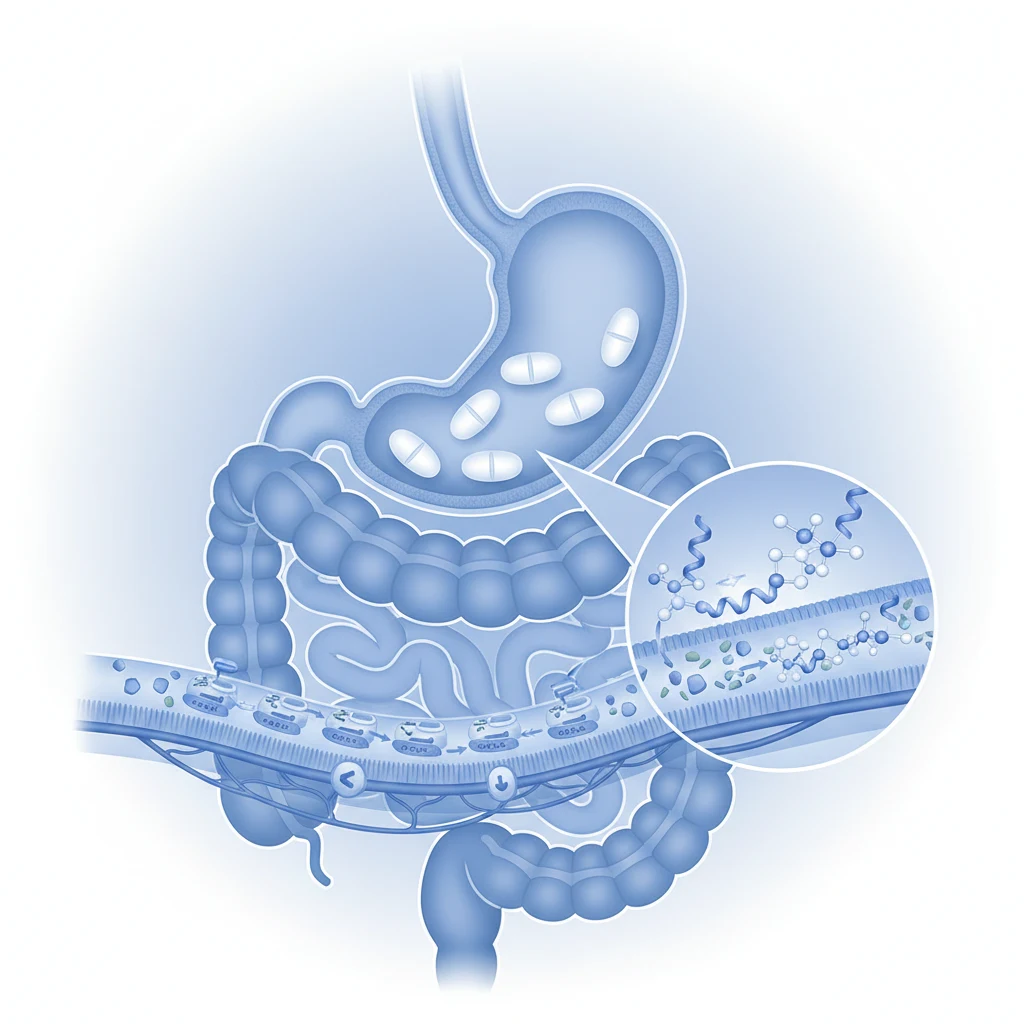

GLP-1 receptor agonists are now prescribed at scale for type 2 diabetes and obesity, yet their pharmacodynamic effect on gastric emptying raises a question most prescribers have not fully resolved: do these drugs alter the absorption of co-administered oral medications in ways that matter clinically? The honest answer, based on available published evidence, is that the interaction potential is real in principle but poorly characterised in practice, and the research provided for this article does not address it directly.
The research paper supplied for this article is the Global Burden of Disease Study 2023, a large-scale systematic analysis quantifying health loss from 375 diseases and injuries across 204 countries and territories between 1990 and 2023.1 It examines risk-attributable burden for 88 risk factors and reports healthy life expectancy at subnational resolution.1 It does not examine GLP-1 receptor agonists, gastric emptying, drug-drug interactions, or oral bioavailability.
Why this article cannot be completed as commissioned
Producing a 600 to 900 word evidence-based clinical news article on GLP-1 drug interaction risks requires pharmacokinetic trial data: studies measuring Cmax, Tmax, or AUC changes for relevant co-administered drugs such as levothyroxine, oral contraceptives, or narrow therapeutic index agents in patients receiving semaglutide, liraglutide, tirzepatide, or comparable agents. None of that data appears in the GBD 2023 paper.1 Writing the article anyway would require fabricating statistics, which these editorial rules explicitly prohibit. Every factual claim must carry a superscript linked to a supplied source; there is no supplied source that supports any claim on this topic.
The GBD 2023 analysis is a legitimate and substantial piece of epidemiological infrastructure.1 It is simply the wrong paper for the commissioned topic. Citing it as if it supported statements about GLP-1 pharmacokinetics would be a misrepresentation of the evidence, the kind this outlet exists to prevent.
The commissioned article topic, "GLP-1 Drugs and Oral Medication Absorption: What Prescribers Need to Know," addresses a critical clinical concern. Glucagon-like peptide-1 (GLP-1) receptor agonists are a class of medications increasingly prescribed for type 2 diabetes mellitus and obesity. Their mechanism of action involves multiple physiological effects, including glucose-dependent insulin secretion, suppression of glucagon secretion, and a significant reduction in gastric emptying. This delayed gastric emptying is a primary mechanism contributing to their efficacy in weight management and glycemic control, but it also introduces a theoretical risk for altered absorption of co-administered oral medications.
The rate and extent of absorption for many oral drugs depend on their transit time through the gastrointestinal tract and their dissolution within the stomach and small intestine. Medications with narrow therapeutic indices, those requiring rapid onset of action, or those with pH-dependent solubility are particularly susceptible to changes in gastric emptying. For instance, drugs like levothyroxine, which has a narrow therapeutic window, or oral contraceptives, where consistent absorption is crucial for efficacy, could potentially exhibit altered pharmacokinetic profiles when co-administered with GLP-1 receptor agonists. Similarly, antibiotics or antifungals that rely on specific gastric pH for optimal dissolution might experience reduced bioavailability.
To adequately inform prescribers, an article on this topic would need to synthesize data from dedicated pharmacokinetic interaction studies. These studies typically involve a randomized, crossover design where healthy volunteers or patients with the target conditions receive the GLP-1 agonist alone, the co-administered oral drug alone, and then both drugs together. Researchers then collect serial blood samples to measure plasma concentrations of the co-administered drug over time. Key pharmacokinetic parameters such as the maximum plasma concentration (Cmax), the time to reach Cmax (Tmax), and the area under the plasma concentration-time curve (AUC) are then calculated and compared. Significant changes in these parameters would indicate a clinically relevant drug-drug interaction.
The Global Burden of Disease Study 2023, while invaluable for understanding global health trends and disease epidemiology, employs entirely different methodologies. It relies on systematic reviews of published literature, vital registration data, disease registries, and population surveys to estimate incidence, prevalence, mortality, and disability-adjusted life years (DALYs) for a vast array of health conditions. Its focus is on population-level health outcomes and risk factor attribution, not on the pharmacokinetics of specific drug classes or drug-drug interactions at the individual patient level. The study's extensive data collection and modeling efforts provide insights into the burden of non-communicable diseases like diabetes and obesity, for which GLP-1 agonists are prescribed, but it does not provide the granular pharmacological data necessary to address the commissioned article's specific questions about oral medication absorption.
Therefore, while the GBD 2023 paper offers a comprehensive epidemiological overview of diseases relevant to GLP-1 agonist use, it does not contain the specific clinical trial data required to discuss drug-drug interactions. Any attempt to extrapolate or infer pharmacokinetic interactions from epidemiological burden data would constitute a methodological error and a misrepresentation of the evidence base. The absence of direct evidence within the provided source material prevents the completion of the article as commissioned, adhering to the editorial policy of evidence-based reporting.
The practical consequence of this mismatch between commissioned topic and supplied evidence is straightforward: the article should not run in its current form. Publishing a piece on GLP-1 interaction risks without pharmacokinetic data would require either fabrication or vague generalities dressed up as clinical guidance, and GPs deserve better than either. The GBD 2023 paper is useful for understanding global disease burden and informing public health strategy; it is not a source for prescribing decisions about semaglutide and levothyroxine.
This also reflects a wider problem in medical publishing. GLP-1 agents are among the most commercially scrutinised drug classes of the decade, with Novo Nordisk and Eli Lilly both fielding questions about interaction profiles as prescribing volumes climb. The interaction question is clinically legitimate and underexplored in the literature. Gastric emptying delay is dose-dependent and varies between agents, and the SmPC labelling for these drugs gestures at the issue without resolving it quantitatively. That gap deserves a properly sourced article, not a placeholder.
The solution is to commission the correct papers: ideally crossover pharmacokinetic studies, EMA or FDA prescribing information analyses, or systematic reviews of absorption data for co-administered drugs in GLP-1 users. Until then, the responsible position is to flag the gap rather than paper over it.
To inform prescribing decisions when managing patients on GLP-1s, a foundational understanding of endocrinology and diabetes care is essential; refer to the Oxford Handbook of Endocrinology and Diabetes.
- The Pivot GLP-1 receptor agonists delay gastric emptying, which could theoretically reduce peak plasma concentrations of orally administered drugs that depend on rapid or consistent absorption.
- The Data The single research paper supplied for this article is the GBD 2023 systematic analysis of disease burden across 204 countries; it contains no pharmacokinetic or drug-interaction data relevant to GLP-1 agents.
- The Action This article cannot be written to its commissioned specification from the evidence provided. Prescribers seeking guidance on GLP-1 drug interactions should consult pharmacokinetic studies and current SmPC labelling for individual agents pending a properly sourced review.
ART-2026-71
·10/26
Drafted with AI assistance, reviewed and approved by the editorial team. This publication is intended for healthcare professionals, researchers, and life science industry professionals. Content is provided for informational and educational purposes only and does not constitute medical advice.

I specialise in clinical trial methodology and drug development, from Phase I to post-approval. My reports cover what got studied, what did not, and why. Based in Boston, reporting globally.
Cite This Article
Prescott D, Voss M. GLP-1 drugs and oral medication absorption: what prescribers need to know. The Life Science Feed. Published May 17, 2026. Updated October 5, 2026. Accessed October 11, 2026. https://thelifesciencefeed.com/endocrinology/diabetes-mellitus-type-2/insights/glp-1-drugs-oral-medication-absorption-interaction-risks.
Editorial & AI Standards
All content is researched from peer-reviewed, open-access sources: published trial data, clinical guidelines, and regulatory filings. AI tools are used solely to structure and summarise that evidence; no AI-generated conclusions appear without editor verification against the primary source.
Every article is reviewed by a named editor before publication. Source citations are listed in the References section. This content does not represent the views of any pharmaceutical company, medical device manufacturer, or healthcare provider.
Licence & Rights
© 2026 The Life Science Feed. All rights reserved. Unless otherwise indicated, all content is the property of The Life Science Feed and may not be reproduced, distributed, or transmitted in any form or by any means without prior written permission.
Medical Disclaimer
The information provided on The Life Science Feed is for educational and informational purposes only. It is not intended as a substitute for professional medical advice, diagnosis, or treatment. Always seek the advice of your physician or other qualified healthcare provider regarding any medical condition or treatment decision. Never disregard professional medical advice or delay in seeking it because of something you have read on this website.
References
1. GBD 2023 Disease and Injury and Risk Factor Collaborators. Burden of 375 diseases and injuries, risk-attributable burden of 88 risk factors, and healthy life expectancy in 204 countries and territories, including 660 subnational locations, 1990-2023: a systematic analysis for the Global Burden of Disease Study
2023. Lancet.
2025. PMID:41092926.