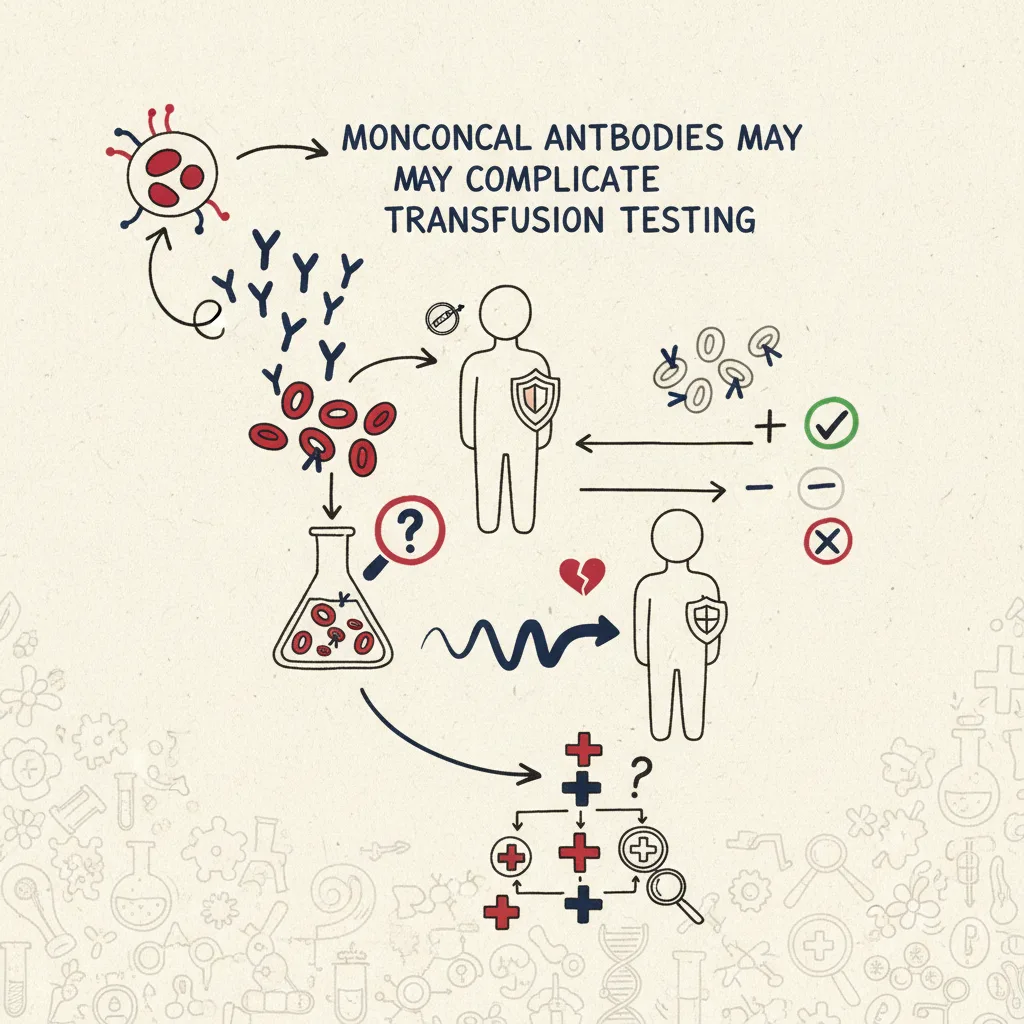

The increasing use of monoclonal antibody therapies presents a growing challenge for transfusion medicine. Specifically, certain IgG4 monoclonal antibodies have been observed to interfere with standard pre-transfusion compatibility testing, potentially leading to delays or misinterpretations. Clinicians should be aware of the potential for these therapies to complicate blood product provision.
Monoclonal antibodies are increasingly employed in various therapeutic areas, including oncology and immunology. While effective in targeting specific disease pathways, these agents can interact with laboratory assays, creating diagnostic complexities. One such interaction involves certain IgG4 monoclonal antibodies and their potential impact on transfusion testing.2
Transfusion Complications with IgG4 Anti-CD47
A case report described a patient receiving an IgG4 anti-CD47 monoclonal antibody, which led to erythrophagocytosis.2 Erythrophagocytosis, the engulfment of red blood cells by phagocytes, can be a significant issue in transfusion medicine as it may mimic or mask underlying immune haemolysis or complicate cross-matching procedures. The presence of such antibodies can interfere with standard serological tests used to identify red blood cell antibodies and ensure compatible blood for transfusion.2
The specific mechanism involves the IgG4 anti-CD47 antibody binding to red blood cells, which can then be recognised and phagocytosed by macrophages. This interaction can lead to false positives or indeterminate results in direct antiglobulin tests (DAT) and antibody screens, making it difficult to accurately assess a patient's transfusion needs.2 The challenge is further compounded by the fact that IgG4 antibodies do not typically activate complement pathways as efficiently as other IgG subclasses, which can alter the expected serological reactions.2
The clinical implications of such interference include potential delays in providing urgently needed blood products, increased resource utilisation for extensive serological workups, and the risk of transfusing incompatible blood if the interference is not correctly identified and managed.2 Accurate identification of red blood cell antibodies is paramount for preventing transfusion reactions, and any therapy that obscures these results requires careful consideration.2
Another case report, while not directly related to transfusion complications, highlighted the diagnostic challenges in patients with complex immunological conditions. An individual in their early 50s presented with idiopathic multicentric Castleman disease (iMCD) with features suggestive of IgG4-related disease (IgG4-RD), including recurrent pancreatitis, retroperitoneal fibrosis, and lymphadenopathy.1 Despite clinical findings, IgG4 levels were within the normal range, and histopathological examination ultimately confirmed iMCD, showing characteristic vascular hyperplasia and polyclonal plasma cell infiltrate without IgG4+ plasma cells.1 The patient improved with siltuximab, an interleukin-6 inhibitor.1 This case underscores the importance of combining clinical, serological, and histopathological analyses for definitive diagnosis, a principle equally relevant when monoclonal antibodies complicate laboratory findings in transfusion medicine.1
The potential for monoclonal antibodies to interfere with laboratory testing is not limited to transfusion services. For instance, a case of necrotising fasciitis in chronic lymphocytic leukaemia presented diagnostic and management challenges.3 While distinct from transfusion complications, it illustrates the broader theme of complex patient presentations where underlying conditions and treatments can obscure or complicate standard diagnostic pathways.3
The emergence of IgG4 anti-CD47 monoclonal antibodies as a cause of erythrophagocytosis and transfusion testing interference presents a clear directive for clinical practice. Transfusion services must adapt their protocols to account for these therapies, potentially requiring more specialised techniques or extended workups to ensure patient safety. This is not merely an academic exercise; delayed or misidentified compatibility can have direct, adverse consequences for patients requiring urgent transfusions.
For prescribing clinicians, particularly oncologists and immunologists, it becomes imperative to communicate a patient's monoclonal antibody therapy status to the transfusion laboratory proactively. This information is no longer ancillary but essential for accurate pre-transfusion assessment. The burden of proof, in a sense, shifts to the prescribing physician to inform the laboratory of potential interferences, rather than the laboratory having to deduce the cause of an atypical reaction.
The industry, in turn, should consider the broader implications for drug development. As more monoclonal antibodies enter the market, particularly those targeting cell surface proteins, the potential for off-target or unintended interactions with diagnostic assays will likely increase. This necessitates early consideration of these interactions during preclinical and clinical development, perhaps even incorporating specific transfusion compatibility assessments into later-phase trials. The goal is not to impede innovation but to ensure that novel therapies do not inadvertently compromise fundamental aspects of patient care, such as safe blood transfusion.
- The Pivot Monoclonal antibodies, particularly IgG4 anti-CD47, can induce erythrophagocytosis, complicating pre-transfusion testing.
- The Data IgG4 anti-CD47 was observed to cause erythrophagocytosis in a reported case.2
- The Action Clinicians should consider monoclonal antibody therapy in patients presenting with transfusion compatibility issues and communicate this information to transfusion services.
ART-2026-436
06/26
Cite This Article
Team TLSFE. Monoclonal antibodies may complicate transfusion testing. The Life Science Feed. Updated June 19, 2026. Accessed June 19, 2026. https://thelifesciencefeed.com/haematology/immune-thrombocytopenia/news/monoclonal-antibodies-may-complicate-transfusion-testing.
Editorial & AI Standards
All content is researched from peer-reviewed, open-access sources — published trial data, clinical guidelines, and regulatory filings. AI tools are used solely to structure and summarise that evidence; no AI-generated conclusions appear without editor verification against the primary source.
Every article is reviewed by a named editor before publication. Source citations are listed in the References section. This content does not represent the views of any pharmaceutical company, medical device manufacturer, or healthcare provider.
Licence & Rights
© 2026 The Life Science Feed. All rights reserved. Unless otherwise indicated, all content is the property of The Life Science Feed and may not be reproduced, distributed, or transmitted in any form or by any means without prior written permission.
Medical Disclaimer
The information provided on The Life Science Feed is for educational and informational purposes only. It is not intended as a substitute for professional medical advice, diagnosis, or treatment. Always seek the advice of your physician or other qualified healthcare provider regarding any medical condition or treatment decision. Never disregard professional medical advice or delay in seeking it because of something you have read on this website.
References
1. Sastre Ortega J, Martinez-Caballero C, Rueda Herrera M. Idiopathic multicentric Castleman disease in a patient with an IgG4-related disease phenotype. BMJ Case Rep 2026.
2. Boligan KF, Loriamini M, Holton MB. IgG4 anti-CD47: Erythrophagocytosis and potential transfusion complications. Transfusion 2026.
3. Tan ACW, Han EY, Harriz Abd Wahab E. Necrotising fasciitis in chronic lymphocytic leukaemia: a diagnostic challenge, management and learning points. BMJ Case Rep 2026.


