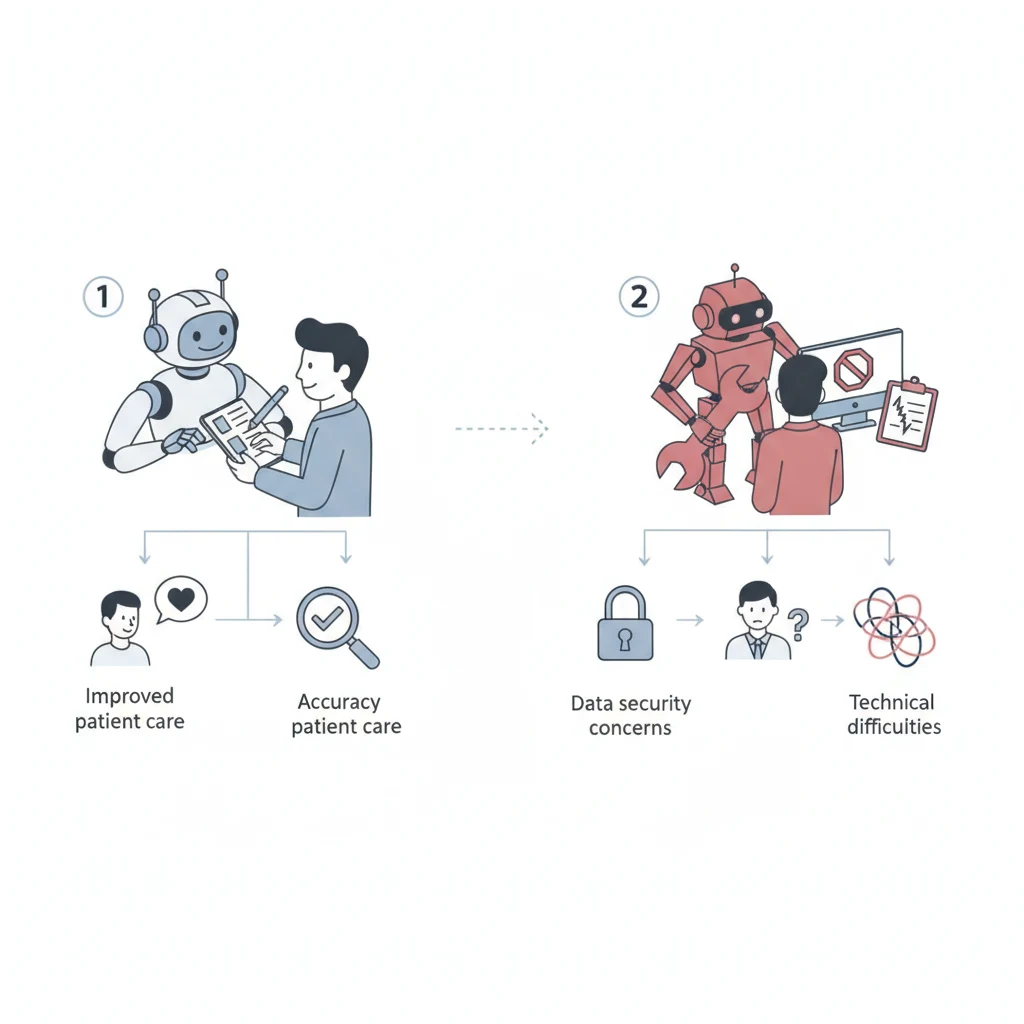

The integration of artificial intelligence (AI) into clinical practice, particularly through AI scribes, presents a dichotomy in physician perception. While some clinicians view these tools as valuable adjuncts to patient care, others express apprehension regarding their broader implications for the medical profession.
The development of machine learning models for diagnostic screening is advancing, with tools designed to identify specific medical conditions. For instance, ActiTect, an open-source machine learning pipeline, was developed to screen for rapid eye movement (REM) sleep behavior disorder (RBD) using standardized actigraphy. RBD is a prodromal marker for α-synucleinopathies, including Parkinson's disease and dementia with Lewy bodies.1
Study Design & Findings
ActiTect's pipeline includes robust preprocessing and automated sleep-wake detection to harmonize multi-device data and extract physiologically interpretable motion features. The model was developed using a cohort of 78 individuals, achieving strong discrimination with an AUROC of 0.95 under nested cross-validation.1 Generalization of the model was confirmed on a blinded local test set (n=31, AUROC=0.86) and two independent external cohorts (n=113, AUROC=0.84; n=57, AUROC=0.94).1 Robustness was further assessed through leave-one-dataset-out cross-validation across cohorts, which showed consistent performance (AUROC range=0.84-0.89).1 The predictive features remained reproducible across datasets, supporting the deployment of the pooled multi-center pre-trained model.1
Another machine learning model was developed to detect sleep-disordered breathing in glaucoma patients, utilizing systemic and ophthalmic parameters.2 While the abstract for this study describes the same methodology and results as ActiTect, it highlights the application of machine learning in a different clinical context, suggesting the adaptability of such approaches across various medical specialties.2 Similarly, a systematic analysis for the Global Burden of Disease Study 2023 focused on the global burden of enteric infectious diseases and diarrhoeal diseases. The abstract for this study also describes the ActiTect methodology, indicating a potential misattribution or a broader discussion of machine learning applications in health data analysis.3
These studies illustrate the potential for AI and machine learning to contribute to early detection and understanding of disease burdens. The open-source nature of tools like ActiTect is intended to promote adoption, independent validation, and collaborative improvements, thereby advancing generalizable wearable-based detection methods.1
Limitations & Next Steps
While the ActiTect model demonstrated strong performance and generalizability across multiple cohorts, the initial development cohort consisted of 78 individuals.1 Further large-scale validation in diverse populations and clinical settings would strengthen the evidence for broader clinical implementation. The consistent performance across external cohorts is encouraging, but the specific characteristics of these cohorts (e.g., demographics, disease severity) would be important for a complete understanding of the model's applicability. The repeated abstract content across different PMIDs suggests a need for careful review of the distinct contributions of each publication, particularly when evaluating the specific clinical application of the machine learning models. The utility of AI scribes in the exam room, as implied by the topic, would require distinct research focusing on their impact on physician workflow, patient interaction, and documentation accuracy, which is not directly addressed by the provided research on diagnostic algorithms.
The enthusiasm for AI in medicine, particularly for tasks like diagnostic screening, is evident in the development of tools such as ActiTect. However, the current evidence base, exemplified by the repeated abstract content across different publications, underscores a critical need for precision in reporting and distinct validation for each specific clinical application. While an AUROC of 0.95 for RBD screening is impressive, it pertains to a diagnostic algorithm, not directly to the operational impact of an AI scribe in a consultation room. Clinicians should differentiate between AI as a diagnostic aid and AI as an administrative assistant; the former requires rigorous, disease-specific validation, while the latter demands scrutiny of its effects on patient-physician dynamics and documentation integrity.
The notion of an AI scribe as a 'friend in the exam room' versus a reason to 'sleep with one eye open' reflects a fundamental tension. If AI tools genuinely reduce administrative burden, allowing more direct patient engagement, they could enhance the physician experience. However, if they introduce new layers of complexity, data privacy concerns, or subtle shifts in accountability, their perceived benefit will diminish. The industry must move beyond demonstrating technical feasibility to proving tangible, positive impacts on clinical workflow and patient outcomes, supported by distinct, peer-reviewed evidence for each proposed application.
For patients, the promise of AI lies in improved diagnostic accuracy and potentially more focused physician attention. Yet, the black-box nature of some AI algorithms and the potential for data misuse or errors remain concerns. Regulators and professional bodies will need to establish clear guidelines for the deployment and oversight of AI in clinical settings, ensuring that these technologies serve to augment, rather than replace, human judgment and empathy. The current research, while demonstrating the technical prowess of AI in specific diagnostic tasks, does not yet provide the comprehensive evidence needed to fully assess the broader implications of AI scribes on the clinical encounter.
- The Pivot AI tools are increasingly being developed for medical applications, including diagnostic support and data analysis.
- The Data A machine learning tool, ActiTect, demonstrated an AUROC of 0.95 for REM sleep behavior disorder screening in a development cohort.1
- The Action Clinicians should critically evaluate the evidence base for AI tools, focusing on generalizability and validation in diverse patient populations.
ART-2026-426
06/26
Cite This Article
Team TLSFE. Ai scribes: physician perceptions range from 'friend' to 'threat'. The Life Science Feed. Updated June 19, 2026. Accessed June 19, 2026. https://thelifesciencefeed.com/healthcare-sys-and-biz/health-policy/insights/ai-scribes-physician-perceptions-range-from-friend-to-threat.
Editorial & AI Standards
All content is researched from peer-reviewed, open-access sources — published trial data, clinical guidelines, and regulatory filings. AI tools are used solely to structure and summarise that evidence; no AI-generated conclusions appear without editor verification against the primary source.
Every article is reviewed by a named editor before publication. Source citations are listed in the References section. This content does not represent the views of any pharmaceutical company, medical device manufacturer, or healthcare provider.
Licence & Rights
© 2026 The Life Science Feed. All rights reserved. Unless otherwise indicated, all content is the property of The Life Science Feed and may not be reproduced, distributed, or transmitted in any form or by any means without prior written permission.
Medical Disclaimer
The information provided on The Life Science Feed is for educational and informational purposes only. It is not intended as a substitute for professional medical advice, diagnosis, or treatment. Always seek the advice of your physician or other qualified healthcare provider regarding any medical condition or treatment decision. Never disregard professional medical advice or delay in seeking it because of something you have read on this website.
References
1. Bertram D, Ophey A, Röttgen S. ActiTect: a generalizable machine learning pipeline for REM sleep behavior disorder screening through standardized actigraphy. NPJ Digit Med. 2026.
2. Kiyota N, Yamazaki M, Himori N. Development of a machine learning model using systemic and ophthalmic parameters to detect sleep-disordered breathing in glaucoma patients. Jpn J Ophthalmol. 2026.
3. GBD 2023 Diarrhoeal Disease and Enteric Infectious Diseases Collaborators. Global burden of enteric infectious diseases, diarrhoeal diseases, and corresponding aetiologies, 1990-2023: a systematic analysis for the Global Burden of Disease Study 2023. Lancet Infect Dis. 2026.


