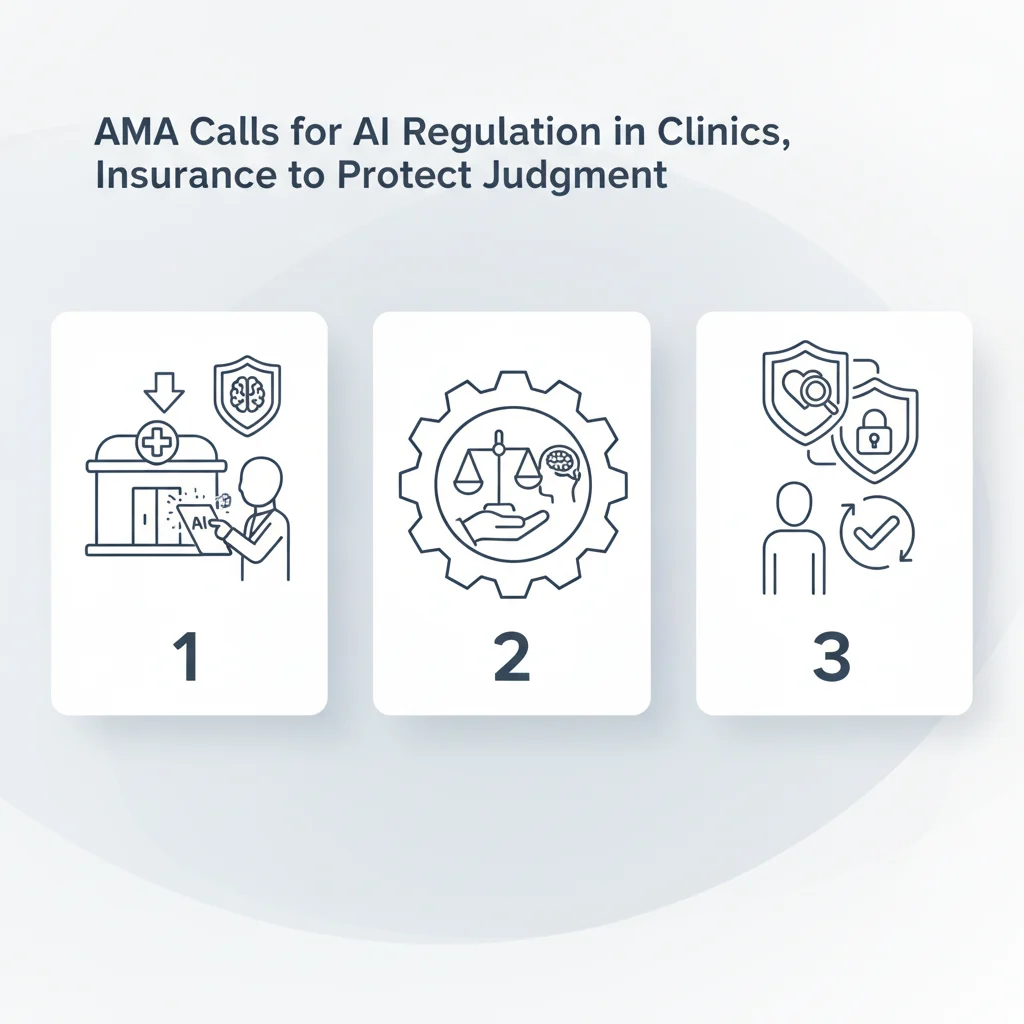

The integration of artificial intelligence (AI) into clinical practice and insurance processes presents both opportunities and challenges for patient care. The American Medical Association (AMA) has issued a call for regulatory frameworks to ensure AI systems support, rather than supersede, the diagnostic and therapeutic decisions of physicians.
The increasing deployment of artificial intelligence (AI) technologies across healthcare, from diagnostic support to administrative tasks and insurance authorisation, necessitates a structured approach to its governance. The American Medical Association (AMA) has articulated a position advocating for comprehensive regulation of AI in clinical and insurance contexts. This stance underscores the principle that AI should function as an assistive tool, enhancing physician capabilities without diminishing the physician's ultimate responsibility for patient care. The AMA's position highlights several critical areas requiring regulatory attention: data privacy, algorithmic bias, transparency, and accountability.
Concerns regarding data privacy are paramount, given the extensive patient data required to train and operate AI systems. Regulatory frameworks must ensure robust protection of sensitive health information, adhering to existing privacy laws while addressing new vulnerabilities introduced by AI. Algorithmic bias represents another significant challenge. AI models, trained on historical datasets, can perpetuate or even amplify existing health disparities if not carefully designed and monitored. This risk is particularly pronounced in populations that have been historically underrepresented in medical research, potentially leading to inequitable access to care or biased diagnostic outcomes. The AMA stresses that AI systems must be rigorously tested for bias before deployment and continuously monitored thereafter. For instance, an AI trained predominantly on data from one demographic group might perform poorly when applied to patients from different ethnic or socioeconomic backgrounds, leading to misdiagnoses or delayed treatment. This underscores the need for diverse and representative training datasets, alongside robust validation processes across varied patient populations to ensure generalizability and fairness.
Regulatory Principles for AI Integration
The AMA's call for regulation extends to ensuring transparency in how AI systems operate. Clinicians and patients must understand the basis for AI-generated recommendations or decisions. This includes clarity on the data used for training, the algorithms employed, and the limitations of the AI's capabilities. Without such transparency, trust in AI technologies may be eroded, hindering their effective adoption. Furthermore, accountability for AI-driven outcomes is a central tenet of the AMA's position. When an AI system contributes to a diagnostic error or an adverse patient event, a clear chain of responsibility must be established. This involves defining the roles of AI developers, healthcare institutions, and individual clinicians in ensuring patient safety. The complexity of AI models, particularly "black box" algorithms, often obscures the precise mechanism by which a recommendation is generated. This lack of interpretability poses a significant challenge to establishing accountability, as it becomes difficult to ascertain whether an error stems from faulty data, an flawed algorithm, or inappropriate clinical application. Therefore, regulatory efforts must encourage the development and adoption of interpretable AI models, or at minimum, require detailed documentation of model architecture, training methodologies, and performance metrics.
In the realm of insurance, AI is increasingly used for prior authorisation, claims processing, and risk assessment. The AMA argues that AI algorithms in these areas must not create new barriers to care or unfairly deny coverage. Regulations should mandate that AI-driven insurance decisions are subject to human review and appeal, preserving the physician's ability to advocate for their patients' needs. The AMA's framework also addresses the need for ongoing education for clinicians regarding AI technologies. Understanding the capabilities and limitations of AI is essential for its safe and effective integration into practice. This includes training on how to interpret AI outputs, identify potential errors, and integrate AI insights into a broader clinical context. The potential for AI to exacerbate existing health inequities in insurance decisions is particularly concerning, as algorithms might inadvertently penalize individuals based on proxies for socioeconomic status or pre-existing conditions, leading to discriminatory outcomes. Therefore, regulatory oversight must specifically address the potential for AI to create or amplify disparities in access to care and financial burden.
The AMA's recommendations do not advocate for a moratorium on AI development, but rather for a measured and responsible approach to its implementation. The goal is to harness the potential benefits of AI, such as improved efficiency and enhanced diagnostic accuracy, while mitigating the risks to patient safety and equitable care. The emphasis remains on the irreplaceable role of physician judgment, experience, and empathy in the delivery of healthcare. AI is positioned as a tool to support, not supplant, this fundamental human element of medicine. The limitations of current AI technologies, such as their inability to understand nuanced human emotions, contextualize complex social determinants of health, or engage in ethical reasoning, reinforce the necessity of physician oversight. While AI can process vast amounts of data and identify patterns beyond human capacity, it lacks the holistic understanding and adaptive reasoning crucial for comprehensive patient care.
The AMA's stance on AI regulation is a necessary intervention in a rapidly evolving technological landscape. The notion that AI can simply be dropped into clinics and insurance companies without explicit guardrails is naive. Clinicians are already grappling with the administrative burden of prior authorisations; adding an opaque AI layer to this process, one that could deny necessary care based on algorithms clinicians cannot interrogate, is a recipe for patient harm and physician burnout. The industry developing these AI tools must recognise that the 'move fast and break things' ethos has no place in healthcare. Patient safety and equitable access to care are non-negotiable.
For patients, the implications are profound. An AI system trained on biased data, for instance, could systematically misdiagnose or undertreat specific demographic groups. This is not a hypothetical concern; it is a documented risk with existing algorithms. Without robust regulatory oversight, patients may find themselves fighting not just a complex healthcare system, but an unyielding algorithm that lacks the capacity for nuance or individual context. The AMA's call for transparency and accountability is therefore critical; patients deserve to know when AI is influencing their care and to have recourse when it fails.
The challenge for regulatory bodies, such as the FDA and state medical boards, will be to develop frameworks that are agile enough to keep pace with technological advancements, yet stringent enough to protect public health. This requires a collaborative effort involving medical professionals, ethicists, AI developers, and policymakers. Simply allowing market forces to dictate AI adoption in healthcare is an abdication of responsibility. The AMA's position serves as a timely reminder that technology must serve medicine, not the other way around, and that the physician-patient relationship remains the bedrock of quality care.
- The Pivot The AMA advocates for specific regulatory oversight of AI in healthcare, moving beyond general ethical guidelines.
- The Data No specific quantitative data from a trial is available for this policy position; the emphasis is on qualitative principles for safe AI integration.
- The Action Clinicians should remain the primary decision-makers, utilising AI as a tool for data analysis and administrative support, while advocating for transparent AI implementation.
ART-2026-482
·08/26
Drafted with AI assistance, reviewed and approved by the editorial team. This publication is intended for healthcare professionals, researchers, and life science industry professionals. Content is provided for informational and educational purposes only and does not constitute medical advice.

Infectious disease, epidemiology, and global health equity. I have covered outbreaks from Ebola to COVID-19 to mpox. The stories I am most drawn to are where the science is clear and the response is slow.
Cite This Article
Reeves T, Voss M. AMA calls for AI regulation in clinics, insurance to protect judgment. The Life Science Feed. Published June 19, 2026. Updated August 8, 2026. Accessed September 18, 2026. https://thelifesciencefeed.com/healthcare-sys-and-biz/health-policy/policy/ama-calls-for-ai-regulation-in-clinics-insurance-to-protect-judgment.
Editorial & AI Standards
All content is researched from peer-reviewed, open-access sources: published trial data, clinical guidelines, and regulatory filings. AI tools are used solely to structure and summarise that evidence; no AI-generated conclusions appear without editor verification against the primary source.
Every article is reviewed by a named editor before publication. Source citations are listed in the References section. This content does not represent the views of any pharmaceutical company, medical device manufacturer, or healthcare provider.
Licence & Rights
© 2026 The Life Science Feed. All rights reserved. Unless otherwise indicated, all content is the property of The Life Science Feed and may not be reproduced, distributed, or transmitted in any form or by any means without prior written permission.
Medical Disclaimer
The information provided on The Life Science Feed is for educational and informational purposes only. It is not intended as a substitute for professional medical advice, diagnosis, or treatment. Always seek the advice of your physician or other qualified healthcare provider regarding any medical condition or treatment decision. Never disregard professional medical advice or delay in seeking it because of something you have read on this website.
References
1. Hussain SA, et al. The bias algorithm: how AI in healthcare exacerbates ethnic and racial disparities - a scoping review. Ethn Health. 2025;30(2):197-214. doi:10.1080/13557858.2024.2422848
2. Cross JL, et al. Bias in medical AI: Implications for clinical decision-making. PLOS Digit Health. 2024;3(11):e0000651. doi:10.1371/journal.pdig.0000651
3. Jeyaraman M, et al. Unraveling the Ethical Enigma: Artificial Intelligence in Healthcare. Cureus. 2023;15(8):e43262. doi:10.7759/cureus.43262
4. Fahim YA, et al. Artificial intelligence in healthcare and medicine: clinical applications, therapeutic advances, and future perspectives. Eur J Med Res. 2025;30(1):848. doi:10.1186/s40001-025-03196-w
5. Tana C, et al. Smart aging: integrating AI into elderly healthcare. BMC Geriatr. 2025;25(1):1024. doi:10.1186/s12877-025-06723-w
6. McManus KA, et al. Geographic Variation in Qualified Health Plan Coverage and Prior Authorization Requirements for HIV Preexposure Prophylaxis. JAMA Netw Open. 2023;6(11):e2342781. doi:10.1001/jamanetworkopen.2023.42781
7. McManus KA, et al. Regional Disparities in Qualified Health Plans' Prior Authorization Requirements for HIV Pre-exposure Prophylaxis in the United States. JAMA Netw Open. 2020;3(6):e207445. doi:10.1001/jamanetworkopen.2020.7445
8. Hartung DM, et al. Effects of a prior-authorization policy for celecoxib on medical service and prescription drug use in a managed care Medicaid population. Clin Ther. 2004;26(9):1518-32. doi:10.1016/j.clinthera.2004.09.013