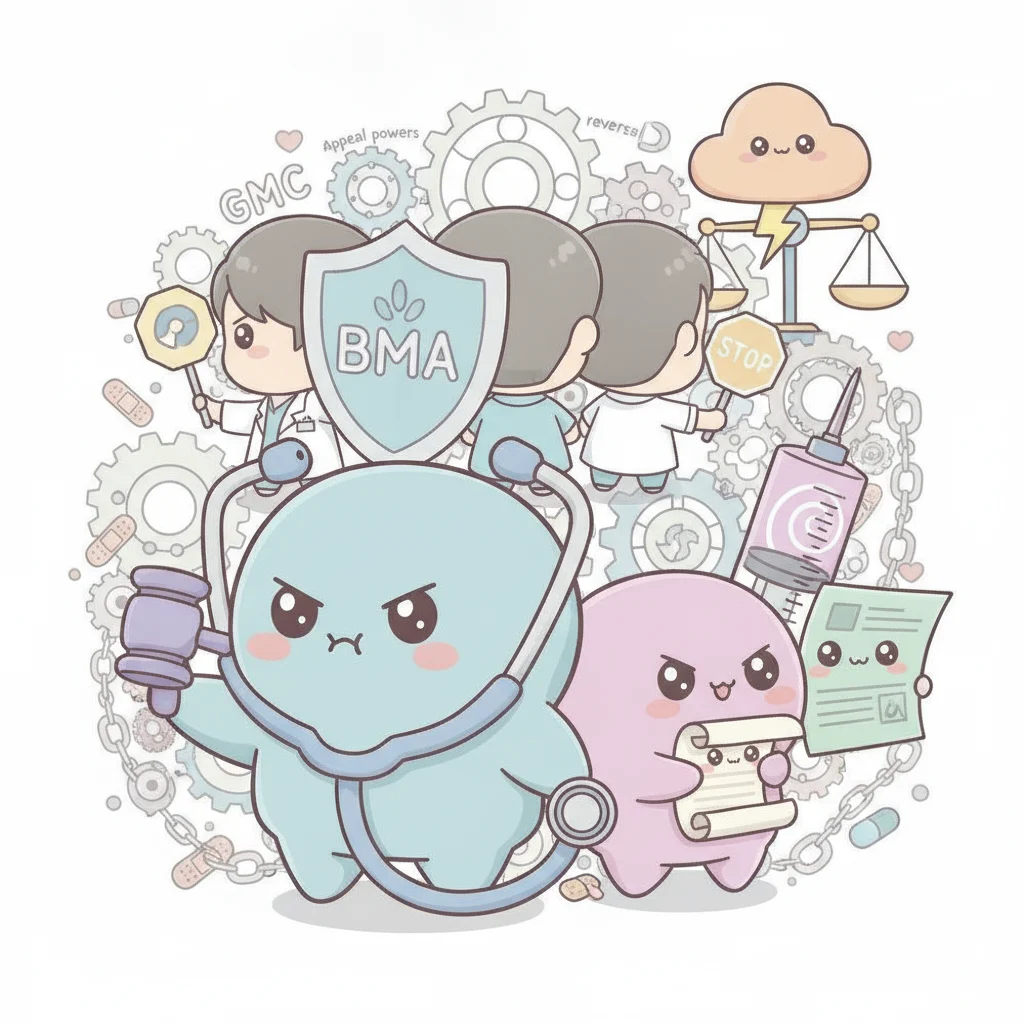

The UK government's recent decision to reverse its position on granting the General Medical Council (GMC) new appeal powers has prompted a legal challenge from the British Medical Association (BMA). This development indicates a potential shift in the regulatory landscape for medical professionals, with direct implications for disciplinary processes and professional accountability.1
The British Medical Association (BMA) has initiated legal action against the UK government, citing a "U turn" regarding proposed changes to the General Medical Council's (GMC) appeal powers.1 This action follows the government's decision to withdraw its support for legislation that would have granted the GMC the ability to appeal decisions made by its Medical Practitioners Tribunal Service (MPTS).1
The proposed legislative changes aimed to align the GMC's powers with those of other professional regulators, such as the Nursing and Midwifery Council (NMC), which already possess appeal rights.1 The BMA's legal challenge centres on the government's abrupt change of stance, which the association views as a breach of prior commitments and a significant setback for regulatory reform.1
The Policy Reversal
The government's initial proposal, supported by the BMA, sought to empower the GMC to appeal MPTS decisions that were deemed too lenient or otherwise inappropriate.1 This measure was intended to enhance public protection and ensure consistency in disciplinary outcomes.1 However, the government subsequently reversed its position, leading to the BMA's threat of legal action.1
The BMA's legal challenge highlights concerns that the government's reversal undermines efforts to modernise medical regulation and could potentially compromise patient safety by limiting the GMC's oversight capabilities.1 The association contends that the government's change of heart lacks a clear rationale and was made without adequate consultation with key stakeholders.1
The legal proceedings are expected to focus on the procedural aspects of the government's decision-making process and whether due process was followed in withdrawing support for the proposed legislation.1 The outcome of this legal challenge could have substantial implications for the future structure of medical regulation in the UK and the powers vested in the GMC.1
The BMA's stance is rooted in the belief that the government's initial commitment to granting the GMC appeal powers was a crucial step towards a more robust and equitable regulatory framework. They argue that the ability for the GMC to challenge MPTS decisions is not merely about increasing punitive measures, but about ensuring that all disciplinary outcomes are proportionate, consistent, and ultimately serve the public interest. Without this power, there is a perceived risk of inconsistent application of sanctions, potentially leading to situations where serious professional misconduct is not adequately addressed, thereby eroding public trust in the medical profession.
Implications for Patient Safety and Professional Standards
The core of the BMA's argument extends beyond procedural fairness to the fundamental implications for patient safety. They contend that a regulatory body without the power to appeal lenient decisions may be hampered in its ability to protect the public from practitioners whose fitness to practice is genuinely compromised. This limitation could create a perception of a two-tiered system, where some serious breaches of professional standards might go unchallenged, potentially endangering patients. The BMA emphasizes that the GMC's role is to uphold the highest standards of medical practice, and the appeal power is a vital tool in achieving this objective.
Furthermore, the BMA highlights the disparity created by this reversal when compared to other healthcare professions. The Nursing and Midwifery Council (NMC), for instance, already possesses the power to appeal tribunal decisions. This creates an uneven playing field, where the regulatory oversight for doctors is perceived as less stringent than for other healthcare professionals. Such inconsistencies can lead to confusion among the public and within the healthcare system regarding the expected standards of accountability across different professions.
The legal challenge is anticipated to delve into the government's reasoning for the abrupt policy shift. The BMA will likely seek disclosure of internal communications and assessments that led to the withdrawal of support for the legislation. This will be crucial in determining whether the government's decision was based on new evidence, a change in policy priorities, or other factors that were not adequately communicated or justified to stakeholders. The outcome could set a precedent for how future regulatory reforms are managed and the level of accountability expected from the government in its legislative commitments.
Should the BMA's legal action be successful, it could compel the government to reconsider its position or provide a more transparent and robust justification for its reversal. Conversely, if the government's decision is upheld, it could solidify the current limitations on the GMC's powers, potentially necessitating a re-evaluation of the regulatory landscape for medical professionals in the UK. This case underscores the complex interplay between government policy, professional bodies, and the overarching goal of maintaining public confidence in healthcare regulation.
The BMA's legal challenge against the government's reversal on GMC appeal powers introduces a layer of uncertainty into medical regulation. For clinicians, this means that the disciplinary landscape, particularly concerning appeals against MPTS decisions, remains in flux. The initial proposal for the GMC to have appeal powers was intended to ensure greater consistency and public protection, aligning it with other regulatory bodies. The current situation, however, leaves the GMC without this specific mechanism, potentially impacting how perceived leniency in tribunal decisions can be addressed.
From an industry perspective, this legal dispute underscores the inherent tensions between professional bodies, government policy, and regulatory oversight. The BMA's decision to pursue legal action indicates a strong belief that the government's "U turn" was not merely a policy adjustment but a breach of a more fundamental understanding or commitment. This could set a precedent for how future legislative changes affecting professional regulation are handled, potentially increasing scrutiny on the government's consultation processes and adherence to agreed-upon reforms.
For patients, the immediate impact is less direct but no less significant. The stated aim of granting the GMC appeal powers was to enhance public protection by ensuring that tribunal decisions adequately reflect the severity of professional misconduct. Without these powers, there is a perception that the system may be less robust in challenging outcomes that are seen as insufficient. While the MPTS operates independently, the ability for the regulator to appeal could have provided an additional safeguard, reinforcing public confidence in the disciplinary process. The resolution of this legal challenge will therefore be critical in shaping the future framework of accountability within the medical profession.
- The Pivot The UK government reversed its decision to grant the GMC new appeal powers.
- The Data The BMA has initiated legal action, citing a "U turn" by the government.1
- The Action Clinicians should be aware of ongoing legal and policy developments regarding medical regulation and disciplinary procedures.
ART-2026-578
·10/26
Drafted with AI assistance, reviewed and approved by the editorial team. This publication is intended for healthcare professionals, researchers, and life science industry professionals. Content is provided for informational and educational purposes only and does not constitute medical advice.

I specialise in clinical trial methodology and drug development, from Phase I to post-approval. My reports cover what got studied, what did not, and why. Based in Boston, reporting globally.
Cite This Article
Prescott D, Voss M. BMA threatens legal action over GMC appeal powers reversal. The Life Science Feed. Published July 1, 2026. Updated October 6, 2026. Accessed October 11, 2026. https://thelifesciencefeed.com/healthcare-sys-and-biz/health-policy/news/bma-threatens-legal-action-over-gmc-appeal-powers-reversal.
Editorial & AI Standards
All content is researched from peer-reviewed, open-access sources: published trial data, clinical guidelines, and regulatory filings. AI tools are used solely to structure and summarise that evidence; no AI-generated conclusions appear without editor verification against the primary source.
Every article is reviewed by a named editor before publication. Source citations are listed in the References section. This content does not represent the views of any pharmaceutical company, medical device manufacturer, or healthcare provider.
Licence & Rights
© 2026 The Life Science Feed. All rights reserved. Unless otherwise indicated, all content is the property of The Life Science Feed and may not be reproduced, distributed, or transmitted in any form or by any means without prior written permission.
Medical Disclaimer
The information provided on The Life Science Feed is for educational and informational purposes only. It is not intended as a substitute for professional medical advice, diagnosis, or treatment. Always seek the advice of your physician or other qualified healthcare provider regarding any medical condition or treatment decision. Never disregard professional medical advice or delay in seeking it because of something you have read on this website.
References
1. Iacobucci G. BMA threatens UK government with legal action over "U turn" on GMC appeal powers. BMJ.