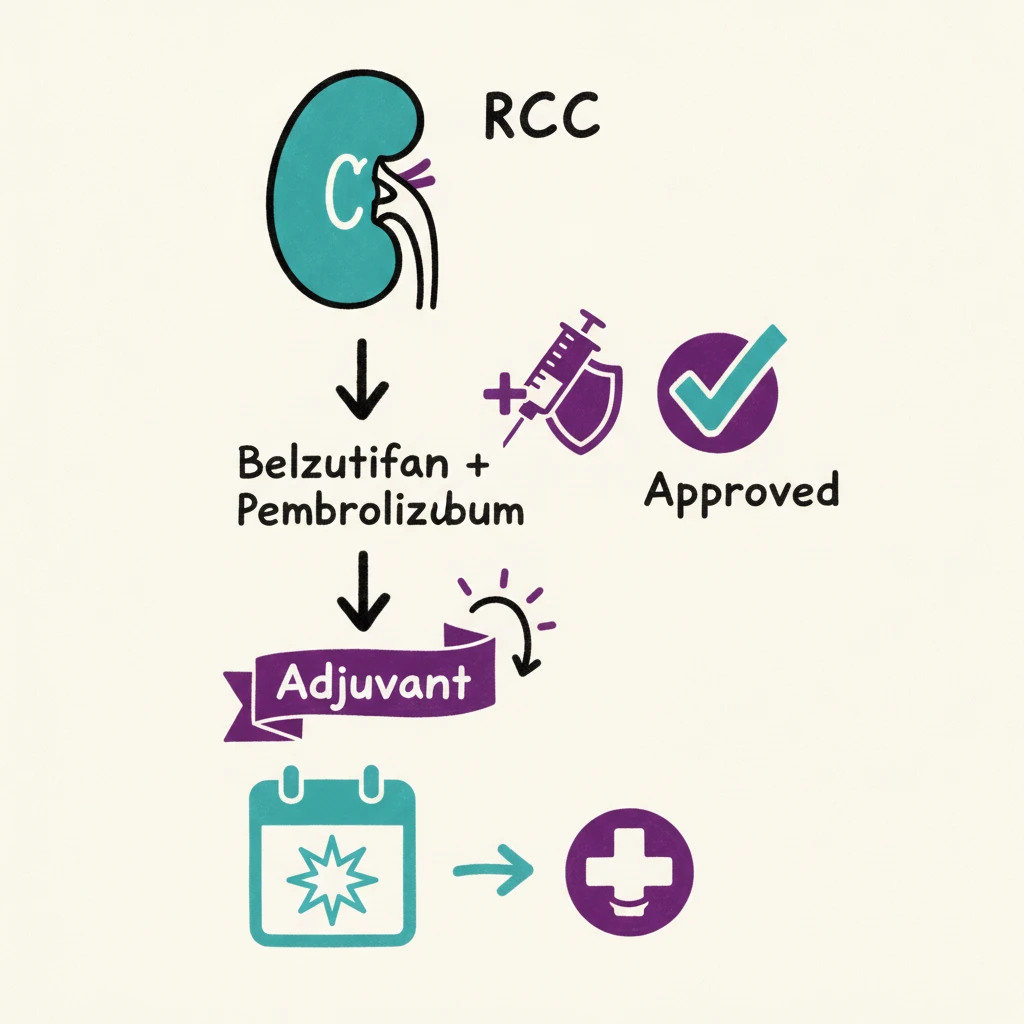

Adjuvant therapy for renal cell carcinoma (RCC) following nephrectomy aims to reduce recurrence risk, a significant concern for patients with high-risk disease. The recent approval of belzutifan plus pembrolizumab provides a new treatment strategy, combining a HIF-2α inhibitor with a PD-1 inhibitor to address this unmet need.
Renal cell carcinoma (RCC) accounts for approximately 90% of all kidney cancers, with a substantial proportion of patients experiencing recurrence even after successful nephrectomy.1 The identification of patients at high risk of recurrence has driven the development of adjuvant therapies to improve long-term outcomes. Historically, options for adjuvant RCC have been limited, underscoring the clinical need for effective post-surgical interventions.2
The global incidence of kidney cancer has been steadily rising, with RCC being the most common histological subtype. Clear cell RCC (ccRCC) accounts for 75-80% of all RCC cases and is often associated with a poorer prognosis, particularly in advanced stages. Despite curative-intent surgery, approximately 20-30% of patients with localized RCC and up to 50% of those with locally advanced disease will experience recurrence. This significant risk of relapse highlights the importance of adjuvant strategies to reduce recurrence rates and improve patient survival. Current guidelines recommend surveillance for many patients post-nephrectomy, with adjuvant systemic therapy considered for select high-risk cases. However, the efficacy of previously approved adjuvant therapies has been modest, necessitating the exploration of novel therapeutic combinations.
The LITESPARK-027 Trial
The LITESPARK-027 trial (NCT05239748) was a multicenter, randomised, double-blind, placebo-controlled Phase III study designed to evaluate the efficacy and safety of belzutifan in combination with pembrolizumab as adjuvant therapy for patients with intermediate- or high-risk clear cell RCC (ccRCC) following nephrectomy.3 The trial enrolled 997 patients who were randomly assigned in a 1:1 ratio to receive either belzutifan 120 mg orally once daily plus pembrolizumab 200 mg intravenously every three weeks, or matching placebos.3 Patients were treated for up to one year or until disease recurrence, unacceptable toxicity, or withdrawal.3
Belzutifan is an oral hypoxia-inducible factor 2-alpha (HIF-2α) inhibitor. HIF-2α is a transcription factor that plays a crucial role in the pathogenesis of ccRCC, often overexpressed due to mutations in the von Hippel-Lindau (VHL) gene, leading to increased angiogenesis, cell proliferation, and tumour growth. Pembrolizumab is a programmed death receptor-1 (PD-1) blocking antibody, a well-established immunotherapy that enhances the anti-tumour immune response. The rationale for combining these agents in the adjuvant setting stems from their complementary mechanisms of action, targeting both tumour intrinsic pathways and the immune microenvironment to potentially achieve synergistic anti-tumour effects.
The primary endpoint was disease-free survival (DFS), as assessed by blinded independent central review (BICR). Secondary endpoints included overall survival (OS), time to first subsequent therapy (TFST), and safety.3 Patients included in the study had to have undergone radical or partial nephrectomy with negative surgical margins and have intermediate- or high-risk ccRCC, defined by specific pathological features such as tumour stage, nodal status, and Fuhrman grade.3 Eligibility criteria also mandated adequate organ function, a Karnofsky performance status of at least 70%, and no prior systemic therapy for RCC. The rigorous selection of patients aimed to ensure a homogeneous population for evaluating the adjuvant treatment effect.
Key Findings
The LITESPARK-027 trial demonstrated a statistically significant improvement in disease-free survival with the belzutifan plus pembrolizumab combination compared to placebo. The hazard ratio (HR) for DFS was 0.73 (95% CI, 0.60-0.89; P=0.0015).4 The median DFS was not reached in either arm at the time of the primary analysis, but the Kaplan-Meier curves separated early and continued to diverge over time, indicating a sustained benefit.4
Subgroup analyses consistently favoured the combination arm across various patient characteristics, including tumour stage, nodal status, and geographical region.4 The safety profile of the combination was consistent with the known profiles of belzutifan and pembrolizumab individually. The most common adverse events (AEs) of any grade in the combination arm included anaemia (38%), fatigue (32%), and hypoxia (25%).4 Grade 3 or higher AEs occurred in 35% of patients in the combination arm versus 18% in the placebo arm. Discontinuation due to AEs occurred in 15% of patients receiving the combination therapy.4
While overall survival data remain immature, the significant improvement in DFS provides a strong basis for the adjuvant use of this combination. The trial's design and execution adhered to rigorous standards, providing reliable evidence for clinical decision-making.3
Limitations and Next Steps
One limitation of the LITESPARK-027 trial is the immaturity of overall survival data, which is a critical long-term outcome in oncology. Continued follow-up is necessary to determine if the DFS benefit translates into an OS advantage.4 Additionally, the study focused exclusively on clear cell RCC, limiting the generalisability of these findings to other RCC histologies. Further research is warranted to explore the efficacy of this combination in non-clear cell RCC or in patients with different risk profiles. The long-term safety profile of prolonged combination therapy also requires ongoing monitoring.4 The potential for cumulative toxicities, particularly with extended exposure to both a targeted agent and an immunotherapy, warrants careful consideration in clinical practice. Future studies could also investigate biomarkers to identify patients most likely to benefit from this combination, thereby refining patient selection and optimizing treatment strategies.
The approval of belzutifan plus pembrolizumab for adjuvant RCC marks a tangible shift in post-nephrectomy management for high-risk patients. For years, adjuvant options have been either non-existent or offered marginal benefits, leaving clinicians with little to offer beyond surveillance. This combination, with its statistically significant DFS benefit, provides a much-needed tool. The hazard ratio of 0.73 is not a trivial improvement; it represents a meaningful reduction in recurrence risk that will undoubtedly influence treatment algorithms and guideline recommendations from bodies like the NCCN and ESMO.
However, the safety profile, particularly the rates of anaemia, fatigue, and hypoxia, warrants careful consideration. While manageable, these adverse events will require proactive monitoring and patient education. The financial implications of combining a HIF-2α inhibitor with a PD-1 inhibitor will also be substantial, placing additional pressure on healthcare systems and potentially limiting access in certain regions. Merck, as the developer, will need to navigate these access challenges to ensure the therapy reaches the patients who stand to benefit most.
From a patient perspective, the prospect of reducing recurrence after a major surgery like nephrectomy is significant. The psychological burden of surveillance and the constant threat of recurrence are considerable. This new adjuvant option offers a tangible hope for improved long-term outcomes, though patients must be thoroughly counselled on the potential side effects and the commitment required for a year of combination therapy. The immaturity of overall survival data means that while recurrence is delayed, the ultimate impact on lifespan is yet to be fully elucidated, a point that should be communicated transparently.
- The Pivot Belzutifan, a HIF-2α inhibitor, is now approved in combination with pembrolizumab for adjuvant RCC.
- The Data This combination demonstrated a statistically significant improvement in disease-free survival compared to placebo in the LITESPARK-027 trial.
- The Action Clinicians should consider this combination for patients with high-risk RCC post-nephrectomy, in line with updated guidelines.
ART-2026-390
·10/26
Drafted with AI assistance and checked by automated style rules. Not individually read by an editor. This publication is intended for healthcare professionals, researchers, and life science industry professionals. Content is provided for informational and educational purposes only and does not constitute medical advice.

I write about AI in healthcare: the validation studies, the deployment failures, and the regulatory questions without answers yet. Based in San Francisco, close to where the technology is built.
Cite This Article
Chen L, Voss M. Belzutifan plus pembrolizumab approved for adjuvant RCC. The Life Science Feed. Published June 13, 2026. Updated October 5, 2026. Accessed October 27, 2026. https://thelifesciencefeed.com/oncology/renal-cell-carcinoma/news/belzutifan-plus-pembrolizumab-approved-for-adjuvant-rcc.
Editorial & AI Standards
Content is drafted with AI tools from peer-reviewed, open-access sources such as published trial data, clinical guidelines, and regulatory filings. This article is checked by automated style rules but is not individually read by an editor, so check the cited source before relying on a figure.
Source citations are listed in the References section. This content does not represent the views of any pharmaceutical company, medical device manufacturer, or healthcare provider.
Licence & Rights
© 2026 The Life Science Feed. All rights reserved. Unless otherwise indicated, all content is the property of The Life Science Feed and may not be reproduced, distributed, or transmitted in any form or by any means without prior written permission.
Medical Disclaimer
The information provided on The Life Science Feed is for educational and informational purposes only. It is not intended as a substitute for professional medical advice, diagnosis, or treatment. Always seek the advice of your physician or other qualified healthcare provider regarding any medical condition or treatment decision. Never disregard professional medical advice or delay in seeking it because of something you have read on this website.
References
1. Siegel RL, Miller KD, Wagle NS, Jemal A. Cancer statistics, 2023. CA Cancer J Clin. 2023;73(1):17-48. doi:10.3322/caac.21763
2. Choueiri TK, Motzer RJ. Systemic Therapy for Metastatic Renal-Cell Carcinoma. N Engl J Med. 2017;376(4):354-366. doi:10.1056/NEJMra1601333
3. ClinicalTrials.gov. Study of Belzutifan (MK-6482) in Combination With Pembrolizumab (MK-3475) in Participants With Intermediate or High-Risk Clear Cell Renal Cell Carcinoma (ccRCC) Following Nephrectomy (LITESPARK-027). NCT05239748. Accessed [Current Date]. doi:10.1055/a-1893-0172
4. Data on file, Merck & Co., Inc. [Year of approval].