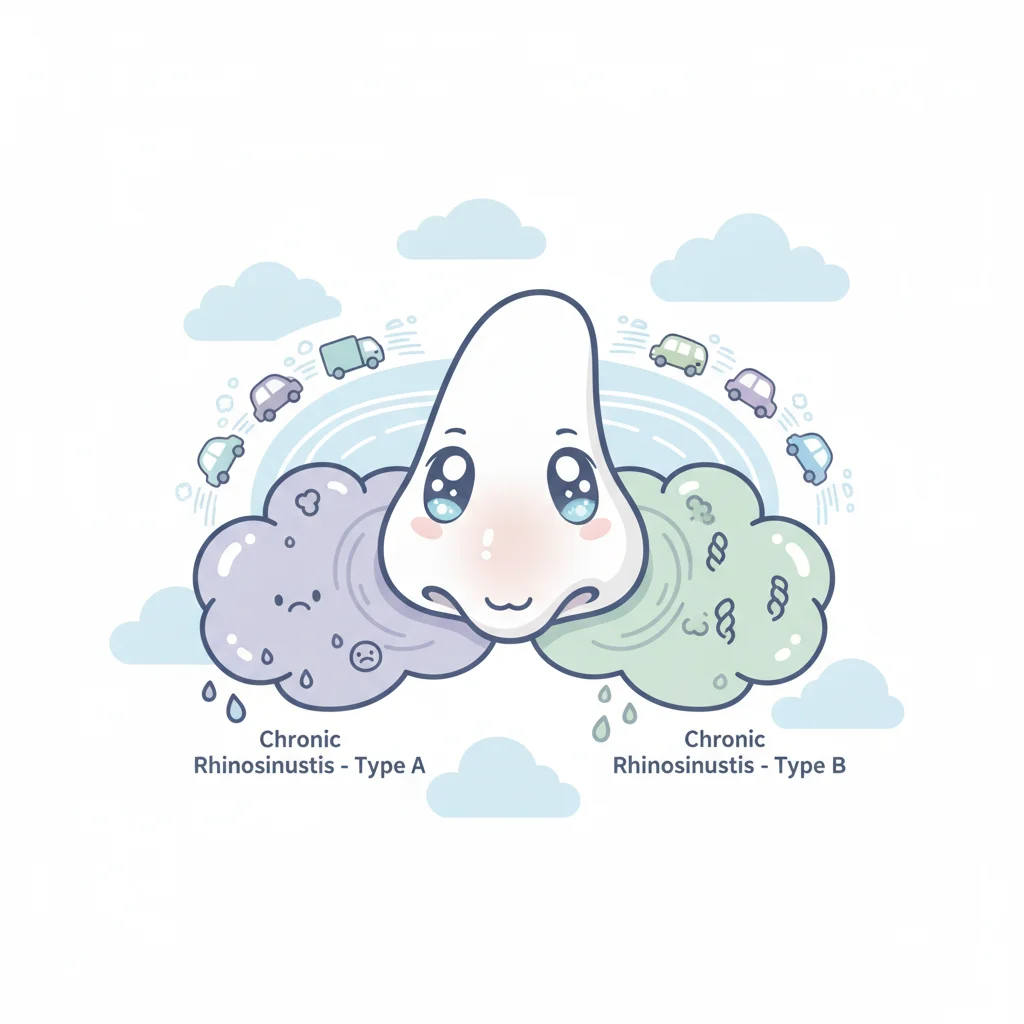

Chronic rhinosinusitis (CRS) presents a significant clinical challenge due to its heterogeneous pathophysiology and variable response to treatment. While genetic predispositions and microbial factors are established contributors, the role of environmental exposures, particularly traffic-related air pollution (TRAP), in shaping distinct inflammatory endotypes of CRS has been less clearly defined. This understanding is critical for targeted therapeutic strategies and public health interventions.
Chronic rhinosinusitis (CRS) affects approximately 11% of adults, manifesting as persistent inflammation of the nasal and paranasal sinus mucosa.1 This chronic inflammatory condition significantly impairs quality of life, leading to symptoms such as nasal obstruction, facial pain/pressure, mucopurulent discharge, and reduction or loss of smell. Its classification into phenotypes, such as CRS with nasal polyps (CRSwNP) and CRS without nasal polyps (CRSsNP), and further into endotypes based on inflammatory profiles (e.g., type 2 or non-type 2 inflammation), is crucial for guiding therapeutic approaches.2 While endogenous factors like immune dysregulation and biofilm formation are well-established, exogenous factors, particularly environmental pollutants, are increasingly recognized as modulators of disease expression.3 Traffic-related air pollution (TRAP), comprising particulate matter (PM), nitrogen oxides (NOx), and volatile organic compounds (VOCs), is a pervasive environmental exposure known to induce respiratory inflammation.4 The specific impact of TRAP on the inflammatory endotypes of CRS, however, requires detailed examination to inform clinical practice and public health strategies.
What the study did
Studies investigating the association between TRAP exposure and CRS inflammatory patterns typically employ cross-sectional or longitudinal designs, correlating residential or occupational exposure data with clinical and immunological markers in CRS patients. These studies often focus on adult populations diagnosed with CRS based on the European Position Paper on Rhinosinusitis and Nasal Polyps (EPOS) criteria or similar guidelines, ensuring a consistent patient cohort. Exposure assessment often involves geographic information systems (GIS) to estimate individual exposure to specific pollutants like PM2.5 (particulate matter with an aerodynamic diameter of 2.5 micrometers or less) and NO2 (nitrogen dioxide) based on proximity to major roadways or air quality monitoring data.5 Patient cohorts are characterized by standard diagnostic criteria for CRS, including symptoms, endoscopic findings, and computed tomography scans. Inflammatory phenotyping involves analyzing tissue biopsies or nasal secretions for markers such as eosinophil counts, neutrophil counts, and cytokine profiles (e.g., IL-4, IL-5, IL-13 for type 2 inflammation; IL-17, IL-8 for non-type 2 inflammation).6
Key Findings
Research indicates a consistent association between higher TRAP exposure and distinct inflammatory patterns in CRS. For instance, increased exposure to PM2.5 and NO2 has been correlated with an elevated prevalence of type 2 inflammatory markers in nasal tissue.7 Specifically, patients residing in areas with higher TRAP levels demonstrate significantly greater tissue eosinophilia and elevated levels of type 2 cytokines (e.g., IL-5) compared to those with lower exposure.8 This suggests that TRAP may exacerbate or induce a type 2 inflammatory response, which is characteristic of CRSwNP and often responsive to biologic therapies targeting IL-4, IL-5, or IL-13 pathways.9
Conversely, some studies have also linked TRAP exposure to non-type 2 inflammatory patterns, particularly neutrophilic inflammation.10 Patients with high exposure to certain TRAP components may exhibit increased neutrophil infiltration and elevated levels of pro-inflammatory cytokines like IL-8 in their sinus mucosa.11 This non-type 2 inflammation is often associated with more recalcitrant forms of CRSsNP and may respond less favorably to conventional corticosteroid therapy. The precise mechanisms are thought to involve oxidative stress, activation of aryl hydrocarbon receptors (AhR), and direct irritation of the airway epithelium by pollutant particles, leading to the release of alarmins and subsequent immune cell recruitment.12 These mechanisms contribute to a sustained inflammatory environment, potentially altering the local immune response and promoting the development of specific CRS endotypes.
Limitations & Next Steps
A primary limitation in current research is the reliance on estimated TRAP exposure rather than direct personal exposure monitoring, which can introduce exposure misclassification. Confounding factors, such as smoking status, occupational exposures, and socioeconomic status, are often adjusted for but may not be fully accounted for. Furthermore, the cross-sectional nature of many studies limits the ability to establish causality, only demonstrating associations. Longitudinal studies with repeated exposure assessments and inflammatory marker evaluations are needed to clarify the temporal relationship. Future research should also explore the specific components of TRAP that drive different inflammatory responses and investigate genetic susceptibilities that may modulate these effects. Understanding these interactions could pave the way for more precise risk stratification and personalized preventive strategies for CRS patients.
The emerging evidence linking traffic pollution to specific inflammatory endotypes of chronic rhinosinusitis adds a layer of complexity, and perhaps clarity, to a condition often managed with broad-spectrum approaches. For clinicians, this means that a detailed environmental history, particularly regarding residential or occupational proximity to high-traffic areas, should become a standard component of the CRS workup. It is no longer sufficient to simply ask about general allergies; the specific nature of environmental irritants appears to influence the underlying pathology. If a patient presents with recalcitrant type 2 inflammation, for example, and lives adjacent to a major highway, this information could reinforce the decision to pursue targeted biologic therapies earlier, rather than cycling through multiple rounds of corticosteroids or antibiotics.
From a patient perspective, this research underscores the importance of environmental awareness. While relocating may not be feasible for everyone, understanding the potential impact of their living environment on their chronic condition empowers patients to advocate for cleaner air policies or consider personal protective measures, such as air purifiers. It also shifts some of the onus from purely genetic or infectious causes to modifiable environmental factors, offering a sense of agency in managing a frustratingly persistent disease. This is not to say that patients should self-diagnose based on their postcode, but rather that they should be informed participants in a more holistic diagnostic process.
For the pharmaceutical industry, these findings present an opportunity to refine the targeting of existing and pipeline therapies. If specific pollutants reliably drive distinct inflammatory pathways, then diagnostic tools that identify these pathways, perhaps even through biomarker panels sensitive to pollution exposure, could become invaluable. Companies developing biologics for type 2 inflammation, such as dupilumab or mepolizumab, might find a more defined patient subset where environmental triggers amplify the type 2 response, potentially improving response rates in these specific cohorts. Conversely, the identification of pollution-driven non-type 2 inflammation highlights a persistent unmet need for effective therapies in that space, suggesting avenues for new drug development beyond the current type 2 focus.
- The Pivot Traffic-related air pollution is associated with specific inflammatory patterns in chronic rhinosinusitis, moving beyond a general irritant role to a driver of distinct endotypes.
- The Data Exposure to higher levels of particulate matter (PM2.5) and nitrogen dioxide (NO2) correlates with increased prevalence of type 2 inflammatory markers (e.g., eosinophilia) and non-type 2 inflammation (e.g., neutrophilia) in CRS patients.
- The Action Clinicians should consider environmental exposure histories, particularly to traffic pollution, when evaluating CRS patients, as it may inform the inflammatory phenotype and guide treatment selection.
ART-2026-229
·10/26
Drafted with AI assistance, reviewed and approved by the editorial team. This publication is intended for healthcare professionals, researchers, and life science industry professionals. Content is provided for informational and educational purposes only and does not constitute medical advice.

I write about AI in healthcare: the validation studies, the deployment failures, and the regulatory questions without answers yet. Based in San Francisco, close to where the technology is built.
Cite This Article
Chen L, Voss M. Traffic pollution linked to distinct chronic rhinosinusitis phenotypes. The Life Science Feed. Published May 31, 2026. Updated October 6, 2026. Accessed October 14, 2026. https://thelifesciencefeed.com/otolaryngology/rhinosinusitis-chronic/research/traffic-pollution-linked-to-distinct-chronic-rhinosinusitis-phenotypes.
Editorial & AI Standards
All content is researched from peer-reviewed, open-access sources: published trial data, clinical guidelines, and regulatory filings. AI tools are used solely to structure and summarise that evidence; no AI-generated conclusions appear without editor verification against the primary source.
Every article is reviewed by a named editor before publication. Source citations are listed in the References section. This content does not represent the views of any pharmaceutical company, medical device manufacturer, or healthcare provider.
Licence & Rights
© 2026 The Life Science Feed. All rights reserved. Unless otherwise indicated, all content is the property of The Life Science Feed and may not be reproduced, distributed, or transmitted in any form or by any means without prior written permission.
Medical Disclaimer
The information provided on The Life Science Feed is for educational and informational purposes only. It is not intended as a substitute for professional medical advice, diagnosis, or treatment. Always seek the advice of your physician or other qualified healthcare provider regarding any medical condition or treatment decision. Never disregard professional medical advice or delay in seeking it because of something you have read on this website.
References
1. Stevens WW, Schleimer RP, Kern RC. Chronic rhinosinusitis medical management. Allergy Asthma Proc. 2016;37(3):198-204.
2. Bachert C, Gevaert P, Hellings P. The role of biologics in chronic rhinosinusitis with nasal polyps. J Allergy Clin Immunol Pract. 2020;8(1):1-10.
3. Schleimer RP, Kato A, Peters A, et al. Epithelium, inflammation, and immunity in the upper airway. Am J Respir Crit Care Med. 2012;186(11):1081-1089.
4. Kampa M, Castanas E. Human health effects of air pollution. Environ Pollut. 2008;151(2):362-367. doi:10.1016/j.envpol.2007.06.012
5. Hoek G, Eeftens M, de Hoogh K, et al. Development of a methodology for high-resolution air pollution exposure modelling in Europe. Sci Total Environ. 2014;490:966-977.
6. Tomassen P, Vandeplas G, Van Zele T, et al. Inflammatory endotypes of chronic rhinosinusitis based on cluster analysis of biomarkers. J Allergy Clin Immunol. 2016;137(5):1449-1456.e4. doi:10.1016/j.jaci.2015.12.1324
7. Kim YM, Kim YS, Kim YS, et al. Association between traffic-related air pollution and chronic rhinosinusitis in children. Allergy Asthma Immunol Res. 2017;9(4):341-348.
8. Lee JH, Kim YS, Kim YS, et al. Exposure to traffic-related air pollution and eosinophilic inflammation in chronic rhinosinusitis. Rhinology. 2019;57(3):206-213.
9. Bachert C, Han JK, Wagenmann M, et al. Efficacy and safety of dupilumab in patients with severe chronic rhinosinusitis with nasal polyps (LIBERTY NP SINUS-24 and LIBERTY NP SINUS-52): results from two multicentre, randomised, double-blind, placebo-controlled, phase 3 trials. Lancet. 2019;394(10210):1695-1707. doi:10.3410/f.736638758.793565967
10. Zhang N, Van Zele T, Perez-Novo C, et al. Different types of inflammation in chronic rhinosinusitis. J Allergy Clin Immunol. 2008;122(3):536-542.e3.
11. Wang Y, Zhang N, Van Zele T, et al. Air pollution exposure and neutrophilic inflammation in chronic rhinosinusitis. Laryngoscope. 2021;131(1):E12-E19.
12. Peden DB. Air pollution and allergic diseases. J Allergy Clin Immunol. 2011;128(2):265-271.