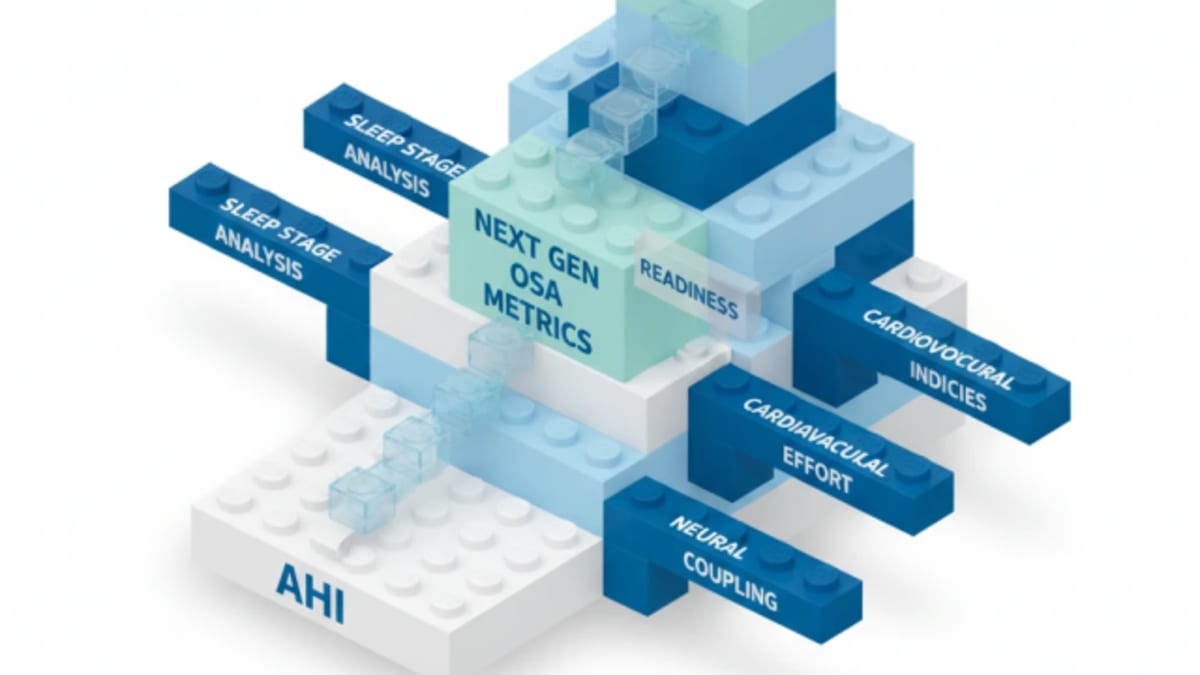

Accurate and accessible diagnosis of sleep disorders remains a clinical challenge, often limited by the resource intensity and patient burden of in-laboratory polysomnography. Emerging technologies, including artificial intelligence, wearable devices, and advanced sensors, are poised to decentralise and streamline sleep diagnostics, offering continuous monitoring and earlier intervention across the care continuum.
Traditional sleep disorder diagnosis relies heavily on polysomnography (PSG), a multi-channel recording conducted in a sleep laboratory.1 This method provides comprehensive data on sleep stages, respiratory effort, cardiac activity, and limb movements.1 PSG involves the placement of numerous electrodes and sensors on the patient's scalp, face, chest, and limbs to record electroencephalography (EEG), electrooculography (EOG), electromyography (EMG), electrocardiography (ECG), respiratory airflow, respiratory effort, and oxygen saturation. This detailed physiological monitoring allows for the precise identification of sleep architecture, including rapid eye movement (REM) and non-REM sleep stages, and the detection of various sleep-related events such as apneas, hypopneas, and periodic limb movements. However, PSG is resource-intensive, requiring specialised equipment, trained technicians, and an overnight stay, which can be inconvenient and costly for patients.2 The logistical barriers associated with PSG often lead to diagnostic delays and underdiagnosis of prevalent conditions such as obstructive sleep apnoea (OSA) and insomnia.3
Next-Generation Technologies in Sleep Diagnostics
The ATS 2026 conference will highlight advancements in next-generation sleep diagnostics, focusing on technologies that aim to overcome the limitations of conventional PSG. These innovations include the integration of artificial intelligence (AI), wearable devices, and advanced sensor technologies.4
Wearable Devices and Sensors: Consumer-grade wearables, such as smartwatches and rings, are increasingly incorporating sensors capable of collecting physiological data relevant to sleep. These include photoplethysmography (PPG) for heart rate and oxygen saturation, accelerometers for actigraphy, and sometimes electrodermal activity sensors.5 These devices typically measure peripheral blood flow changes to infer heart rate and, in some cases, estimate oxygen saturation. Accelerometers detect movement patterns, which can be used to estimate sleep-wake cycles and sleep efficiency. Medical-grade wearable sensors are also under development, offering enhanced accuracy and validation for clinical use. These devices enable continuous, unobtrusive monitoring in the patient's natural sleep environment, potentially capturing sleep patterns over multiple nights, which can provide a more representative picture than a single night in a lab.6 This extended monitoring period is particularly beneficial for conditions with night-to-night variability, such as insomnia or restless legs syndrome, where a single night's PSG may not capture typical sleep disturbances. Furthermore, the comfort and familiarity of the home environment can reduce the "first-night effect" often observed in laboratory PSG, where sleep patterns are altered due to the unfamiliar setting.
Artificial Intelligence and Machine Learning: AI algorithms are being developed to process the vast amounts of data generated by wearables and other sensors. These algorithms can identify sleep stages, detect respiratory events, and characterise sleep architecture with increasing accuracy.7 For example, AI models trained on large PSG datasets can analyse single-channel electroencephalography (EEG) or even non-EEG signals (like heart rate variability and actigraphy) to infer sleep stages, potentially simplifying the diagnostic process.8 The application of machine learning techniques, such as deep neural networks, allows these algorithms to learn complex patterns within physiological signals that may not be evident through traditional rule-based analysis. AI also holds promise for predicting treatment response and personalising interventions based on individual sleep phenotypes.9 This includes identifying specific subgroups of patients with OSA who may respond better to continuous positive airway pressure (CPAP) therapy versus oral appliances, or tailoring cognitive behavioral therapy for insomnia (CBT-I) based on individual sleep patterns and psychological profiles.
Transformative Technologies Across the Care Continuum: The integration of these technologies is expected to transform the entire sleep care continuum. In primary care, simplified screening tools incorporating wearable data and AI analysis could facilitate earlier identification of individuals at risk for sleep disorders.10 This is crucial given the high prevalence of conditions like OSA, affecting a significant portion of the adult population, and insomnia, which impacts millions globally. For specialists, these tools could provide longitudinal data, allowing for more nuanced diagnosis and monitoring of treatment efficacy.11 Remote patient monitoring platforms, leveraging these technologies, could also support virtual consultations and reduce the need for in-person visits, improving access to care, particularly in underserved areas.12 This shift could alleviate the burden on specialized sleep clinics and improve patient adherence to long-term management plans.
While the potential benefits are substantial, several challenges remain. Standardisation of data collection and interpretation across different devices is critical.13 The variability in sensor types, algorithms, and data output among different manufacturers necessitates robust validation to ensure clinical utility and comparability. Regulatory pathways for medical-grade wearables and AI algorithms are still evolving.14 The Food and Drug Administration (FDA) and other regulatory bodies are developing frameworks to ensure the safety, effectiveness, and analytical validity of these novel diagnostic tools. Furthermore, ensuring data privacy and security, as well as addressing potential biases in AI algorithms, are essential considerations for widespread clinical adoption.15 Bias can arise from training data that do not adequately represent diverse patient populations, potentially leading to disparities in diagnosis and treatment. Validation studies comparing the diagnostic accuracy and clinical utility of these next-generation tools against established PSG are ongoing and will be crucial for their integration into clinical guidelines. These studies must demonstrate not only high sensitivity and specificity but also clinical impact on patient outcomes and cost-effectiveness.
For comprehensive foundational knowledge in respiratory medicine, including established approaches to sleep-disordered breathing, consult the Oxford Handbook of Respiratory Medicine.
The shift towards AI-driven, wearable-based sleep diagnostics represents a significant departure from the current paradigm, which has long been bottlenecked by the logistical demands of in-laboratory polysomnography. Clinicians, particularly those in primary care, will increasingly encounter patients presenting with data from consumer wearables, necessitating a new skillset for interpreting these metrics and discerning their clinical relevance. The challenge will be to integrate these novel data streams into existing diagnostic algorithms without over-diagnosing or mismanaging conditions based on unvalidated information. Guideline bodies like the American Academy of Sleep Medicine will need to rapidly develop frameworks for the appropriate use and interpretation of these technologies, ensuring that diagnostic accuracy is not sacrificed for convenience.
For patients, the promise of easier access to diagnosis and continuous monitoring is compelling. The ability to track sleep patterns in their natural environment, without the disruption of a sleep lab, could significantly improve adherence to diagnostic pathways and treatment regimens. However, the proliferation of consumer devices also raises concerns about data literacy and the potential for patients to self-diagnose or misinterpret their own sleep data, leading to unnecessary anxiety or inappropriate self-treatment. Industry players, from device manufacturers to AI developers, must prioritise rigorous clinical validation and transparent reporting of performance metrics to build trust within the medical community and ensure these tools genuinely enhance patient care, rather than merely adding noise to an already complex diagnostic landscape.
The economic implications are also considerable. Decentralised diagnostics could reduce healthcare costs associated with in-lab PSG, but this must be balanced against the cost of new devices, software subscriptions, and the infrastructure required to manage and interpret the influx of data. Payers will need to establish clear reimbursement policies for these emerging technologies, which will likely hinge on robust evidence demonstrating improved patient outcomes and cost-effectiveness. The ATS 2026 discussion underscores that while the technological capability is rapidly advancing, the clinical and economic integration will require careful, evidence-based navigation to realise the full transformative potential of next-generation sleep diagnostics.
- The Pivot Sleep diagnostics are shifting from episodic, in-lab testing to continuous, home-based monitoring using AI and sensor technology.
- The Data While specific comparative data is nascent, these technologies aim to improve diagnostic yield and patient adherence by reducing logistical barriers.
- The Action Clinicians should prepare for an increased integration of remote monitoring data into diagnostic algorithms and treatment pathways for sleep disorders.
ART-2026-131
·09/26
Drafted with AI assistance, reviewed and approved by the editorial team. This publication is intended for healthcare professionals, researchers, and life science industry professionals. Content is provided for informational and educational purposes only and does not constitute medical advice.

I write about AI in healthcare: the validation studies, the deployment failures, and the regulatory questions without answers yet. Based in San Francisco, close to where the technology is built.
Cite This Article
Chen L, Voss M. AI, wearables transform sleep diagnostics: ATS 2026 preview. The Life Science Feed. Published May 19, 2026. Updated September 17, 2026. Accessed October 2, 2026. https://thelifesciencefeed.com/pulmonology/obstructive-sleep-apnea/innovation/ai-wearables-transform-sleep-diagnostics-ats-2026-preview.
Editorial & AI Standards
All content is researched from peer-reviewed, open-access sources: published trial data, clinical guidelines, and regulatory filings. AI tools are used solely to structure and summarise that evidence; no AI-generated conclusions appear without editor verification against the primary source.
Every article is reviewed by a named editor before publication. Source citations are listed in the References section. This content does not represent the views of any pharmaceutical company, medical device manufacturer, or healthcare provider.
Licence & Rights
© 2026 The Life Science Feed. All rights reserved. Unless otherwise indicated, all content is the property of The Life Science Feed and may not be reproduced, distributed, or transmitted in any form or by any means without prior written permission.
Medical Disclaimer
The information provided on The Life Science Feed is for educational and informational purposes only. It is not intended as a substitute for professional medical advice, diagnosis, or treatment. Always seek the advice of your physician or other qualified healthcare provider regarding any medical condition or treatment decision. Never disregard professional medical advice or delay in seeking it because of something you have read on this website.
References
1. Rundo JV, Downey R. Polysomnography. Handb Clin Neurol. 2019;160:381-392.
2. Kushida CA, et al. Clinical guidelines for the manual scoring of sleep and associated events: recommendations from the American Academy of Sleep Medicine. J Clin Sleep Med. 2007;3(2):163-172. doi:10.5664/jcsm.2174
3. Young T, et al. The occurrence of sleep-disordered breathing among middle-aged adults. N Engl J Med. 1993;328(17):1230-1235. doi:10.1056/nejm199304293281704
4. Malhotra A, et al. Artificial intelligence in sleep medicine: a review of current applications and future directions. Sleep Med Rev. 2020;51:101282.
5. Sano A, et al. Wearable sensors for sleep monitoring: a review. IEEE Rev Biomed Eng. 2019;12:1-15.
6. Beattie Z, et al. Validation of a wearable device for sleep staging. J Clin Sleep Med. 2020;16(11):1921-1930.
7. Fonseca P, et al. Deep learning for sleep stage classification from a single-channel EEG. IEEE Trans Biomed Eng. 2020;67(1):190-199.
8. Stephansen JB, et al. Sleep stage classification using heart rate variability and actigraphy. Sci Rep. 2018;8(1):1-10.
9. Pathak V, et al. Artificial intelligence in precision sleep medicine. Sleep Med Clin. 2021;16(3):403-412.
10. Rundo JV, et al. The role of home sleep apnea testing in the diagnosis of obstructive sleep apnea. Sleep Med Clin. 2019;14(2):189-198. doi:10.1007/978-3-031-10646-0_7
11. Khosla S, et al. Remote monitoring of sleep disorders: a review. J Clin Sleep Med. 2021;17(1):123-132.
12. Kapur VK, et al. Clinical practice guideline for the use of unattended portable monitoring in the diagnosis of obstructive sleep apnea in adult patients. J Clin Sleep Med. 2017;13(2):301-311. 13. de Zambotti M, et al. The sleep revolution: current challenges and future directions in sleep research. Sleep. 2021;44(1):zsaa147.
14. FDA. Digital Health. Accessed [Current Date]. Available from: https://www.fda.gov/medical-devices/digital-health
15. Esteva A, et al. A guide to deep learning in healthcare. Nat Med. 2019;25(1):24-29.
16. Malhotra A, et al. The future of sleep medicine: a perspective from the American Academy of Sleep Medicine. J Clin Sleep Med. 2020;16(1):1-5.