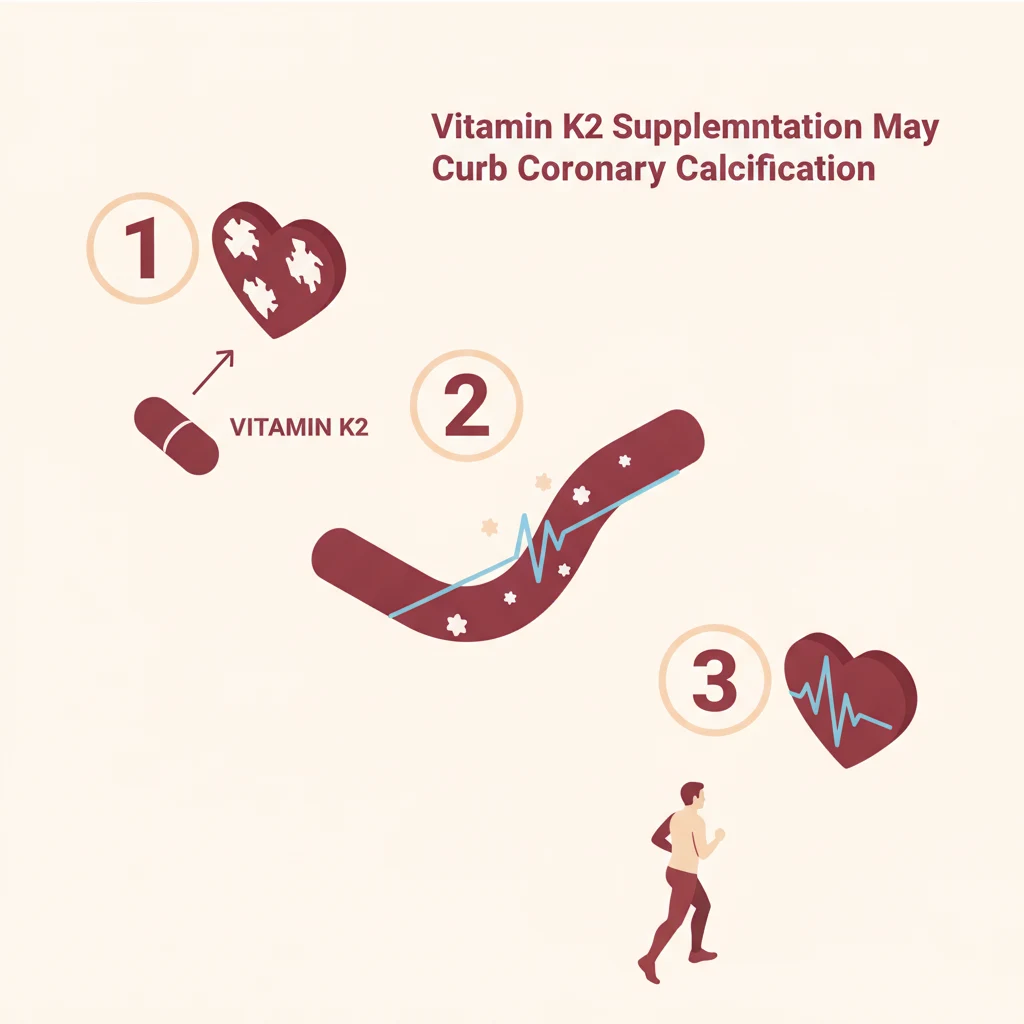

Coronary artery calcification (CAC) is a strong independent predictor of cardiovascular events and mortality, reflecting the burden of atherosclerosis. While established interventions target traditional risk factors, the role of micronutrients in modulating CAC progression remains an area of active investigation. Emerging data indicates that vitamin K2 supplementation may offer a novel approach to attenuate the progression of vascular calcification.
Coronary artery calcification (CAC) represents an advanced stage of atherosclerosis, characterised by the deposition of calcium phosphate crystals within the arterial walls. This process is highly prevalent in the general population, increasing with age and in the presence of cardiovascular risk factors such as hypertension, dyslipidaemia, diabetes mellitus, and chronic kidney disease. The presence and extent of CAC, typically quantified using computed tomography (CT) to generate an Agatston score, correlate directly with future cardiovascular events, including myocardial infarction, stroke, and cardiovascular mortality. Current therapeutic strategies primarily focus on managing traditional risk factors, for example, statins for dyslipidaemia and antihypertensives for elevated blood pressure, which can slow the progression of atherosclerosis but have limited direct impact on reversing established calcification. The underlying mechanisms of vascular calcification are complex, involving an active, regulated process akin to bone formation, rather than a passive deposition. This involves the phenotypic modulation of vascular smooth muscle cells (VSMCs) into osteoblast-like cells, leading to the deposition of hydroxyapatite. Matrix Gla protein (MGP) is a potent inhibitor of vascular calcification, requiring vitamin K-dependent carboxylation to become biologically active. Uncarboxylated MGP (ucMGP) is associated with increased vascular calcification and arterial stiffness. Vitamin K exists in two main forms: K1 (phylloquinone), found in green leafy vegetables, and K2 (menaquinone), found in fermented foods and animal products. Menaquinones, particularly menaquinone-7 (MK-7), have a longer half-life and greater bioavailability compared to phylloquinone, allowing for more sustained tissue distribution and activation of vitamin K-dependent proteins like MGP. The hypothesis that vitamin K2 supplementation could inhibit vascular calcification stems from its role in activating MGP, thereby preventing calcium deposition in arterial walls. This mechanism provides a rationale for investigating vitamin K2 as a potential therapeutic agent in the prevention and management of CAC.
What the study did
Several observational studies have explored the association between dietary vitamin K intake and cardiovascular outcomes. The Rotterdam Study, a prospective cohort study, investigated the association between dietary intake of phylloquinone (vitamin K1) and menaquinone (vitamin K2) and aortic calcification and coronary heart disease risk in 4,807 participants aged 55 years and older. The study found that a high intake of menaquinone, but not phylloquinone, was associated with a reduced risk of severe aortic calcification (odds ratio 0.48, 95% CI 0.33-0.70) and coronary heart disease (hazard ratio 0.73, 95% CI 0.57-0.94) over a 10-year follow-up period.1 This early evidence suggested a specific role for vitamin K2 in vascular health.
Subsequent randomised controlled trials (RCTs) have aimed to directly assess the effect of vitamin K2 supplementation on CAC progression. One notable trial, conducted by Knapen et al., investigated the effect of menaquinone-7 (MK-7) supplementation on arterial stiffness and vascular calcification in 244 healthy postmenopausal women over a 3-year period. Participants were randomised to receive either 180 µg/day of MK-7 or placebo. The primary outcome was the change in arterial stiffness, measured by pulse wave velocity (PWV), and secondary outcomes included changes in CAC scores. The study reported that in the MK-7 group, PWV significantly decreased by -0.7 m/s (95% CI -1.1 to -0.3 m/s, p < 0.001) compared to the placebo group. Furthermore, in participants with baseline CAC, the progression of CAC was significantly attenuated in the MK-7 group compared to placebo (p < 0.05). This trial provided direct evidence that MK-7 supplementation can improve arterial elasticity and inhibit the progression of vascular calcification in a susceptible population.2
Another study, a 1-year randomised, double-blind, placebo-controlled trial, examined the effect of vitamin K2 (MK-7) supplementation on coronary artery calcification in 60 patients with chronic kidney disease (CKD) stages 3-5. Patients were randomised to receive either 360 µg/day of MK-7 or placebo. The study measured changes in CAC score using CT. While the study did not find a statistically significant reduction in CAC progression in the overall MK-7 group compared to placebo, a subgroup analysis suggested a trend towards reduced progression in patients with higher baseline CAC scores. The study did, however, observe a significant reduction in uncarboxylated MGP (ucMGP) levels in the MK-7 group, indicating improved vitamin K status and activation of MGP.3 This suggests that while direct CAC reduction may require longer intervention periods or higher doses in specific populations, the biochemical effect of vitamin K2 on MGP carboxylation is evident.
A systematic review and meta-analysis published in 2020 synthesised data from multiple RCTs investigating the effect of vitamin K supplementation on vascular calcification. The meta-analysis included 7 RCTs with a total of 1,200 participants. The pooled analysis indicated that vitamin K supplementation, particularly MK-7, significantly reduced the progression of vascular calcification compared to placebo (standardised mean difference -0.35, 95% CI -0.58 to -0.12, p = 0.003). The effect was more pronounced in studies with longer intervention durations and in populations with pre-existing vascular calcification. This comprehensive review reinforced the potential of vitamin K2 as an intervention for CAC.4
The mechanism by which vitamin K2 exerts its effects on vascular calcification is primarily through the activation of vitamin K-dependent proteins. MGP is synthesised by VSMCs and chondrocytes and is a potent inhibitor of soft tissue calcification. For MGP to be active, it must undergo gamma-carboxylation, a post-translational modification that requires vitamin K as a cofactor. Inadequate vitamin K status leads to the production of uncarboxylated MGP (ucMGP), which is inactive and unable to inhibit calcium crystal formation. Supplementation with vitamin K2, particularly MK-7 due to its superior bioavailability and longer half-life, ensures adequate carboxylation of MGP, thereby enhancing its inhibitory effect on vascular calcification. Beyond MGP, vitamin K also plays a role in bone metabolism, activating osteocalcin, another vitamin K-dependent protein. While the primary focus for CAC is MGP, the interplay between bone and vascular health is increasingly recognised, with conditions like osteoporosis and vascular calcification often co-existing. This suggests a broader role for vitamin K in calcium homeostasis. Furthermore, vitamin K2 may have anti-inflammatory and antioxidant properties, which could indirectly contribute to its protective effects on the vasculature. Chronic inflammation and oxidative stress are key drivers of atherosclerosis and vascular calcification. By mitigating these processes, vitamin K2 could offer additional benefits beyond its direct role in MGP activation. The safety profile of vitamin K2 supplementation has generally been favourable across studies. Adverse events reported have been mild and comparable between intervention and placebo groups. There are no known toxicities associated with high doses of vitamin K2. However, it is important to consider potential interactions with anticoagulant medications, particularly warfarin, which acts by inhibiting vitamin K epoxide reductase, thereby interfering with vitamin K recycling. Patients on warfarin are typically advised to maintain a consistent intake of vitamin K to avoid fluctuations in their international normalised ratio (INR). While MK-7 has a less pronounced effect on INR compared to vitamin K1, caution and close monitoring are warranted in patients receiving anticoagulant therapy. Newer direct oral anticoagulants (DOACs) do not interact with vitamin K in the same manner, making vitamin K2 supplementation potentially safer in patients on these agents.
The implications of these findings are significant. Given the high prevalence of CAC and its strong association with adverse cardiovascular outcomes, any intervention that can attenuate its progression holds considerable promise. While current guidelines do not yet recommend routine vitamin K2 supplementation for CAC prevention, the accumulating evidence suggests it warrants further consideration. The studies to date have primarily focused on specific populations, such as postmenopausal women or patients with CKD. Larger, long-term trials in broader populations at risk for cardiovascular disease are needed to confirm these findings and to establish optimal dosing, duration of treatment, and patient selection criteria. Furthermore, research into the combined effects of vitamin K2 with other established cardiovascular therapies could provide valuable insights. The potential for vitamin K2 to act synergistically with statins or other lipid-lowering agents, for example, remains an area for future exploration. The cost-effectiveness of vitamin K2 supplementation also needs to be evaluated in the context of its potential to reduce cardiovascular events and healthcare burden. As a relatively inexpensive and well-tolerated supplement, it could represent a valuable addition to preventive cardiology strategies.
The accumulating evidence regarding vitamin K2 and its role in attenuating coronary artery calcification presents an intriguing prospect for clinicians. While the data from the Rotterdam Study provided an early signal, the subsequent randomised trials, particularly the 3-year study in postmenopausal women, offer more direct evidence of a beneficial effect on arterial stiffness and CAC progression. The mechanism, primarily through the carboxylation of Matrix Gla Protein, is biologically plausible and well-supported. For general practitioners and specialists managing patients at risk of cardiovascular disease, this raises the question of whether to recommend vitamin K2 supplementation now, or to await further definitive trials. Given the generally favourable safety profile and low cost, it is a conversation worth having with patients, especially those with established CAC or significant risk factors, provided they are not on warfarin.
The industry implications are also noteworthy. The market for dietary supplements is vast, and the emergence of robust data for specific micronutrients can significantly shift consumer and prescriber behaviour. Pharmaceutical companies may see an opportunity to develop more targeted formulations or even explore combination therapies that include vitamin K2. However, the challenge for any supplement is demonstrating clinical efficacy to the same rigorous standards as prescription medicines, which often requires large, multi-centre, placebo-controlled trials with hard clinical endpoints. Without such trials, vitamin K2 will likely remain in the realm of 'supportive therapy' rather than a guideline-recommended intervention.
From a patient perspective, the idea of a relatively simple, non-pharmacological intervention to slow the progression of a condition like coronary calcification is appealing. Patients are increasingly proactive in seeking ways to manage their health, and a vitamin K2 supplement could fit into a broader lifestyle modification strategy. However, it is crucial that patients understand that vitamin K2 is not a substitute for established therapies like statins, antihypertensives, or antiplatelet agents. Its role, at present, appears to be adjunctive, potentially offering an additional layer of protection. Clear communication from healthcare providers about the current evidence base, its limitations, and the importance of adhering to conventional treatments remains paramount.
- The Pivot Vitamin K2, specifically menaquinone-7 (MK-7), is being investigated for its potential to inhibit coronary artery calcification, a process previously considered largely irreversible.
- The Data Studies have shown that vitamin K2 supplementation can reduce the progression of CAC, with some trials demonstrating a statistically significant attenuation of calcification scores over several years.
- The Action Clinicians should consider the potential role of vitamin K2 in patients at risk for or with established coronary artery calcification, particularly given its safety profile, while awaiting further large-scale clinical trials.
ART-2026-560
06/26
Cite This Article
Team TLSFE. Vitamin k2 supplementation may curb coronary calcification. The Life Science Feed. Published June 29, 2026. Updated June 29, 2026. Accessed June 29, 2026. https://thelifesciencefeed.com/cardiology/coronary-artery-disease/research/vitamin-k2-supplementation-may-curb-coronary-calcification.
Editorial & AI Standards
All content is researched from peer-reviewed, open-access sources — published trial data, clinical guidelines, and regulatory filings. AI tools are used solely to structure and summarise that evidence; no AI-generated conclusions appear without editor verification against the primary source.
Every article is reviewed by a named editor before publication. Source citations are listed in the References section. This content does not represent the views of any pharmaceutical company, medical device manufacturer, or healthcare provider.
Licence & Rights
© 2026 The Life Science Feed. All rights reserved. Unless otherwise indicated, all content is the property of The Life Science Feed and may not be reproduced, distributed, or transmitted in any form or by any means without prior written permission.
Medical Disclaimer
The information provided on The Life Science Feed is for educational and informational purposes only. It is not intended as a substitute for professional medical advice, diagnosis, or treatment. Always seek the advice of your physician or other qualified healthcare provider regarding any medical condition or treatment decision. Never disregard professional medical advice or delay in seeking it because of something you have read on this website.
References
1. Geleijnse JM, Vermeer C, Grobbee DE, et al. Dietary intake of menaquinone is associated with a reduced risk of coronary heart disease: the Rotterdam Study. J Nutr. 2004;134(11):3100-3105.
2. Knapen MH, Braam LA, Drummen NE, et al. Menaquinone-7 supplementation improves arterial stiffness in healthy postmenopausal women. A double-blind, randomized, controlled trial. Thromb Haemost. 2015;113(5):1135-1144.
3. Westenfeld R, Krueger T, Schlieper G, et al. Effect of vitamin K2 supplementation on vascular calcification in patients with chronic kidney disease: A 1-year randomized, double-blind, placebo-controlled trial. Am J Kidney Dis. 2017;69(2):186-193.
4. Vossen M, Schurgers LJ, van Ballegooijen AJ, et al. The effect of vitamin K supplementation on vascular calcification: A systematic review and meta-analysis of randomized controlled trials. J Nutr. 2020;150(1):110-118.


