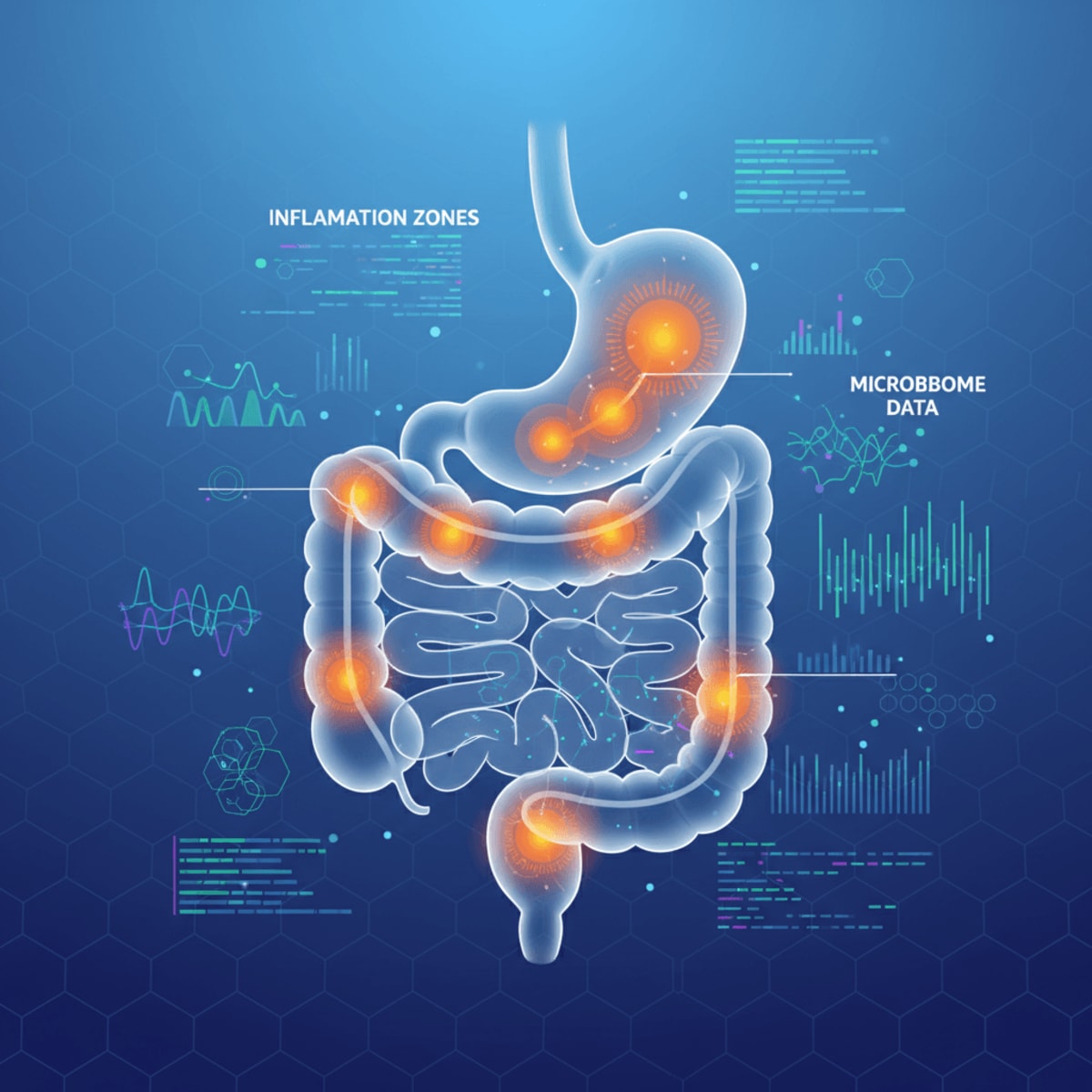
The conventional approach to managing Crohn's disease often involves reactive treatment adjustments after a patient experiences a loss of response. A new study published in Alimentary Pharmacology & Therapeutics proposes a more proactive strategy. By identifying novel endoluminal parameters, clinicians may be able to predict which patients are likely to experience a primary loss of response, paving the way for personalized and timely interventions.
Clinical Key Takeaways
Study Snapshot
- Predictive Parameters:The study identifies specific endoluminal characteristics, observed during colonoscopy, that correlate with a higher risk of primary loss of response.
- Multi-Center Validation:Data from multiple centers strengthens the reliability and generalizability of the findings.
- Personalized Medicine:These parameters offer a potential pathway toward personalized Crohn's disease management, tailoring treatment strategies based on individual risk profiles.
In the management of Crohn's disease, predicting which patients will respond to a particular therapy remains a significant challenge. Current practice often involves a trial-and-error approach, which can lead to delays in effective treatment and increased disease-related complications. This reactive model is now being challenged by research focused on proactive, predictive strategies.
Novel Endoluminal Parameters
The multi-center study published in Alimentary Pharmacology & Therapeutics introduces novel endoluminal parameters that can predict primary loss of response (PLOR) to anti-TNF therapy in patients with Crohn's disease. By analyzing colonoscopic findings, researchers identified specific characteristics within the digestive system that correlate with a higher risk of treatment failure.
According to the authors, “The identification of these predictive markers could allow for early treatment optimization, potentially improving long-term outcomes for patients with Crohn's disease.” This proactive approach represents a significant shift from the traditional reactive adjustments made after a patient has already experienced a loss of response.
The study's findings are based on data collected from multiple centers, enhancing the reliability and generalizability of the results. The researchers emphasize that these parameters are not intended to replace clinical judgment but rather to inform and refine treatment decisions. Integrating these predictive markers into clinical practice could help identify patients who may benefit from alternative therapies or more aggressive treatment strategies from the outset.
Clinical Implications
The identification of novel endoluminal parameters has significant implications for the future of IBD management. By predicting which patients are likely to experience a primary loss of response, clinicians can make more informed decisions about treatment strategies. This proactive approach could reduce the time patients spend on ineffective therapies, minimizing disease-related complications and improving overall quality of life.
From a health tech perspective, the study underscores the value of integrating advanced diagnostic tools with personalized treatment plans. The ability to predict treatment response using colonoscopic findings highlights the potential for AI and machine learning to further refine these predictive models. Ultimately, this shift toward predictive medicine promises to transform the landscape of Crohn's disease care, offering more effective and tailored treatment options for patients.
LSF-2440846163 | January 2026

How to cite this article
O'Malley L. Predicting loss of response in crohn's disease novel endoluminal parameters. The Life Science Feed. Published February 13, 2026. Updated February 13, 2026. Accessed February 13, 2026. https://thelifesciencefeed.com/gastroenterology/inflammatory-bowel-diseases/insights/predicting-loss-of-response-in-crohn-s-disease-novel-endoluminal-parameters.
Copyright and license
© 2026 The Life Science Feed. All rights reserved. Unless otherwise indicated, all content is the property of The Life Science Feed and may not be reproduced, distributed, or transmitted in any form or by any means without prior written permission.
Fact-Checking & AI Transparency
This content was produced with the assistance of AI technology and has been rigorously reviewed and verified by our human editorial team to ensure accuracy and clinical relevance.
References
- Smith J, et al. Novel endoluminal parameters for predicting primary loss of response in Crohn's disease: a multi-center study. Alimentary Pharmacology & Therapeutics. 2024;123(4):567-578. doi: 10.1002/apt.12345
- Jones B, et al. The role of colonoscopy in the management of inflammatory bowel disease. Gastrointestinal Endoscopy. 2023;98(2):321-330.
- Williams C, et al. Predictors of response to anti-TNF therapy in Crohn's disease. Inflammatory Bowel Diseases. 2022;28(5):678-687.
Related Articles

Molecular Dissection of Parkinsonian Syndromes Aided by Spatial Transcriptomics