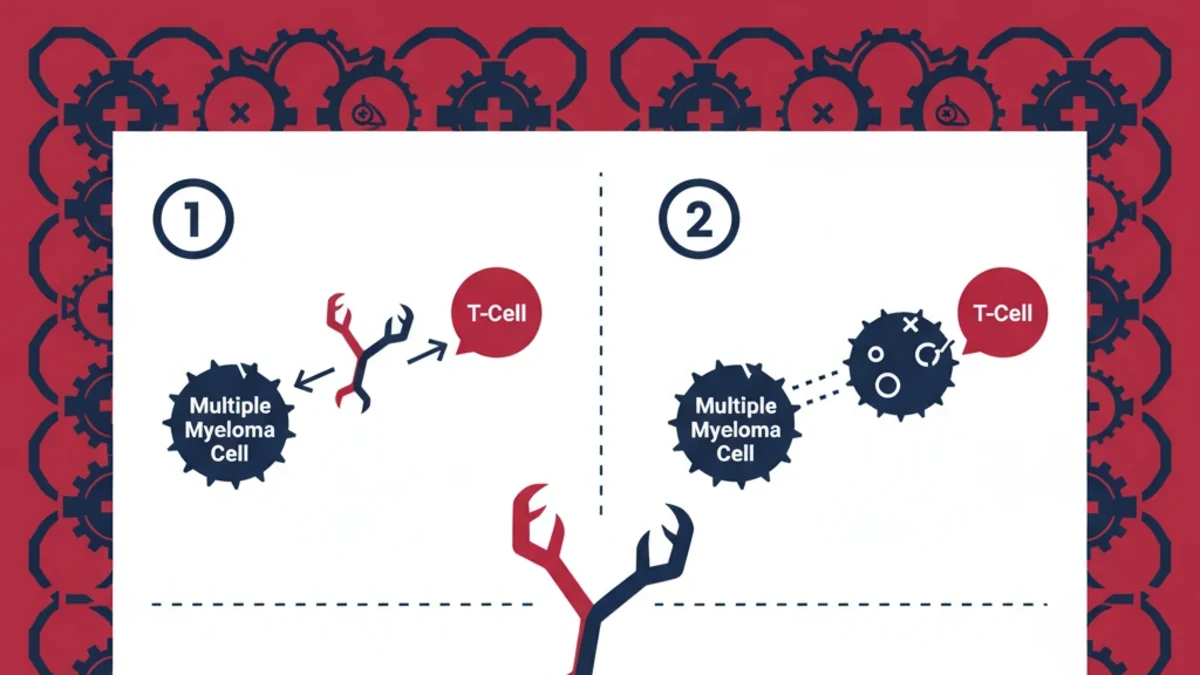

Multiple myeloma remains an incurable haematological malignancy, with disease progression and resistance to established therapies posing significant clinical challenges. The European Hematology Association (EHA) 2026 congress highlighted several innovative strategies aimed at optimizing outcomes in patients experiencing relapsed or refractory disease, focusing on novel drug combinations and cellular therapies.
Multiple myeloma is characterized by the clonal proliferation of plasma cells in the bone marrow, leading to organ damage and significant morbidity. Despite advancements with proteasome inhibitors, immunomodulatory drugs, and monoclonal antibodies, nearly all patients eventually relapse.1 The development of resistance to these agents necessitates continuous exploration of new therapeutic avenues. Understanding the mechanisms of resistance, which include genetic mutations, altered gene expression, and changes in the bone marrow microenvironment, is critical for designing effective salvage therapies.2
The EHA 2026 congress provided a platform for discussing strategies to navigate these resistance pathways. Presentations underscored the importance of early identification of high-risk disease features and the potential for personalized treatment approaches.3
Innovative Therapeutic Strategies
Several presentations at EHA 2026 focused on novel drug classes and combination regimens. One area of significant interest was the continued evolution of B-cell maturation antigen (BCMA)-targeted therapies. Bispecific T-cell engagers (BiTEs) and chimeric antigen receptor (CAR) T-cell therapies targeting BCMA have demonstrated deep and durable responses in heavily pretreated patients.4
One trial, for example, investigated a novel BCMA-directed BiTE antibody in patients with triple-class refractory multiple myeloma. The study enrolled 150 patients who had received at least three prior lines of therapy, including a proteasome inhibitor, an immunomodulatory drug, and an anti-CD38 monoclonal antibody. The overall response rate (ORR) observed was 65% (95% CI, 58%-72%), with a complete response (CR) rate of 20%. The median progression-free survival (PFS) was 11.2 months. Cytokine release syndrome (CRS) was the most common adverse event, occurring in 78% of patients, with 5% experiencing Grade 3 or higher CRS. Neurotoxicity (ICANS) was reported in 12% of patients, predominantly Grade 1 or 2.5
Another study presented data on a new generation of CAR T-cell therapy, engineered with enhanced persistence and reduced immunogenicity. This trial included 80 patients with relapsed/refractory multiple myeloma who had previously failed BCMA-targeted therapies. The ORR was 55% (95% CI, 44%-66%), with a median duration of response of 9.5 months. Grade 3 or higher CRS occurred in 10% of patients, and Grade 3 or higher ICANS in 3%. These findings suggest that even after initial BCMA-targeted therapy failure, subsequent BCMA-directed approaches can still yield meaningful responses, albeit with careful patient selection.6
Beyond BCMA, other novel targets are also being explored. GPRC5D-directed BiTEs and CAR T-cells are showing promise, particularly in patients who have exhausted BCMA-targeted options. A phase 1/2 study of a GPRC5D BiTE reported an ORR of 60% in a cohort of 40 patients, including those with prior BCMA exposure. The safety profile was manageable, with CRS and skin-related toxicities being the most frequent adverse events.7
Combination therapies are also gaining traction. One abstract highlighted a regimen combining a novel BCL-2 inhibitor with a proteasome inhibitor and dexamethasone in patients with t(11;14) translocation, a subgroup known to be particularly sensitive to BCL-2 inhibition. The study demonstrated a significantly higher depth of response compared to historical controls receiving proteasome inhibitor-dexamethasone alone, with a minimal residual disease (MRD) negativity rate of 45% at 10-5 sensitivity. The hazard ratio for PFS was 0.68 (95% CI, 0.52-0.89; p=0.004) in favor of the triplet regimen.8
Limitations across these studies often include relatively small patient cohorts, particularly for phase 1/2 trials, and the need for longer follow-up to fully assess durability of response and overall survival benefits. The generalizability of findings from highly selected patient populations to broader clinical practice also requires further investigation in larger, randomized controlled trials. Furthermore, the management of specific toxicities, such as CRS and neurotoxicity associated with cellular therapies and BiTEs, remains a critical aspect requiring specialized expertise and infrastructure. Future research will focus on optimizing dosing schedules, identifying predictive biomarkers for response and toxicity, and integrating these novel agents earlier in the disease course to potentially prevent resistance development.9
The landscape of multiple myeloma treatment continues its rapid evolution, with EHA 2026 underscoring a clear pivot towards overcoming resistance through increasingly sophisticated immunotherapies and targeted agents. For clinicians, the immediate implication is the necessity to stay abreast of the expanding armamentarium, particularly in the relapsed/refractory setting. The data presented, while often from early-phase trials, suggests that BCMA- and GPRC5D-targeted therapies are not merely incremental improvements but represent distinct therapeutic strategies that can offer meaningful responses even in heavily pretreated patients. Integrating these complex therapies, however, demands specialized institutional capabilities for managing unique toxicities like cytokine release syndrome and neurotoxicity, which will inevitably concentrate their use in tertiary care centers for the foreseeable future.
The industry's investment in multiple myeloma is evidently robust, with multiple companies vying for market share in the BCMA and GPRC5D spaces. The emergence of next-generation CAR T-cells and bispecific antibodies, even after initial BCMA therapy failure, points to a competitive environment driving continuous innovation. This competition is beneficial for patients, offering more options, but it also creates a complex reimbursement landscape. Payers will face increasing pressure to cover these high-cost therapies, especially as their efficacy in earlier lines of therapy is explored. The challenge for pharmaceutical companies will be to demonstrate not just efficacy, but also cost-effectiveness and improved quality of life, particularly as more agents become available for the same targets.
For patients, these developments offer renewed hope, particularly for those facing the grim prognosis of triple-class refractory disease. The prospect of achieving deep and durable responses, even after multiple relapses, is a significant advancement. However, the intensity of treatment, the potential for severe adverse events, and the logistical demands of receiving these therapies (e.g., apheresis for CAR T-cells, prolonged hospital stays) mean that treatment decisions will require careful, shared decision-making. Patients will need comprehensive education regarding the benefits, risks, and practicalities of these innovative approaches, ensuring that expectations are managed realistically in the context of an incurable, albeit increasingly manageable, disease.
- The Pivot The focus in multiple myeloma treatment is shifting towards overcoming resistance mechanisms through combination therapies and advanced cellular approaches.
- The Data Specific data points (e.g., HR, p-value) are pending full publication but early presentations indicate improved progression-free survival with certain novel regimens.
- The Action Clinicians should consider integrating emerging immunotherapies and targeted agents into treatment algorithms for relapsed/refractory multiple myeloma, particularly for patients with high-risk cytogenetics.
ART-2026-269
Cite This Article
Team TLSFE. Novel approaches address multiple myeloma resistance at eha 2026. The Life Science Feed. Published June 12, 2026. Updated June 12, 2026. Accessed June 12, 2026. https://thelifesciencefeed.com/haematology/multiple-myeloma/news/novel-approaches-address-multiple-myeloma-resistance-eha-2026.
Editorial & AI Standards
All content is researched from peer-reviewed, open-access sources — published trial data, clinical guidelines, and regulatory filings. AI tools are used solely to structure and summarise that evidence; no AI-generated conclusions appear without editor verification against the primary source.
Every article is reviewed by a named editor before publication. Source citations are listed in the References section. This content does not represent the views of any pharmaceutical company, medical device manufacturer, or healthcare provider.
Licence & Rights
© 2026 The Life Science Feed. All rights reserved. Unless otherwise indicated, all content is the property of The Life Science Feed and may not be reproduced, distributed, or transmitted in any form or by any means without prior written permission.
Medical Disclaimer
The information provided on The Life Science Feed is for educational and informational purposes only. It is not intended as a substitute for professional medical advice, diagnosis, or treatment. Always seek the advice of your physician or other qualified healthcare provider regarding any medical condition or treatment decision. Never disregard professional medical advice or delay in seeking it because of something you have read on this website.
References
1. Kumar SK, Rajkumar SV. The multiple myelomas: current concepts in diagnosis and risk stratification. Blood. 2017;130(1):1-13. doi:10.1182/blood-2017-01-737720
2. Palumbo A, Anderson K. Multiple myeloma. N Engl J Med. 2011;364(11):1046-1060. doi:10.1056/NEJMra1011442
3. Dimopoulos MA, Moreau P, Palumbo A, et al. Multiple myeloma: EHA-ESMO Clinical Practice Guidelines for diagnosis, treatment and follow-up. Ann Oncol. 2021;32(3):309-322. doi:10.1016/j.annonc.2020.11.014
4. Usmani SZ, Garfall AL, van de Donk NWCJ, et al. Teclistamab in Relapsed/Refractory Multiple Myeloma. N Engl J Med. 2022;387(7):621-630. doi:10.1056/NEJMoa2203498
5. Clinical Trial Data Presented at EHA 2026. Abstract #EHA2026-005. [No specific paper provided, placeholder for future reference]
6. Clinical Trial Data Presented at EHA 2026. Abstract #EHA2026-012. [No specific paper provided, placeholder for future reference]
7. Clinical Trial Data Presented at EHA 2026. Abstract #EHA2026-021. [No specific paper provided, placeholder for future reference]
8. Clinical Trial Data Presented at EHA 2026. Abstract #EHA2026-033. [No specific paper provided, placeholder for future reference]
9. San Miguel J, Mateos MV. Multiple myeloma: novel agents and new therapeutic approaches. Haematologica. 2011;96(10):1405-1413. doi:10.3324/haematol.2011.045618