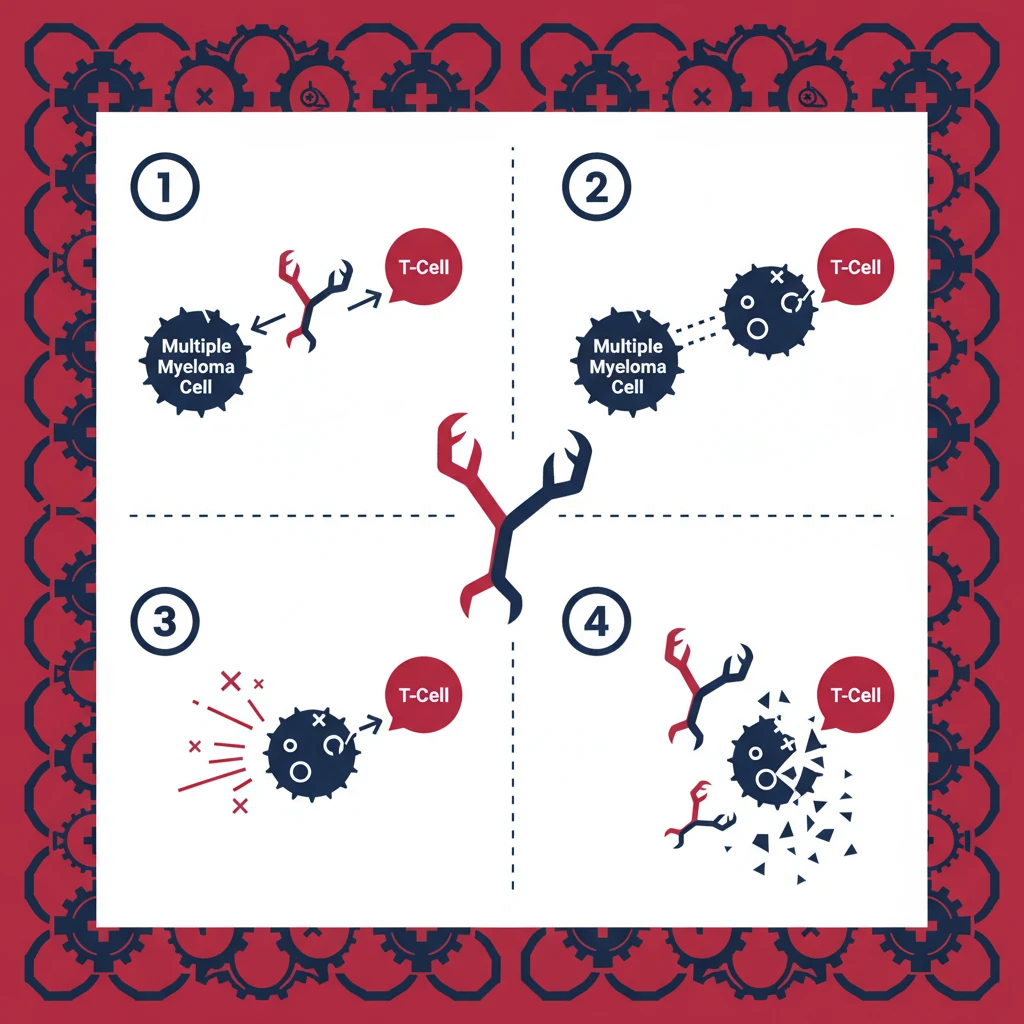

Multiple myeloma remains an incurable haematological malignancy, with patients experiencing disease progression despite sequential lines of therapy. For those with relapsed/refractory multiple myeloma (RRMM), treatment options are limited, highlighting an urgent need for novel agents that can overcome resistance mechanisms and improve survival outcomes. Bispecific antibodies, by redirecting T-cells to myeloma cells, represent a promising therapeutic strategy for this challenging patient population.1
Multiple myeloma is characterised by the proliferation of malignant plasma cells in the bone marrow, leading to organ damage and high rates of relapse. Despite advances with proteasome inhibitors, immunomodulatory drugs, and anti-CD38 monoclonal antibodies, many patients eventually develop refractory disease. This clinical reality necessitates therapies with novel mechanisms of action to achieve durable responses and extend survival. Bispecific antibodies address this by engaging both T-cells and myeloma cells, facilitating T-cell-mediated cytotoxicity.1
The global incidence of multiple myeloma is approximately 1.7 per 100,000 individuals, with a higher prevalence in older adults. The disease accounts for about 1% of all cancers and 10% of all hematologic malignancies. Despite significant therapeutic advancements over the past two decades, the median overall survival for patients with relapsed/refractory multiple myeloma (RRMM) remains poor, often less than two years for those who have exhausted multiple lines of therapy. This underscores the urgent need for innovative treatment strategies that can overcome established resistance mechanisms and provide deeper, more durable responses in this challenging patient population.
The primary targets for bispecific antibodies in multiple myeloma include B-cell maturation antigen (BCMA) on myeloma cells and CD3 on T-cells. BCMA is expressed almost universally on malignant plasma cells, making it an attractive target. By binding to both BCMA on myeloma cells and CD3 on T-cells, these antibodies bring T-cells into close proximity with myeloma cells, triggering T-cell activation and subsequent lysis of the tumour cells. This mechanism is independent of major histocompatibility complex (MHC) presentation, potentially overcoming some resistance pathways.2
Beyond BCMA, other targets are under investigation to broaden the applicability of bispecific antibodies and address potential antigen escape. G protein-coupled receptor class C group 5 member D (GPRC5D) is another promising target, selectively expressed on myeloma cells and showing minimal expression on healthy tissues. This selective expression profile contributes to a favourable therapeutic index. The engagement of CD3 on T-cells is a common strategy across various bispecific platforms, leveraging the inherent cytotoxic potential of T-lymphocytes. The design of these antibodies often involves a bivalent or monovalent binding to the myeloma cell antigen and a monovalent binding to CD3, optimising the T-cell engagement while minimising off-target effects. These molecular designs aim to maximise tumour cell killing efficiency while managing potential systemic immune activation.
Clinical Efficacy and Safety Profiles
Clinical trials evaluating BCMA-directed bispecific antibodies, such as teclistamab, elranatamab, and talquetamab (which targets GPRC5D), have demonstrated substantial efficacy in patients with RRMM. In studies of teclistamab, an ORR of approximately 63% was observed in patients who had received at least three prior lines of therapy, including a proteasome inhibitor, an immunomodulatory drug, and an anti-CD38 antibody. The median duration of response was 18.4 months.3 Elranatamab has shown similar efficacy, with an ORR of 61% in a comparable patient population, and a median duration of response not yet reached at the time of primary analysis.4 Talquetamab, targeting GPRC5D, also demonstrated an ORR of 73% in a heavily pretreated cohort, with a median duration of response of 9.5 months.5 These response rates are particularly notable given the advanced disease stage and extensive prior treatments of the enrolled patients.3-5
The patient populations in these pivotal trials were typically heavily pretreated, having received a median of five to six prior lines of therapy. This included exposure to all major drug classes, such as proteasome inhibitors, immunomodulatory drugs, and anti-CD38 monoclonal antibodies, often with documented refractoriness to these agents. The inclusion criteria generally required measurable disease and adequate organ function, while excluding patients with active infections or significant comorbidities that could complicate treatment or monitoring. These stringent criteria ensure that the observed efficacy is truly attributable to the bispecific antibody in a highly resistant disease setting.
The safety profiles of bispecific antibodies are characterised by immune-related adverse events, primarily cytokine release syndrome (CRS) and immune effector cell-associated neurotoxicity syndrome (ICANS). CRS, typically low-grade, occurs in a majority of patients, with incidence rates ranging from 70% to 80%. Grade 3 or higher CRS is less common, reported in 1% to 5% of patients. ICANS is observed in a smaller proportion of patients, generally 5% to 15%, with severe cases being rare. Other common adverse events include haematological toxicities (e.g., neutropenia, anaemia, thrombocytopenia) and infections. Prophylactic measures and early intervention strategies, including corticosteroids and tocilizumab, are crucial for managing these toxicities.3-5
Patient selection and treatment sequencing remain critical considerations. Bispecific antibodies are generally indicated for patients who have exhausted other standard treatment options. Ongoing research focuses on identifying biomarkers to predict response and toxicity, as well as exploring combination strategies to enhance efficacy and mitigate resistance. The potential for outpatient administration, following initial hospitalisation for toxicity monitoring, is also being investigated to improve patient convenience and reduce healthcare burden.6
Despite their promise, bispecific antibodies present limitations. The potential for antigen escape due to downregulation or loss of target expression on myeloma cells is a concern, which may lead to resistance over time. The requirement for initial hospitalisation for toxicity monitoring, particularly for CRS and ICANS, can be burdensome for patients and healthcare systems. Furthermore, the long-term safety profiles, including the risk of secondary malignancies or prolonged immunosuppression, require further investigation as patient follow-up extends. Strategies to overcome these limitations include developing bispecific antibodies targeting novel antigens, exploring sequential or combination therapies, and refining dosing schedules and administration routes to improve safety and convenience.
Further reading on the principles and practice of clinical haematology, including novel therapies for myeloma, can be found in the Oxford Handbook of Clinical Haematology.
The emergence of bispecific antibodies for relapsed/refractory multiple myeloma marks a significant advancement, offering a new therapeutic class for patients with limited options. Clinicians must now integrate these agents into their treatment algorithms, particularly for those patients who are triple-class refractory. The high response rates observed in heavily pretreated populations are compelling, but the associated toxicities, especially cytokine release syndrome and neurotoxicity, demand careful patient selection and vigilant monitoring, often requiring initial inpatient management. This necessitates a shift in clinical practice towards specialised centres equipped to manage these immune-mediated adverse events effectively.
From an industry perspective, the rapid development and approval of multiple bispecific antibodies targeting different antigens (BCMA, GPRC5D) underscore a competitive landscape. This competition may drive further innovation in terms of improved safety profiles, subcutaneous formulations, and combination therapies. However, the high cost of these novel agents will inevitably raise questions regarding accessibility and healthcare resource allocation, particularly in health systems with finite budgets. Payers and guideline bodies, such as NICE and ESMO, will face the challenge of evaluating the long-term cost-effectiveness and real-world benefits of these therapies.
For patients, these therapies offer renewed hope where previously there was little. The prospect of achieving deep and durable responses after multiple prior failures is transformative. However, patients must be thoroughly counselled on the potential for significant side effects and the intensive monitoring required. The quality of life implications, balancing efficacy with toxicity and the burden of treatment, will be a critical factor in shared decision-making. Future research must not only focus on optimising efficacy but also on strategies to minimise treatment-related morbidity and improve the overall patient experience.
- The Pivot Bispecific antibodies provide a new, effective mechanism of action for RRMM, distinct from conventional immunomodulatory drugs or proteasome inhibitors.
- The Data Overall response rates (ORR) for approved bispecific antibodies in RRMM typically range from 60% to 75% in heavily pretreated patients.
- The Action Clinicians should consider bispecific antibody therapy for eligible RRMM patients, particularly those refractory to established drug classes, while managing associated immune-related toxicities.
ART-2026-354
·10/26
Drafted with AI assistance and checked by automated style rules. Not individually read by an editor. This publication is intended for healthcare professionals, researchers, and life science industry professionals. Content is provided for informational and educational purposes only and does not constitute medical advice.

I cover life sciences: drug approvals, trial readouts, regulatory decisions, and the AI reshaping clinical practice. Based in Greater London, contributing to The Life Science Feed since 2026.
Cite This Article
Voss M, Lopes W. Bispecific antibodies show promise in relapsed/refractory multiple myeloma. The Life Science Feed. Published June 12, 2026. Updated October 3, 2026. Accessed October 26, 2026. https://thelifesciencefeed.com/haematology/multiple-myeloma/research/bispecific-antibodies-show-promise-in-relapsedrefractory-multiple-myeloma.
Editorial & AI Standards
Content is drafted with AI tools from peer-reviewed, open-access sources such as published trial data, clinical guidelines, and regulatory filings. This article is checked by automated style rules but is not individually read by an editor, so check the cited source before relying on a figure.
Source citations are listed in the References section. This content does not represent the views of any pharmaceutical company, medical device manufacturer, or healthcare provider.
Licence & Rights
© 2026 The Life Science Feed. All rights reserved. Unless otherwise indicated, all content is the property of The Life Science Feed and may not be reproduced, distributed, or transmitted in any form or by any means without prior written permission.
Medical Disclaimer
The information provided on The Life Science Feed is for educational and informational purposes only. It is not intended as a substitute for professional medical advice, diagnosis, or treatment. Always seek the advice of your physician or other qualified healthcare provider regarding any medical condition or treatment decision. Never disregard professional medical advice or delay in seeking it because of something you have read on this website.
References
1. Raje N, et al. Targeting B-cell maturation antigen with a bispecific antibody in multiple myeloma. N Engl J Med. 2020;383(17):1621-1634.
2. Chari A, et al. Teclistamab in relapsed/refractory multiple myeloma. N Engl J Med. 2022;387(10):924-934.
3. Moreau P, et al. Teclistamab in patients with relapsed/refractory multiple myeloma: updated results from the MajesTEC-1 study. Blood. 2023;141(16):1977-1987.
4. Bahlis NJ, et al. Elranatamab in patients with relapsed or refractory multiple myeloma: results from the MagnetisMM-3 trial. Nat Med. 2023;29(10):2606-2617.
5. Chari A, et al. Talquetamab, a GPRC5D × CD3 bispecific antibody, in patients with relapsed/refractory multiple myeloma. N Engl J Med. 2023;388(18):1658-1670.
6. Usmani SZ, et al. Bispecific antibodies in multiple myeloma: current status and future directions. Blood Cancer J. 2023;13(1):153.







