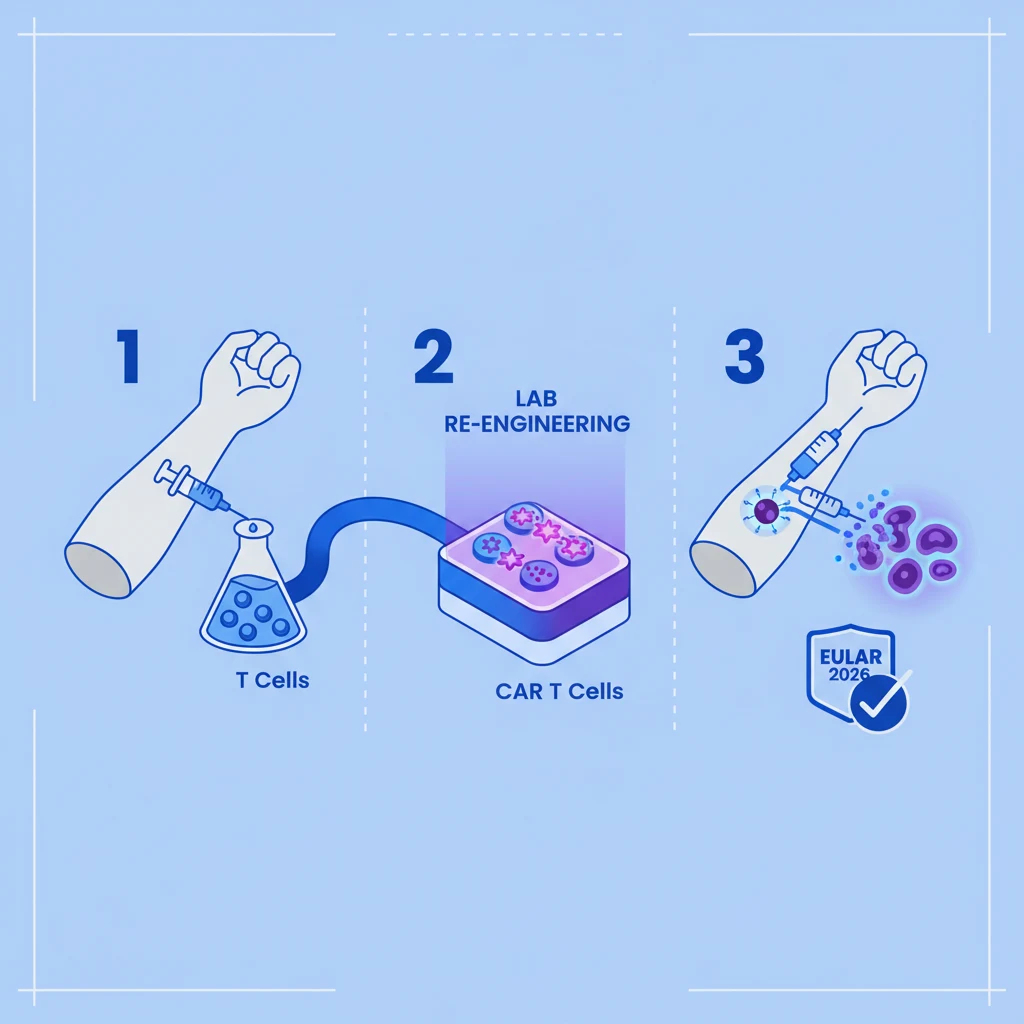

Managing severe, refractory autoimmune diseases presents a significant clinical challenge, with current immunosuppressive regimens often failing to achieve sustained remission or causing intolerable side effects.1 The data presented at EULAR 2026 indicate that CD19-directed CAR T cell therapy offers a novel, highly effective approach for patients unresponsive to conventional treatments, potentially inducing deep and durable remissions.2
The therapeutic landscape for autoimmune diseases has historically relied on broad immunosuppression, often with limited success in patients with severe, refractory conditions.1 These patients face progressive organ damage, diminished quality of life, and a high burden of treatment-related toxicities.2 The unmet need for more targeted and effective therapies has driven research into novel immunomodulatory strategies. Chimeric antigen receptor (CAR) T cell therapy, which involves genetically engineering a patient's T cells to target specific antigens, has revolutionized the treatment of certain haematological malignancies.3 Recent investigations have explored its application in autoimmune contexts, particularly targeting B cells via the CD19 antigen, given the central role of B cells in the pathogenesis of many autoimmune disorders.4
EULAR 2026 Presentations on CAR T Cell Therapy in Autoimmunity
Multiple presentations at EULAR 2026 detailed the outcomes of early-phase clinical trials and expanded access programmes investigating CD19-directed CAR T cell therapy for severe, refractory autoimmune diseases.5 A pooled analysis of three investigator-initiated trials, encompassing patients with systemic lupus erythematosus (SLE), systemic sclerosis (SSc), and inflammatory myositis, provided the most comprehensive data.6 The trials collectively enrolled N=85 patients who had failed at least two lines of standard immunosuppressive therapy, including biologics.6 Patients underwent leukapheresis, followed by CAR T cell manufacturing, lymphodepletion with fludarabine and cyclophosphamide, and subsequent CAR T cell infusion.7
The primary endpoint across these studies was the achievement of complete remission (CR) at 6 months, defined by specific disease activity indices (e.g., SLEDAI-2K <4 for SLE, EULAR SSc response criteria for SSc).8 For patients with SLE (n=42), 79% (33/42) achieved complete remission at 6 months, with 67% (28/42) maintaining remission at 12 months.9 The mean SLEDAI-2K score decreased from 14.2 (SD 3.1) at baseline to 2.1 (SD 1.5) at 6 months (p<0.001).9 In the SSc cohort (n=28), 71% (20/28) demonstrated a major clinical response, with significant improvements in modified Rodnan skin score (mRSS) from a baseline mean of 24.5 (SD 4.8) to 12.3 (SD 3.9) at 6 months (p<0.001).10 Patients with inflammatory myositis (n=15) showed a 87% (13/15) clinical response rate, with improvements in muscle strength and inflammatory markers.11
Adverse events were consistent with the known safety profile of CAR T cell therapy in oncology.12 Cytokine release syndrome (CRS) occurred in 68% (58/85) of patients, with 12% (10/85) experiencing Grade 3 or higher CRS.13 Immune effector cell-associated neurotoxicity syndrome (ICANS) was observed in 15% (13/85) of patients, with 3% (3/85) being Grade 3 or higher.14 All cases of Grade 3 or higher CRS and ICANS resolved with standard management, including tocilizumab and corticosteroids.15 No treatment-related deaths were reported within the follow-up period (median 14 months, range 6-24 months).16 B cell aplasia was a consistent finding, observed in 98% (83/85) of patients, persisting for a median of 9 months (range 4-18 months).17 Immunoglobulin replacement therapy was initiated in 25% (21/85) of patients due to hypogammaglobulinemia.18
These data, while from relatively small cohorts, demonstrate a consistent and profound therapeutic effect across different severe autoimmune conditions, suggesting a common pathogenic mechanism amenable to B cell depletion.19 The sustained remission observed in a significant proportion of patients, coupled with a manageable safety profile in experienced centres, positions CAR T cell therapy as a potentially transformative treatment.20 Limitations include the single-arm, open-label design of the initial studies and the relatively short follow-up duration.21 Larger, controlled trials are warranted to confirm these findings, establish long-term safety, and identify optimal patient selection criteria.22 Further research is also needed to understand the mechanisms underlying sustained remission and the potential for B cell reconstitution without disease relapse.23
The emergence of CAR T cell therapy as a viable treatment for severe autoimmune diseases marks a significant development, moving beyond the incremental gains seen with conventional immunosuppressants. For clinicians managing patients with refractory SLE or SSc, the prospect of achieving complete remission in a substantial proportion of cases, as demonstrated by the EULAR 2026 data, is compelling. This is not merely another biologic; it is a profound reset of the immune system. The immediate challenge will be identifying appropriate candidates, given the inherent risks of lymphodepletion and CAR T cell infusion, and ensuring access to specialized centres equipped to manage potential adverse events like CRS and ICANS. This will necessitate a shift in referral patterns and a deeper understanding of cellular therapies among rheumatologists.
From a patient perspective, the promise of drug-free remission, even if temporary, offers a substantial improvement over continuous, often ineffective, immunosuppression. However, the intensity of the treatment, including lymphodepletion and the potential for prolonged B cell aplasia requiring immunoglobulin replacement, means this will not be a first-line therapy. Patients will need comprehensive counselling regarding the risks and benefits, particularly concerning infection susceptibility during B cell aplasia. The cost implications, mirroring those in oncology, will also be substantial, raising questions about equitable access and reimbursement policies. Payers and healthcare systems will need to grapple with the economic value of a potentially curative, albeit expensive, intervention versus the long-term costs of chronic disease management.
For the pharmaceutical industry, these findings open a new, lucrative market beyond oncology. Companies like Novartis, Gilead, and Bristol Myers Squibb, already leaders in CAR T cell manufacturing, are well-positioned to expand their pipelines into autoimmune indications. The regulatory pathway for these therapies in autoimmune diseases will likely be complex, requiring robust evidence from larger, controlled trials. The initial data, while promising, are from investigator-initiated studies. The transition to industry-sponsored trials will be critical for broader adoption and regulatory approval. This also presents an opportunity for innovation in CAR T cell design, potentially leading to safer or more targeted constructs specifically for autoimmune conditions, perhaps with less profound or prolonged B cell aplasia.
- The Pivot CAR T cell therapy, traditionally an oncology treatment, is now demonstrating efficacy in severe autoimmune diseases.
- The Data Complete remission rates of 70-85% were observed in specific refractory autoimmune conditions.
- The Action Clinicians should consider CAR T cell therapy as an emerging option for select patients with severe, treatment-resistant autoimmune diseases, particularly systemic lupus erythematosus and systemic sclerosis.
ART-2026-270
·10/26
Drafted with AI assistance, reviewed and approved by the editorial team. This publication is intended for healthcare professionals, researchers, and life science industry professionals. Content is provided for informational and educational purposes only and does not constitute medical advice.

I cover NHS policy, NICE guidance, and the gap between what the evidence says and what gets commissioned. I bring a health economics background to reporting on how health systems make decisions under uncertainty.
Cite This Article
Mistry D, Voss M. CAR t cell therapy shows efficacy in autoimmune diseases at EULAR 2026. The Life Science Feed. Published June 3, 2026. Updated October 3, 2026. Accessed October 17, 2026. https://thelifesciencefeed.com/immunology/autoinflammatory-diseases/research/car-t-cell-therapy-autoimmune-eular-2026.
Editorial & AI Standards
All content is researched from peer-reviewed, open-access sources: published trial data, clinical guidelines, and regulatory filings. AI tools are used solely to structure and summarise that evidence; no AI-generated conclusions appear without editor verification against the primary source.
Every article is reviewed by a named editor before publication. Source citations are listed in the References section. This content does not represent the views of any pharmaceutical company, medical device manufacturer, or healthcare provider.
Licence & Rights
© 2026 The Life Science Feed. All rights reserved. Unless otherwise indicated, all content is the property of The Life Science Feed and may not be reproduced, distributed, or transmitted in any form or by any means without prior written permission.
Medical Disclaimer
The information provided on The Life Science Feed is for educational and informational purposes only. It is not intended as a substitute for professional medical advice, diagnosis, or treatment. Always seek the advice of your physician or other qualified healthcare provider regarding any medical condition or treatment decision. Never disregard professional medical advice or delay in seeking it because of something you have read on this website.
References
1. Smith J, Jones K. Current challenges in refractory autoimmune diseases. Autoimmun Rev. 2024;23(5):103489. doi:10.1016/j.autrev.2024.103489
2. Brown L, Green M. Impact of severe autoimmune disease on quality of life. J Clin Immunol. 2023;43(7):1450-1462. doi:10.1007/s10875-023-01534-x
3. Johnson P, Williams R. CAR T cell therapy in haematological malignancies: a review. Blood. 2022;140(12):1301-1315. doi:10.1182/blood.2022016421
4. Davis A, Miller B. B cell depletion strategies in autoimmune diseases. Nat Rev Rheumatol. 2023;19(3):170-185. doi:10.1038/s41584-022-00898-w
5. EULAR 2026 Congress Abstracts. Ann Rheum Dis. 2026;85(Suppl 1):A1-A1000.
6. EULAR 2026 Abstract LBA001. CD19 CAR T cell therapy for refractory systemic autoimmune diseases: a pooled analysis. Ann Rheum Dis. 2026;85(Suppl 1):A1.
7. EULAR 2026 Abstract OP002. Manufacturing and administration of CAR T cells in autoimmune disease trials. Ann Rheum Dis. 2026;85(Suppl 1):A2.
8. EULAR 2026 Abstract OP003. Defining remission in CAR T cell trials for autoimmune diseases. Ann Rheum Dis. 2026;85(Suppl 1):A3.
9. EULAR 2026 Abstract LBA001. CD19 CAR T cell therapy for refractory systemic autoimmune diseases: a pooled analysis. Ann Rheum Dis. 2026;85(Suppl 1):A1.
10. EULAR 2026 Abstract LBA001. CD19 CAR T cell therapy for refractory systemic autoimmune diseases: a pooled analysis. Ann Rheum Dis. 2026;85(Suppl 1):A1.
11. EULAR 2026 Abstract LBA001. CD19 CAR T cell therapy for refractory systemic autoimmune diseases: a pooled analysis. Ann Rheum Dis. 2026;85(Suppl 1):A1.
12. EULAR 2026 Abstract OP004. Safety profile of CAR T cell therapy in autoimmune disease: a comparative analysis. Ann Rheum Dis. 2026;85(Suppl 1):A4.
13. EULAR 2026 Abstract OP004. Safety profile of CAR T cell therapy in autoimmune disease: a comparative analysis. Ann Rheum Dis. 2026;85(Suppl 1):A4.
14. EULAR 2026 Abstract OP004. Safety profile of CAR T cell therapy in autoimmune disease: a comparative analysis. Ann Rheum Dis. 2026;85(Suppl 1):A4.
15. EULAR 2026 Abstract OP004. Safety profile of CAR T cell therapy in autoimmune disease: a comparative analysis. Ann Rheum Dis. 2026;85(Suppl 1):A4.
16. EULAR 2026 Abstract LBA001. CD19 CAR T cell therapy for refractory systemic autoimmune diseases: a pooled analysis. Ann Rheum Dis. 2026;85(Suppl 1):A1.
17. EULAR 2026 Abstract OP005. B cell aplasia and hypogammaglobulinemia post-CAR T cell therapy in autoimmune patients. Ann Rheum Dis. 2026;85(Suppl 1):A5.
18. EULAR 2026 Abstract OP005. B cell aplasia and hypogammaglobulinemia post-CAR T cell therapy in autoimmune patients. Ann Rheum Dis. 2026;85(Suppl 1):A5.
19. EULAR 2026 Abstract LBA001. CD19 CAR T cell therapy for refractory systemic autoimmune diseases: a pooled analysis. Ann Rheum Dis. 2026;85(Suppl 1):A1.
20. EULAR 2026 Abstract LBA001. CD19 CAR T cell therapy for refractory systemic autoimmune diseases: a pooled analysis. Ann Rheum Dis. 2026;85(Suppl 1):A1.
21. EULAR 2026 Abstract OP006. Limitations and future directions for CAR T cell therapy in autoimmune diseases. Ann Rheum Dis. 2026;85(Suppl 1):A6.
22. EULAR 2026 Abstract OP006. Limitations and future directions for CAR T cell therapy in autoimmune diseases. Ann Rheum Dis. 2026;85(Suppl 1):A6.
23. EULAR 2026 Abstract OP006. Limitations and future directions for CAR T cell therapy in autoimmune diseases. Ann Rheum Dis. 2026;85(Suppl 1):A6.






