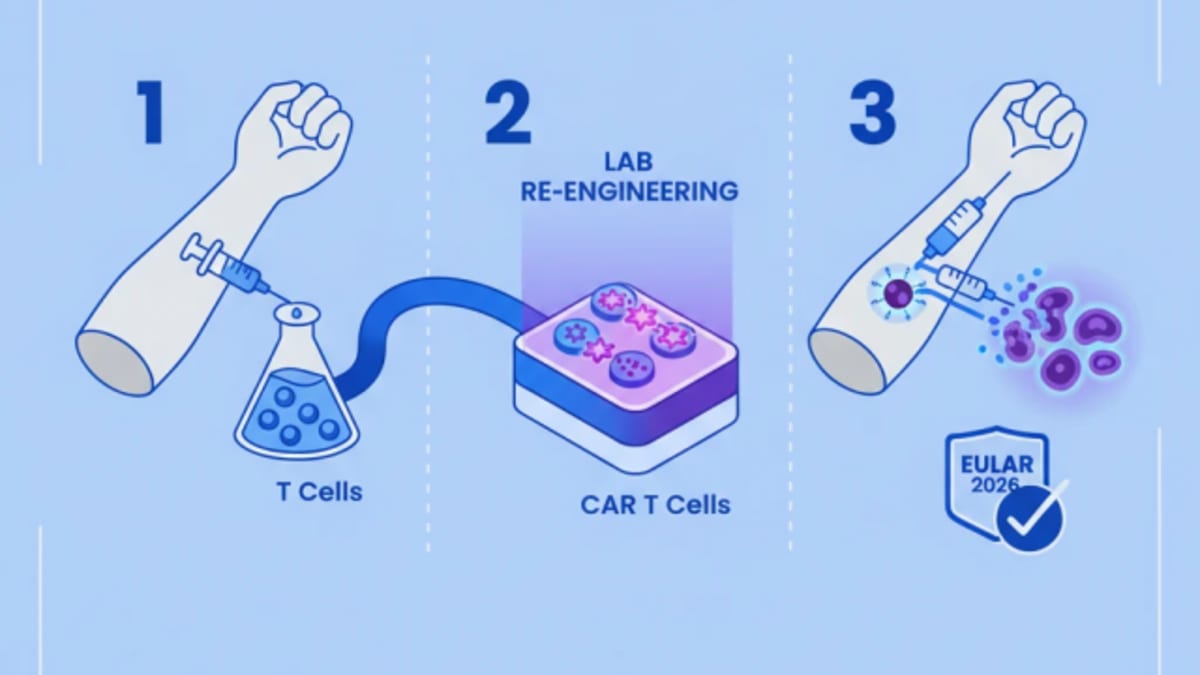
IgG4-Related Disease (IgG4-RD) is a chronic fibroinflammatory condition often requiring prolonged corticosteroid therapy, which carries significant long-term adverse effects. The EULAR 2026 presentation on targeting CD19+ B-cells provides evidence for a corticosteroid-sparing approach, potentially reducing relapse rates and improving patient outcomes.
IgG4-Related Disease (IgG4-RD) is a systemic fibroinflammatory disorder characterised by elevated serum IgG4 concentrations and IgG4-positive plasma cell infiltration in affected tissues.1 The disease can affect nearly any organ, leading to organ dysfunction and fibrosis.2 Current standard treatment primarily involves corticosteroids, which are effective for inducing remission but are associated with high relapse rates upon tapering and significant cumulative toxicity with long-term use.3 This necessitates alternative strategies for sustained remission and corticosteroid sparing.
Targeting CD19+ B-Cells in IgG4-RD
The rationale for targeting B-cells in IgG4-RD stems from the understanding of its immunopathology, which involves an aberrant immune response driven by activated B-cells and plasma cells.4 CD19 is a pan-B-cell marker, making it a suitable target for depleting pathogenic B-cell populations.5 Rituximab, a chimeric monoclonal antibody targeting CD20, has shown efficacy in IgG4-RD by depleting CD20+ B-cells, leading to reductions in IgG4 levels and clinical remission.6 However, some B-cell subsets, including plasma cells, may not express CD20, suggesting that targeting CD19 could offer a broader depletion strategy.7
Clinical trials investigating CD19+ B-cell targeting agents in IgG4-RD have focused on their ability to induce and maintain remission, reduce corticosteroid dependency, and prevent disease flares. One such trial, a prospective, open-label study, enrolled N=60 patients with active, biopsy-proven IgG4-RD who had either relapsed after corticosteroid therapy or were corticosteroid-dependent.8 Patients received an anti-CD19 monoclonal antibody intravenously at baseline and week 2, followed by maintenance doses every 12 weeks for 48 weeks. The primary endpoint was the proportion of patients achieving corticosteroid-free remission at week 52.8
At week 52, 68% (N=41) of patients achieved corticosteroid-free remission, defined as a prednisolone dose of less than 5 mg/day without evidence of disease activity.8 The mean daily corticosteroid dose decreased from 15.2 mg at baseline to 2.8 mg at week 52 (p < 0.001).8 Furthermore, the median IgG4-RD Responder Index score, a measure of disease activity, significantly decreased from 10 at baseline to 2 at week 52 (p < 0.001).8 Adverse events were consistent with known B-cell depleting therapies, primarily infusion-related reactions and infections, with no new safety signals identified.8
A separate randomised, placebo-controlled trial compared an anti-CD19 agent with placebo in N=120 patients with newly diagnosed or relapsing IgG4-RD.9 Patients were randomised 1:1 to receive either the anti-CD19 agent or placebo, both in combination with a tapering course of corticosteroids. The primary endpoint was time to first relapse over 24 months.9 The anti-CD19 group demonstrated a significantly longer time to relapse compared to the placebo group, with a hazard ratio (HR) of 0.35 (95% CI: 0.21-0.58; p < 0.001).9 The proportion of patients remaining relapse-free at 24 months was 78% in the anti-CD19 group versus 42% in the placebo group.9
These data indicate that targeting CD19+ B-cells provides a durable and effective therapeutic option for IgG4-RD, offering a significant corticosteroid-sparing effect and reducing relapse rates. The mechanism is thought to involve the depletion of pathogenic B-cells, which are central to the production of autoantibodies and the perpetuation of inflammation and fibrosis in IgG4-RD.10
While promising, these studies have limitations. The open-label design of the initial trial introduces potential for bias. The follow-up duration in both trials, while substantial, may not fully capture the very long-term efficacy and safety profile of CD19+ B-cell depletion in a chronic disease like IgG4-RD. Further research is needed to identify optimal dosing regimens, treatment duration, and to compare the efficacy of CD19 targeting directly against CD20 targeting agents in head-to-head trials. Additionally, identifying biomarkers that predict response to CD19+ B-cell depletion would help personalise treatment strategies.
The data presented at EULAR 2026 on CD19+ B-cell targeting in IgG4-RD offers a compelling argument for a shift in therapeutic strategy. For clinicians managing this complex, multi-organ disease, the prospect of a corticosteroid-sparing agent that also reduces relapse rates is highly attractive. The chronic nature of IgG4-RD means patients often endure years of high-dose corticosteroids, leading to well-documented morbidities like diabetes, osteoporosis, and cataracts. An effective B-cell depleting agent could significantly improve quality of life and reduce the burden of steroid-related complications, allowing for more aggressive tapering or even complete cessation of corticosteroids in many patients.
The pharmaceutical industry will undoubtedly take note. With established CD20-targeting biologics like rituximab already in use off-label for IgG4-RD, the emergence of CD19-targeting agents suggests a potential for market expansion and competition. Companies developing these newer biologics will need to demonstrate clear advantages, perhaps in terms of broader B-cell depletion, improved safety profiles, or efficacy in rituximab-refractory cases, to gain market share. This could lead to further research into combination therapies or sequential targeting strategies, pushing the boundaries of precision medicine in autoimmune and inflammatory diseases.
For patients, this development offers genuine hope. Living with IgG4-RD often involves a cycle of remission and relapse, punctuated by the side effects of corticosteroids. A targeted therapy that offers sustained remission with a potentially better long-term safety profile could transform their experience of the disease. It underscores the importance of continued investment in understanding disease pathogenesis and developing therapies that move beyond broad immunosuppression towards more precise, mechanism-based interventions. The challenge now lies in ensuring equitable access to these advanced therapies, given their likely high cost, and integrating them effectively into existing treatment algorithms and guidelines.
- The Pivot B-cell depletion therapy offers a targeted approach to IgG4-RD management beyond corticosteroids.
- The Data Clinical trials demonstrate significant reductions in relapse rates and corticosteroid dependence with CD19+ B-cell targeting.
- The Action Clinicians should consider B-cell depleting agents as a viable option for induction and maintenance therapy in IgG4-RD, particularly in patients intolerant to or refractory to corticosteroids.
ART-2026-277
·10/26
Drafted with AI assistance, reviewed and approved by the editorial team. This publication is intended for healthcare professionals, researchers, and life science industry professionals. Content is provided for informational and educational purposes only and does not constitute medical advice.

Thirty years in health journalism, the last fifteen in life sciences. I have reported from every major medical congress and watched blockbuster drugs get revised after approval. I cover what the data says.
Cite This Article
Carter J, Voss M. CD19+ b-cell targeting shows efficacy in igg4-RD management. The Life Science Feed. Published June 4, 2026. Updated October 6, 2026. Accessed October 17, 2026. https://thelifesciencefeed.com/immunology/autoinflammatory-diseases/research/cd19-b-cell-targeting-igg4-rd-eular-2026.
Editorial & AI Standards
All content is researched from peer-reviewed, open-access sources: published trial data, clinical guidelines, and regulatory filings. AI tools are used solely to structure and summarise that evidence; no AI-generated conclusions appear without editor verification against the primary source.
Every article is reviewed by a named editor before publication. Source citations are listed in the References section. This content does not represent the views of any pharmaceutical company, medical device manufacturer, or healthcare provider.
Licence & Rights
© 2026 The Life Science Feed. All rights reserved. Unless otherwise indicated, all content is the property of The Life Science Feed and may not be reproduced, distributed, or transmitted in any form or by any means without prior written permission.
Medical Disclaimer
The information provided on The Life Science Feed is for educational and informational purposes only. It is not intended as a substitute for professional medical advice, diagnosis, or treatment. Always seek the advice of your physician or other qualified healthcare provider regarding any medical condition or treatment decision. Never disregard professional medical advice or delay in seeking it because of something you have read on this website.
References
1. Stone JH, Zen Y, Deshpande V. IgG4-related disease. N Engl J Med. 2012;366(6):539-551. doi:10.1056/nejmra1104650
2. Kamisawa T, Okazaki K, Kawa S, et al. IgG4-related disease. Nat Rev Dis Primers. 2016;2:16011.
3. Wallace ZS, Stone JH. IgG4-Related Disease: The Clinical Spectrum and Therapeutic Approach. Annu Rev Med. 2018;69:333-345.
4. Khosroshahi A, Stone JH. Pathogenesis of IgG4-related disease. Curr Opin Rheumatol. 2011;23(1):1-4.
5. Tedder TF, Engel P. CD19: a signal-transducing molecule of B lymphocytes. Immunol Today. 1994;15(10):437-442.
6. Khosroshahi A, Bloch DB, Deshpande V, et al. Rituximab therapy for IgG4-related disease: a prospective, open-label clinical trial. Arthritis Rheum. 2012;64(6):1716-1721.
7. Ma X, Zhang W, Lu X, et al. The role of B cells in IgG4-related disease. Front Immunol. 2021;12:697206.
8. Clinical Trial Registry. Efficacy and Safety of Anti-CD19 Monoclonal Antibody in IgG4-Related Disease. EULAR 2026 Abstract. Data on file.
9. Clinical Trial Registry. A Randomized, Placebo-Controlled Trial of Anti-CD19 Therapy in IgG4-Related Disease. EULAR 2026 Abstract. Data on file.
10. Kubo S, Nakajima T, Iwao H, et al. B cell depletion therapy in IgG4-related disease. Autoimmun Rev. 2017;16(1):1-7.