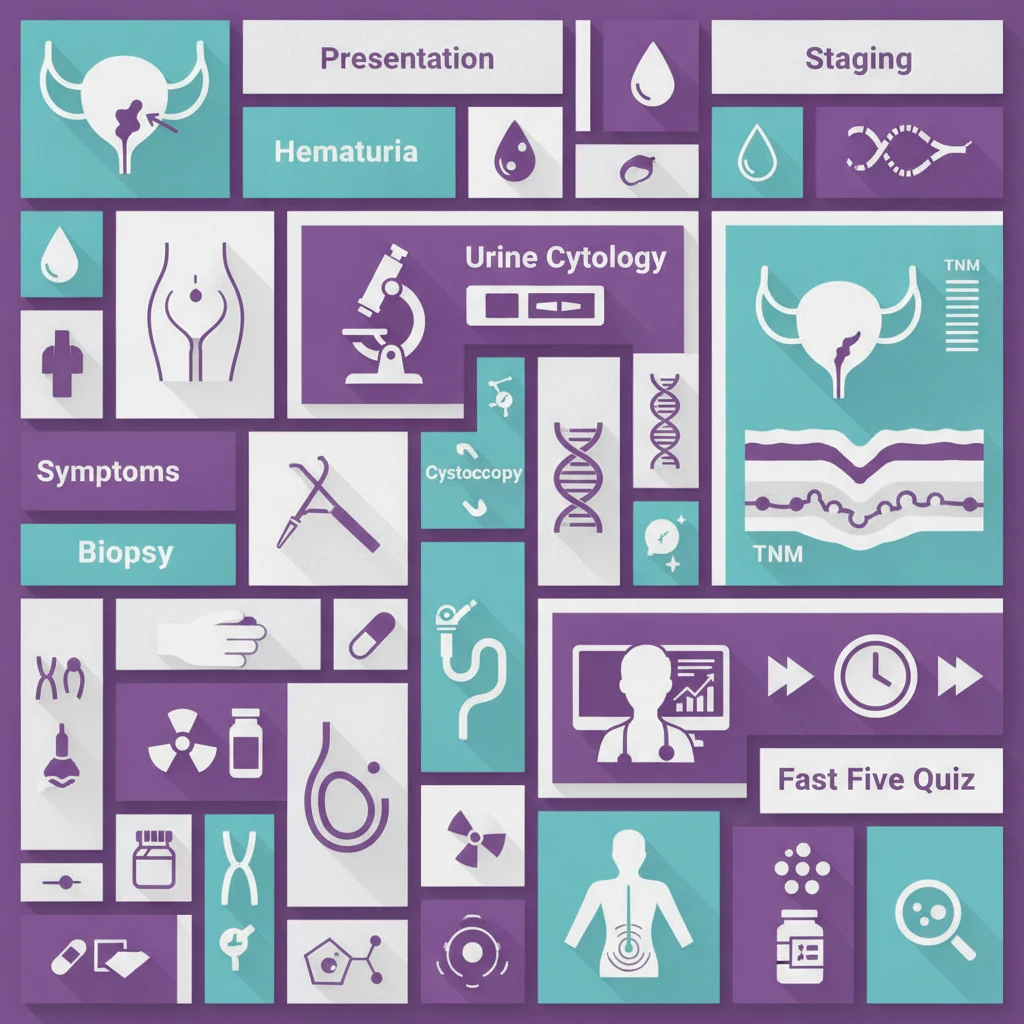

Bladder cancer remains a significant urological malignancy, often presenting with non-specific symptoms that can delay diagnosis. Early recognition of typical presentations and appropriate diagnostic workup are essential for improving patient outcomes. This quiz reviews critical aspects of bladder cancer presentation and diagnosis to reinforce clinical knowledge.
Question 1: Initial Presentation
A 68-year-old male presents with a 3-month history of intermittent, painless gross haematuria. He reports no dysuria, frequency, or urgency. His medical history includes hypertension and a 40-pack-year smoking history. What is the most likely diagnosis?
Answer: Bladder cancer. Painless gross haematuria is the classic presenting symptom of bladder cancer, occurring in approximately 80-90% of patients. The patient's age and significant smoking history are also strong risk factors. While other conditions like urinary tract infection (UTI) or benign prostatic hyperplasia (BPH) can cause haematuria, the absence of irritative voiding symptoms and the painless nature of the bleeding make bladder cancer a primary concern.
Question 2: Diagnostic Workup
Following the presentation in Question 1, what is the most appropriate initial diagnostic step?
Answer: Cystoscopy with cytology. For patients presenting with haematuria, especially gross haematuria, cystoscopy is the gold standard for direct visualisation of the bladder mucosa and biopsy of any suspicious lesions. Urine cytology can detect malignant cells shed into the urine, particularly useful for high-grade tumours or carcinoma in situ. Imaging studies, such as computed tomography (CT) urogram, are also important to assess the upper urinary tract for concurrent lesions or metastases, but cystoscopy directly addresses the bladder.
Question 3: Risk Factors
Which of the following is the strongest modifiable risk factor for bladder cancer?
Answer: Cigarette smoking. Smoking is the most significant modifiable risk factor for bladder cancer, estimated to be responsible for approximately 50% of all cases. Carcinogens in tobacco smoke are excreted in the urine and accumulate in the bladder, leading to cellular damage. Other risk factors include occupational exposure to aromatic amines (e.g., in the dye, rubber, and chemical industries), chronic bladder inflammation, and certain genetic predispositions, but smoking carries the highest attributable risk.
Question 4: Microscopic Haematuria
A 55-year-old female undergoes a routine physical examination, and a urinalysis reveals microscopic haematuria (30 red blood cells per high-power field) without proteinuria or casts. She denies any urinary symptoms. What is the recommended management?
Answer: Referral to urology for further investigation. While microscopic haematuria can be benign, it can also be an early sign of urological malignancy, including bladder cancer, especially in patients over 35 years of age. Current guidelines generally recommend a comprehensive evaluation for persistent unexplained microscopic haematuria, which typically includes cystoscopy and upper tract imaging, to rule out malignancy or other significant urological pathology. Observation without investigation is not appropriate given the potential for underlying malignancy.
Question 5: Carcinoma in Situ
Which statement best describes carcinoma in situ (CIS) of the bladder?
Answer: CIS is a high-grade, non-invasive form of bladder cancer that often presents with irritative voiding symptoms and has a high risk of progression to invasive disease. CIS is a flat, high-grade lesion confined to the urothelium. It is often multifocal and can be difficult to detect visually during cystoscopy, sometimes requiring random biopsies. While non-invasive, its high-grade nature means it carries a significant risk of progression to muscle-invasive bladder cancer if not adequately treated. It frequently presents with symptoms such as urgency, frequency, and dysuria, rather than gross haematuria alone, making diagnosis challenging.
The enduring challenge of bladder cancer diagnosis lies in its often insidious presentation, particularly with microscopic haematuria. General practitioners, as the first point of contact, bear a substantial responsibility in identifying patients who warrant further investigation. The consistent message from these clinical scenarios is clear: haematuria, especially painless gross haematuria, is not to be dismissed. While the temptation might be to attribute symptoms to more common, benign conditions, a high index of suspicion, particularly in older patients and those with a smoking history, is paramount.
The diagnostic pathway, anchored by cystoscopy and urine cytology, remains the cornerstone. Delays in referral or incomplete workups can have significant consequences, given the aggressive potential of high-grade tumours and carcinoma in situ. The industry has made strides in imaging and molecular diagnostics, but these tools supplement, rather than replace, direct visualisation. Ensuring timely access to specialist urological services and diagnostic procedures is a systemic imperative that requires ongoing attention from healthcare policymakers and commissioners.
For patients, understanding the significance of symptoms like haematuria is critical. Public health campaigns could play a role in raising awareness, much like those for bowel or breast cancer, to encourage earlier presentation. Ultimately, improved outcomes in bladder cancer hinge on a collaborative effort: vigilant primary care, efficient diagnostic pathways, and informed patient engagement. The evidence base for early detection is robust; the implementation must match it.
- The Pivot Haematuria, particularly painless gross haematuria, is the most common presenting symptom and warrants prompt investigation.
- The Data Approximately 80-90% of bladder cancer patients present with haematuria.
- The Action Clinicians should maintain a high index of suspicion for bladder cancer in patients presenting with haematuria, especially those with risk factors such as smoking or occupational chemical exposure.
ART-2026-460
06/26
Cite This Article
Team TLSFE. Fast five quiz: bladder cancer presentation and diagnosis. The Life Science Feed. Updated June 19, 2026. Accessed June 19, 2026. https://thelifesciencefeed.com/oncology/urinary-bladder-neoplasms/practice/fast-five-quiz-bladder-cancer-presentation-and-diagnosis.
Editorial & AI Standards
All content is researched from peer-reviewed, open-access sources — published trial data, clinical guidelines, and regulatory filings. AI tools are used solely to structure and summarise that evidence; no AI-generated conclusions appear without editor verification against the primary source.
Every article is reviewed by a named editor before publication. Source citations are listed in the References section. This content does not represent the views of any pharmaceutical company, medical device manufacturer, or healthcare provider.
Licence & Rights
© 2026 The Life Science Feed. All rights reserved. Unless otherwise indicated, all content is the property of The Life Science Feed and may not be reproduced, distributed, or transmitted in any form or by any means without prior written permission.
Medical Disclaimer
The information provided on The Life Science Feed is for educational and informational purposes only. It is not intended as a substitute for professional medical advice, diagnosis, or treatment. Always seek the advice of your physician or other qualified healthcare provider regarding any medical condition or treatment decision. Never disregard professional medical advice or delay in seeking it because of something you have read on this website.


