

Hosted by Sarah Mitchell & James Carter
Show Notes
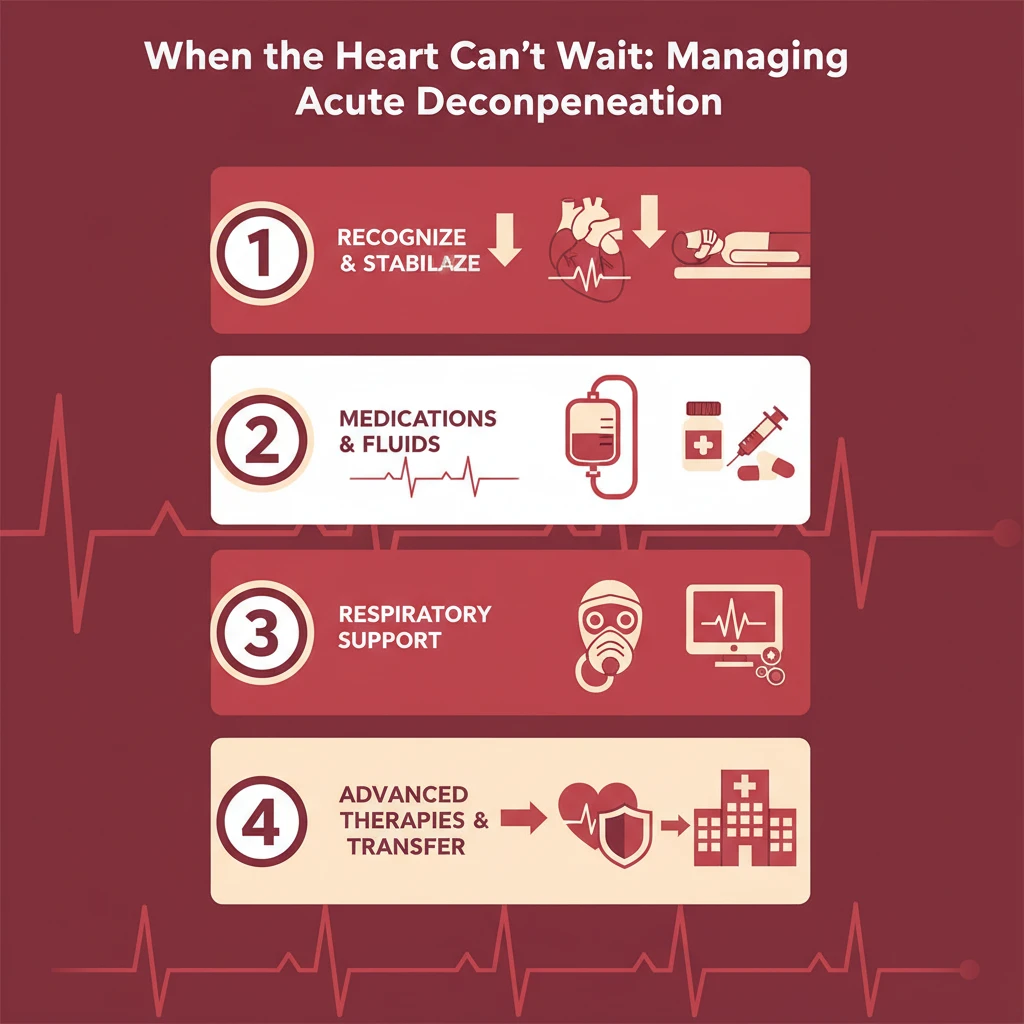
Acute decompensated heart failure drives over one million hospital admissions annually. 30-day readmission rates are 25%. When the heart cannot compensate, the tools change entirely - IV diuretics, inotropes, mechanical circulatory support. Sarah Mitchell and James Carter cover ADHF management, cardiogenic shock, and how to prevent the revolving door.
Transcription
Imagine for a second, um that you're asleep in your own bed. It's 3:00 a.m. The house is completely quiet.
CO-HOST: Right.
But suddenly your eyes snap open and you realize with this terrifying like primal jolt that you simply cannot breathe.
CO-HOST: Oh, wow.
Yeah.
You try to take a breath, you know, to pull air into your lungs, but it feels like you are literally submerged underwater. And I mean, this isn't a slow gradual decline over a few weeks where you just feel a bit winded taking the stairs.
CO-HOST: No, not at all.
It's an acute life-threatening crisis that is happening in your chest right in this very moment.
CO-HOST: It's, well, it's a harrowing scenario to even visualize. Yeah. And the tragic reality here is that this exact panic, this feeling of drowning in your own bed, it plays out thousands of times every single night across the country.
Which brings us to the core of today's deep dive. We have a specialized clinical briefing in front of us covering the management of acute decompensated heart failure, which is often abbreviated as ADHF, and its even more catastrophic cousin, cardiogenic shock.
CO-HOST: Yeah, the really severe end of the spectrum.
Right. So our mission today is to figure out the actual mechanics of this crisis. We want to understand what happens when a human heart suddenly loses the ability to compensate for its own weakness.
CO-HOST: Absolutely.
We're going to explore how emergency doctors pull patients back from that 3:00 a.m. brink and look at some genuinely mind-blowing technology designed to stop you from ending up in that hospital bed in the first place.
CO-HOST: To really ground this conversation, I mean, we need to look at the sheer scale of the problem. We are talking about over 1 million hospital admissions every single year in the US alone. And that's just looking at patients over the age of 65.
A million admissions, that's staggering.
CO-HOST: It is. But even more alarming than the admission rate is uh what happens after they leave. The 30-day readmission rate is 25%.
Wait, 25%?
CO-HOST: Yeah. One in four of those people will be right back in the emergency room fighting for their breath within a single month of being discharged.
Okay, let's unpack this because a 25% failure rate in a single month is massive. Why does the heart suddenly just stop keeping up? Like what is physically happening in the body at 3:00 a.m. that turns a chronic condition into an acute emergency?
CO-HOST: To understand the sudden crisis, we really have to look closely at the underlying pathophysiology. The classic model that cardiologists use to explain acute decompensated heart failure is, um, it's called congestion.
See, when I hear congestion, I just think of a blocked nose or like a traffic jam on the highway.
CO-HOST: Well, the traffic jam is actually a brilliant way to picture it. So the heart is essentially a two-sided pump. The right side pumps blood to the lungs and the left side pumps it out to the rest of the body.
Right, pre-basic plumbing.
CO-HOST: Exactly. But when that left-sided pump begins to fail and weaken, it can't efficiently push the incoming blood forward because the blood is still trying to flow into the heart, the pressure inside those cardiac chambers just starts to rise.
So it creates a backlog.
CO-HOST: A massive backlog. The blood physically backs up into the pulmonary circulation, which is your lungs, and eventually into the periphery, like your legs and your abdomen.
Oh, wow.
CO-HOST: Yeah. And the pressure in the vessels gets so high that fluid is literally forced out of the bloodstream and leaks into the tiny air sacs of the lungs. That is the congestion. That fluid filling the lungs is what causes that terrifying sensation of drowning.
So the pump gets weak, the pipes back up, and the fluid just spills over. But this doesn't just happen randomly out of nowhere, right? I mean, our sources mention these specific triggers or uh precipitants that push a heart that was previously managing just fine completely over the edge.
CO-HOST: Right, because a fragile heart is always performing this really delicate balancing act. Any sudden stressor can completely disrupt it. A very common trigger is simply missing a few doses of medication or eating a meal packed with sodium, which, you know, causes the body to retain more water.
Yeah, the extra volume just overwhelms the weak pump.
CO-HOST: Exactly.
Okay.
CO-HOST: Or a sudden infection, like pneumonia, forces the body's metabolism into overdrive, which demands way more blood flow than the heart can actually deliver. We also see new erratic heart rhythms, like atrial fibrillation.
Oh, Afib, right.
CO-HOST: Yeah, Afib basically destroys the coordinated squeezing of the heart muscle. And even a a minor acute coronary event, like a really small heart attack, can instantly tip the scales from stable to drowning.
And there is a low output component too, right? Because it's not just the backward flooding into the lungs. If the pump is weak, the forward flow is also too sluggish. The organs downstream, um, like the kidneys, they aren't getting enough fresh blood to function properly.
CO-HOST: That's a critical point.
Yeah.
CO-HOST: The kidneys are highly sensitive to blood flow. When they sense a drop in pressure, their natural survival response is to hold on to even more salt and water to try and boost the blood pressure.
Which normally makes sense if you're like bleeding out or dehydrated.
CO-HOST: Right. In a healthy person, that works perfectly. But in a heart failure patient, holding on to more water just makes the congestion infinitely worse. It is this devastating vicious cycle.
Yeah. Which brings us to a huge registry of patient data mentioned in the briefing called the CHARM program. When researchers actually zoomed out and looked at tens of thousands of heart failure hospitalizations over time, they found a terrifying pattern.
CO-HOST: Yeah, the data there is sobering.
It really is. Recurrent hospitalization isn't just a symptom of advanced heart failure, it is actively accelerating the disease. Every single time a patient is hospitalized for this, it roughly doubles their subsequent mortality risk. It's a permanent step down in cardiac function every time.
CO-HOST: Because the heart muscle sustains actual damage during these acute episodes, the baseline function permanently drops. You never quite get back to where you were.
It's kind of like imagine a house with a failing sump pump in the basement. The pump is old and weak, so the water starts backing up and flooding the basement, which in this case is the lungs in the body.
CO-HOST: I like that analogy.
Right. And if every single flood permanently rots the wood and damages the house's foundation, then the medical goal isn't just rushing in with buckets to bail the water out. The goal is stopping the cycle entirely.
CO-HOST: What's fascinating here is, well, how the medical field actually executes that bailing out process in the emergency room and how our understanding of when to stop bailing has completely evolved based on some really hard lessons.
Because obviously, if someone comes into the ER and their basement is completely flooded, the immediate overwhelming medical priority is rapid decongestion. I mean, you have to get the fluid out so they can just breathe.
CO-HOST: Absolutely. The cornerstone of that rescue process is intravenous loop diuretics. The most common ones you'll see used are drugs like furosemide or bumetanide.
How do they actually work, though? Like how do they force the water out of the body so quickly?
CO-HOST: So, in a healthy kidney, there is a specific microscopic structure called the loop of Henle. Its whole job is to reabsorb salt and water back into your bloodstream as the kidneys filter your blood.
Mhm.
CO-HOST: Loop diuretics chemically block that specific reabsorption loop. Suddenly, all that salt and water has nowhere to go but out through your urine. The kidneys are forced to excrete massive amounts of fluid very, very rapidly.
The clinical briefing highlights a landmark study here called the DOSE trial. I found this fascinating because it answered such a basic question. Like, how much of this diuretic do you give a drowning patient?
CO-HOST: There was a massive debate in cardiology for years over this exact issue. Doctors were honestly terrified of damaging the kidneys. They worried that pushing too much fluid out too fast with huge doses of diuretics would starve the kidneys of blood flow and cause permanent renal failure.
Right, you fix the lungs but destroy the kidneys.
CO-HOST: Exactly. But the DOSE trial proved that fear was largely misplaced. When researchers tested giving patients a low dose versus a high dose, and by high dose, they meant two and a half times the patient's normal at-home maintenance dose. The high dose was the clear winner.
Wow, really? Even at two and a half times the dose.
CO-HOST: Yeah. Patients got much faster symptom relief, they peed out significantly more fluid, and crucially, it didn't cause worse outcomes for their kidneys. The trial also settled another huge debate, showing that hooking a patient up to a continuous IV drip of the drug wasn't actually any better than just giving them scheduled intermittent blasts of the medication.
That's super interesting. But we also have other tools for specific scenarios, right? What if the issue isn't just a weak pump and extra fluid, but insanely high blood pressure that is physically pushing that fluid into the lungs. The sources mention IV nitrate.
CO-HOST: Right, nitrates are potent vasodilators. They chemically relax and open up the blood vessels. If a patient comes in with hypertensive pulmonary edema, meaning their blood pressure is sky-high, creating immense resistance that the weak heart has to pump against, nitrates are a fantastic rescue strategy.
Because opening the pipes drops the resistance instantly.
CO-HOST: Exactly. It takes the strain off the pump. However, for your standard acute decompensated heart failure patient who doesn't have extreme blood pressure, looking at the long-term data, adding nitrates to diuretics doesn't actually improve hard outcomes like survival or readmission.
So the heavy-duty diuretics really are the main weapon to drain the flood. But reading through the history here, there was a massive, honestly deadly flaw in how patients used to be managed. The sources point to massive databases, specifically the ADHERE and OPTIMIZE-HF registries.
CO-HOST: Yeah. When researchers analyzed those registries, they uncovered a severe systemic failure in clinical practice. A massive proportion of heart failure patients were being discharged from the hospital with residual congestion.
Wait, I don't get this. They were sending them home while secretly still flooded. I mean, why wouldn't the doctors just keep them in the hospital until they were completely 100% dry?
CO-HOST: The flaw was a total reliance on outward, visible clinical symptoms. Doctors would look at the patient. If their breathing had improved, if they could lie flat in bed without gasping, and if the visible puffy swelling in their legs had gone down, the medical team just assumed the job was done.
Like, the basement looked dry, so they packed up the buckets.
CO-HOST: Precisely. But the registry data revealed something truly insidious. If you discharge someone based only on how they look, while their internal microscopic markers of fluid overload are actually still elevated, their readmission and mortality rates over the next 60 to 90 days completely skyrocket.
For you listening right now, this is so crucial to understand if you or a family member is ever navigating this. Advocating for biochemical proof of recovery, not just saying, oh, I feel a little better, is literally the difference between life and death.
CO-HOST: You absolutely need proof that the flood is gone at a cellular level. And thankfully, we now have that proof in the form of a biomarker called NT-proBNP.
The sources describe it almost like the heart's chemical distress signal.
CO-HOST: That is the perfect way to conceptualize it. NT-proBNP is a hormone secreted directly by the heart muscle cells, but only when they are being physically stretched and stressed by fluid overload.
So it's literally a physical reaction to the flooding?
CO-HOST: Exactly. If the heart is struggling against excess volume, it dumps this hormone into the bloodstream.
So the modern target for doctors isn't just clinical decongestion, meaning you look fine and your oxygen monitor is normal. It requires biochemical decongestion. You need to see that NT-proBNP distress signal trending down, ideally below a specific threshold of 1000 picograms per milliliter, before that patient is ever cleared to walk out the hospital doors.
CO-HOST: And once you achieve that baseline, the immediate challenge becomes keeping them there. This led to a major paradigm shift with the STRONG-HF trial.
Yeah, this trial seemed to completely disrupt the standard of care.
CO-HOST: Historically, doctors would stabilize the patient, send them home, and wait a few weeks or months before starting them on the really heavy-hitting long-term preventative medications. They worried the patient was just too fragile right after an acute episode.
But STRONG-HF proved that waiting is dangerous, right? The post-hospitalization period is an incredibly vulnerable window.
CO-HOST: Exactly right. The trial showed you have to fix the foundation immediately. Initiating high-intensity guideline-directed medical therapy, which are the heavy-hitter oral drugs, right away while they're still in the hospital, and then following up aggressively within the first six weeks, drastically cuts the risk of death and readmission at six months.
Basically, you don't wait for the basement to dry out and then think about maybe waterproofing it next year. You install the heavy-duty waterproofing system before they ever leave the property.
CO-HOST: I love that.
Yes. Exactly.
CO-HOST: But so far, we've only been talking about a flooded basement. Draining the flood makes sense if the pump is just weak and backed up. What happens if the pump just, well, what if it just stops?
Oh.
CO-HOST: Like if it completely stalls out to the point where it can't even push a fraction of the necessary blood to the vital organs, we are shifting from fluid overload to catastrophic low output. This is the extreme edge of the briefing. Cardiogenic shock.
Cardiogenic shock is the absolute most critical, terrifying end of the heart failure spectrum.
CO-HOST: The clinical definition involves severe hypotension, meaning a systolic blood pressure plummeting under 90 mm of mercury, combined with clear signs that your end organs are actively dying from oxygen starvation.
When you read about the physical presentation of someone in cardiogenic shock, it just sounds grim. The body is in full panic mode, literally shunting whatever tiny amount of blood is left away from the arms and legs to try and save the brain and the heart.
CO-HOST: Yeah. When you examine these patients in the ER, their skin is cold and clammy, their blood test shows surging levels of lactic acid because their tissues are switching to anaerobic metabolism, just trying to survive without oxygen.
And the kidneys shut down too, right?
CO-HOST: Yeah, they develop oliguria. The kidneys completely stop producing urine because there is simply no blood pressure to drive the filtration. Historically, the mortality rate for someone entering this state is 40 to 50%.
I just want to pause on that for a second. Even in a modern hospital with all our tech, if you go into cardiogenic shock, it is basically a coin flip on whether you survive.
CO-HOST: It is a devastating condition, truly.
So how on earth do doctors fix a pump that has completely stalled out?
CO-HOST: Well, the first line of defense relies on heavy-duty intravenous drugs. We use vasopressors, which tightly clamp down and squeeze the blood vessels to physically force the blood pressure back up.
Just to keep the brain alive.
CO-HOST: Right. And there was a major study called the SOA2 trial that compared different vasopressors. It definitively showed that norepinephrine is the preferred drug here. The older alternative, dopamine, was actually causing dangerous chaotic heart arrhythmias and leading to higher mortality.
And beyond just clamping the pipes, there are inotropes. Drugs like dobutamine and milrinone. They chemically force the failing heart muscle to squeeze harder to increase the cardiac output.
CO-HOST: That's right.
But reading how they work, it sounds kind of like whipping a totally exhausted horse. Yes, the horse might run faster for a minute, but you're demanding more energy and oxygen from a muscle that is already starving and dying. You risk fatal heart rhythms just trying to keep the blood moving.
CO-HOST: This raises an important question. If chemical stimulation is effectively whipping an exhausted horse to death, how do we keep the patient alive without permanently destroying their heart?
Yeah.
CO-HOST: That realization is exactly why the field of cardiology has dramatically shifted toward mechanical support. If the horse simply cannot pull the cart, you bring in a machine to take the load off entirely.
But the history of these machines is wild. I mean, for decades, the absolute standard of care in every hospital was this device called the intra-aortic balloon pump or IABP.
CO-HOST: Oh, the balloon pump is ubiquitous. The concept made sense on paper. It was a long balloon threaded into the aorta, which is the main artery leaving the heart. It would quickly inflate when the heart was resting to push blood into the coronary arteries and then instantly deflate right as the heart squeezed.
Which created a vacuum to help pull blood forward, right?
CO-HOST: Exactly. It was supposed to be the perfect assist device.
But then in 2012, this landmark study, the IABPSHOCK II trial, comes out and completely upends practice. It showed absolutely zero 30-day mortality benefit for using the balloon pump in patients who went into cardiogenic shock after a heart attack. Decades of medical practice invalidated overnight.
CO-HOST: It was a massive shock to the cardiology community. But shedding that ineffective therapy paved the way for the rise of true microaxial pumps, specifically the Impella device.
The engineering of the Impella is mind-blowing. Imagine threading a tiny motor, like a little propeller on the end of a wire, through a puncture in your leg artery, pushing it all the way up into your chest, and placing it directly inside the left ventricle of your failing heart.
CO-HOST: Instead of just a balloon inflating and deflating, the Impella is an active, continuous flow Archimedes screw. It literally sucks blood out of the exhausted ventricle and shoots it into the aorta. It completely unloads the heart, taking over the physical work of pumping.
But the sources stress that the Impella isn't some magic bullet. The timing has to be flawless. There is a brand new 2024 trial cited in the briefing called DANGER-SHOCK. It proved that the Impella does provide a significant 180-day survival benefit, but only if it is used early.
CO-HOST: The word early is the entire key to survival here. The clinical concept is early mechanical unloading. By taking the physical workload away from the heart muscle immediately, you drastically reduce its need for oxygen.
Which stops the muscle from dying.
CO-HOST: Exactly. This limits the size of the tissue death and gives the muscle a crucial window of time to heal. If you wait, you know, you try chemical vasopressors for six hours and only escalate to the Impella when the patient is already in total multi-organ systemic collapse, it's simply too late. The damage is done.
What if the patient's lungs are failing too, though? I mean, during the pandemic, we heard so much about ECMO. Is there a machine that just replaces everything?
CO-HOST: You are thinking of VA ECMO, which stands for venoarterial extracorporeal membrane oxygenation. It is essentially a full heart-lung bypass machine. It pumps the blood out of the body, oxygenates it externally, and pumps it back in, providing total cardiorespiratory support.
So it does the work of both the heart and the lungs.
CO-HOST: Right. It's used as a bridge, a bridge to let the native heart recover, or a bridge to implanting a permanent pump, or even a bridge to a full heart transplant.
But the briefing notes a trial called ECMO-CS, which showed that ECMO shouldn't just be the default first step for everyone in cardiogenic shock.
CO-HOST: No, absolutely not. ECMO carries massive severe risks of vascular complications and catastrophic bleeding. The trial didn't show a routine survival benefit when applied universally, so it's strictly reserved for those absolute refractory worst-case scenarios where nothing else works.
And for the patients who survive the shock, but um, their heart is permanently destroyed, like it's never gonna recover.
CO-HOST: Then we turn to advanced therapies, like the HeartMate 3. This is a permanent implantable mechanical pump, a left ventricular assist device, or LVAD. It uses magnetic levitation to continuously pump blood.
Magnetic levitation inside the chest? That is incredible.
CO-HOST: It really is. The MOMENTUM 3 trial tracked these patients and showed a two-year survival rate of over 80%. That is comparable to getting an actual heart transplant, but without the agonizing hurdle of waiting on a list for a scarce donor organ.
Okay, so we've seen how incredible the tools are for rescuing someone from the absolute brink of death, draining the flood, taking over the heart with a micropump. But looking at the entirety of these sources, it becomes incredibly clear that true success in modern cardiology isn't a miraculous middle-of-the-night emergency rescue. It's preventing the crisis from ever happening.
CO-HOST: The ultimate goal of every cardiologist today is breaking the cycle. We have to close that revolving door of hospital readmissions.
The briefing lays out three proven ways to do this. First is that STRONG-HF approach. Immediately optimizing the guideline-directed oral medications before the patient ever leaves the hospital. Second is intense follow-up. The European Society of Cardiology guidelines actually mandate a multidisciplinary clinic visit within 7 to 14 days of a patient going home. No more waving goodbye and saying call us in six months.
CO-HOST: Yeah, the old way just isn't acceptable anymore. And the third method, however, is where we are witnessing a true paradigm shift in the practice of medicine. It's remote hemodynamic monitoring. Specifically, an implanted device called CardioMEMS.
This device sounds like pure science fiction made real. It's a tiny wireless pressure sensor, roughly the size of a paperclip. A doctor permanently implants it directly into the patient's pulmonary artery using a catheter.
CO-HOST: The brilliance of the CardioMEMS device is its predictive power. Think back to the beginning of our conversation. We established that the filling pressures inside the heart began to rise well before the fluid actually leaks out and floods the lungs.
Right, the backlog builds up pressure first.
CO-HOST: Exactly. The CardioMEMS sensor continuously measures those microscopic pressure changes and wirelessly transmits the data directly to the patient's clinical team.
Meaning the doctor can literally see the flood water starting to rise days before the patient ever feels a single drop in their lungs.
CO-HOST: It's remarkable. The CHAMPION trial tested this in patients with severe Class III heart failure. By watching this daily stream of pressure data, doctors could call the patient at home and adjust their diuretic medications remotely, heading off the crisis entirely.
Wow.
CO-HOST: Yeah, implementing the sensor resulted in a massive 37% reduction in heart failure hospitalizations.
And the sources point out that this is just the beginning of the predictive era. I mean, we are moving toward a future of continuous biometric monitoring via smartwatches and AI algorithms that can reliably predict a decompensation event two to three days out, just based on subtle changes in heart rate, activity levels, and breathing patterns.
CO-HOST: It's a completely new frontier for medicine.
So, what does this all mean? For you listening, it means we are witnessing a fundamental shift in how we approach one of the deadliest conditions on earth. We are finally moving away from reactive emergency medicine, waiting for you to show up drowning in the ER at 3:00 a.m. and moving toward a model of predictive, remote-controlled maintenance.
CO-HOST: If we connect this to the bigger picture, you know, the great tragedy of modern heart failure management is no longer a lack of scientific tools. As the clinical briefing concludes, the challenge in 2026 is not evidence, it is implementation.
It's the gap between the lab and the living room.
CO-HOST: Exactly. It is the vast frustrating gap between what these incredible clinical trials prove is possible and what everyday patients actually receive in the real world. Lives are being lost unnecessarily simply because the right drugs, the right monitoring sensors, and the right mechanical devices aren't making it to the people who desperately need them.
Let's quickly recap the incredible journey we've taken today. We explored the compounding permanent danger of fluid congestion and how doctors use aggressive high-dose loop diuretics to block kidney reabsorption and essentially bail out the basement.
CO-HOST: Right.
We learned why you must demand biochemical proof of that decongestion, getting that NT-proBNP distress signal below 1,000, rather than just settling for feeling a little better. We looked at the extreme edge of cardiogenic shock, the physical shunting of blood to the brain, and how early mechanical support with an Impella pump can save an exhausted heart. And finally, we saw the game-changing nature of predictive sensors like CardioMEMS.
CO-HOST: We really have covered an incredible evolution in medical care today. But I want to leave you with a thought that goes beyond the clinical trial data that we reviewed. If artificial intelligence and implanted biometric sensors eventually become so deeply advanced that they can predict a heart failure crisis days before a patient feels even slightly short of breath, well, will the concept of acute decompensation become a preventable historical relic, rather than a middle-of-the-night emergency?
That's a profound thought.
CO-HOST: And more importantly, if our technology effectively eliminates the crisis, how do we ensure that every single patient, not just the privileged few, gets access to this invisible life-saving digital safety net?
Because no one should ever have to wake up at 3:00 a.m. completely unable to breathe. Thank you for joining us on this deep dive. Stay curious.
Free Clinical Resources
Episode Infographic
Key data, mechanisms, and clinical takeaways distilled into a single shareable page. Save it for reference or use it in your next team discussion.
Clinical Flashcards
Core concepts from this episode in flashcard format, structured for spaced repetition, pre-consultation review, or CPD reflection with your team.
ART-2026-242
·09/26
This podcast episode is produced with AI assistance. This publication is intended for healthcare professionals, researchers, and life science industry professionals. Content is provided for informational and educational purposes only and does not constitute medical advice.
I cover women's health, reproductive medicine, and the persistent gaps in how conditions that primarily affect women get studied and funded. The evidence base is thinner than it should be. I write about why.
Cite This Podcast
Mitchell S, Carter J. Managing acute heart failure and cardiogenic shock. The Life Science Feed. Published June 1, 2026. Updated September 15, 2026. Accessed October 22, 2026. https://thelifesciencefeed.com/podcast/2026-06-01/managing-acute-heart-failure-and-cardiogenic-shock.
Editorial & AI Standards
Content is drafted with AI tools from peer-reviewed, open-access sources such as published trial data, clinical guidelines, and regulatory filings. This episode is produced with AI assistance.
Source citations are listed in the References section. This content does not represent the views of any pharmaceutical company, medical device manufacturer, or healthcare provider.
Licence & Rights
© 2026 The Life Science Feed. All rights reserved. Unless otherwise indicated, all content is the property of The Life Science Feed and may not be reproduced, distributed, or transmitted in any form or by any means without prior written permission.
Podcast Disclaimer
This podcast is produced for educational and informational purposes only. The conversation between hosts represents a discussion of published clinical evidence and is not intended as clinical advice, a substitute for professional medical judgment, or a recommendation for any specific treatment. Healthcare professionals should rely on their own clinical training, current guidelines, and individual patient assessment when making treatment decisions. The views expressed are those of the hosts and do not constitute endorsement of any specific therapy, product, or manufacturer.
References
Abraham WT et al. CHAMPION. Lancet. 2011;377:658-666
Felker GM et al. DOSE. N Engl J Med. 2011;364:797-805
Mebazaa A et al. STRONG-HF. Lancet. 2022;400:1938-1952
Moller JE et al. DanGer Shock. N Engl J Med. 2024;390:1304-1315
Thiele H et al. IABP-SHOCK II. N Engl J Med. 2012;367:1287-1296

Safe caffeine intake does not harm heart health
Established guidelines for safe caffeine intake do not pose a risk to cardiovascular health, despite the expanding market of caffeine-containing products.

Heart Failure Treatment in 2026: A Clinical Overview
Heart failure management has changed substantially over the past decade. This clinical overview covers the four pillars of guideline-directed medical therapy, the role of device therapy, and emerging treatments entering practice in 2026.
More from: Heart Failure Deep Dive Series

Four drug classes (ARNi, beta-blocker, MRA, SGLT2 inhibitor) have together produced a 73% reduction in cardiovascular death and hospitalisation versus placebo in HFrEF. Sarah Mitchell and James Carter unpack why each drug works, what the landmark trials showed, and why clinical inertia is still the biggest barrier to optimal care.
James Carter & Sarah Mitchell

Heart failure with preserved ejection fraction accounts for more than half of all HF diagnoses. For two decades every major drug trial failed. Then SGLT2 inhibitors changed everything - twice. Sarah Mitchell and James Carter explain why HFpEF was so hard, and what finally worked.
Sarah Mitchell & James Carter
More than 80% of HFpEF patients are overweight or obese. STEP-HFpEF showed semaglutide 2.4mg improved symptoms by 16 points on the KCCQ and reduced weight by 13.3% - now a Class IIa ESC recommendation. Sarah Mitchell and James Carter explore why treating the metabolic environment is the new paradigm for HFpEF.
Sarah Mitchell & James Carter







