


Hosted by James Carter & Sarah Mitchell
Follow the show while you are there, and new episodes turn up on their own.Listen on Spotify
Show Notes
Deucravacitinib (the first approved TYK2 inhibitor) offers a new oral option for moderate-to-severe psoriasis without the cardiovascular safety concerns attached to pan-JAK inhibitors. Sarah Mitchell and James Carter examine how the oral therapy landscape is evolving and what it means for patients who refuse injections.
Transcription
You know, you probably think that treating a really severe systemic autoimmune condition requires uh some pretty heavy duty medical intervention.
CO-HOST: Oh, absolutely. Most people picture a very sterile clinical setting.
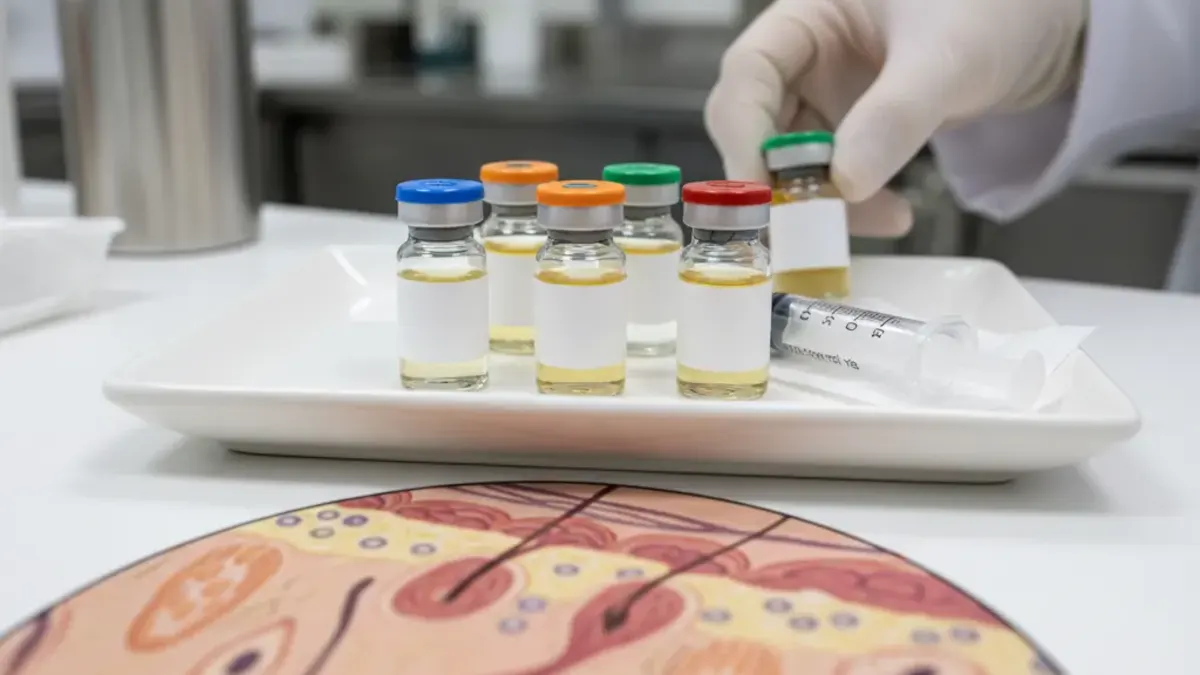
Right. You picture refrigerated vials, maybe a specialized nurse carefully hooking up an IV line or giving an injection.
CO-HOST: Yeah, the classic high-tech medicine visual.
Exactly. But um, what if the future of this incredibly complex immunology isn't actually in a syringe at a specialist's office. What if it's just sitting right there in a standard medicine cabinet?
CO-HOST: It's, I mean, it represents a fundamental shift in how we approach chronic disease. Because for years, the absolute gold standard for severe autoimmune conditions, especially severe psoriasis, has been injectable biologics.
Which are great, right?
CO-HOST: They're incredible medications. Really, they are. But what we're looking at today is a massive high-tech comeback for the simple oral pill. And it is completely changing the landscape of, you know, who actually gets treated and how effectively we can do it.
Okay, let's unpack this. We're pulling today's insights for a really comprehensive expert medical breakdown of the newest dermatology drugs.
CO-HOST: It's a fascinating set of sources.
It really is. And digging into this deep dive, it becomes super clear that we're moving out of an era dominated solely by injectables and into something totally new.
CO-HOST: Yeah, a completely different paradigm.
So we're going to look at the massive barriers created by our current treatments. Decode a genuinely brilliant biological trick that scientists have recently figured out, and then peek into a medical pipeline that is moving at absolute warp speed.
CO-HOST: And to really grasp why the shift back to pills is so monumental, we have to ground ourselves in the reality of what it's actually like to be a patient right now.
Right, the day-to-day experience.
CO-HOST: Exactly. As I mentioned, we have these highly effective injectable biologics. They target the immune system with incredible precision, often clearing skin completely. But uh, that efficacy comes with substantial logistical and physical hurdles.
They aren't exactly low maintenance, are they? I mean, you can't just throw them your bag and go on a road trip.
CO-HOST: Oh, it's far from it. Biologics are large, really highly complex proteins. You can't just swallow them.
Because your stomach acid would just destroy them, right?
CO-HOST: Right, long before they ever reached your bloodstream.
Yeah.
CO-HOST: So by default, they require needle administration. That's either a self-injection at home or going to a clinic for an infusion.
Which is already a hurdle for a lot of people.
CO-HOST: Huge hurdle. And on top of that, these delicate proteins require a strict cold chain.
Meaning they have to stay cold the whole time.
CO-HOST: Constant refrigeration from the manufacturer to the pharmacy, right into the patient's home fridge. And honestly, getting a prescription for a biologic in the first place generally requires initiation and ongoing monitoring by a specialist.
Like a dermatologist or a rheumatologist.
CO-HOST: Exactly.
I like to think of biologics like um, high-end custom built sports cars.
CO-HOST: Oh, that's a good way to put it.
Right. The performance is absolutely amazing. They're unbeatable on the track.
CO-HOST: Mm-hmm.
But they require a highly specialized mechanic. You have to park them in a climate controlled garage and frankly not everyone has the resources or the access to a luxury dealership to actually own one.
CO-HOST: That analogy hits the core of the issue perfectly, which is health equity. Because of all those stringent requirements, you know, the cold chain, the needles, the months-long wait list to see a specialist, a significant proportion of patients simply fall through the cracks.
Yeah, patients with moderate to severe psoriasis who just don't have access to the absolute best care.
CO-HOST: Or they might just be terrified of needles. We really shouldn't gloss over that. Needle aversion is a very real, very powerful psychological barrier.
Oh, totally. Imagine being told the only way to find relief is to pull a cold syringe out of your fridge and, you know, stab yourself every couple of weeks. For a lot of people, that's just a non-starter.
CO-HOST: It is a massive barrier. So what happens to these patients who can't or won't take biologics? They often end up managed on older oral medications.
Things like Methotrexate or Acitretin.
CO-HOST: Right. Yeah. And while those do offer the convenience of a simple pill, they come with meaningful tolerability issues. The side effects can be incredibly rough.
Like liver toxicity, gastrointestinal distress.
CO-HOST: Exactly, which requires constant blood tests to monitor.
Which means if you live in a lower resource setting or you don't have the time to constantly visit a clinic for blood work, you end up dramatically undertreated. You're just living with painful, itchy and highly visible plaques.
CO-HOST: Right. So from a prescriber's perspective, the ultimate dream has always been an oral agent, a simple pill that is safe enough to be prescribed by your local primary care doctor.
Something that just avoids the injection site reactions, skips the refrigeration, and offers a much simpler pathway.
CO-HOST: Yes, just letting the patient live their life.
But wait, let me step in here for a second because we do have newer pills on the market already. The sources spend a good amount of time talking about Apremast.
CO-HOST: Yes, Apremast has been around for a bit.
It's an oral option generally considered very safe, but the issue seems to be the ceiling on how well it actually works. The data in our sources notes that Apremast hits a PASI 75 rate of around 30 to 40%.
CO-HOST: Correct.
And just to clarify for you listening, PASI stands for Psoriasis Area and Severity Index. So a PASI 75 means a 75% improvement in a patient's symptoms.
CO-HOST: Right.
Let me play devil's advocate here and push back a bit. If Apremast gives say 30 to 40% of patients a really solid improvement safely in a convenient daily pill, isn't that, you know, good enough? Why the desperate race to replace it?
CO-HOST: Well, if we connect this to the bigger picture, we have to look at what is actually possible in modern medicine today. In the era of biologics, doctors and patients have seen what complete or near complete skin clearance looks like.
The bar has been raised.
CO-HOST: Significantly. A 30 to 40% improvement is certainly better than nothing, and for some, it brings real relief. But patients shouldn't be forced into this false choice between the basic convenience of a pill and top-tier efficacy.
Yeah, that makes sense.
CO-HOST: When you have moderate to severe psoriasis and only 40% of your lesions clear up, you are still left with a massive burden of disease. You're still dealing with pain, flaking, and the social stigma that comes with visible skin conditions.
Put that way, good enough isn't actually good enough at all. Especially when we know the science can do better.
CO-HOST: The scientific community recognized that exact gap. They needed to engineer an oral drug that could push past that 40% ceiling, driving deeper clearance without trading away the safety profile.
And that long search brings us to the headline act of the research we're looking at today. Ducrevasitinib.
CO-HOST: Yes, Ducrevasitinib.
It's quite the tongue twister, but uh, the data behind it is wild.
CO-HOST: It really is. It's currently approved in the US, the EU, and multiple other global markets for moderate to severe plaque psoriasis. And to understand why dermatologists are paying so much attention to it, we need to dive into the clinical trial data.
Specifically the POET trials.
CO-HOST: Right. Yeah, the PSO1 and PSO2 trials. These were massive, rigorous trials. And they showed that at week 16, Ducrevasitinib achieved PASI 75 rates again, that 75% improvement in about 53 to 58% of patients.
That's a big jump.
CO-HOST: And even more impressive, it hit PASI 90, which is a 90% improvement, essentially clear skin, in about 30 to 40% of patients.
Wow. And the part that really made me do a double take is the head-to-head data. In the PSO2 trial, they didn't just compare it to a placebo, they pitted Ducrevasitinib directly against the older pill, Apremast.
CO-HOST: Yes, a direct comparison.
And it was a complete smackdown. At week 16, Ducrevasitinib hit that 53% PASI 75 mark, while Apremast in that specific trial group only managed 9%.
CO-HOST: It's a night and day difference in efficacy for an oral medication.
That's not just a minor improvement, that's blowing the old standard completely out of the water.
CO-HOST: Absolutely. But the real triumph of Ducrevasitinib isn't just that it works better, the massive breakthrough is how it works.
This is the cool part.
CO-HOST: Ducrevasitinib is what we call a TYK2 inhibitor. Now, TYK2 is an enzyme that belongs to the broader JAK family of enzymes. And these play a huge role in transmitting signals within your immune system.
Okay, I have to pause you there because JAK inhibitors aren't new and haven't they had some pretty scary safety issues in the past? Like whenever I read about the JAK class of drugs, there's always a lot of caution.
CO-HOST: You're touching on the exact reason this new drug is such a big deal. Traditional JAK inhibitors are indeed known for causing systemic off-target effects. We're talking about an excess risk of MACE.
Which stands for major adverse cardiovascular events.
CO-HOST: Exactly. Things like heart attacks or strokes, as well as VTE or blood clots, and significant hematological toxicity. Because of those severe risks, in the US, the FDA has placed severe boxed warnings on the entire older JAK inhibitor class.
And a boxed warning is basically the FDA's loudest, most serious megaphone saying, hey, this works, but use it with extreme caution.
CO-HOST: That's right. But Ducrevasitinib managed to escape those class-wide boxed warnings. It doesn't carry that same broad stroke of severe risks.
Wow.
CO-HOST: And the reason why is an incredible leap forward in molecular engineering.
Okay, here's where it gets really interesting because this is the biological trick I hinted at in the beginning. It completely changes how we target the immune system.
CO-HOST: Yes, the mechanism is entirely different.
The older JAK inhibitors use what's called a catalytic mechanism. They bind to the active catalytic domain of the enzyme to shut it down.
CO-HOST: Right.
But the problem is that catalytic domain is structurally almost identical across all the different JAK enzymes, JAK1, JAK2, JAK3 and TYK2.
CO-HOST: They all look essentially the same to the drug.
Right. So using an older JAK inhibitor is kind of like trying to stop a noisy, malfunctioning machine on a factory floor by just taking a sledgehammer and smashing the main engine block.
CO-HOST: It gets the job done but it's messy.
Exactly. Yes, you successfully stop the noise, but because the machinery's all connected, you also shut down the power to half the building.
CO-HOST: You get all those off-target side effects.
The heart risks, the blood clots because you're inhibiting vital pathways you never meant to touch in the first place.
CO-HOST: And that collateral damage has held oral immunology back for years. But Ducrevasitinib uses an allosteric mechanism.
So it doesn't bind to the catalytic domain at all.
CO-HOST: Not at all. Instead, it binds to a completely different part of the enzyme called the regulatory domain.
So instead of smashing the engine block, this allosteric mechanism is like finding a hidden, highly specific override switch on the back of the control panel.
CO-HOST: That's a perfect way to visualize it.
Flipping it only turns off that one specific faulty alarm, while leaving the rest of the factory's power completely intact.
CO-HOST: What's fascinating here is just how elegant that molecular design really is. Because it binds to that unique regulatory domain, the drug is incredibly selective for just TYK2.
So it just ignores the others.
CO-HOST: It largely leaves JAK1, JAK2, and JAK3 alone to do their normal jobs. And because it avoids those other pathways, it avoids the systemic toxicity. You get the targeted immunosuppression you need to clear the psoriasis plaques without the cardiovascular and blood clotting risks associated with broad JAK inhibition.
It's precision medicine, but delivered in a pill rather than a refrigerated syringe.
CO-HOST: And we now have the long-term data to back that up. The three-year safety data is out and it continues to show a very consistent, reassuring profile.
What are the main side effects then, if it's not the scary stuff?
CO-HOST: The most common side effects are upper respiratory infections or nasopharyngitis basically, the common cold.
Oh, okay.
CO-HOST: Which makes sense. When you're lightly modulating the immune system, you might catch a cold a bit easier, but we aren't seeing anything severe or unexpected.
So, if I'm a patient or a doctor advising a patient and an oral treatment is the goal, Ducrevasitinib essentially becomes the new preferred choice over something like Apremast.
CO-HOST: It provides that crucial middle ground that has been missing. For the absolute most severe recalcitrant cases of psoriasis, those high-end injectables, the biologics, are still going to be the top-tier option.
Naturally.
CO-HOST: But for a massive swath of patients who want a highly effective pill before making the jump to a biologic, this is a monumental upgrade.
And it has implications beyond psoriasis, doesn't it?
CO-HOST: Oh, definitely. What's really exciting is that researchers are already running trials for this drug in other diseases like psoriatic arthritis, lupus, and inflammatory bowel disease. This allosteric TYK2 story is going to be much bigger than just psoriasis.
It's amazing. We found the allosteric override switch and it actually works in the real world.
CO-HOST: It's a huge win.
But of course, the scientific community is never totally satisfied.
CO-HOST: Never.
Ducrevasitinib is a huge leap, but as you mentioned, it still doesn't perfectly match the absolute highest tier of efficacy that you get from the most powerful injectables.
CO-HOST: Right, there's still a gap there.
So, if we have this hidden switch, yeah, what is the pharmaceutical world doing right now to close that final gap? Like what's the missing piece?
CO-HOST: The search for that missing piece brings us directly to the pipeline of the future. Researchers are looking very closely at two specific immune pathways, IL17 and IL23.
Wait, aren't those the same pathways the biologics target?
CO-HOST: Exactly. These are the exact same immunological pathways that drove the injectable biologic revolution in the first place. Biologics shut these pathways down beautifully, but again, they're massive proteins.
So the challenge is figuring out how to hit those exact same IL17 and IL23 pathways with a small molecule.
CO-HOST: Yes, a chemical structure small enough to survive the stomach acid and cross into the bloodstream, rather than a giant fragile protein. Getting sufficient drug levels into the system orally to block those pathways without causing massive systemic toxicity is basically the holy grail of dermatology right now.
Are we getting close?
CO-HOST: We are seeing some interesting stepping stones along the way. For example, the sources mention a drug in development called Izokibep.
Izokibep. Okay.
CO-HOST: Now, it's not a pill. It's still an injectable, but it's a small molecule targeting IL17A. It's a stepping stone because it shows how the physical format of these drugs is shrinking, getting us closer to a pill-sized solution.
But the real prize is the true oral pill.
CO-HOST: And one of the most promising avenues they are exploring to get there is IRK4 inhibition.
Okay, let's break that down because IRK4 sounds like a droid from Star Wars.
CO-HOST: Yeah.
How does that work differently than what we've already talked about?
CO-HOST: IRK4 is an enzyme that sits much further upstream in the innate immune pathway. Think of it like a central dispatcher.
Okay, dispatcher.
CO-HOST: If the IL17 and IL23 proteins are the fire trucks rushing to the skin and causing the inflammation, IRK4 is the dispatcher sending them the signal to deploy.
Oh, I see.
CO-HOST: By inhibiting IRK4, you are trying to catch the problem at the source, stopping the production of those inflammatory proteins before they even get going.
So instead of trying to block the fire trucks once they're already on the road, you just turn off the dispatcher's radio.
CO-HOST: That's the goal. But perhaps the most talked about drug in the pipeline right now takes a different, much more aggressive approach.
What's that one?
CO-HOST: It's called Bepacitinib. This is a dual inhibitor. It doesn't just target one thing, it targets both TYK2 and JAK1 simultaneously.
Both of them?
CO-HOST: Yeah. And the phase two clinical data for Bepacitinib is turning a lot of heads because the PASI 90 rates, that near total skin clearance, are finally approaching the levels we usually only see with biologics.
So, um, what does this all mean? I I need to pause and look at this critically for a second.
CO-HOST: Sure.
We literally just spent all this time praising Ducrevasitinib because it was so incredibly smart and selective. It used that allosteric switch to only hit TYK2 and completely avoided JAK1.
CO-HOST: Yes, we did.
And we celebrated that because avoiding JAK1 is how it escaped those terrifying FDA boxed warnings for heart attacks and blood clots. Now you're telling me the hot new drug in the pipeline, Bepacitinib, is intentionally going after both TYK2 and JAK1 to get better results?
CO-HOST: That's correct.
Are we just moving backwards? Aren't we reopening that catalytic engine block and risking those exact same scary safety issues we just figured out how to avoid?
CO-HOST: This raises an important question and you're highlighting the exact tension at the heart of immunology right now. It is the ultimate tightrope walk between risk and reward.
It seems super risky.
CO-HOST: Yes, by deliberately inhibiting both TYK2 and JAK1, you achieve a much stronger, broader suppression of the immune response. That is exactly why the efficacy data is looking so close to the powerful biologics. But you are absolutely right to point out the risk, you are stepping back into the territory of broader JAK inhibition.
It feels like a gamble. You get clear skin, but at what cost to the rest of the body?
CO-HOST: The source material makes this very clear, hitting biologic-level efficacy in a single convenient pill is entirely within reach. In fact, experts predict we will see it within the next five years.
Wow, five years.
CO-HOST: But the ultimate test isn't just going to be whether it clears the skin plaques. The true test will be whether the massive phase three trials and the real world safety data that follows hold up to these more aggressive dual pathway attacks.
So will the FDA look at a dual inhibitor like Bepacitinib and decide it needs that severe boxed warning back on the label?
CO-HOST: Exactly, we simply don't know yet.
It's the classic medical trade-off. Pushing for more power often means accepting more risk.
CO-HOST: Which is why researchers aren't putting all their eggs in the JAK/TYK basket. Well, we also shouldn't ignore the even more futuristic stuff detailed in the sources. Scientists are looking at entirely novel mechanisms that step away from these pathways altogether.
Like what?
CO-HOST: For instance, the Aryl Hydrocarbon Receptor pathway or AHR.
How does that one work?
CO-HOST: The AHR is essentially a chemical sensor located in your skin and immune cells that reacts to environmental toxins and helps regulate local immunity. Think of it like a local neighborhood watch.
Okay, neighborhood watch.
CO-HOST: By designing a drug that modulates the sensor, you can calm down the inflammation locally without suppressing the entire systemic immune system.
And there was another one mentioned, uh, ROCK2 inhibitors.
CO-HOST: Yes, ROCK2. This pathway regulates the actual cellular shape and movement. Immune cells have to physically travel to the skin to cause a psoriasis plaque.
Oh, so they have to migrate there.
CO-HOST: Exactly. ROCK2 inhibitors essentially interfere with the cellular scaffolding, making it harder for these rogue immune cells to migrate and cause the damage. They have early data in inflammatory skin conditions, and they represent completely different, highly creative ways to approach oral applicability, avoiding the JAK family risks entirely.
It really feels like we are in a golden age of rapid discovery for this field. The sheer volume of targeted, small molecule options in development is just unprecedented.
CO-HOST: It is a phenomenal time for immunology. The sheer variety of approaches means we are much more likely to find the perfect balance of safety and efficacy.
So, stepping back and looking at the big picture we've painted today from these sources. If we look at the landscape right now, Ducrevasitinib has really emerged as the new champion for patients seeking an oral treatment for moderate to severe psoriasis.
CO-HOST: Its efficacy substantially exceeds the older generation of pills like Apremast, and it achieves that through that brilliant allosteric trick.
Right, binding to the regulatory domain remaining highly selective for TYK2.
CO-HOST: And therefore, maintaining a remarkably clean safety profile without those broad JAK inhibitor boxed warnings.
Meanwhile, the pipeline right behind it is incredibly hot. We've got dual inhibitors like Bepacitinib trying to close that final gap with biologics by aggressively targeting multiple pathways at once.
CO-HOST: And novel mechanisms like AHR and ROCK2 trying to bypass the old risks entirely.
The balancing that increased power with long-term safety will definitely be the defining challenge for the FDA and researchers over the next five years.
CO-HOST: But ultimately, the biggest takeaway from all this research isn't just a story about convenience. This isn't just about avoiding a needle because it pinches. This is fundamentally about health equity.
That is the most crucial point to remember. Biologics are wonderful, but their strict requirements, the cold storage, the specialist visits, the high cost, they leave too many people behind.
CO-HOST: It's tragic, really.
Developing highly effective, shelf stable, simple oral pills means we can finally get powerful, life changing treatments to anyone, anywhere, regardless of their proximity to a specialist clinic or a specialized pharmacy.
CO-HOST: It democratizes the science. It takes the absolute cutting edge of immunology and puts it in a bottle you can just keep on your nightstand.
The total game changer.
CO-HOST: Which leaves us with one final provocative thought to mull over. You know, we've seen how scientists have figured out how to use these allosteric override switches to safely reprogram the immune system's response in severe psoriasis.
Yeah.
CO-HOST: Turning down the specific alarm without killing the power to the whole factory. If we can master that level of precision in a simple pill, could this exact same approach be the key to designing side effect-free pills that turn off other even more devastating autoimmune conditions?
That's a huge question.
CO-HOST: Or, taking it a step further, could this be how we eventually prevent the immune system from rejecting transplanted organs without leaving the patient totally vulnerable to every passing infection?
It's a profound possibility, and based on the incredible trajectory we've seen today, that kind of medical revolution might not be as far off as we think.
CO-HOST: Thank you for joining us on this deep dive. Keep questioning, keep exploring, and we'll catch you next time.
Free Clinical Resources
Episode Infographic
Key data, mechanisms, and clinical takeaways distilled into a single shareable page. Save it for reference or use it in your next team discussion.
Clinical Flashcards
Core concepts from this episode in flashcard format, structured for spaced repetition, pre-consultation review, or CPD reflection with your team.
ART-2026-182
·09/26
This podcast episode is produced with AI assistance. This publication is intended for healthcare professionals, researchers, and life science industry professionals. Content is provided for informational and educational purposes only and does not constitute medical advice.
Thirty years in health journalism, the last fifteen in life sciences. I have reported from every major medical congress and watched blockbuster drugs get revised after approval. I cover what the data says.
Cite This Podcast
Carter J, Mitchell S. Replacing biologic injections with oral pills. The Life Science Feed. Published May 28, 2026. Updated September 14, 2026. Accessed October 26, 2026. https://thelifesciencefeed.com/podcast/2026-05-28/replacing-biologic-injections-with-oral-pills.
Editorial & AI Standards
Content is drafted with AI tools from peer-reviewed, open-access sources such as published trial data, clinical guidelines, and regulatory filings. This episode is produced with AI assistance.
Source citations are listed in the References section. This content does not represent the views of any pharmaceutical company, medical device manufacturer, or healthcare provider.
Licence & Rights
© 2026 The Life Science Feed. All rights reserved. Unless otherwise indicated, all content is the property of The Life Science Feed and may not be reproduced, distributed, or transmitted in any form or by any means without prior written permission.
Podcast Disclaimer
This podcast is produced for educational and informational purposes only. The conversation between hosts represents a discussion of published clinical evidence and is not intended as clinical advice, a substitute for professional medical judgment, or a recommendation for any specific treatment. Healthcare professionals should rely on their own clinical training, current guidelines, and individual patient assessment when making treatment decisions. The views expressed are those of the hosts and do not constitute endorsement of any specific therapy, product, or manufacturer.
References
Armstrong AW, Gooderham M, Warren RB, et al. Deucravacitinib in plaque psoriasis — efficacy and safety from POETYK PSO-1. J Am Acad Dermatol. 2023;88(1):40–51. https://doi.org/10.1016/j.jaad.2022.08.061
Banfield C, Scaramozza M, Zhang W, et al. The safety, tolerability, pharmacokinetics, and pharmacodynamics of a TYK2/JAK1 inhibitor (brepocitinib): a phase 2a study. Clin Pharmacol Ther. 2018;104(5):901–913. https://doi.org/10.1002/cpt.1061
Nogueira M, Puig L, Torres T. JAK inhibitors for psoriasis: focus on selective TYK2 inhibitors. Drugs. 2020;80(4):341–352. https://doi.org/10.1007/s40265-020-01261-8
Papp K, Gordon K, Thaçi D, et al. Phase 2 trial of selective tyrosine kinase 2 inhibition in plaque psoriasis. N Engl J Med. 2018;379(14):1313–1321. https://doi.org/10.1056/NEJMoa1806382
Paul C, Cather J, Gooderham M, et al. Efficacy and safety of apremilast over 52 weeks (ESTEEM 2). Br J Dermatol. 2015;173(6):1387–1399. https://doi.org/10.1111/bjd.14164
Strober B, Thaçi D, Sofen H, et al. Deucravacitinib versus placebo and apremilast in moderate-to-severe plaque psoriasis (POETYK PSO-2). J Am Acad Dermatol. 2023;88(1):29–39. https://doi.org/10.1016/j.jaad.2022.07.002

Closing the gap: a 5-step plan for psoriasis and metabolic disease
A new framework outlines a five-step action plan to improve screening and management of metabolic comorbidities in patients with psoriasis.

Patient-Reported Factors Redefine Alopecia Areata Severity
New research characterizes patient-reported factors beyond scalp hair loss that contribute to alopecia areata severity.
More from: Psoriasis Deep Dive Series

Monitoring for methotrexate-related liver toxicity dominated psoriasis practice for decades, but now the PIIINP blood test has replaced routine liver biopsies in most guidelines. Sarah Mitchell and James Carter walk through the current monitoring framework for systemic and biologic therapies in psoriasis.
James Carter & Sarah Mitchell

Up to half of psoriasis patients discontinue their treatment within a year. The reasons are complex: side effect fear, injection fatigue, visible improvement masking ongoing disease. The solutions require as much psychology as pharmacology. Sarah Mitchell and James Carter examine the adherence crisis and what works.
Sarah Mitchell & James Carter
The NOR-SWITCH trial established that switching from reference infliximab to a biosimilar is safe. Multiple subsequent studies have confirmed this across adalimumab and other biologics. Sarah Mitchell and James Carter examine the switching evidence, the nocebo effect, and how the biosimilar dividend is reshaping access to care.
Sarah Mitchell & James Carter






