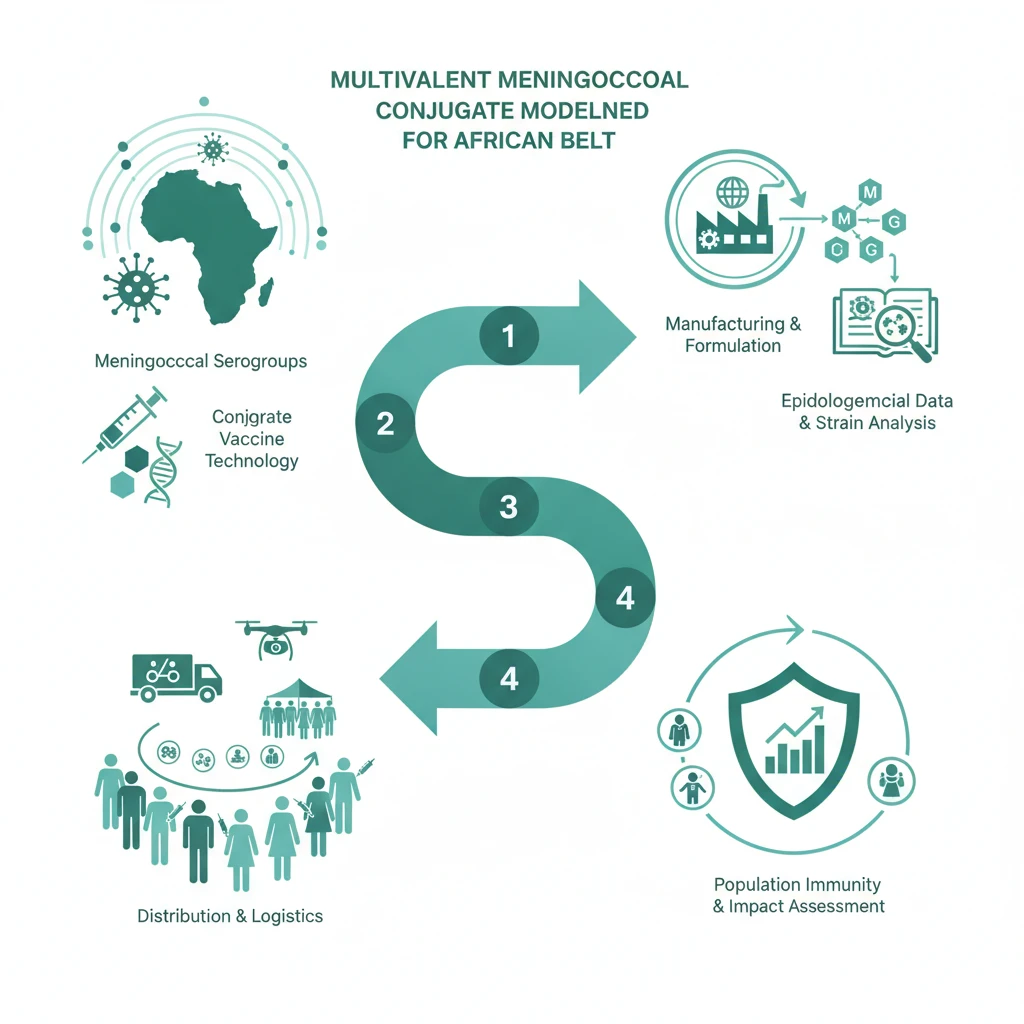

The African meningitis belt has seen significant reductions in group A meningococcal meningitis following MenAfriVac introduction, yet other serogroups, specifically C, W, Y, and X (MenCWYX), continue to pose an epidemic threat. A new transmission dynamic model has been developed to evaluate the potential impact of multivalent meningococcal conjugate vaccines (MMCVs) against MenCWYX, providing insights into optimal vaccination strategies for this region.1
The introduction of MenAfriVac has substantially reduced group A meningococcal meningitis in the African meningitis belt. However, epidemics caused by other serogroups, including C, W, Y, and X (MenCWYX), persist. To address this ongoing threat, a new multivalent meningococcal conjugate vaccine (MMCV) has been developed and pre-qualified by the World Health Organization (WHO).1
Clinical Background on Meningococcal Disease
Meningococcal disease, caused by the bacterium Neisseria meningitidis, is a severe bacterial infection that can lead to meningitis (inflammation of the membranes surrounding the brain and spinal cord) and septicemia (blood poisoning). The disease can progress rapidly and often results in death or severe long-term complications, such as hearing loss, neurological damage, or limb amputation, even with appropriate treatment. The African meningitis belt, a region stretching from Senegal to Ethiopia, experiences the highest burden of meningococcal disease globally, with seasonal epidemics occurring during the dry season. While MenAfriVac effectively controlled serogroup A, the emergence and persistence of other serogroups, particularly W and X, underscore the urgent need for broader protection. Multivalent conjugate vaccines are crucial because they target multiple serogroups, offering comprehensive protection against the most prevalent strains in the region.
What the study did
A study extended a previously established transmission dynamic model for MenA to incorporate MenCWYX, allowing for the evaluation of various vaccination strategies for MMCVs.1 The model used Burkina Faso as a case study to simulate the impact of mass campaigns targeting different age groups and routine vaccination through the Essential Programme on Immunization (EPI).1 The primary outcomes assessed were the number of cases averted and the delay in disease resurgence.1 Sensitivity analyses were also performed to confirm the robustness of strategy rankings and to highlight the importance of accurate estimates for vaccine efficacy and transmission parameters.1
Expanded Methodology and Patient Population Context
The transmission dynamic model employed in this study was an age-structured compartmental model, a common approach in infectious disease epidemiology. This type of model divides the population into compartments based on their disease status (e.g., susceptible, infected, recovered, vaccinated) and age. The model simulates the movement of individuals between these compartments over time, driven by parameters such as contact rates, vaccine efficacy, and duration of protection. By incorporating age structure, the model could differentiate the impact of vaccination strategies on various age groups, which is critical given the age-dependent transmission patterns and disease susceptibility of meningococcal disease. The model was calibrated using epidemiological data from Burkina Faso, a country representative of the meningitis belt in terms of its demographic structure and historical meningococcal disease burden. The simulated patient population thus reflected the age distribution and disease dynamics observed in this high-risk region. The model's ability to simulate both mass vaccination campaigns and routine immunization allowed for a comprehensive comparison of different rollout strategies, considering their potential impact on both immediate epidemic control and long-term disease prevention. The inclusion of MenCWYX serogroups in the model was a significant advancement, as it allowed for a more realistic assessment of the impact of MMCVs in a multi-serogroup epidemiological landscape.
The results indicated that mass vaccination campaigns targeting individuals aged 1-29 years were the most effective strategy for averting cases and delaying disease resurgence.1 Campaigns targeting 1-19-year-olds offered a resource-efficient alternative, demonstrating comparable benefits with potentially lower resource expenditure.1 The model also showed that vaccine efficacy against carriage and the duration of protection significantly influenced outcomes.1 Specifically, greater efficacy (90% versus 60%) and longer protection delayed resurgence and reduced the total number of cases.1 Routine-only vaccination, while valuable in lower-risk settings, was less effective than combined strategies that included catch-up campaigns.1
Mechanism of Action and Limitations
Meningococcal conjugate vaccines work by linking a polysaccharide capsule from the bacterium to a carrier protein. This conjugation enhances the immune response, particularly in infants and young children, and induces T-cell dependent immunity, leading to immunological memory and a more robust and long-lasting protection. Furthermore, conjugate vaccines can reduce nasopharyngeal carriage of the bacteria, thereby limiting transmission within the population and contributing to herd immunity. The model's findings on vaccine efficacy against carriage underscore the importance of this mechanism in achieving sustained disease control. A higher efficacy against carriage directly translates to a greater reduction in transmission, which in turn delays disease resurgence and reduces the overall burden. The duration of protection is also critical, as longer-lasting immunity reduces the need for frequent booster doses and ensures sustained population-level protection.
Despite data limitations and uncertainties, the model provides insights for optimising vaccine rollout.1 The findings suggest that countries within the meningitis belt should integrate MMCVs into their immunisation programs.1 High-risk countries, in particular, should prioritise catch-up campaigns for children and young adults.1 The study also highlighted critical research needs, such as a better understanding of vaccine effectiveness against carriage, to further refine vaccination strategies.1 These results support informed decision-making to sustain progress against meningitis and protect populations from future epidemics, indicating that MMCVs hold promise in further reducing the meningitis burden and moving towards disease elimination in the region.1
The modelling study on multivalent meningococcal conjugate vaccines (MMCVs) provides a clear directive for public health officials and clinicians in the African meningitis belt. The emphasis on catch-up campaigns for children and young adults (1-29 years) is not merely a suggestion; it represents the most effective strategy for disease control and prevention, according to the available evidence. GPs and specialists in these regions should be prepared for the logistical demands of such campaigns, understanding that a broad age range requires significant coordination and community engagement to achieve optimal coverage.
From an industry perspective, the pre-qualification of the new MMCV by WHO is a critical step, but the study underscores that vaccine efficacy against carriage and duration of protection are paramount. Manufacturers developing future meningococcal vaccines must prioritise these characteristics, as even a 30% difference in efficacy (90% vs. 60%) significantly alters epidemic dynamics. The market for these vaccines will likely see sustained demand, particularly if combined with robust public health initiatives that integrate both mass campaigns and routine immunisation.
For patients, the prospect of extended protection against multiple meningococcal serogroups is a substantial public health gain. While routine vaccination offers foundational protection, the modelling suggests that without targeted catch-up campaigns, populations remain vulnerable to resurgence. This implies that patient education and adherence to recommended vaccination schedules, especially during campaign periods, will be crucial for the success of these new strategies. The dry, precise language of the model's output translates directly into a call for immediate and strategic action to protect vulnerable populations.
- The Pivot A new multivalent meningococcal conjugate vaccine (MMCV) has been developed and pre-qualified by WHO to address MenCWYX epidemics.
- The Data Campaigns targeting 1-29-year-olds were most effective in averting cases and delaying disease resurgence.1
- The Action Countries in the meningitis belt should integrate MMCVs into their immunisation programs, prioritising catch-up campaigns for children and young adults in high-risk settings.1
ART-2026-532
·09/26
Drafted with AI assistance, reviewed and approved by the editorial team. This publication is intended for healthcare professionals, researchers, and life science industry professionals. Content is provided for informational and educational purposes only and does not constitute medical advice.

Thirty years in health journalism, the last fifteen in life sciences. I have reported from every major medical congress and watched blockbuster drugs get revised after approval. I cover what the data says.
Cite This Article
Carter J, Voss M. Multivalent meningococcal conjugate vaccines modelled for african belt. The Life Science Feed. Published June 21, 2026. Updated September 14, 2026. Accessed September 19, 2026. https://thelifesciencefeed.com/infectious-diseases/covid19/news/multivalent-meningococcal-conjugate-vaccines-modelled-for-african-belt.
Editorial & AI Standards
All content is researched from peer-reviewed, open-access sources: published trial data, clinical guidelines, and regulatory filings. AI tools are used solely to structure and summarise that evidence; no AI-generated conclusions appear without editor verification against the primary source.
Every article is reviewed by a named editor before publication. Source citations are listed in the References section. This content does not represent the views of any pharmaceutical company, medical device manufacturer, or healthcare provider.
Licence & Rights
© 2026 The Life Science Feed. All rights reserved. Unless otherwise indicated, all content is the property of The Life Science Feed and may not be reproduced, distributed, or transmitted in any form or by any means without prior written permission.
Medical Disclaimer
The information provided on The Life Science Feed is for educational and informational purposes only. It is not intended as a substitute for professional medical advice, diagnosis, or treatment. Always seek the advice of your physician or other qualified healthcare provider regarding any medical condition or treatment decision. Never disregard professional medical advice or delay in seeking it because of something you have read on this website.
References
1. Karachaliou Prasinou A, Trotter C. Modelling of strategies for the introduction and routine use of multivalent meningococcal conjugate vaccines (MMCVs) in the African meningitis belt. PLoS One. 2025;20(1):e040880354. doi:10.1371/journal.pone.0330627







