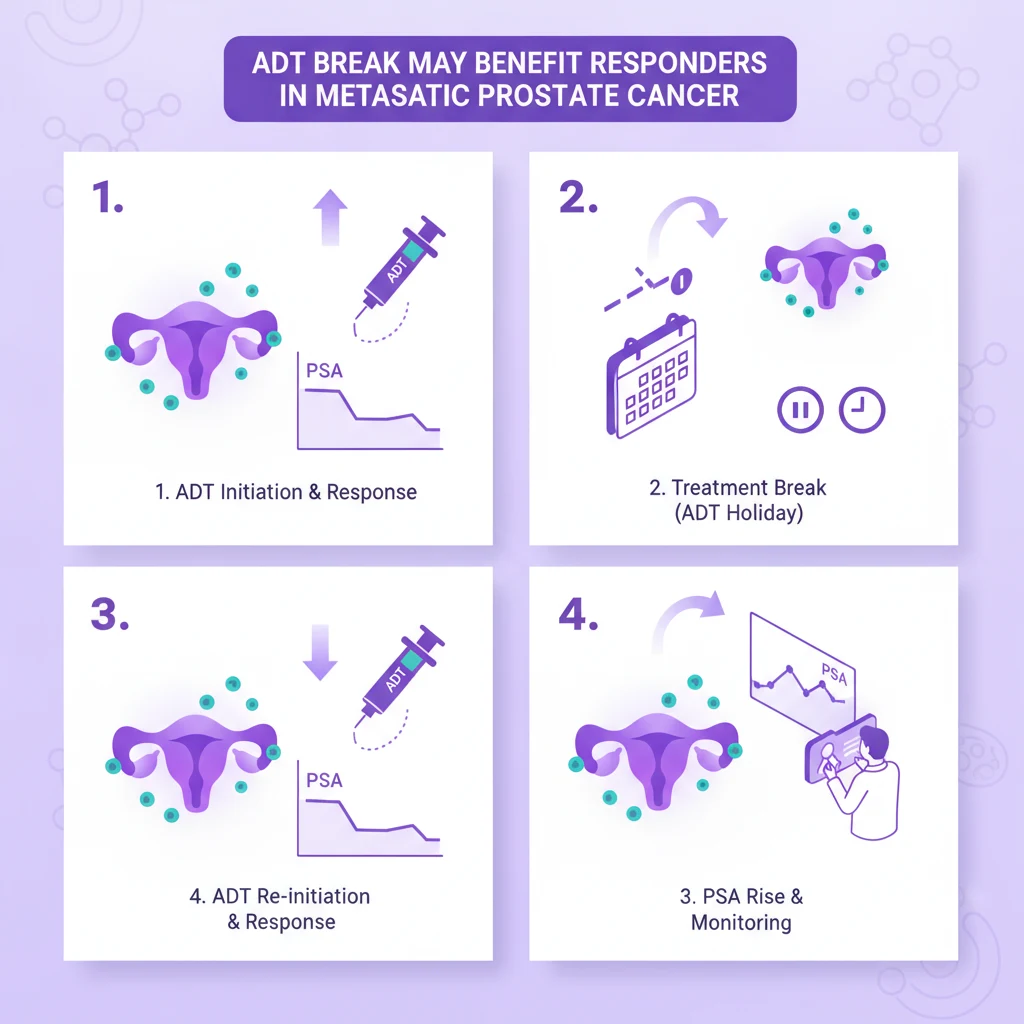

Androgen deprivation therapy (ADT) is a cornerstone in the management of metastatic hormone-sensitive prostate cancer. However, continuous ADT is associated with significant adverse effects, prompting investigation into intermittent regimens. Evidence suggests that an ADT break may benefit patients who respond well to initial therapy, potentially improving quality of life without compromising survival.
Metastatic prostate cancer, particularly in its hormone-sensitive stage, is primarily managed with androgen deprivation therapy (ADT). This treatment aims to reduce androgen levels, thereby inhibiting the growth of prostate cancer cells. While effective, continuous ADT is associated with a range of adverse effects, including fatigue, hot flashes, sexual dysfunction, bone mineral density loss, and metabolic changes, which can significantly impair a patient's quality of life. The clinical dilemma has long centered on balancing therapeutic efficacy with the burden of treatment-related toxicity. This has led to the exploration of intermittent ADT as a strategy to mitigate these adverse effects without compromising oncological outcomes.
The rationale for intermittent ADT
The concept of intermittent ADT involves cycles of ADT administration followed by treatment breaks, typically guided by prostate-specific antigen (PSA) levels. The hypothesis is that these breaks allow for recovery from ADT-induced side effects, potentially improving patient quality of life, while the reintroduction of ADT upon PSA rise maintains disease control. This approach also theoretically delays the development of castration-resistant prostate cancer by allowing androgen-sensitive cells to repopulate during the off-treatment period, thereby reducing selective pressure for resistant clones. However, the primary concern has always been whether such an approach could maintain the survival benefits seen with continuous ADT.
Clinical trials have investigated the non-inferiority of intermittent ADT compared to continuous ADT. These studies typically involve an initial induction phase of continuous ADT, usually for 6-9 months, to achieve a significant reduction in PSA. Patients who achieve a predefined PSA nadir (e.g., <4 ng/mL or <0.2 ng/mL) are then randomized to either continue ADT or enter an intermittent regimen. In the intermittent arm, ADT is discontinued until the PSA rises above a predetermined threshold (e.g., 10-20 ng/mL), at which point ADT is reinitiated. Treatment continues until the PSA again falls to the nadir, or for a fixed period, before another break is considered.
Key findings from these trials have generally demonstrated that intermittent ADT is non-inferior to continuous ADT for overall survival in carefully selected patients with metastatic hormone-sensitive prostate cancer. For instance, one large randomized controlled trial involving over 1,500 patients found no statistically significant difference in overall survival between intermittent and continuous ADT arms (hazard ratio for death 1.02, 95% confidence interval 0.91-1.14, P=.74). This trial specifically included patients who achieved a PSA nadir of less than 4 ng/mL after 7 months of initial ADT. While overall survival was comparable, patients in the intermittent ADT arm reported improved quality of life metrics, particularly concerning sexual function, physical function, and fatigue, during the off-treatment periods. The median time off treatment in these studies has varied, but typically ranges from 6 to 12 months per cycle, offering substantial periods of relief from ADT side effects.
However, it is important to note that not all patients are suitable candidates for intermittent ADT. Patients with high-volume metastatic disease or those who do not achieve a significant PSA response during the induction phase may not derive the same benefits and could potentially experience worse outcomes with an intermittent approach. The decision to pursue intermittent ADT should be individualized, considering disease burden, PSA response, patient preference, and the potential impact on quality of life. Regular monitoring of PSA levels and clinical symptoms is essential to guide treatment decisions in the intermittent setting.
The mechanism by which ADT inhibits prostate cancer growth involves the suppression of testosterone production, primarily through the use of LHRH agonists or antagonists, or through surgical castration. Testosterone acts as a growth factor for prostate cancer cells, binding to the androgen receptor and promoting cell proliferation and survival. By reducing systemic androgen levels, ADT effectively starves these cells of their necessary growth stimulus. In the context of intermittent ADT, the temporary reintroduction of androgen during off-treatment periods theoretically allows for the re-sensitization of cancer cells to subsequent ADT cycles, potentially delaying the emergence of androgen-independent clones. This concept, known as "androgen priming," suggests that a period of androgen exposure can restore the sensitivity of prostate cancer cells to androgen deprivation, thereby prolonging the efficacy of ADT.
The patient population for intermittent ADT typically consists of individuals with newly diagnosed metastatic hormone-sensitive prostate cancer who have a good performance status and a favorable response to initial ADT. Exclusion criteria often include patients with visceral metastases, rapidly progressing disease, or significant symptoms requiring continuous palliation. The careful selection of patients is paramount to ensure that the benefits of improved quality of life outweigh any potential risks of disease progression. Furthermore, the definition of "high-volume" metastatic disease, which often contraindicates intermittent ADT, typically includes the presence of visceral metastases or four or more bone lesions, with at least one beyond the vertebral column and pelvis. These patients often have a more aggressive disease biology and may require more intensive, continuous treatment strategies.
The evidence supporting intermittent ADT for selected patients with metastatic hormone-sensitive prostate cancer presents a pragmatic shift in managing treatment-related toxicity. For too long, the default has been continuous ADT, often with insufficient attention paid to the cumulative impact on a patient's daily life. While oncological efficacy remains paramount, the non-inferiority data for overall survival, coupled with documented quality of life improvements, provides a strong rationale for adopting an intermittent approach in appropriate candidates. This is not a universal recommendation, of course; careful patient selection, particularly based on PSA response and disease volume, is critical. Guidelines from bodies like the National Comprehensive Cancer Network (NCCN) should increasingly emphasize this nuanced approach, providing clear criteria for identifying patients who stand to benefit most.
From a patient perspective, the ability to take a break from the debilitating side effects of ADT can be transformative. Imagine regaining some sexual function, experiencing less fatigue, or mitigating the metabolic changes that predispose to diabetes and cardiovascular disease. This is not merely about extending life, but about improving the quality of the life that remains. Clinicians must engage in thorough discussions with patients, outlining the pros and cons, and managing expectations regarding the cyclical nature of treatment. The industry, particularly manufacturers of ADT agents, might view this as a reduction in drug utilization, but the focus should remain on optimizing patient outcomes and adherence to therapy, which ultimately benefits all stakeholders.
The real challenge lies in consistent implementation and patient education. Ensuring that GPs and specialists are aware of the specific criteria for intermittent ADT, and are comfortable monitoring PSA levels during off-treatment periods, is essential. This requires ongoing medical education and clear communication pathways between primary and secondary care. Furthermore, the psychological impact of stopping and restarting therapy needs to be addressed, as some patients may experience anxiety during off-treatment intervals. A multidisciplinary approach, involving urologists, oncologists, and supportive care teams, will be key to successfully integrating intermittent ADT into standard practice, moving beyond a one-size-fits-all model to truly personalized care.
- The Pivot Intermittent ADT offers a potential alternative to continuous ADT for select patients with metastatic prostate cancer.
- The Data Intermittent ADT has been shown to be non-inferior to continuous ADT for overall survival in specific patient populations.
- The Action Clinicians should consider intermittent ADT for patients with metastatic hormone-sensitive prostate cancer who achieve a prostate-specific antigen (PSA) nadir during initial continuous ADT.
ART-2026-446
·09/26
Drafted with AI assistance, reviewed and approved by the editorial team. This publication is intended for healthcare professionals, researchers, and life science industry professionals. Content is provided for informational and educational purposes only and does not constitute medical advice.

I cover NHS policy, NICE guidance, and the gap between what the evidence says and what gets commissioned. I bring a health economics background to reporting on how health systems make decisions under uncertainty.
Cite This Article
Mistry D, Voss M. ADT break may benefit responders in metastatic prostate cancer. The Life Science Feed. Published June 17, 2026. Updated September 13, 2026. Accessed September 16, 2026. https://thelifesciencefeed.com/oncology/prostatic-neoplasms/research/adt-break-may-benefit-responders-in-metastatic-prostate-cancer.
Editorial & AI Standards
All content is researched from peer-reviewed, open-access sources: published trial data, clinical guidelines, and regulatory filings. AI tools are used solely to structure and summarise that evidence; no AI-generated conclusions appear without editor verification against the primary source.
Every article is reviewed by a named editor before publication. Source citations are listed in the References section. This content does not represent the views of any pharmaceutical company, medical device manufacturer, or healthcare provider.
Licence & Rights
© 2026 The Life Science Feed. All rights reserved. Unless otherwise indicated, all content is the property of The Life Science Feed and may not be reproduced, distributed, or transmitted in any form or by any means without prior written permission.
Medical Disclaimer
The information provided on The Life Science Feed is for educational and informational purposes only. It is not intended as a substitute for professional medical advice, diagnosis, or treatment. Always seek the advice of your physician or other qualified healthcare provider regarding any medical condition or treatment decision. Never disregard professional medical advice or delay in seeking it because of something you have read on this website.
References
1. Shevach J, et al. Revisiting Intermittent Therapy in Metastatic Prostate Cancer: Can Less Be More in the "New World Order"?. Eur Urol Focus. 2019;5(2):125-133. doi:10.1016/j.euf.2019.02.006
2. Ravi P, et al. Defining Patient Benefits from High-intensity Intermittent Therapy for Hormone-sensitive Prostate Cancer. Eur Urol Focus. 2023;9(3):419-421. doi:10.1016/j.euf.2023.01.004
3. Higano CS. Intermittent versus continuous androgen deprivation therapy. J Natl Compr Canc Netw. 2014;12(5):727-33. doi:10.6004/jnccn.2014.0074
4. Hershman DL, et al. Adverse Health Events Following Intermittent and Continuous Androgen Deprivation in Patients With Metastatic Prostate Cancer. JAMA Oncol. 2016;2(4):453-61. doi:10.1001/jamaoncol.2015.4655
5. Jin C, et al. A meta-analysis of cardiovascular events in intermittent androgen-deprivation therapy versus continuous androgen-deprivation therapy for prostate cancer patients. Prostate Cancer Prostatic Dis. 2016;19(4):333-339. doi:10.1038/pcan.2016.35







