


Hosted by Sarah Mitchell & James Carter
Follow the show while you are there, and new episodes turn up on their own.Listen on Spotify
Show Notes
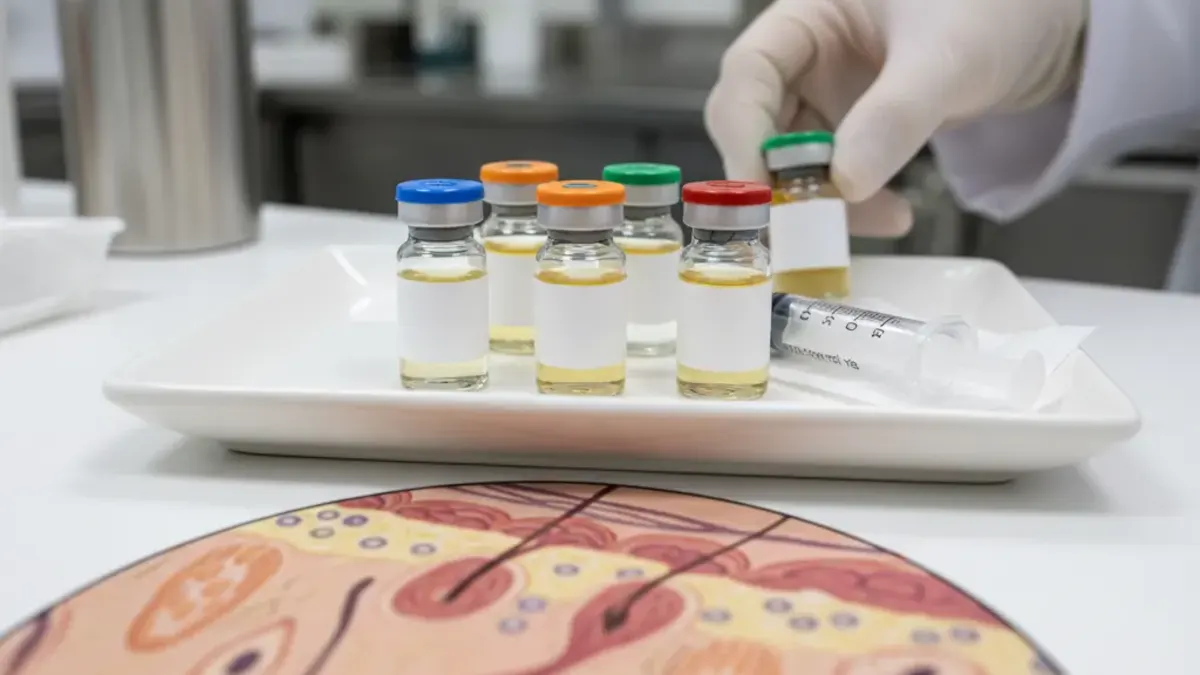
The NOR-SWITCH trial established that switching from reference infliximab to a biosimilar is safe. Multiple subsequent studies have confirmed this across adalimumab and other biologics. Sarah Mitchell and James Carter examine the switching evidence, the nocebo effect, and how the biosimilar dividend is reshaping access to care.
Transcription
Picture a patient for a second. Uh, he's 43 years old and he has plaque psoriasis.
CO-HOST: Okay.
And we're not talking about like a mild rash on his elbow. Imagine 40% of his body covered in these painful, itchy, just severely inflamed plaques.
CO-HOST: Oh, wow. Yeah, that is a really severe presentation.
Right. And he's been through the ringer trying to find relief. He's failed two different conventional systemic treatments already.
CO-HOST: Which is exhausting for a patient.
Totally. But finally, his medical team prescribes this biologic drug called Adalumab, and it works flawlessly. I mean, he achieves a PASI 90.
CO-HOST: Oh, that's huge. Uh, for those listening in dermatology, PASI 90 translates to near total clearance of the disease. It is the absolute gold standard outcome.
Right. So, for 18 straight months, his body is perfectly stable. He essentially has his life back.
CO-HOST: When you work in clinical practice, getting a patient to that level of sustained clearance is the ultimate goal. That's what you want.
Exactly. But then a wrench gets thrown into the gears. His insurance coverage changes.
CO-HOST: Oh, of course.
Almost overnight, his doctor gets this notice from the pharmacy benefit manager saying, "Hey, you need to switch this perfectly stable patient off his current medication. You have to transition him to a cheaper alternative, uh, called a biosimilar."
CO-HOST: Yeah, that's a classic scenario.
And the doctor looks at this patient who is finally thriving after years of suffering, and she hesitates. She pushes back against the insurance company.
CO-HOST: Naturally.
Right. And that leaves her wrestling with a really serious professional dilemma. Is she being a good, fiercely protective clinician, or is she being, you know, overly cautious to the point of actively resisting evidence-based medicine?
CO-HOST: This is a profound dilemma. And honestly, it highlights this massive tension we see between clinical instinct and the sort of economic realities of modern healthcare systems.
Totally. So, welcome to today's deep dive. We are exploring a really fascinating discussion we sourced between a consultant dermatologist and a clinical pharmacologist.
CO-HOST: Yeah, it's a great exchange.
It really is. They tackle the deep science, the complicated psychology, and the fundamental ethics of biosimilar drugs.
CO-HOST: There's a lot to get into.
There is. Our mission today is to unpack a really critical question for you. When your body is perfectly stable on a highly complex medication, is it ever truly safe to swap it out for a cheaper alternative? So, okay, let's unpack this.
CO-HOST: Sounds good. To really understand why the doctor in that opening scenario hesitated, we kind of have to establish what a biosimilar actually is.
Right, because there's a lot of confusion there.
CO-HOST: There is a pervasive assumption, um, even among some practicing clinicians, honestly, that a biosimilar is essentially just a generic version of a biologic drug.
Like it's the exact same thing, just a different brand name.
CO-HOST: Exactly. But they are fundamentally different categories.
I think a lot of us fall into that trap because we're just so used to how generic drugs work, you know? Like, you take a brand name medication like aspirin, the patent expires, and another company starts manufacturing generic aspirin. At the end of the day, you're dealing with a small molecule drug.
CO-HOST: Yes, a very simple structure.
Right. It's a relatively simple chemical structure that can be perfectly synthesized in really any well-equipped commercial lab.
CO-HOST: And the output is chemically identical. You can analyze the generic aspirin and the brand name aspirin down to the literal atom, and there is zero structural difference.
But biologics aren't like that.
CO-HOST: Not at all. Biologics do not follow that rule. These are not simple chemicals synthesized in a beaker. They are massive, intensely complex proteins, and they're produced by living cells.
Living cells, that's wild.
CO-HOST: Yeah. Adalimumab, the drug our 43-year-old patient was taking, is a monoclonal antibody. It consists of roughly 1,300 amino acids folded into this highly specific three-dimensional shape.
Which means the manufacturing process is an entirely different beast. You're dealing with what? Living cell lines, specific fermentation vets, highly proprietary purification steps.
CO-HOST: Exactly. The industry mantra is literally, "The process is the product."
Wow, the process is the product.
CO-HOST: Right. If a new manufacturer wants to make a biosimilar, they do not have access to the original company's exact cell line. They don't have their specific bioreactor conditions.
So they have to guess.
CO-HOST: Well, they have to reverse engineer the entire process.
Okay. So it's sort of like trying to perfectly clone a prize-winning racehorse.
CO-HOST: Oh, I like that.
Like even if you manage to secure the exact same genetic blueprint, the environment matters.
CO-HOST: Right.
If your cloned horse is raised in a slightly different climate or fed a slightly different blend of oats, which I guess in our scenario is the biological fermentation vet.
CO-HOST: That's exactly.
Its muscle development and its temperament will be subtly different. You are never going to get a 100% identical atomic clone of the original horse.
CO-HOST: That captures the biological reality perfectly. Because it's grown in a living system, a biosimilar will naturally have minor structural variations.
So it's not a perfect twin?
CO-HOST: No, the goal of the manufacturer isn't to create an identical twin. It is to engineer a highly similar molecule that regulators agree has, quote, "no clinically meaningful differences" in safety, efficacy, or immunogenicity.
Okay, wait. No clinically meaningful difference sounds a lot like lawyer speak to me.
CO-HOST: It does sound like that, yeah.
If the scientific community openly admits that a biosimilar is not a flawless 100% clone, how can a regulatory agency legally guarantee a patient's safety?
CO-HOST: That's the big question.
Like what is stopping a seemingly subtle difference in that protein fold from triggering some massive clinical failure?
CO-HOST: So regulatory agencies like the FDA in the US and the EMA in Europe rely on a framework called the Totality of Evidence approach.
Okay, what does that mean?
CO-HOST: It completely flips the traditional drug approval process on its head. With a brand new novel drug, the ultimate proof of safety and efficacy comes at the very end of the pipeline.
Right, during those massive phase three clinical trials involving thousands of human patients.
CO-HOST: Exactly. Because you have no idea how this totally new chemical will behave in a complex human system until you test it at scale.
But a biosimilar isn't a totally novel concept.
CO-HOST: Right. The target and the mechanism are already well understood. So the regulatory heavy lifting happens at the very beginning of the pipeline in the laboratory.
Before it ever touches a human.
CO-HOST: Yes. Regulators demand exhaustive analytical characterization. We're talking mass spectrometry, advanced blinding assays, deep functional analysis.
We really put it under the microscope.
CO-HOST: Literally and figuratively. They map the molecular structure and test its biological activity down to the most microscopic detail possible.
They're essentially playing the most rigorous game of spot the difference imaginable, just analyzing the protein fold by fold.
CO-HOST: Yes. Long before a single human patient is involved. And once that structural and functional parity is definitively proven in the lab, then they run pharmacokinetic studies.
Just to verify that the drug clears the human body at the same rate.
CO-HOST: Exactly. By the time they actually run a clinical trial, the trial itself is usually quite small.
Oh, really?
CO-HOST: Yeah, it's not designed to prove if the drug works, the analytical data already proved that. It's merely a confirmatory step to catch any highly improbable residual issues.
Wow. Okay, so because that extensive lab data does so much of the heavy lifting, it leads to a regulatory mechanism that, um, makes a lot of prescribers very uncomfortable.
CO-HOST: You're talking about extrapolation.
Yes, extrapolation. If the structural data is rock solid, regulators will approve a biosimilar for diseases it was never even tested on in human trials.
CO-HOST: It is a major psychological hurdle for doctors.
I can imagine.
CO-HOST: If a biosimilar is rigorously tested in a clinical trial specifically for rheumatoid arthritis, the EMA or FDA might extrapolate that data and automatically approve the drug for plaque psoriasis as well.
Without requiring a multi-million dollar dedicated psoriasis trial.
CO-HOST: Exactly.
Which invites a totally valid pushback, I think. I mean, psoriasis involves entirely different inflammatory pathways and completely distinct patient demographics compared to rheumatoid arthritis.
CO-HOST: It's true. They are very different diseases.
If a master key works flawlessly on the lock to a sprawling mansion, it is a massive leap of faith to assume it works on the lock to a tiny apartment just because they're both buildings, you know?
CO-HOST: The analogy holds, but we have to shift our perspective on what the lock actually is here.
Okay.
CO-HOST: The key isn't fitting into the house of the broader disease. It is fitting into the specific molecular lock of the inflammation itself.
Ah, I see.
CO-HOST: Adalimumab works by seeking out and binding to a very specific inflammatory cytokine called TNF-alpha.
So if the lab data proves the biosimilar binds to TNF-alpha with the exact same affinity as the original drug, the downstream clinical effect on the human body is going to be identical.
CO-HOST: Exactly. Regardless of whether that TNF-alpha is causing joint pain in arthritis or skin plaques in psoriasis.
The mechanism of action is agnostic to the disease state.
CO-HOST: Right. Now, regulators are not reckless about this.
Okay, good to know.
CO-HOST: When you look at a more complex biologic like ustekinumab, which targets two different inflammatory pathways, IL-12 and IL-23.
Which is used for vastly different conditions like psoriasis and Crohn's disease, right?
CO-HOST: Yes. For those, the extrapolation bar is much higher. Regulators demand rigorous scientific justification to prove that the minor structural variations won't impact one disease state differently than the other.
Okay, that makes sense. And we're not just relying on theoretical molecular models anymore either. We actually have extensive post-marketing registry data for the older biosimilars now.
CO-HOST: We do. And registries are great because they capture the messy real-world patients that controlled clinical trials usually exclude.
Right. And the data from thousands of psoriasis patients in those registries confirms that the extrapolation was scientifically sound.
CO-HOST: The clinical efficacy remains exactly as predicted.
Okay, so let's pivot back to that 43-year-old patient from our introduction.
CO-HOST: Right, the guy with the insurance switch.
Yeah. The extrapolation data proves the biosimilar works for new patients starting therapy. But we are talking about swapping out the medication of a patient whose immune system is perfectly suppressed and highly stable on the original biologic.
CO-HOST: That is the core clinical dilemma. Establishing efficacy in a naive patient is one thing. Disrupting a stabilized patient is another.
Right.
CO-HOST: To answer that, we really have to look at the landmark Nor-Switch trial. It was published in The Lancet back in 2017.
This was a huge watershed moment in the medical community.
CO-HOST: It truly was. The researchers took nearly 500 patients who were completely stable on an original biologic called infliximab. Crucially, these patients represented six different indications.
Mm-hm.
CO-HOST: So you had rheumatoid arthritis, psoriasis, inflammatory bowel disease, et cetera.
And they randomized the group, right?
CO-HOST: Yes. Half remained on their original medication and half were abruptly switched to a biosimilar.
Wow. So they were actively testing the extrapolation theory and the switching theory simultaneously across multiple diseases.
CO-HOST: Very ambitious trial.
What was the outcome for the patients who were forced to switch?
CO-HOST: The trial established non-inferiority.
Okay.
CO-HOST: Over a 52-week period, disease worsening occurred in 26% of the patients who switched to the biosimilar compared to 30% of the patients who remained on the original biologic.
So it was statistically comparable, meaning the literal act of switching did not cause a catastrophic loss of stability.
CO-HOST: Exactly.
But Nor-Switch only looked at a single isolated swap. What happens when insurance formularies force a patient to bounce back and forth between different biosimilars multiple times over a few years?
CO-HOST: Yeah, that exact scenario was the focus of another study, the Voltarex study.
Oh, they actually studied that?
CO-HOST: They did. They looked specifically at psoriasis patients taking adalimumab who underwent multiple alternating switches between the reference product and the biosimilar.
Yeah.
CO-HOST: The results were highly reassuring. They showed no significant loss of efficacy and no spike in adverse events despite the repeated disruption.
That's impressive. But we need to address the underlying biological fear here, which is immunogenicity.
CO-HOST: Right. The immune response.
Yeah. When you inject a massive complex protein like a monoclonal antibody into a human body, there is always a risk that the immune system will flag it as a foreign threat.
CO-HOST: And start producing anti-drug antibodies to neutralize it.
Which neutralizes the drug's efficacy entirely.
CO-HOST: Exactly. The clinical fear is that the subtle structural differences in a biosimilar, you know, those minor variations from the fermentation process, could be just enough to trigger an immune response in a patient who was previously perfectly tolerant to the original drug.
Okay, but the clinical trial data for single switches does not show any signal for increased immunogenicity.
CO-HOST: That's true.
However, the source material notes a pretty glaring structural flaw in how we measure that risk. Immunogenicity testing is not universally standardized across these various studies.
CO-HOST: It's really not. The assays used to detect these antibodies vary significantly from trial to trial.
They use different testing methods, different sensitivities, and even different baseline definitions of what constitutes a positive antibody result.
CO-HOST: Right. It's kind of the wild west.
So, if one laboratory test is only sensitive enough to detect a massive systemic immune response, it might report zero antibodies.
CO-HOST: Yep.
Meanwhile, a highly sensitive test run on the exact same blood sample might find micro-reactions. So without a universal standard, an absence of signal in a trial might just mean the researchers were looking through a blurry microscope.
CO-HOST: That is a vital caveat. The data we have is incredibly reassuring, but the lack of assay standardization means we cannot offer a titanium-clad guarantee based on trials alone.
Right.
CO-HOST: That is why pharmacovigilance, the mandatory ongoing safety tracking required by the FDA and EMA after a drug hits the market, is the true safety net here.
We are constantly monitoring those real-world registries for any unexpected spikes in immune reactions.
CO-HOST: Exactly. And while single switches are heavily supported by this data, multiple sequential switches still make clinical pharmacologists quite cautious.
Because of that cumulative risk.
CO-HOST: Yeah. Every time you swap a patient to a different biosimilar to chase a cheaper pharmacy contract, you are introducing a new micro-exposure.
A new variable.
CO-HOST: Right. There are theoretical concerns that this formulary ping-pong could eventually provoke cumulative immunogenicity over time. The current data doesn't prove multiple switches are harmful, but it certainly doesn't endorse the practice as harmless either.
Okay, so if the molecular data for a single switch is so robust and the clinical trials show non-inferiority, why do so many clinics report that patients genuinely feel worse after being transitioned to a biosimilar?
CO-HOST: That's a fascinating phenomenon. A patient walks in and says their joints are aching, their skin is flaring up, and the new drug is clearly failing them. If the mechanism of action is identical, what is causing the physical decline?
We are looking at a classic nocebo effect here.
CO-HOST: The nocebo effect.
Yeah, the negative psychosocial context of the prescription swap is actually triggering somatic symptoms.
CO-HOST: So it's basically the psychological inverse of the placebo effect.
Precisely.
CO-HOST: With the placebo, the expectation of healing physically reduces pain. With a nocebo effect, a patient's deep anxiety and negative expectations about a drug actually manifest as physical side effects and decreased efficacy.
The anxiety itself can trigger stress responses that exacerbate the very inflammatory pathways the biologic is attempting to suppress.
CO-HOST: That's incredible.
The TrECIE study provided brilliant insight into this phenomenon. Researchers monitored patients who were being transitioned to biosimilars.
CO-HOST: Okay.
They found that patients who were thoroughly educated about the switch, patients who understood the totality of evidence approach and the rigorous safety data, were significantly less likely to report nocebo-related symptoms.
Which exposes a massive vulnerability in modern clinical practice, frankly.
CO-HOST: Oh, totally. Doctors are operating under immense time pressure.
Right. For many prescribers, transitioning a patient to a biosimilar is viewed as a tedious administrative mandate from an insurance company.
CO-HOST: Just a box to check.
Yeah. They click a button in the electronic health record, hand over the new prescription, and rush to the next room.
CO-HOST: The communication gap is profound.
I mean, think about your last visit to the pharmacy. If the pharmacist suddenly swapped your life-saving, highly specialized medication without any prior warning just to satisfy a new insurance contract, your heart rate would spike.
CO-HOST: You panic.
You would instantly assume you're receiving an inferior generic knockoff. You would go home hypervigilant, scanning your body for every minor ache or skin blemish, convinced the drug was failing you.
CO-HOST: It's completely understandable.
So a purely administrative headache is translating into a biological inflammatory flare-up that completely changes the definition of what a side effect can be.
CO-HOST: It really does, and it highlights why clinical communication is as vital as the molecule itself.
Absolutely.
CO-HOST: The blueprint for mitigating this nocebo effect is entirely manageable, though. First, never let the patient discover the switch at the pharmacy counter.
Have a dedicated conversation in the clinic first.
CO-HOST: Yes. Second, be transparent about the minor non-clinical differences.
Like acknowledging that the injection pen might be a different color.
CO-HOST: Or that the injection might sting a little more because the manufacturer uses a different citrate preservative.
Oh, that's a good point.
CO-HOST: If you proactively warn them about those sensory changes, they process them as expected variations rather than terrifying evidence that the drug is toxic.
All right.
CO-HOST: Finally, schedule a dedicated follow-up appointment for 8 to 12 weeks post-switch. Establishing that safety net dramatically lowers patient anxiety.
So we have addressed the psychological component. But clinical confidence is not a static metric. How confident should a doctor actually be today when looking across the entire landscape of biosimilars?
CO-HOST: Well, confidence is heavily dependent on the specific timeline and vintage of the drug in question.
Meaning how long it's been around.
CO-HOST: Right. For older biologics like adalimumab and etanercept, the biosimilars have been circulating in European markets since 2016 and 2018.
So we have a lot of data on those.
CO-HOST: Mountains of it. We have access to massive multi-year real-world tracking systems like the Danbio Registry in Scandinavia.
Okay.
CO-HOST: For those specific drugs, clinical confidence is absolute. Single switches are unequivocally supported by the data.
But what about the newer biosimilars hitting the market right now?
CO-HOST: Like biosimilars for ustekinumab, which are just receiving approvals around 2024 and 2025. Yeah. The analytical and structural data is incredibly strong, but the real-world longitudinal switching data is still accumulating. So the clinical posture there is moderate to high confidence.
Meaning you proceed with the switch, but you maintain robust monitoring.
CO-HOST: Exactly.
And there are drugs where the medical community still needs to proceed with extreme caution, right?
CO-HOST: Oh, certainly. We're looking at the upcoming pipeline of IL-17 inhibitors like secukinumab, which are currently navigating Phase 3 trials, or the IL-23 inhibitors that are still three to five years away from biosimilar approval.
So when those eventually launch, you can't blindly apply the soaring confidence of an eight-year-old adalimumab biosimilar to a brand new product.
CO-HOST: No, absolutely not. And we must always account for the clinical unknowns, which are the special populations.
Right, because clinical trials are inherently designed to study relatively stable, predictable adults.
CO-HOST: They systematically exclude pediatric patients, elderly patients managing complex polypharmacy, and individuals with profound immunosuppression.
So when you are extrapolating a biosimilar's efficacy into those highly vulnerable demographics, the standard of caution must be significantly higher.
CO-HOST: It has to be.
So, zooming all the way out, it becomes clear that responsible medicine kind of rejects extremes here. It is not about blindly demanding that every patient switch immediately to save the healthcare system money.
CO-HOST: Nor is it about stubbornly refusing to switch anyone because the concept of biological variants feels a bit uncomfortable.
Right, it's about actively matching the established vintage and data profile of the drug to the specific clinical reality of the patient sitting in the exam room.
CO-HOST: That is the definition of evidence-based pragmatism, really.
Exactly. Which brings us back to our opening scenario. The 43-year-old patient who achieved near total clearance on his original biologic.
CO-HOST: Oh, yes.
His doctor was agonizing over whether to fight the insurance mandate or proceed with the biosimilar swap. Based on the totality of the evidence today, what is the correct clinical verdict?
CO-HOST: The verdict is clear. You transition him to the biosimilar.
You do.
CO-HOST: You do. You sit down, you invest five minutes in an empathetic, scientifically grounded conversation about why the drug is safe. You warn him about the different injection pen, and you schedule a 12-week follow-up.
Because the data overwhelmingly indicates he will maintain his clearance.
CO-HOST: It does. In fact, withholding that transition out of an abundance of undocumented caution ultimately does a disservice to the broader sustainability of the healthcare system.
The source text highlighted a really fascinating psychological barrier here actually. The dermatologist in the discussion realized her hesitation wasn't genuinely rooted in the molecular science.
CO-HOST: Right, she knew the trial data was solid.
Exactly. Her hesitation stemmed from the deep psychological discomfort of disrupting a patient who was finally stable. Medical professionals are human, you know? They fall victim to the status quo bias just like anyone else.
CO-HOST: When things are quiet, the instinct is to avoid rocking the boat at all costs.
But the clinical pharmacologist offered a brilliant reframing of that mindset. They said, "Stability is not the same as optimal."
CO-HOST: It is a crucial distinction for any practitioner to make.
I agree.
CO-HOST: If clinicians prioritize the sheer comfort of a quiet status quo over integrating new evidence, medicine would just stagnate.
Right. Dosages would never be optimized, outdated treatments would never be retired, and the systemic costs of healthcare would become completely unmanageable. That perfectly sets up a final thought for you to mull over as we wrap up this deep dive. We can clearly see how a doctor's instinct to cling to a comfortable status quo can inadvertently prevent a patient from receiving sustainable optimized care. But step outside the walls of the medical clinic for a moment. Where else in your life are you letting the sheer comfort of a stable status quo prevent you from adopting a change? A change that might require a slightly uncomfortable transition at first, but is ultimately much more sustainable for you and for the larger systems you participate in. Something to think about.
Free Clinical Resources
Episode Infographic
Key data, mechanisms, and clinical takeaways distilled into a single shareable page. Save it for reference or use it in your next team discussion.
Clinical Flashcards
Core concepts from this episode in flashcard format, structured for spaced repetition, pre-consultation review, or CPD reflection with your team.
ART-2026-188
·09/26
This podcast episode is produced with AI assistance, reviewed and approved by the editorial team. This publication is intended for healthcare professionals, researchers, and life science industry professionals. Content is provided for informational and educational purposes only and does not constitute medical advice.
I cover women's health, reproductive medicine, and the persistent gaps in how conditions that primarily affect women get studied and funded. The evidence base is thinner than it should be. I write about why.
Cite This Podcast
Mitchell S, Carter J. Is it safe to switch biosimilars?. The Life Science Feed. Published May 28, 2026. Updated September 15, 2026. Accessed October 11, 2026. https://thelifesciencefeed.com/podcast/2026-05-28/is-it-safe-to-switch-biosimilars.
Editorial & AI Standards
All content is researched from peer-reviewed, open-access sources: published trial data, clinical guidelines, and regulatory filings. AI tools are used solely to structure and summarise that evidence; no AI-generated conclusions appear without editor verification against the primary source.
Every article is reviewed by a named editor before publication. Source citations are listed in the References section. This content does not represent the views of any pharmaceutical company, medical device manufacturer, or healthcare provider.
Licence & Rights
© 2026 The Life Science Feed. All rights reserved. Unless otherwise indicated, all content is the property of The Life Science Feed and may not be reproduced, distributed, or transmitted in any form or by any means without prior written permission.
Podcast Disclaimer
This podcast is produced for educational and informational purposes only. The conversation between hosts represents a discussion of published clinical evidence and is not intended as clinical advice, a substitute for professional medical judgment, or a recommendation for any specific treatment. Healthcare professionals should rely on their own clinical training, current guidelines, and individual patient assessment when making treatment decisions. The views expressed are those of the hosts and do not constitute endorsement of any specific therapy, product, or manufacturer.
References
Blauvelt A et al. Switching from originator to biosimilar: systematic review in dermatology. J Dermatol Sci. 2021;103:143-150
EMA. Biosimilar medicines: questions and answers. European Medicines Agency. 2022
Gerdes S et al. Biosimilar use in dermatology: switching from adalimumab originator to biosimilar. J Eur Acad Dermatol Venereol. 2020;34:2272-2280
Jorgensen KK et al. NOR-SWITCH: switching from reference infliximab to biosimilar CT-P13. Lancet. 2017;389:2304-2316
Warren RB et al. Secukinumab biosimilar SB17 vs reference secukinumab in psoriasis. Br J Dermatol. 2024

Closing the gap: a 5-step plan for psoriasis and metabolic disease
A new framework outlines a five-step action plan to improve screening and management of metabolic comorbidities in patients with psoriasis.

Patient-Reported Factors Redefine Alopecia Areata Severity
New research characterizes patient-reported factors beyond scalp hair loss that contribute to alopecia areata severity.
More from: Psoriasis Deep Dive Series
Deucravacitinib (the first approved TYK2 inhibitor) offers a new oral option for moderate-to-severe psoriasis without the cardiovascular safety concerns attached to pan-JAK inhibitors. Sarah Mitchell and James Carter examine how the oral therapy landscape is evolving and what it means for patients who refuse injections.
James Carter & Sarah Mitchell

Monitoring for methotrexate-related liver toxicity dominated psoriasis practice for decades, but now the PIIINP blood test has replaced routine liver biopsies in most guidelines. Sarah Mitchell and James Carter walk through the current monitoring framework for systemic and biologic therapies in psoriasis.
James Carter & Sarah Mitchell

Up to half of psoriasis patients discontinue their treatment within a year. The reasons are complex: side effect fear, injection fatigue, visible improvement masking ongoing disease. The solutions require as much psychology as pharmacology. Sarah Mitchell and James Carter examine the adherence crisis and what works.
Sarah Mitchell & James Carter






