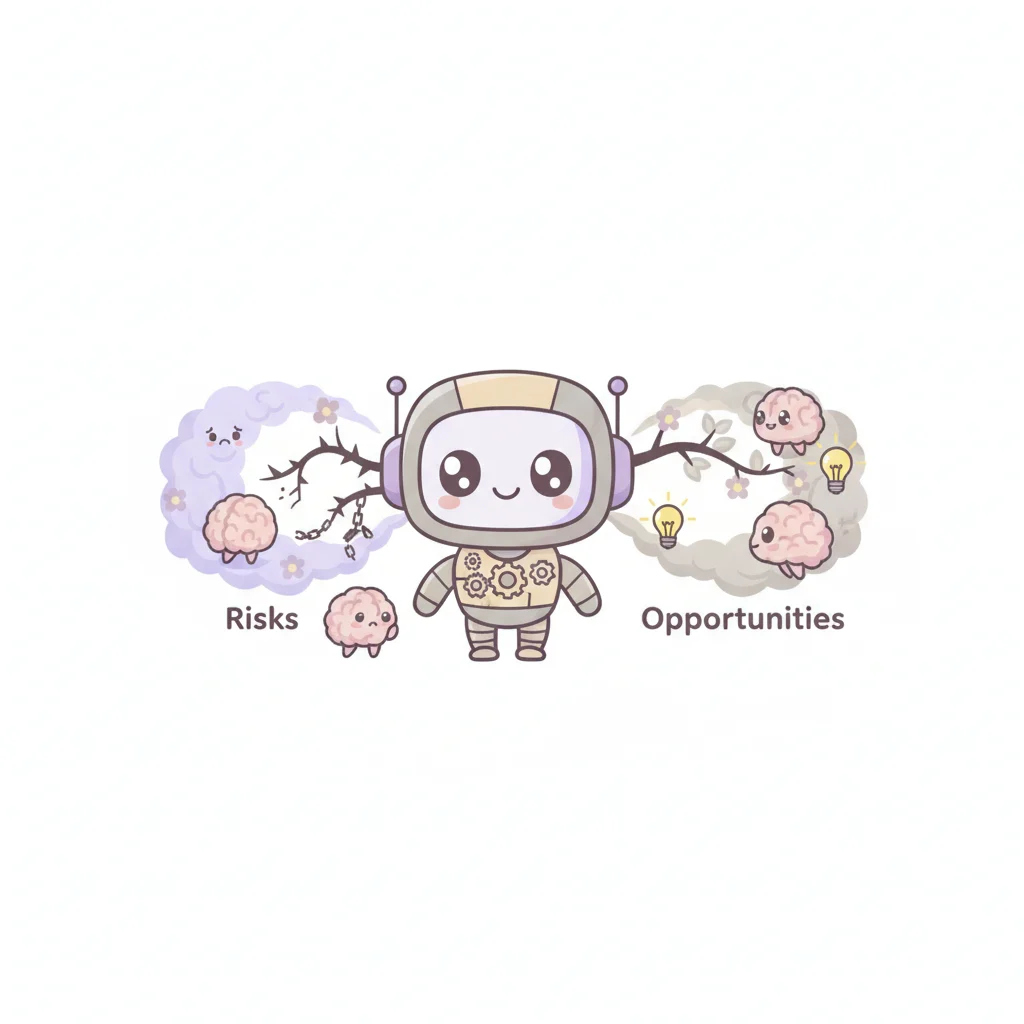

The integration of artificial intelligence (AI) into mental healthcare systems in the UK presents a complex clinical dilemma. While AI offers potential for improved access and efficiency, its implementation also carries risks that could exacerbate existing mental health challenges. Clinicians must understand the immediate implications of AI adoption to mitigate harm and leverage its benefits effectively.
The potential for artificial intelligence (AI) to transform mental healthcare in the UK is widely discussed, encompassing applications from diagnostic support to personalised therapeutic interventions. However, the impact of AI on mental health is not uniformly positive; it presents a dual challenge of opportunity and risk. Understanding these facets is essential for healthcare professionals navigating this evolving landscape.
AI in Mental Health: Opportunities and Challenges
AI technologies offer several potential advantages for mental health service delivery. These include enhancing the accessibility of mental health support, particularly in underserved areas, through AI-powered chatbots and virtual therapists. Such tools can provide initial assessments, offer psychoeducational content, and deliver low-intensity cognitive behavioural therapy (CBT) interventions, potentially reducing waiting times for specialist services. Furthermore, AI algorithms can analyse large datasets to identify patterns indicative of mental health conditions, potentially aiding in earlier diagnosis and personalised treatment planning. For example, natural language processing (NLP) can analyse patient narratives for linguistic markers associated with depression or anxiety, while machine learning models can predict treatment response based on patient demographics and clinical history.
Despite these opportunities, significant challenges and risks are associated with AI implementation in mental health. A primary concern is algorithmic bias, where AI models trained on unrepresentative datasets may perpetuate or amplify existing health inequalities. If an AI system is predominantly trained on data from specific demographic groups, its diagnostic accuracy or treatment recommendations may be suboptimal or even harmful for individuals from different backgrounds. This could lead to misdiagnosis or inappropriate interventions, particularly for minority groups or those with complex presentations. The lack of transparency in some AI algorithms, often referred to as 'black box' models, further complicates this issue, making it difficult for clinicians to understand how decisions are reached and to identify potential biases.
Data privacy and security represent another critical challenge. Mental health data is highly sensitive, and the collection, storage, and processing of such information by AI systems raise substantial ethical and legal questions. Ensuring robust data protection measures and obtaining informed consent for data use are paramount to maintaining patient trust and complying with regulations such as the General Data Protection Regulation (GDPR). The potential for data breaches or misuse could have severe consequences for individuals, including discrimination or stigma.
The impact on the therapeutic relationship is also a concern. The human element of empathy, nuance, and non-verbal communication is central to effective mental healthcare. While AI can augment care, over-reliance on automated systems could diminish the quality of the patient-clinician bond, potentially leading to reduced patient engagement and poorer outcomes. The ethical implications of AI making decisions that affect mental well-being, particularly in crisis situations, require careful consideration and clear lines of accountability.
Finally, the regulatory framework for AI in healthcare is still developing. Without clear guidelines on validation, safety, efficacy, and ethical use, there is a risk of deploying unproven or poorly tested AI tools. This could lead to patient harm, erode public trust, and hinder the legitimate advancement of beneficial AI applications. The need for rigorous clinical validation of AI tools, similar to that required for new pharmaceutical interventions, is essential to ensure that these technologies deliver genuine clinical benefit without undue risk.
Addressing these challenges necessitates a multi-faceted approach. Robust regulatory sandboxes and pilot programs are crucial for evaluating AI tools in real-world clinical settings, allowing for iterative refinement and the development of best practices. Furthermore, investment in interdisciplinary research, combining expertise from AI specialists, clinicians, ethicists, and patients, is vital to ensure that AI solutions are not only technologically advanced but also clinically relevant and ethically sound. Training healthcare professionals in AI literacy will also be paramount, enabling them to critically appraise AI tools, understand their limitations, and integrate them effectively and safely into their practice. This includes understanding potential biases and knowing when human oversight is indispensable.
Future Directions and Recommendations
The successful integration of AI into UK mental healthcare hinges on proactive strategies. Developing clear, evidence-based guidelines for AI development and deployment, alongside robust ethical frameworks, is non-negotiable. This includes mandating transparency in algorithmic design and ensuring mechanisms for accountability when errors occur. Prioritising patient and public involvement in the design and evaluation of AI tools will foster trust and ensure that solutions are patient-centred. Ultimately, AI should serve as an augmentative tool, empowering clinicians and enhancing patient care, rather than replacing the irreplaceable human element of mental health support.
The integration of AI into UK mental health services is not merely a technological upgrade; it is a fundamental shift that demands proactive engagement from clinicians. While the promise of AI to alleviate pressure on overstretched services and improve access is compelling, the current landscape is fraught with unaddressed risks. The absence of robust, independent clinical trials for many AI applications means that clinicians are often asked to adopt tools with insufficient evidence of efficacy or safety. This is not merely an academic point; it directly impacts patient care, particularly when algorithmic biases can lead to misdiagnosis or perpetuate health inequalities in vulnerable populations.
The industry's rapid development of AI tools often outpaces regulatory oversight. This creates a vacuum where products can be deployed without the rigorous validation expected of other medical interventions. Clinicians must demand transparency regarding how AI algorithms are trained, what data they use, and how their decisions are made. Without this, the 'black box' nature of some AI systems makes it impossible to assess their clinical utility or identify potential harm. Furthermore, the commercial imperative to scale AI solutions must not overshadow the ethical imperative to protect patient data and preserve the nuanced human element of therapeutic relationships. The Royal College of Psychiatrists and other professional bodies have a critical role in developing clear, actionable guidelines that prioritise patient safety and ethical practice over technological novelty.
For patients, the prospect of AI-driven mental health support offers both hope and trepidation. While increased access to support is welcome, concerns about data privacy, the depersonalisation of care, and the potential for algorithmic discrimination are legitimate. Patients need assurance that AI tools are not merely cost-saving measures but genuinely enhance their care. This requires clear communication from clinicians about the role of AI, its limitations, and the safeguards in place. Ultimately, the success of AI in UK mental health will hinge on its ability to augment, rather than replace, human expertise, and on the establishment of a regulatory environment that ensures accountability and prioritises evidence-based practice above all else.
- The Pivot AI is increasingly integrated into mental health services, shifting traditional care delivery models.
- The Data No specific trial data is available, but established medical knowledge indicates both positive (e.g., improved access) and negative (e.g., algorithmic bias, privacy concerns) impacts.
- The Action Clinicians should advocate for evidence-based AI tools, robust validation, and clear ethical guidelines to protect patient well-being.
ART-2026-535
06/26
Cite This Article
Team TLSFE. Ai's dual impact on uk mental health: risks and opportunities. The Life Science Feed. Updated June 23, 2026. Accessed June 24, 2026. https://thelifesciencefeed.com/psychiatry/depressive-disorder/insights/ais-dual-impact-on-uk-mental-health-risks-and-opportunities.
Editorial & AI Standards
All content is researched from peer-reviewed, open-access sources — published trial data, clinical guidelines, and regulatory filings. AI tools are used solely to structure and summarise that evidence; no AI-generated conclusions appear without editor verification against the primary source.
Every article is reviewed by a named editor before publication. Source citations are listed in the References section. This content does not represent the views of any pharmaceutical company, medical device manufacturer, or healthcare provider.
Licence & Rights
© 2026 The Life Science Feed. All rights reserved. Unless otherwise indicated, all content is the property of The Life Science Feed and may not be reproduced, distributed, or transmitted in any form or by any means without prior written permission.
Medical Disclaimer
The information provided on The Life Science Feed is for educational and informational purposes only. It is not intended as a substitute for professional medical advice, diagnosis, or treatment. Always seek the advice of your physician or other qualified healthcare provider regarding any medical condition or treatment decision. Never disregard professional medical advice or delay in seeking it because of something you have read on this website.


