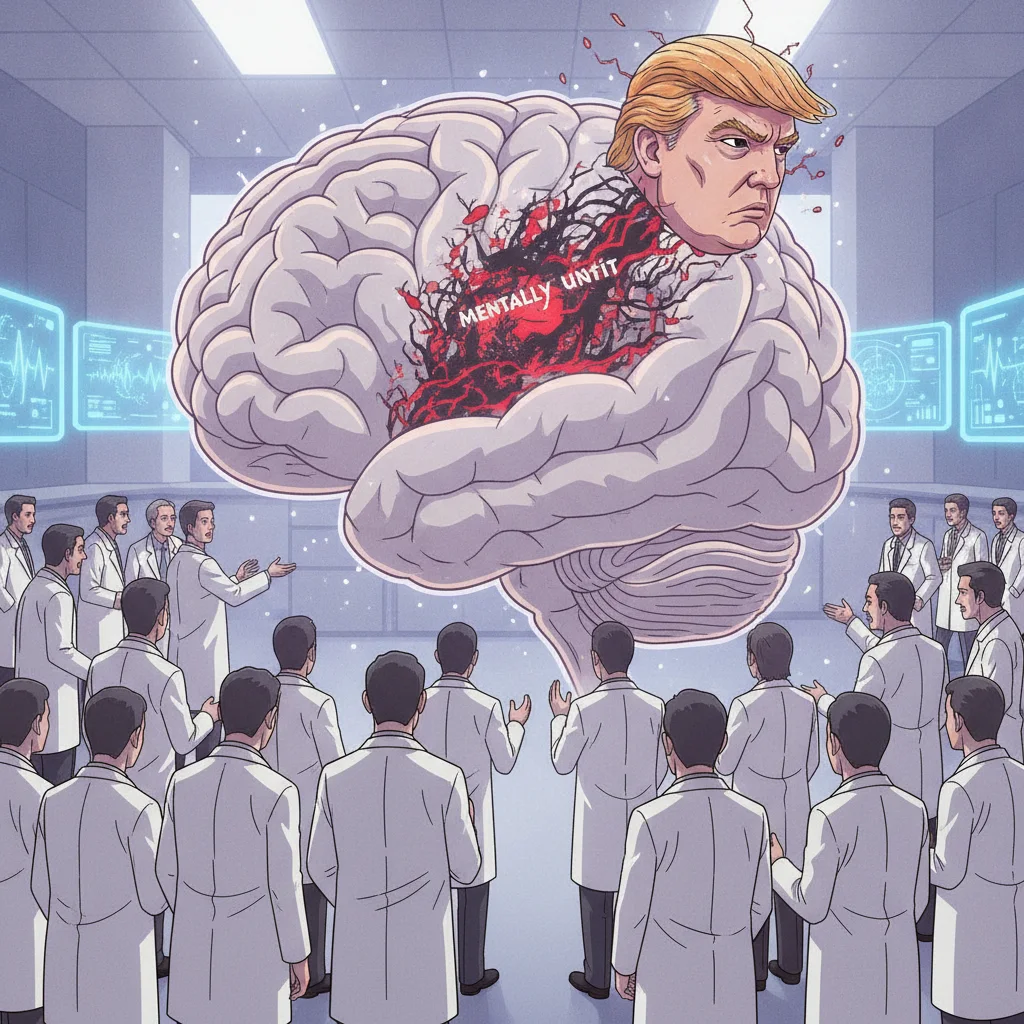

The mental fitness of public figures, particularly those in high office, presents a complex clinical dilemma, balancing public interest with professional ethical guidelines. A recent publication addresses this directly, reporting that 30 senior US doctors have formally declared former President Trump mentally unfit for office, based on their assessment of his public conduct.1 Data supporting this approach is available in the peer-reviewed literature.
Assessing the mental fitness of individuals in positions of significant public responsibility generates intense debate within medical ethics. The declaration by 30 senior US doctors regarding former President Trump's mental state highlights the tension between a clinician's duty to the public and the ethical constraints of diagnosing individuals without direct examination.1
Public Diagnoses Violate Established Clinical Assessment Standards
Diagnosing high-profile individuals without direct clinical examination breaches fundamental medical ethics. A report in the BMJ in 2026 detailed that 30 senior US doctors formally declared former President Trump mentally unfit for office.1 The BMJ article, titled "Trump mental health: 30 senior US doctors declare president mentally unfit," was authored by Moberly T.1 This event forces the medical community to confront the boundary between civic duty and professional overreach.
This declaration was reportedly based on observations of his public behaviour.1 The doctors involved utilized media appearances and public statements to form their clinical consensus rather than standard psychiatric evaluations. Relying on curated public appearances introduces severe selection bias into any clinical assessment. Observers see only a fraction of an individual's behaviour, often filtered through highly stressful, scripted, or performative environments designed for public consumption. True clinical evaluation requires observing a patient in unscripted, private settings to assess baseline cognitive function.
The specific criteria or methodologies used by these doctors to arrive at their conclusion were not detailed in the available abstract.1 No further details regarding the abstract or the full paper's content are available to elaborate on the specific aspects of Trump's public behaviour that led to this declaration, nor the specialties of the doctors involved.1 The article does not provide information on whether these doctors had direct clinical access to the former president or if their assessment was solely based on publicly available information.1 This total absence of methodological transparency prevents any peer review of their diagnostic process, rendering the claim unverifiable by standard scientific metrics.
For clinicians reading such reports, the absence of a formal mental status examination renders the conclusions clinically unusable. Evaluating cognitive impairment or personality disorders requires a multidisciplinary approach involving neurologists, geriatricians, and psychiatrists working with primary data. Physicians must treat these public declarations as political commentary rather than actionable medical data. The standard of care demands objective testing, a comprehensive clinical history, and collateral information from close family members, none of which can be obtained through media observation.
Remote Psychiatric Assessments Lack Diagnostic Validity
Assessing mental fitness from a distance strips the clinician of the tools required to differentiate between performative behaviour and genuine pathology. The American Psychiatric Association established the Goldwater Rule in 1973 to explicitly prohibit psychiatrists from offering professional opinions on public figures they have not personally examined. This rule protects the integrity of the diagnostic process by ensuring that medical labels are applied only after rigorous, direct evaluation. It prevents the medicalization of political disagreement.
Proponents of these public declarations argue that physicians have a moral obligation to warn the public when a leader's behaviour appears erratic or dangerous. They frame cognitive impairment at the highest levels of government as an urgent public health threat requiring immediate intervention. But this perceived duty to warn directly conflicts with the foundational requirement for informed consent. A clinical diagnosis is a medical intervention that requires a voluntary doctor-patient relationship, not a unilateral pronouncement made from afar.
The BMJ report does not establish how the observed behaviours align with recognized diagnostic criteria from manuals such as the DSM-5 or ICD-11. Without a standardized assessment framework, remote diagnoses are highly susceptible to observer bias and political leaning. A definitive diagnosis requires ruling out organic causes of behavioural changes, such as metabolic imbalances, vascular events, or pharmacological side effects. This critical step in the differential diagnosis is impossible to conduct through television screens or social media feeds.
This case serves as a strict boundary marker for medical professionals navigating the intersection of healthcare and politics. Engaging in diagnosis by proxy risks weaponizing medical terminology and severely eroding public trust in the psychiatric profession. Clinicians must restrict their diagnostic authority to patients under their direct care. When asked by patients or peers to validate remote assessments of public figures, physicians should clarify that accurate diagnosis demands direct examination, objective cognitive testing, and full clinical context.
The public declaration by 30 senior US doctors regarding a former president's mental fitness raises significant questions for the medical community. While the impulse to inform the public about potential risks associated with leadership is understandable, the absence of direct clinical examination in such high-profile cases complicates the ethical landscape. Clinicians are bound by principles of confidentiality and the necessity of a thorough diagnostic process, which typically includes direct patient interaction and comprehensive assessment tools. This situation underscores the need for clear professional guidelines on how medical professionals should address concerns about public figures' mental health, particularly when those concerns are based solely on observed public behaviour.
For the broader medical profession, this event highlights the ongoing challenge of balancing professional responsibility with the potential for politicisation of medical opinion. It also prompts reflection on the 'Goldwater Rule,' which advises against psychiatrists offering professional opinions on public figures they have not personally examined. While the specialties of the 30 doctors were not specified, the principle remains relevant. The public relies on medical professionals for objective, evidence-based assessments, and any deviation from standard diagnostic practice, even with good intentions, can erode public trust in the impartiality of medicine.
Ultimately, this report serves as a reminder that declarations of mental unfitness, especially for individuals in positions of power, carry immense weight and should ideally be grounded in rigorous, ethically sound clinical evaluation. Without such a foundation, even well-intentioned statements risk being perceived as speculative, potentially undermining the credibility of the medical community and the serious nature of mental health diagnoses.
- The Pivot A cohort of senior US doctors has publicly assessed the mental fitness of a former president.
- The Data 30 senior US doctors declared former President Trump mentally unfit.
- The Action Clinicians should be aware of the ongoing discourse regarding the mental health of public figures and the ethical considerations involved in such declarations.
ART-2026-561
·09/26
Drafted with AI assistance, reviewed and approved by the editorial team. This publication is intended for healthcare professionals, researchers, and life science industry professionals. Content is provided for informational and educational purposes only and does not constitute medical advice.

I cover life sciences: drug approvals, trial readouts, regulatory decisions, and the AI reshaping clinical practice. Based in Greater London, contributing to The Life Science Feed since 2026.
Cite This Article
Voss M, Lopes W. 30 US doctors declare trump mentally unfit, citing public behaviour. The Life Science Feed. Published June 21, 2026. Updated September 17, 2026. Accessed September 21, 2026. https://thelifesciencefeed.com/psychiatry/depressive-disorder/news/30-us-doctors-declare-trump-mentally-unfit-citing-public-behaviour.
Editorial & AI Standards
All content is researched from peer-reviewed, open-access sources: published trial data, clinical guidelines, and regulatory filings. AI tools are used solely to structure and summarise that evidence; no AI-generated conclusions appear without editor verification against the primary source.
Every article is reviewed by a named editor before publication. Source citations are listed in the References section. This content does not represent the views of any pharmaceutical company, medical device manufacturer, or healthcare provider.
Licence & Rights
© 2026 The Life Science Feed. All rights reserved. Unless otherwise indicated, all content is the property of The Life Science Feed and may not be reproduced, distributed, or transmitted in any form or by any means without prior written permission.
Medical Disclaimer
The information provided on The Life Science Feed is for educational and informational purposes only. It is not intended as a substitute for professional medical advice, diagnosis, or treatment. Always seek the advice of your physician or other qualified healthcare provider regarding any medical condition or treatment decision. Never disregard professional medical advice or delay in seeking it because of something you have read on this website.
References
1. Moberly T. Trump mental health: 30 senior US doctors declare president mentally unfit. BMJ.
2026. doi:10.1136/bmj.s905