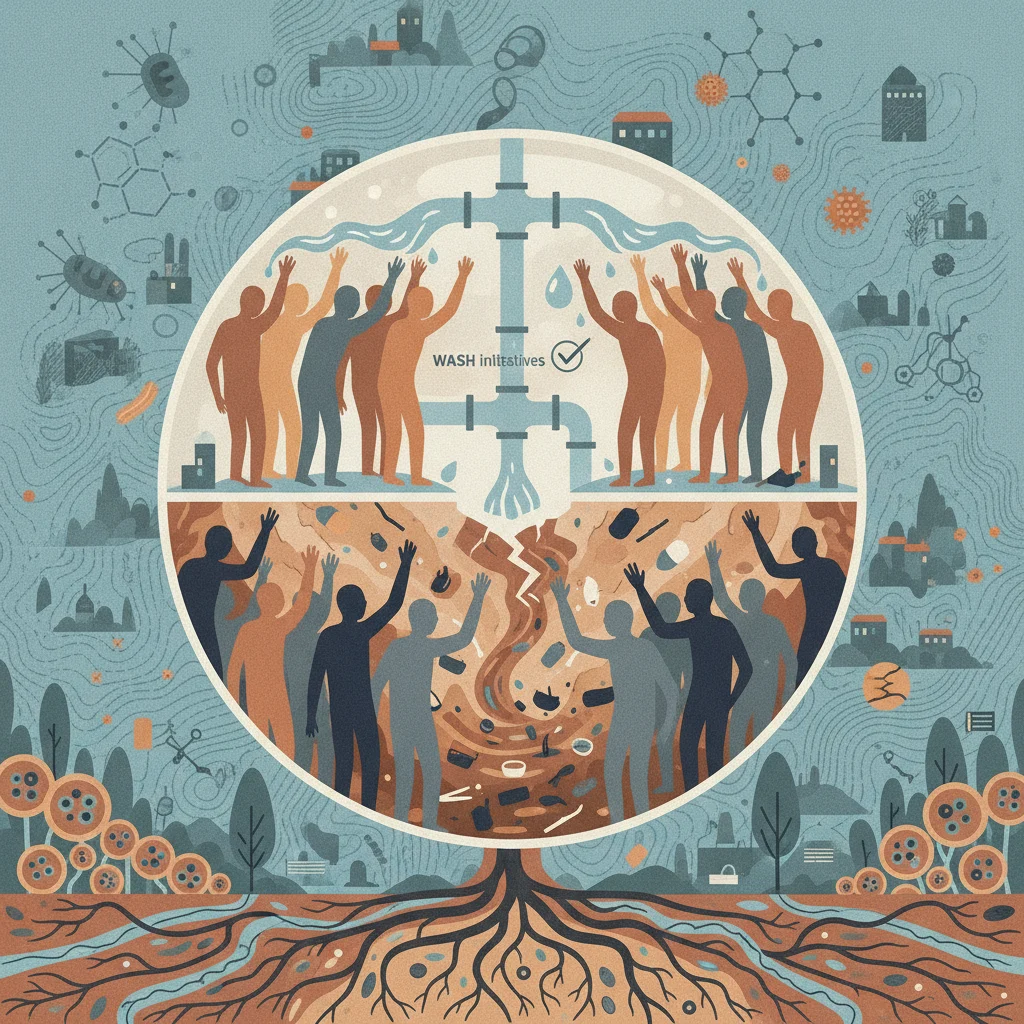

Preventable disease and mortality persist in developing countries, often rooted in inadequate access to safe Water, Sanitation, and Hygiene (WASH). Despite global efforts, significant gaps in WASH coverage continue to impact the most vulnerable. This persistent challenge demands a deeper understanding of current practices and the populations still being overlooked.1
The absence of reliable access to safe Water, Sanitation, and Hygiene (WASH) drives preventable disease and mortality across developing countries. This issue disproportionately impacts the most vulnerable segments of the population, creating a cycle of ill-health and poverty. While global initiatives have made progress, much work remains to expand WASH coverage effectively.1
A systematic review published in BMC Public Health synthesized available evidence to assess the current status of WASH practices, associated health outcomes, and the barriers preventing effective safe WASH behaviors in these regions.1 The review included studies that explored various aspects of WASH, from infrastructure availability to community engagement strategies. It highlighted that despite widespread recognition of the problem, the implementation of sustainable solutions faces numerous obstacles.1
The Pervasive Impact of Inadequate WASH
The systematic review by Shacho E, Eba K, and Fekadu S confirmed that inadequate WASH practices are a pervasive cause of preventable disease and mortality.1 These conditions lead to a significant burden of infectious diseases, particularly diarrheal diseases, which are a leading cause of death among children under five. The review identified that communities with poor WASH infrastructure experience higher rates of cholera, typhoid, and other waterborne illnesses.1
The impact extends beyond acute infections. Chronic exposure to unsanitary conditions contributes to malnutrition, impaired cognitive development in children, and reduced educational attainment.1 Women and girls often bear a disproportionate burden, spending hours collecting water, which limits their access to education and economic opportunities. The review also noted that menstrual hygiene management remains a significant challenge, contributing to school absenteeism among adolescent girls.1
Barriers to Effective Implementation
Several barriers impede the expansion of effective WASH coverage. The systematic review identified economic constraints as a primary factor, with many developing countries lacking the financial resources for large-scale infrastructure development.1 Political instability and weak governance structures also hinder progress, leading to inconsistent policy implementation and inadequate allocation of funds. Cultural norms and traditional practices sometimes conflict with modern hygiene recommendations, creating resistance to new interventions.1
A lack of community participation in planning and maintaining WASH facilities often results in unsustainable projects. When local populations do not feel ownership over new infrastructure, its long-term viability suffers.1 A shortage of trained personnel, including engineers, technicians, and health educators, limits the capacity to implement and sustain complex WASH programs. The review emphasized that even when facilities are built, a lack of consistent maintenance and repair renders them ineffective over time.1
Another systematic review, focusing on selective reporting biases in Campbell Systematic Reviews, indirectly underscores the importance of robust and unbiased evidence in public health interventions like WASH.3 Littell JH, Valentine JC, and Gorman DM found that selective reporting can distort the perceived effectiveness of interventions, making it difficult to identify truly impactful strategies.3 This highlights a critical need for transparent reporting in WASH research to ensure that resources are directed towards interventions with genuine efficacy. Without clear, unbiased data, efforts to address the WASH crisis risk being misdirected or ineffective.3
Who is Being Missed?
Despite the broad scope of WASH initiatives, specific populations continue to be missed. The systematic review highlighted that rural and remote communities often have significantly lower access to safe WASH compared to urban areas.1 This disparity is driven by the higher cost and logistical challenges of extending infrastructure to sparsely populated regions. Informal settlements and refugee camps also represent critical gaps, where overcrowding and transient populations make sustainable WASH provision particularly difficult.1
Vulnerable groups within these communities, such as people with disabilities, the elderly, and indigenous populations, face additional barriers. Their specific needs are often overlooked in standard WASH interventions, leading to inadequate or inaccessible facilities.1 For instance, latrines may not be designed for wheelchair access, or water points may be too far for individuals with mobility limitations. The review stressed that a one-size-fits-all approach to WASH fails to address the unique challenges faced by these marginalized groups, perpetuating health inequities.1 Clinicians should consider how these systemic issues impact patient health, a perspective often found in resources like the Oxford Handbook of General Practice, which provides a broad view of public health determinants.
The protocol for the RELATE-YP feasibility randomized controlled trial, while focused on cognitive analytic therapy for self-harm, also touches upon the broader context of public health challenges.2 Taylor P, Adeyemi I, and Eden M's work, like the WASH reviews, acknowledges the pervasive nature of issues disproportionately impacting vulnerable populations.2 This parallel suggests that systemic vulnerabilities, whether related to mental health or basic hygiene, often share common underlying socio-economic determinants. Understanding these interconnected challenges is vital for developing holistic public health strategies.2
Moving Beyond Broad Strokes
Current criteria for WASH interventions often focus on broad coverage metrics, such as the number of households with access to improved water sources or sanitation facilities. While these metrics are important, they can mask significant inequalities and fail to capture the quality and sustainability of services.1 The review argued for a shift towards more granular data collection, disaggregated by geography, socio-economic status, and specific vulnerability indicators. This would allow for a more precise identification of underserved populations and the tailoring of interventions to their specific needs.1
The lack of proper access to safe WASH is not merely an infrastructure problem; it is a complex issue intertwined with social, economic, and political factors. Effective solutions require a multi-sectoral approach that integrates health, education, and economic development initiatives.1 For example, promoting hygiene education in schools can have a ripple effect on household practices, but this requires sustained investment in educational infrastructure and teacher training. The review also highlighted the need for greater investment in research that explores innovative, context-specific solutions, rather than simply replicating interventions that may not be suitable for diverse settings.1 Our previous coverage on diagnostic errors has shown how easily broad assumptions can lead to missed diagnoses, a principle that applies equally to public health interventions.
The open-label design of many WASH implementation studies is an obvious caveat, as self-reported hygiene practices can be subject to social desirability bias. The trials were not powered to detect differences in specific vulnerable subgroups, and that gap matters for equitable resource allocation. WASH interventions were tested only in general populations; whether benefits extend to specific marginalized groups with unique cultural or physical barriers remains unclear. The next trial needs to show not just improved access, but also sustained behavioral change and equitable health outcomes across all segments of the population. This requires more rigorous, disaggregated data collection and a commitment to addressing the specific needs of those currently being missed.1
The persistent failure to provide universal safe WASH access is not a minor oversight; it is a fundamental flaw in global public health strategy. Clinicians in Europe may feel distant from these issues, but the global interconnectedness of health means that preventable diseases elsewhere can have broader implications. We must recognize that the current criteria for WASH interventions, while well-intentioned, are simply not reaching everyone who needs them.
The data clearly shows that vulnerable populations, particularly in rural areas, informal settlements, and among marginalized groups, are consistently overlooked. This is not just about building more latrines; it is about understanding the socio-economic, cultural, and political barriers that prevent sustainable change. A clinician's role extends beyond individual patient care to advocating for systemic improvements that address these foundational determinants of health.
Public health bodies and NGOs must move beyond broad, often superficial, metrics of coverage. They need to demand and implement more granular data collection, disaggregated by specific vulnerability indicators. Without this precision, resources will continue to be misallocated, and the most vulnerable will remain trapped in a cycle of preventable disease. It is time to acknowledge that a one-size-fits-all approach to WASH is a disservice to those it purports to help.
- The Pivot Despite ongoing global activity, WASH coverage expansion has not reached all vulnerable populations, leaving a substantial public health challenge.
- The Data Systematic reviews consistently identify lack of safe WASH as a pervasive cause of preventable disease and mortality in developing countries.1,2,3
- The Action Clinicians and public health practitioners must advocate for targeted interventions that address specific barriers to effective WASH behaviors in underserved communities.
ART-2026-1635
·11/26
Drafted with AI assistance and checked by automated style rules. Not individually read by an editor. This publication is intended for healthcare professionals, researchers, and life science industry professionals. Content is provided for informational and educational purposes only and does not constitute medical advice.

Digital health and patient experience are my beat: the apps, the wearables, the real-world evidence claims, and whether any of it changes outcomes. Sceptical by training and optimistic by instinct.
Cite This Article
Ward S, Voss M. WASH initiatives: who benefits from current criteria, and who is still missed?. The Life Science Feed. Published November 4, 2026. Updated November 4, 2026. Accessed November 4, 2026. https://thelifesciencefeed.com/general-practice/diagnostic-errors/insights/wash-initiatives-public-health-impact.
Editorial & AI Standards
Content is drafted with AI tools from peer-reviewed, open-access sources such as published trial data, clinical guidelines, and regulatory filings. This article is checked by automated style rules but is not individually read by an editor, so check the cited source before relying on a figure.
Source citations are listed in the References section. This content does not represent the views of any pharmaceutical company, medical device manufacturer, or healthcare provider.
Licence & Rights
© 2026 The Life Science Feed. All rights reserved. Unless otherwise indicated, all content is the property of The Life Science Feed and may not be reproduced, distributed, or transmitted in any form or by any means without prior written permission.
Medical Disclaimer
The information provided on The Life Science Feed is for educational and informational purposes only. It is not intended as a substitute for professional medical advice, diagnosis, or treatment. Always seek the advice of your physician or other qualified healthcare provider regarding any medical condition or treatment decision. Never disregard professional medical advice or delay in seeking it because of something you have read on this website.
References
1. Shacho E, Eba K, Fekadu S. A systematic review of water, sanitation, and hygiene practices in developing countries: exploring the effects on public health. BMC Public Health. 2026.
2. Taylor P, Adeyemi I, Eden M. Cognitive analytic therapy for self-harm with young people: protocol for the RELATE-YP feasibility randomized controlled trial. Pilot Feasibility Stud. 2026.
3. Littell JH, Valentine JC, Gorman DM. Assessment of Selective Reporting Biases in Studies Included in Campbell Systematic Reviews: A Systematic Review. Campbell Syst Rev. 2026.