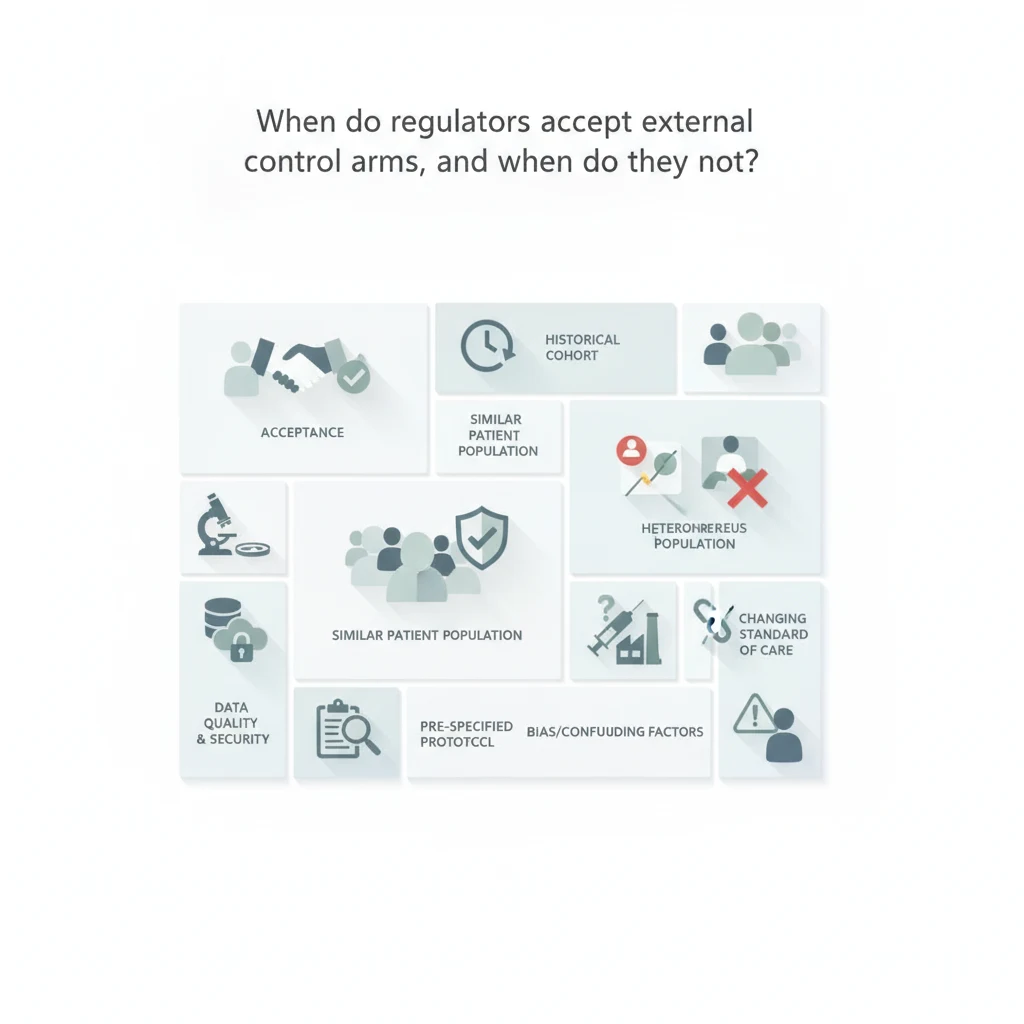

The use of external control arms (ECAs) in clinical trials offers a potential pathway for drug development, particularly in rare diseases or conditions with high unmet need where traditional randomised controlled trials (RCTs) are impractical or unethical. But the regulatory market for their acceptance remains complex and inconsistent across European health technology assessment (HTA) bodies. Understanding these complexities is critical for sponsors navigating market access.1
External control arms, derived from real-world data (RWD), offer an alternative to concurrent control groups in clinical trials. These controls leverage existing patient data from registries, electronic health records, or previous trials to provide a comparator for an investigational therapy. The approach aims to accelerate development, especially for conditions where patient recruitment for traditional RCTs is challenging or where withholding an active treatment is ethically problematic.1
A qualitative investigation explored the role and value of real-world evidence (RWE), specifically external control arms, in health technology decision-making across France, Germany, Italy, Spain, and the UK. The study, published in International Journal of Technology Assessment in Health Care, gathered insights from HTA representatives, payers, and industry experts.1
Varied Acceptance Across Europe
Regulators in France and Germany appear more receptive to the use of external control arms compared to their counterparts in the UK, Italy, and Spain. This divergence stems from differing national frameworks, data infrastructure, and historical precedents for RWE integration into HTA processes. The French HTA body, Haute Autorité de Santé (HAS), and the German Gemeinsamer Bundenausschuss (G-BA) have established pathways that, while stringent, allow for the consideration of RWE in certain contexts.1
The UK's National Institute for Health and Care Excellence (NICE), along with HTA bodies in Italy and Spain, maintain a more cautious stance. These bodies typically prioritise evidence from prospective, randomised controlled trials, viewing ECAs with greater scrutiny due to potential biases and confounding factors inherent in retrospective data. This often translates to higher evidentiary hurdles for therapies relying on ECAs for market access.1
One key challenge for ECAs lies in ensuring comparability between the intervention arm and the external control. Differences in patient characteristics, treatment protocols, and data collection methods can introduce significant bias, making it difficult to attribute observed effects solely to the investigational therapy. This issue is particularly pronounced when dealing with heterogeneous patient populations or rapidly evolving standards of care.1
The quality and completeness of real-world data sources also dictate the utility of an ECA. Fragmented data, missing variables, or inconsistencies in coding can severely limit the reliability of an external control. Robust data governance and standardised data collection practices are essential to build confidence in RWE-derived comparators.1
The Role of Real-World Data Quality
The utility of real-world evidence, including ECAs, hinges on the quality and relevance of the underlying data. Gambling is now widely acknowledged to be a major public health issue, with associated harms categorised into seven themes: financial, relationship/conflict, emotional and psychological (mental health), health decrements (physical health), employment/education, cultural, and criminal activity.2,3 This understanding highlights the need for comprehensive, population-level interventions to reduce harms, which in turn requires data collection with a large n and a narrow confidence interval on public health issues.2,3
The Office for Health Improvement and Disparities conservatively estimated that gambling harm is associated with an annual cost of £1.05-£1.77 billion in England alone.2,3 Such extensive public health issues necessitate high-quality data for effective policy and intervention evaluation, a principle that extends directly to the RWE used in clinical trial external controls. Without reliable, consistent data, the validity of any ECA is compromised.2,3
A realist review study protocol aims to identify the effects of interventional public health laws and regulations intended to reduce gambling-related harms.2 This type of rigorous review, focusing on how and why interventions work in real-world settings, mirrors the critical assessment required for RWE used in regulatory submissions. The methodology for evaluating public health interventions, as described by Fisher, Piper, and Mavi, shows the importance of understanding context and mechanisms, which are equally vital when constructing and evaluating an ECA.2
A qualitative investigation into the feasibility and acceptability of lower risk gambling guidelines further illustrates the complexities of real-world data.3 Egerer, Jääskeläinen, and Marionneau's work highlights the need for understanding how interventions are perceived and adopted, which can significantly impact the data generated. This applies directly to the collection of real-world data for ECAs; if data collection methods are not feasible or acceptable in clinical practice, the resulting data will be incomplete or biased.3
Navigating Regulatory Expectations
Early engagement with HTA bodies is paramount for sponsors considering an ECA. Discussions should cover the proposed data sources, statistical methodologies for bias adjustment, and the specific patient population. Regulators often require a clear rationale for why an RCT is not feasible and how the ECA addresses the limitations of non-randomised comparisons. This proactive approach can help align expectations and identify potential roadblocks before significant resources are committed.1
The choice of statistical methods to mitigate bias in ECAs is also a critical point of contention. Propensity score matching, inverse probability weighting, and other advanced statistical techniques are often employed to balance baseline characteristics between the intervention arm and the external control. But the effectiveness of these methods depends heavily on the availability of comprehensive covariate data and the underlying assumptions of the models.1
The open-label design is an obvious caveat for many trials incorporating ECAs. Without blinding, the potential for performance and ascertainment bias increases, particularly for subjective endpoints. While statistical adjustments can attempt to account for some biases, they cannot fully replicate the rigour of a double-blinded, randomised trial. This inherent limitation often drives regulatory caution.1
The trial was not powered to detect differences in specific subgroups, and that gap matters for many HTA bodies. Regulators frequently seek evidence of consistent treatment effects across relevant patient subgroups, and an ECA may struggle to provide this granular data if the real-world data sources lack sufficient detail or sample size for subgroup analyses. This is a common challenge for decentralized trials as well, which often rely on diverse data streams.1
Still, the increasing availability of high-quality real-world data, coupled with advancements in analytical methods, continues to push the boundaries of what is acceptable. As HTA bodies gain more experience with RWE, their guidelines may evolve to accommodate ECAs more readily, particularly for conditions with high unmet medical need or where ethical considerations strongly favour their use. The ongoing dialogue between industry and regulators will shape the future of this evolving area.1
The question remains: will the benefits of accelerated drug development outweigh the inherent methodological challenges of ECAs in the eyes of all European regulators? The current trial pipeline suggests a cautious but evolving acceptance, with significant national variations that demand careful strategic planning from developers. The next trials will need to show not just efficacy, but also methods for bias control and data transparency to gain broader regulatory confidence.1
The uneven acceptance of external control arms across European HTA bodies creates a fragmented environment for drug developers. Clinicians should be aware that a therapy approved based on an ECA in one country might face significant hurdles in another, potentially delaying patient access to innovative treatments. This disparity shows the need for harmonisation in regulatory guidance.
For industry, this means a one-size-fits-all approach to RWE is a non-starter. Early, country-specific engagement with HTA bodies is not merely advisable, it is essential. Investing in high-quality, prospectively collected real-world data that minimises bias will be critical for gaining regulatory confidence, especially in markets like the UK, Italy, and Spain.
Patients with rare diseases or conditions lacking effective treatments stand to benefit most from the judicious use of ECAs, as these designs can accelerate access to therapies that might otherwise be delayed by lengthy traditional trials. But the trade-off is often a less robust evidence base, which clinicians must weigh when considering new treatments. The Oxford Handbook of Clinical Medicine remains a valuable resource for navigating these complex evidence landscapes.
The ongoing evolution of RWE methodologies and regulatory frameworks will shape future treatment paradigms. Clinicians should stay informed about the specific evidentiary standards applied to new therapies, particularly those relying on ECAs, to ensure they are making evidence-based decisions for their patients.
- The Pivot HTA bodies in France and Germany demonstrate greater openness to external control arms than those in the UK, Italy, and Spain.
- The Data No specific quantitative data on ECA acceptance rates across countries was provided in the research.
- The Action Sponsors should engage early and frequently with national HTA bodies to understand specific evidentiary requirements for external control arms.
ART-2026-1290
·10/26
Drafted with AI assistance, reviewed and approved by the editorial team. This publication is intended for healthcare professionals, researchers, and life science industry professionals. Content is provided for informational and educational purposes only and does not constitute medical advice.

I specialise in clinical trial methodology and drug development, from Phase I to post-approval. My reports cover what got studied, what did not, and why. Based in Boston, reporting globally.
Cite This Article
Prescott D, Voss M. When do regulators accept external control arms, and when do they not?. The Life Science Feed. Published August 27, 2026. Updated October 6, 2026. Accessed October 11, 2026. https://thelifesciencefeed.com/healthcare-sys-and-biz/clinical-trial-design/insights/external-control-arms-regulatory-acceptance.
Editorial & AI Standards
All content is researched from peer-reviewed, open-access sources: published trial data, clinical guidelines, and regulatory filings. AI tools are used solely to structure and summarise that evidence; no AI-generated conclusions appear without editor verification against the primary source.
Every article is reviewed by a named editor before publication. Source citations are listed in the References section. This content does not represent the views of any pharmaceutical company, medical device manufacturer, or healthcare provider.
Licence & Rights
© 2026 The Life Science Feed. All rights reserved. Unless otherwise indicated, all content is the property of The Life Science Feed and may not be reproduced, distributed, or transmitted in any form or by any means without prior written permission.
Medical Disclaimer
The information provided on The Life Science Feed is for educational and informational purposes only. It is not intended as a substitute for professional medical advice, diagnosis, or treatment. Always seek the advice of your physician or other qualified healthcare provider regarding any medical condition or treatment decision. Never disregard professional medical advice or delay in seeking it because of something you have read on this website.
References
1. Vidalis A, Dumoulin O, Godbole M. The role and value of real-world evidence in health technology decision-making in France, Germany, Italy, Spain, and the UK: insights on external control arms. Int J Technol Assess Health Care. 2025;41(2):e14. https://pubmed.ncbi.nlm.nih.gov/40260460/
2. Fisher M, Piper T, Mavi S. Effects of interventional public health laws and regulations intended to reduce gambling-related harms: a realist review study protocol. BMJ Open. 2025;15(1):e087113. https://pubmed.ncbi.nlm.nih.gov/40669915/
3. Egerer M, Jääskeläinen P, Marionneau V. A qualitative investigation of the feasibility and acceptability of lower risk gambling guidelines. Harm Reduct J. 2025;22(1):50. https://pubmed.ncbi.nlm.nih.gov/40281558/