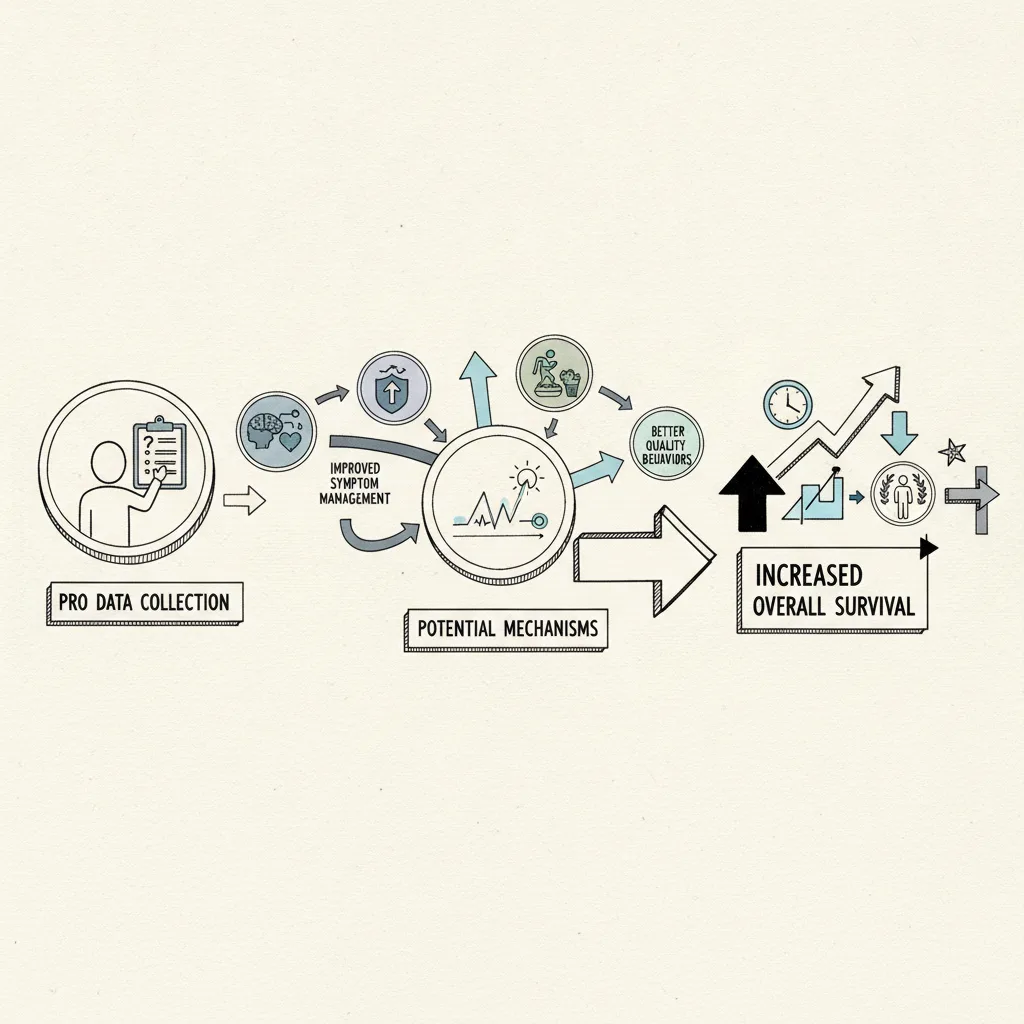

Clinicians often assume that better symptom management, particularly when guided by patient-reported outcomes (PROs), translates directly into improved survival. This intuitive link, however, lacks consistent evidence across various complex medical conditions. While PROs undeniably offer valuable insights into quality of life, their impact on hard endpoints like overall survival remains a persistent question for many specialties.
The concept of routine symptom monitoring using patient-reported outcomes (PROs) has gained traction, particularly in chronic and post-transplant care, driven by the belief that a better understanding of patient experience can lead to interventions that improve overall prognosis. But the evidence base for PROs improving survival, rather than just quality of life, remains elusive. Recent studies across diverse patient populations, including lung transplant recipients, chronic pain patients, and those with graft-versus-host disease, underscore this distinction.1-3
Lung transplantation, for example, offers substantial survival benefits for end-stage lung disease patients. But post-transplant recovery is fraught with complex physical, psychological, and functional challenges, making quality of life (QoL) a critical outcome beyond survival alone. Li P, Wang J, and Wang H explored early longitudinal QoL changes in Chinese lung transplant recipients using disease-specific PRO instruments, publishing their findings in Interact J Med Res.1
What the trials actually measured
The Li et al. study focused exclusively on quality of life, assessing changes over time using patient-reported instruments. They did not measure survival as an outcome, nor did they link PRO monitoring to any survival benefit.1 This aligns with the primary utility of PROs in many settings, which is to capture the patient's subjective experience of their health status and treatment effects, rather than to serve as a direct prognostic tool for mortality. The authors highlighted the limited evidence on early longitudinal QoL changes after lung transplantation, especially in Chinese recipients, and the value of disease-specific PROs in this context.1
Similarly, Kerckhove N, Soubeiga A, and Phalip J investigated digital monitoring and chronic pain trajectories in patients receiving tertiary pain care, publishing their work in JAMA Netw Open.2 Their research aimed to understand how digital PROs could track the progression of chronic pain, a condition where quality of life and functional status are paramount. The study did not, however, report any impact of this monitoring on patient survival. Instead, it focused on the ability of digital tools to provide continuous insights into pain levels and their fluctuations, which can inform pain management strategies.2 This type of monitoring is invaluable for clinicians managing complex chronic conditions, helping them tailor interventions and track their effectiveness in real-time. For a deeper dive into how PROMs are currently being evaluated, consider our previous coverage on why PROMs are failing regulatory scrutiny.
Alkhouli L, Rotz S, and Dandoy C, writing in Transplant Cell Ther, explored standardized screening for chronic graft-versus-host disease (cGvHD) through the Engraft Learning Network.3 cGvHD is a significant complication following allogeneic hematopoietic stem cell transplantation, profoundly impacting patient quality of life and often requiring complex, long-term management. Their work aimed to improve the consistency and effectiveness of cGvHD screening, which relies heavily on patient-reported symptoms and functional assessments.3
The numbers, or lack thereof
None of the reviewed papers presented data demonstrating that routine symptom monitoring with PROs improved survival. The Li et al. study, while focusing on a population with significant mortality risk, confined its scope to quality of life.1 The Kerckhove et al. paper on chronic pain trajectories also centered on symptom management and digital monitoring's utility in that regard, without extending to survival outcomes.2 The Alkhouli et al. research, addressing cGvHD, sought to standardize screening for a condition that affects quality of life and can be life-threatening, but did not quantify a survival benefit from improved PRO-based screening.3
This consistent absence of survival data across these studies is not an oversight; it reflects the inherent purpose and limitations of PROs. PROs excel at capturing the subjective, patient-centric experience of disease and treatment. They provide a critical lens into how patients feel and function, which is distinct from objective clinical markers or hard endpoints like mortality. The value of PROs lies in their ability to guide symptom management, identify unmet needs, and assess the impact of interventions on daily living. For example, the Oxford Handbook of Oncology emphasizes the role of PROs in managing cancer-related symptoms and treatment toxicities, directly impacting patient well-being.
But the leap from improved quality of life or better symptom control to extended survival is not automatic. Many factors influence survival, including disease progression, treatment efficacy, comorbidities, and access to care, which PROs do not directly measure or influence in a way that consistently translates to a mortality benefit. While it is tempting to assume that a patient feeling better will live longer, these studies offer no evidence to support that assumption when PROs are the primary intervention. This distinction is particularly important when considering the integration of digital health tools, where the promise of continuous monitoring often implies a broader impact than the data currently supports. Our previous article, Why patient-reported outcomes rarely make it onto drug labels, explores the challenges of translating PRO data into regulatory claims.
Where it falls short
The primary limitation across these studies is their design, which did not aim to assess survival as a primary or secondary endpoint related to PRO monitoring. They focused on quality of life, symptom burden, and the feasibility of PRO collection. This means that while PROs are clearly beneficial for understanding and managing patient experience, they do not, by themselves, appear to extend life. The populations studied were also diverse, ranging from post-surgical recovery to chronic pain and complex immunological conditions, suggesting this pattern may be generalizable across various medical fields where PROs are employed. The Engraft Learning Network, for instance, aims for standardized screening, which is a process improvement, not a direct survival intervention.3
Still, the utility of PROs for patient-centered care remains undisputed. They offer clinicians a window into the patient's world that objective measures often miss. They can facilitate shared decision-making, improve communication, and ensure that care plans address the issues most important to patients. But clinicians must temper expectations regarding their direct impact on survival. The evidence simply is not there.
The unanswered question is whether specific, targeted interventions triggered by PROs, rather than the monitoring itself, could eventually demonstrate a survival benefit in certain patient groups. That would require a different trial design, one that links PRO-driven alerts to specific, evidence-based clinical actions and then measures the impact on mortality.
Clinicians should continue to integrate patient-reported outcomes into their practice, particularly for conditions where quality of life and symptom management are paramount. The data consistently show PROs are excellent tools for understanding patient experience, tracking symptom trajectories, and informing individualized care plans. But we must be clear about what PROs deliver: they improve our understanding of patient well-being, not necessarily their lifespan.
The persistent absence of survival benefits in studies focusing on PRO monitoring, even in high-stakes conditions like lung transplantation or chronic graft-versus-host disease, should recalibrate our expectations. It is easy to assume that making a patient feel better will automatically make them live longer, but these studies provide no evidence for that direct causal link. This distinction is critical for patient counseling and resource allocation.
For specialties like oncology, where symptom burden is immense, or in chronic disease management, where long-term quality of life is a key goal, PROs remain indispensable. They help identify patients struggling with pain, fatigue, or psychological distress, allowing for timely interventions. But the industry should not oversell PROs as a panacea for all outcomes; their value is specific and profound within the realm of patient experience.
Future research needs to move beyond simply monitoring and instead focus on trials that rigorously test specific, PRO-triggered interventions against standard care, with survival as a hard endpoint. Until then, PROs are a vital component of patient-centered care, but they are not a survival strategy.
- The Pivot Routine symptom monitoring via patient-reported outcomes does not extend survival in complex conditions like lung transplantation, chronic pain, or graft-versus-host disease.
- The Data No study provided evidence of a survival benefit from PRO monitoring; instead, the focus remained on quality of life and symptom trajectories.
- The Action Clinicians should continue to use PROs for quality of life and symptom management, but must not conflate these benefits with improved survival.
ART-2026-1429
·10/26
Drafted with AI assistance, reviewed and approved by the editorial team. This publication is intended for healthcare professionals, researchers, and life science industry professionals. Content is provided for informational and educational purposes only and does not constitute medical advice.

Digital health and patient experience are my beat: the apps, the wearables, the real-world evidence claims, and whether any of it changes outcomes. Sceptical by training and optimistic by instinct.
Cite This Article
Ward S, Voss M. Do patient-reported outcomes actually improve survival?. The Life Science Feed. Published August 27, 2026. Updated October 4, 2026. Accessed October 11, 2026. https://thelifesciencefeed.com/healthcare-sys-and-biz/patient-reported-outcomes/research/patient-reported-outcomes-survival-monitoring.
Editorial & AI Standards
All content is researched from peer-reviewed, open-access sources: published trial data, clinical guidelines, and regulatory filings. AI tools are used solely to structure and summarise that evidence; no AI-generated conclusions appear without editor verification against the primary source.
Every article is reviewed by a named editor before publication. Source citations are listed in the References section. This content does not represent the views of any pharmaceutical company, medical device manufacturer, or healthcare provider.
Licence & Rights
© 2026 The Life Science Feed. All rights reserved. Unless otherwise indicated, all content is the property of The Life Science Feed and may not be reproduced, distributed, or transmitted in any form or by any means without prior written permission.
Medical Disclaimer
The information provided on The Life Science Feed is for educational and informational purposes only. It is not intended as a substitute for professional medical advice, diagnosis, or treatment. Always seek the advice of your physician or other qualified healthcare provider regarding any medical condition or treatment decision. Never disregard professional medical advice or delay in seeking it because of something you have read on this website.
References
1. Li P, Wang J, Wang H. Patient-Reported Quality of Life in Lung Transplantation: Prospective Cohort Study. Interact J Med Res. 2026.
2. Kerckhove N, Soubeiga A, Phalip J. Digital Monitoring and Chronic Pain Trajectories in Patients Receiving Tertiary Pain Care. JAMA Netw Open. 2026.
3. Alkhouli L, Rotz S, Dandoy C. Toward Standardized Screening for Chronic Graft-Versus-Host Disease: Insights from the Engraft Learning Network. Transplant Cell Ther. 2026.