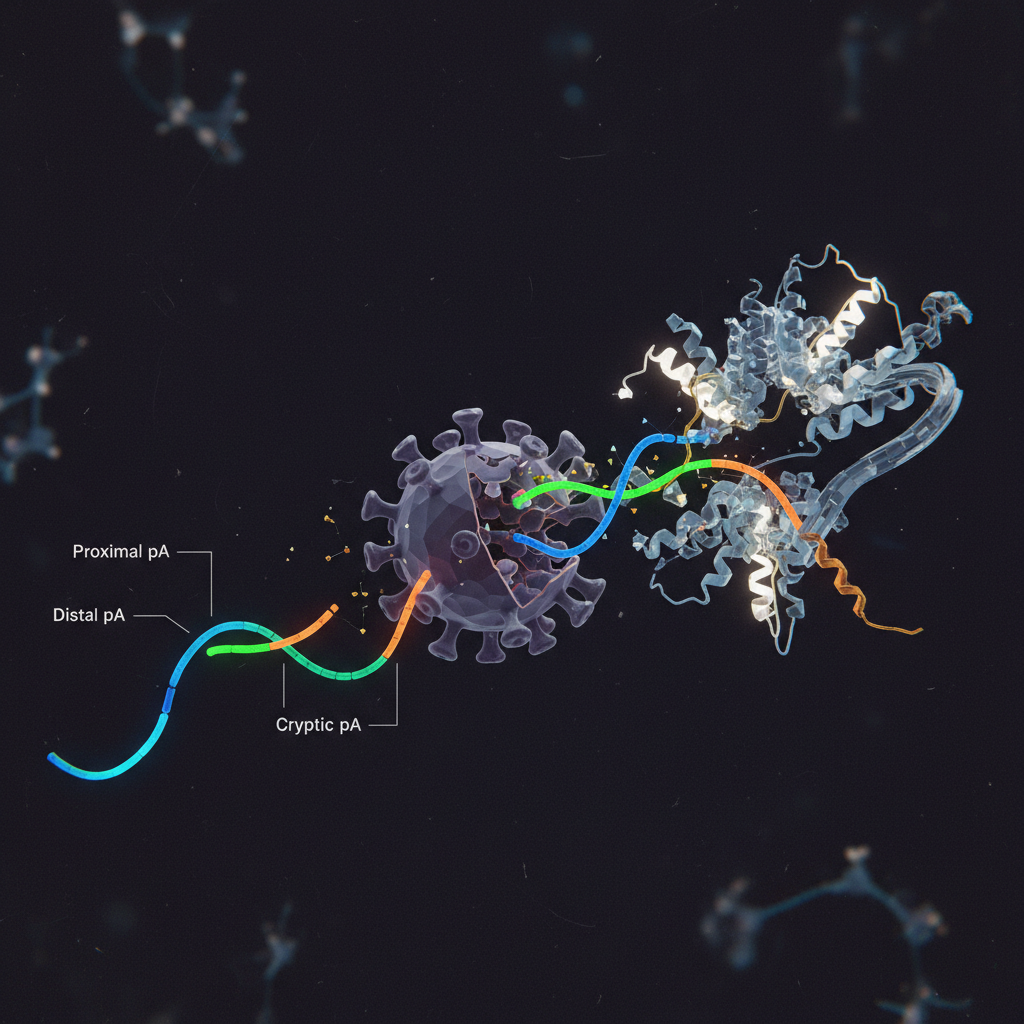

HIV-1 infection presents a persistent challenge in clinical practice, often evading host defenses through complex molecular mechanisms. A recent study highlights how the virus exploits alternative polyadenylation (APA), a fundamental cellular process, to produce diverse protein isoforms from a single gene, thereby optimizing its replication and immune evasion.
This manipulation of APA, particularly involving the protein CPSF6, offers a novel perspective on viral pathogenesis and suggests new avenues for therapeutic intervention beyond current DHHS guidelines for initial ART regimens.
Alternative Polyadenylation and HIV-1
Alternative polyadenylation (APA) is a process that allows a single gene to produce multiple different messenger RNA (mRNA) transcripts, which can then be translated into different protein isoforms with varying functions.2 This is achieved by using different polyadenylation sites within the gene, leading to mRNA molecules with different 3' ends.2,6 It's akin to having multiple exits on a highway, each leading to a slightly different destination. How does this relate to HIV? The virus, in its relentless quest to replicate, exploits this cellular mechanism.2,3,5,6
The significance of this finding lies in the fact that APA can influence the stability, translation efficiency, and localization of mRNA, ultimately affecting protein expression.2 By manipulating APA, HIV-1 can fine-tune its own gene expression to optimize its replication and evade host immune responses.2,3,5,6 This is NOT addressed in current DHHS guidelines regarding initial ART regimens.
The Role of CPSF6
The study focuses on the cleavage and polyadenylation specificity factor 6 (CPSF6), a protein involved in mRNA processing.1,2,4,5 The researchers found that knocking out CPSF6 in primary T cells, the main target of HIV-1, altered APA patterns and enhanced HIV-1 infection.2-4 Specifically, the absence of CPSF6 led to increased usage of distal polyadenylation sites in viral RNA, resulting in transcripts with longer 3' untranslated regions (UTRs).1,4 These longer 3' UTRs can affect mRNA stability and translation, potentially favoring viral replication.4
This suggests that CPSF6 normally acts as a suppressor of HIV-1 infection by promoting the use of proximal polyadenylation sites.1-4 When CPSF6 is absent, the virus can switch to using distal sites, leading to enhanced replication.3,4 Understanding this mechanism could pave the way for developing novel therapeutic strategies that target APA to disrupt HIV-1 replication.6
Study Limitations
Before we get too excited, it's important to acknowledge the limitations of this study. First, it was conducted in vitro, using primary T cells.4 The findings may not necessarily translate to in vivo conditions, where the immune system and other factors can influence viral replication. Second, the study focused on a single protein, CPSF6.4 While the results suggest that CPSF6 plays a role in regulating HIV-1 replication, other factors may also be involved. Third, the exact mechanisms by which APA influences viral RNA stability and translation remain to be fully elucidated. Finally, like many basic science studies, the work is funded via NIH grants, and the commercial implications are far from clear.
Finally, there is the reproducibility question. While the methodology appears sound, independent validation is needed before these findings can be considered definitive. Is this phenomenon observed across different HIV-1 subtypes? Does it vary depending on the genetic background of the host? These are questions that future research needs to address.
Potential Therapeutic Avenues
Despite these limitations, the study opens up new avenues for therapeutic intervention. If APA is indeed a key regulator of HIV-1 replication, then targeting this process could lead to the development of novel antiviral therapies.6 For example, drugs that promote the use of proximal polyadenylation sites could suppress viral replication, even in the absence of CPSF6. Alternatively, therapies that target the proteins involved in APA could disrupt the virus's ability to manipulate this process.
However, any therapeutic strategy targeting APA would need to be carefully designed to avoid off-target effects on host gene expression. APA is a fundamental cellular process that is involved in regulating a wide range of biological functions. Interfering with this process could have unintended consequences. Even so, the potential reward - a new weapon in the fight against HIV-1 - warrants further investigation.
Furthermore, the interplay between APA and other viral or host factors warrants further exploration. HIV-1 is known for its complex regulatory mechanisms, and it is likely that APA acts in concert with other processes to fine-tune viral gene expression. Future research should aim to unravel these intricate networks to gain a more comprehensive understanding of HIV-1 pathogenesis. This holistic view will be crucial for developing multi-pronged therapeutic approaches that can effectively combat the virus.
The most striking implication here is the potential for a completely new class of antiretroviral therapies. Current DHHS guidelines for initial ART regimens do not address alternative polyadenylation (APA). If targeting APA can disrupt HIV-1 replication, pharmaceutical companies like Gilead Sciences or ViiV Healthcare might explore small molecule inhibitors that modulate polyadenylation site usage. This could offer a valuable addition to existing drug classes, particularly for patients with resistance to current treatments.
For clinicians, this research, while in its early stages, highlights the intricate ways HIV-1 manipulates host cellular machinery. Understanding these mechanisms could eventually inform treatment strategies. While the evidence is thin for immediate clinical application, it underscores the dynamic nature of viral evasion. This is not a phenomenon observed across all HIV-1 subtypes or host genetic backgrounds yet, requiring further validation.
Patients may benefit from these findings in the long term. Novel therapies that target APA could offer new hope for managing HIV-1 infection, especially if they can overcome existing drug resistance. However, any such treatment would need careful development to avoid unintended consequences on host gene expression, as APA is a fundamental cellular process.
The work, funded via NIH grants, is foundational. The commercial implications are far from clear, and independent validation of these in vitro findings in primary T cells is crucial. We need to see if these findings translate to in vivo conditions and how they interact with the broader immune system before considering clinical trials.
- The Pivot HIV-1 exploits alternative polyadenylation (APA), a cellular mechanism, to produce diverse proteins from a single gene, optimizing its replication and immune evasion.
- The Data Knocking out CPSF6 in primary T cells enhanced HIV-1 infection by increasing the usage of distal polyadenylation sites in viral RNA.
- The Action While intriguing, these in vitro findings do not currently warrant changes to initial ART regimens or clinical practice; further in vivo research is needed.
LSF-5143176941
·10/26
Drafted with AI assistance and checked by automated style rules. Not individually read by an editor. This publication is intended for healthcare professionals, researchers, and life science industry professionals. Content is provided for informational and educational purposes only and does not constitute medical advice.

Infectious disease, epidemiology, and global health equity. I have covered outbreaks from Ebola to COVID-19 to mpox. The stories I am most drawn to are where the science is clear and the response is slow.
Cite This Article
Reeves T, Lopes W. HIV-1: why a single gene makes so many different proteins. The Life Science Feed. Published October 26, 2026. Updated October 26, 2026. Accessed October 26, 2026. https://thelifesciencefeed.com/infectious-diseases/hiv-infections/research/hiv-1-why-a-single-gene-makes-so-many-different-proteins.
Editorial & AI Standards
Content is drafted with AI tools from peer-reviewed, open-access sources such as published trial data, clinical guidelines, and regulatory filings. This article is checked by automated style rules but is not individually read by an editor, so check the cited source before relying on a figure.
Source citations are listed in the References section. This content does not represent the views of any pharmaceutical company, medical device manufacturer, or healthcare provider.
Licence & Rights
© 2026 The Life Science Feed. All rights reserved. Unless otherwise indicated, all content is the property of The Life Science Feed and may not be reproduced, distributed, or transmitted in any form or by any means without prior written permission.
Medical Disclaimer
The information provided on The Life Science Feed is for educational and informational purposes only. It is not intended as a substitute for professional medical advice, diagnosis, or treatment. Always seek the advice of your physician or other qualified healthcare provider regarding any medical condition or treatment decision. Never disregard professional medical advice or delay in seeking it because of something you have read on this website.
References
1. Cornish D, Jackson-Jones KA, Ling-Hu T, et al. Alternative polyadenylation upon CPSF6 knock-out enhances HIV-1 infection in primary T cells. PLoS Pathog. 2025;21(12):e1013745. doi:10.1371/journal.ppat.1013745
2. Luchsinger C, Dai AZ, Yalamanchili H, et al. HIV-1 Infection Regulates Gene Expression by Altering Alternative Polyadenylation Through CPSF6 and CPSF5 Delocalization. bioRxiv. 2025. doi:10.1101/2025.08.07.669137
3. Luchsinger C, Dai AZ, Yalamanchili H, et al. HIV-1 infection regulates gene expression by altering alternative polyadenylation correlated with CPSF6 and CPSF5 redistribution. mBio. 2026;17(1):e0286525. doi:10.1128/mbio.02865-25
4. Hultquist J, Cornish D, Jackson-Jones K, et al. Disruption of CPSF6 enhances cellular permissivity to HIV-1 infection through alternative polyadenylation. Res Sq. 2024. doi:10.21203/rs.3.rs-5099896/v1
5. Bialas K, Diaz-Griffero F. HIV-1-induced translocation of CPSF6 to biomolecular condensates. Trends Microbiol. 2024;32(8):781-790. doi:10.1016/j.tim.2024.01.001
6. Mahiet C, Swanson CM. Control of HIV-1 gene expression by SR proteins. Biochem Soc Trans. 2016;44(5):1417-1425. doi:10.1042/BST20160113