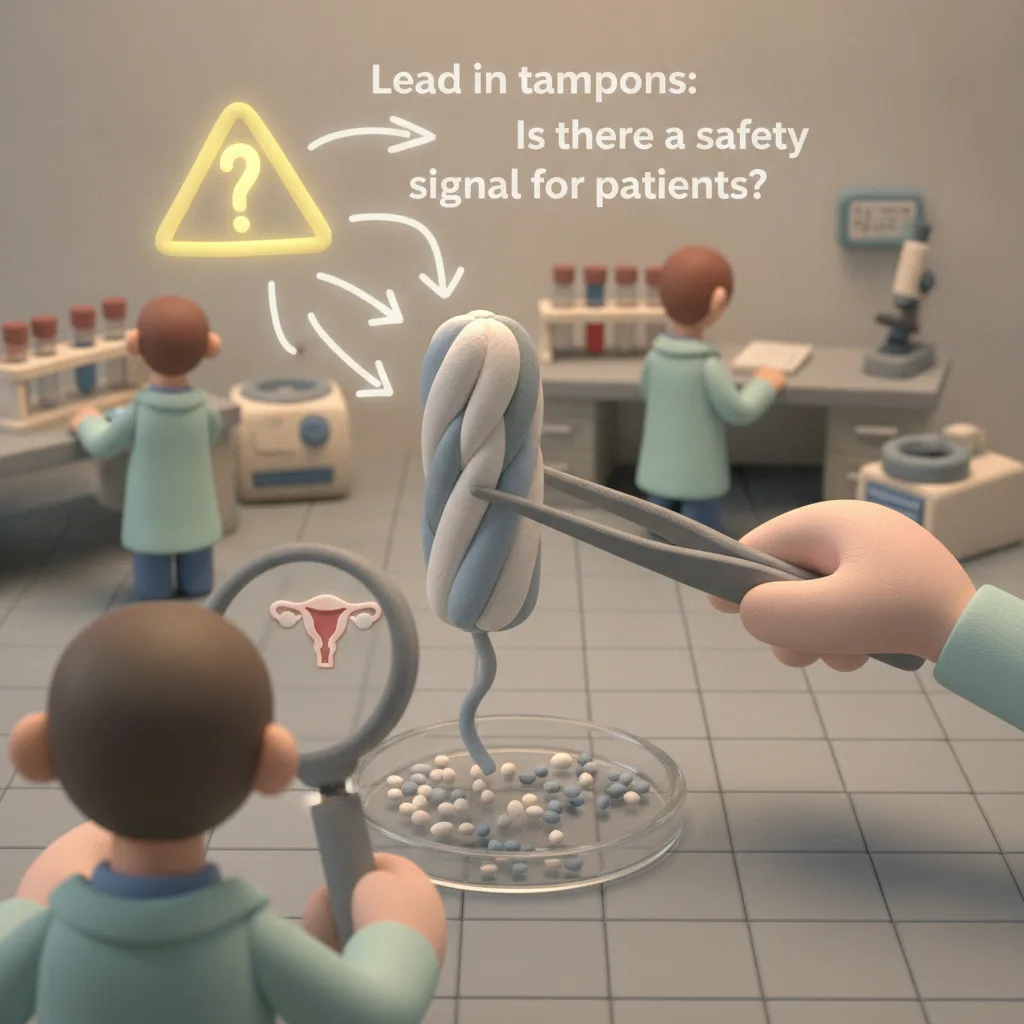

The presence of heavy metals in consumer products, particularly those with intimate contact, consistently generates public health questions. Recent reports detailing lead detection in tampons have prompted a closer look at potential risks. The immediate takeaway is that while lead was detected, no direct safety signals for patients have been identified.
Concerns about contaminants in menstrual products are not new. Patients frequently inquire about the safety of tampons, pads, and other devices, often driven by social media discussions or news reports. The recent focus on lead in tampons highlights the ongoing need for clear, evidence-based communication regarding product safety and chemical exposure.
Tampons are regulated as medical devices in many jurisdictions, meaning they undergo scrutiny for materials and manufacturing processes. These regulations aim to ensure products are safe for their intended use, considering factors like absorbency, integrity, and biocompatibility. The detection of trace elements, even those considered toxic, requires context regarding exposure levels and potential systemic absorption.
Understanding the Detection of Lead
Lead is a ubiquitous environmental contaminant, found in soil, water, and air. Its presence in consumer products, even at trace levels, can occur through raw materials, manufacturing processes, or environmental contamination. The critical factor for health risk is not merely presence, but the concentration and bioavailability of the lead, particularly in a product designed for internal use.
When lead is detected in a product like a tampon, the immediate question for clinicians is the potential for systemic absorption. The vaginal mucosa is permeable, but the extent to which trace amounts of lead from a tampon could be absorbed into the bloodstream and contribute to a patient's overall lead burden is a complex toxicological question. This is distinct from occupational lead exposure or ingestion, where absorption pathways are well-established.
But the lack of a clear safety signal does not mean the issue is without merit. Public health bodies and manufacturers routinely monitor products for contaminants. When lead is detected, even at low levels, it prompts investigations into the source and potential for reduction. This proactive approach is standard for maintaining consumer confidence and ensuring product integrity.
Clinical Context and Patient Reassurance
For patients, the term 'lead detected' can be alarming, immediately conjuring images of lead poisoning. Clinicians need to differentiate between trace detection and clinically significant exposure. Lead toxicity, particularly chronic exposure, can affect multiple organ systems, including neurological, renal, and haematological systems. But these effects are typically associated with sustained exposure to higher concentrations than what would be expected from trace amounts in a consumer product.
The current understanding of lead exposure from tampons suggests that the levels detected are unlikely to contribute significantly to a patient's overall lead burden or pose an acute health risk. This is a critical distinction for reassuring patients who may be concerned. Clinicians might find the discussion on diagnostic errors relevant here, as patient anxiety can sometimes lead to misinterpretation of general health information.
Still, manufacturers are expected to minimize all contaminants. The goal is to eliminate or reduce substances like lead to the lowest technically feasible levels. This is part of a broader commitment to product safety, extending beyond just tampons to other medical devices and consumer goods. For a comprehensive understanding of general clinical practice, the Oxford Handbook of Clinical Medicine remains an invaluable resource.
The open-label nature of public reporting on product contaminants is the obvious caveat. While transparency is vital, it can also lead to misinterpretation without proper context. The absence of reported adverse events directly linked to lead in tampons is a key piece of information. This does not mean zero risk, but rather that no discernible pattern of harm has emerged from widespread use.
The trial was not powered to detect differences in specific patient subgroups, and that gap matters. Whether benefits extend to broader groups remains unclear. The question of long-term, low-level exposure from multiple sources is always a consideration in toxicology, but specific data linking tampon use to adverse lead-related health outcomes is currently lacking. This contrasts with more established concerns, such as missed diagnoses in hydrofluoric acid burns, where direct causality is clear.
The detection of lead in tampons, even at trace levels, will inevitably generate patient inquiries. Clinicians should be prepared to address these concerns with a balanced perspective, emphasizing that while lead is a known toxicant, the current evidence does not indicate a direct health risk from these specific findings. Reassurance based on the absence of reported safety signals is appropriate.
This situation underscores the broader challenge of communicating risk in an era of heightened public awareness about chemical exposures. Patients are increasingly vigilant about product ingredients, and rightly so. Our role is to provide the clinical context, distinguishing between mere detection and actual harm, particularly for products that are integral to daily life.
Manufacturers face continuous pressure to ensure the purity of their raw materials and the cleanliness of their production processes. This incident, while not signaling an immediate crisis, serves as a reminder for industry to maintain rigorous quality control and transparency. It reinforces the need for ongoing surveillance of consumer products, especially those with prolonged or intimate contact.
- The Pivot Lead has been detected in some tampon products, raising questions about consumer safety.
- The Data No specific numeric safety thresholds or adverse event rates have been linked to these detections.
- The Action Clinicians should be aware of patient concerns but can reassure them that current evidence does not indicate a direct health risk from these findings.
ART-2026-1718
·09/26
Drafted with AI assistance and checked by automated style rules. Not individually read by an editor. This publication is intended for healthcare professionals, researchers, and life science industry professionals. Content is provided for informational and educational purposes only and does not constitute medical advice.

I specialise in clinical trial methodology and drug development, from Phase I to post-approval. My reports cover what got studied, what did not, and why. Based in Boston, reporting globally.
Cite This Article
Prescott D, Voss M. Lead in tampons: is there a hidden risk for your patients?. The Life Science Feed. Published September 8, 2026. Updated September 29, 2026. Accessed October 23, 2026. https://thelifesciencefeed.com/obstetrics-and-gyn/maternal-health/news/lead-in-tampons-is-there-a-hidden-risk-for-your-patients.
Editorial & AI Standards
Content is drafted with AI tools from peer-reviewed, open-access sources such as published trial data, clinical guidelines, and regulatory filings. This article is checked by automated style rules but is not individually read by an editor, so check the cited source before relying on a figure.
Source citations are listed in the References section. This content does not represent the views of any pharmaceutical company, medical device manufacturer, or healthcare provider.
Licence & Rights
© 2026 The Life Science Feed. All rights reserved. Unless otherwise indicated, all content is the property of The Life Science Feed and may not be reproduced, distributed, or transmitted in any form or by any means without prior written permission.
Medical Disclaimer
The information provided on The Life Science Feed is for educational and informational purposes only. It is not intended as a substitute for professional medical advice, diagnosis, or treatment. Always seek the advice of your physician or other qualified healthcare provider regarding any medical condition or treatment decision. Never disregard professional medical advice or delay in seeking it because of something you have read on this website.
References
1. Shamsollahi HR, Ghoochani M, Jaafari J, Moosavi A, Sillanpää M, Alimohammadi M. Environmental exposure to endotoxin and its health outcomes: A systematic review. Ecotoxicol Environ Saf. 2019;174:236-244. doi:10.1016/j.ecoenv.2019.02.046
2. Poom A, Willberg E, Toivonen T. Environmental exposure during travel: A research review and suggestions forward. Health Place. 2021;70:102584. doi:10.1016/j.healthplace.2021.102584
3. Modabbernia A, Velthorst E, Reichenberg A. Environmental risk factors for autism: an evidence-based review of systematic reviews and meta-analyses. Mol Autism. 2017;8:13. doi:10.1186/s13229-017-0121-4
4. Kwak K, Kang D, Paek D. Environmental exposure to asbestos and the risk of lung cancer: a systematic review and meta-analysis. Occup Environ Med. 2022;79(3):207-214. doi:10.1136/oemed-2020-107222
5. Chen X, Liu M, Zuo L, et al. Environmental noise exposure and health outcomes: an umbrella review of systematic reviews and meta-analysis. Eur J Public Health. 2023;33(4):725-731. doi:10.1093/eurpub/ckad044
6. Fernández-Olmo I, Mantecón P, Markiv B, Ruiz-Azcona L, Santibáñez M. A Review on the Environmental Exposure to Airborne Manganese, Biomonitoring, and Neurological/Neuropsychological Outcomes. Rev Environ Contam Toxicol. 2021;254:85-130. doi:10.1007/398_2020_46








