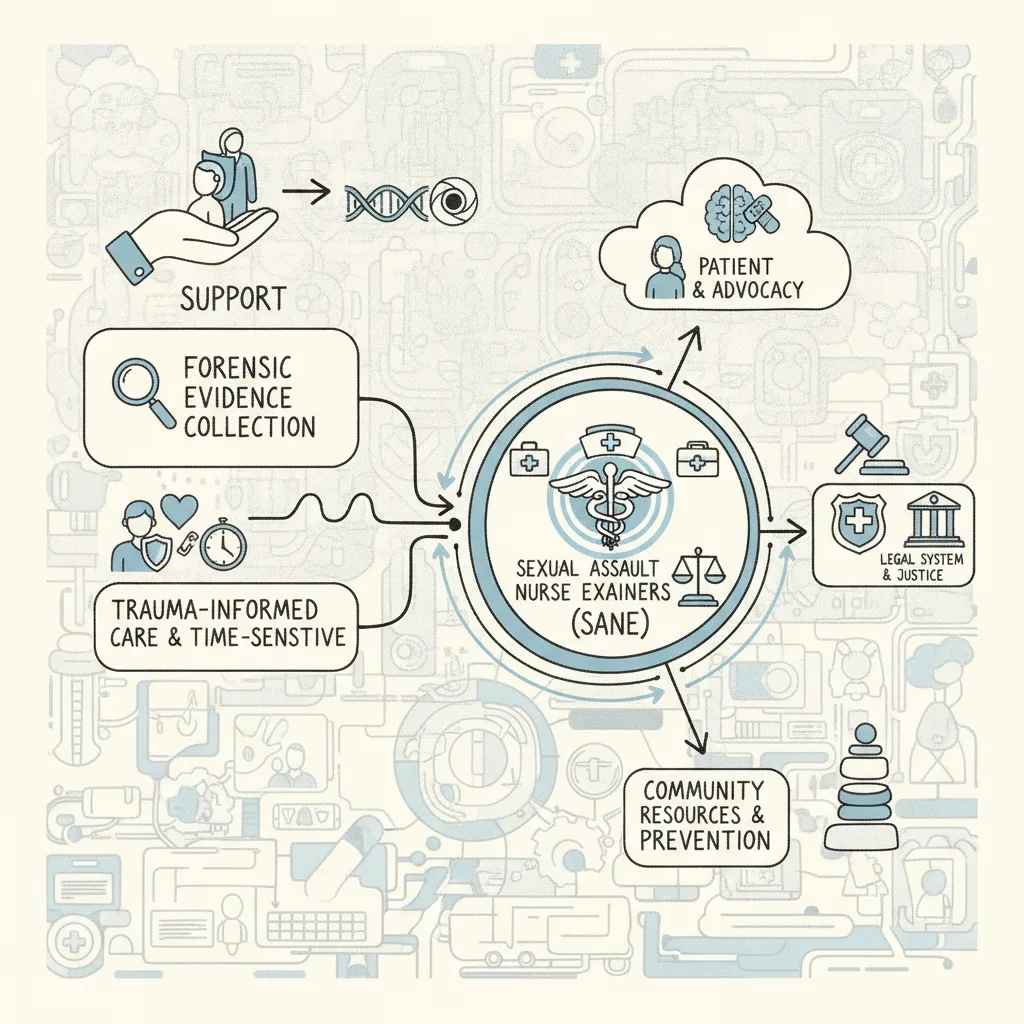

The immediate aftermath of sexual assault presents a complex clinical dilemma, requiring both compassionate medical care and meticulous forensic evidence collection. Sexual Assault Nurse Examiners (SANEs) are registered nurses with advanced training who address this dual need, ensuring patient-centred care while preserving crucial evidence for legal proceedings.
Sexual assault survivors often present to emergency departments with acute physical and psychological trauma. The immediate clinical response must address urgent medical needs, including injury assessment, sexually transmitted infection (STI) prophylaxis, and emergency contraception, while simultaneously navigating the sensitive process of forensic evidence collection. This dual requirement necessitates a highly specialised approach that general emergency department staff may not be equipped to provide without specific training.
The prevalence of sexual assault underscores the critical need for such specialised care. While exact figures vary by region and reporting mechanisms, global estimates indicate that a significant proportion of individuals will experience sexual violence in their lifetime. These incidents often result in a complex array of physical injuries, ranging from abrasions and contusions to more severe internal trauma, alongside profound psychological distress including acute stress disorder, post-traumatic stress disorder (PTSD), depression, and anxiety. The initial medical encounter is therefore a crucial juncture, influencing not only immediate health outcomes but also long-term recovery and engagement with the legal system.
The Role of Sexual Assault Nurse Examiners
Sexual Assault Nurse Examiners (SANEs) are registered nurses who have completed extensive post-basic education in forensic nursing, focusing on the medical and legal aspects of sexual assault. This training encompasses trauma-informed care principles, detailed physical examination techniques for identifying and documenting injuries, and the precise methodology required for collecting and preserving forensic evidence. Their expertise ensures that survivors receive comprehensive medical care in a sensitive manner, minimising further trauma during the examination process.
The SANE examination typically involves a detailed medical history, a head-to-toe physical assessment for visible and non-visible injuries, and the collection of biological evidence such as DNA, hair, and fibres. SANEs are trained to use specialised equipment, including colposcopes, to document genital and perianal injuries that may not be apparent to the naked eye. The meticulous documentation and chain of custody procedures followed by SANEs are critical for the admissibility of evidence in legal proceedings. Beyond the physical examination, SANEs provide emotional support, crisis intervention, and referrals to mental health services, victim advocacy groups, and legal aid. This holistic approach addresses the immediate and ongoing needs of survivors, extending beyond the acute medical encounter.
The methodology of forensic evidence collection by SANEs adheres to strict protocols designed to prevent contamination and ensure the integrity of samples. This includes the use of sterile collection kits, proper labelling, and secure packaging. SANEs understand the nuances of different types of evidence, such as seminal fluid, saliva, and skin cells, and employ appropriate techniques for their recovery from various body sites and clothing. The ability to differentiate between consensual and non-consensual injury patterns, and to accurately document findings using medical terminology that translates effectively into legal contexts, represents a core competency. This detailed approach is essential for supporting criminal investigations and prosecution efforts.
The presence of SANEs in healthcare settings, particularly emergency departments, has been shown to improve the quality of care for sexual assault survivors. Their specialised knowledge allows for a more thorough and accurate collection of forensic evidence, which can be instrumental in criminal investigations. Furthermore, the trauma-informed approach employed by SANEs can reduce re-victimisation and promote healing for survivors. The integration of SANEs into the healthcare system represents a recognition of the unique challenges faced by sexual assault survivors and the necessity for a dedicated, expert response.
Despite the clear benefits, the availability of SANE programs remains a challenge in many areas, particularly in rural or underserved communities. Barriers to implementation include funding limitations, a shortage of trained forensic nurses, and the logistical complexities of maintaining a 24/7 SANE response team. These limitations can result in survivors having to travel significant distances to access specialised care or, in some cases, receiving examinations from non-SANE trained personnel, which may compromise evidence collection or the provision of trauma-informed support. Addressing these systemic gaps requires sustained investment in forensic nursing education, recruitment, and program development to ensure equitable access to high-quality care for all sexual assault survivors.
The specialised role of Sexual Assault Nurse Examiners (SANEs) underscores a critical gap in general emergency medicine training. While emergency physicians and nurses are adept at acute care, the nuanced requirements of forensic evidence collection, coupled with trauma-informed care for sexual assault survivors, demand a distinct skill set. Relying solely on generalist staff risks suboptimal evidence collection, potentially compromising legal outcomes, and may inadvertently exacerbate patient trauma. The investment in SANE programmes, therefore, is not merely an enhancement of services but a fundamental requirement for ethical and effective care in these sensitive cases.
For healthcare systems, the implications are clear: adequate funding and staffing for SANE units are essential. This includes not only the initial training but also ongoing professional development to keep pace with evolving forensic science and trauma care best practices. Without dedicated SANEs, the burden falls disproportionately on already stretched emergency departments, where staff may lack the time or specific expertise to perform these examinations to the required standard. This can lead to inconsistencies in care and a postcode lottery for survivors seeking justice and recovery.
From a patient perspective, access to a SANE can significantly alter the trajectory of their recovery. The compassionate, expert care provided by a SANE can mitigate the psychological impact of the assault and the examination itself. Knowing that the forensic process is handled by a specialist who understands both the medical and legal ramifications can empower survivors, offering a sense of control and validation during a profoundly vulnerable time. This specialised care is not a luxury; it is a standard that all survivors of sexual assault deserve, and it is incumbent upon healthcare providers and policymakers to ensure its widespread availability.
- The Pivot SANEs offer specialised, trauma-informed care that integrates medical treatment with forensic evidence collection, a critical distinction from general emergency department care.
- The Data While specific quantitative data on SANE impact is not provided in the research, their role is established as essential for comprehensive care and evidence preservation.
- The Action Clinicians should understand the SANE role to facilitate appropriate referrals and ensure survivors receive specialised care, enhancing both patient outcomes and forensic integrity.
ART-2026-508
·09/26
Drafted with AI assistance, reviewed and approved by the editorial team. This publication is intended for healthcare professionals, researchers, and life science industry professionals. Content is provided for informational and educational purposes only and does not constitute medical advice.

I cover women's health, reproductive medicine, and the persistent gaps in how conditions that primarily affect women get studied and funded. The evidence base is thinner than it should be. I write about why.
Cite This Article
Mitchell S, Voss M. Sexual assault nurse examiners: essential role in forensic care. The Life Science Feed. Published June 19, 2026. Updated September 14, 2026. Accessed September 17, 2026. https://thelifesciencefeed.com/obstetrics-and-gyn/pregnancy-complications/practice/sexual-assault-nurse-examiners-essential-role-forensic-care.
Editorial & AI Standards
All content is researched from peer-reviewed, open-access sources: published trial data, clinical guidelines, and regulatory filings. AI tools are used solely to structure and summarise that evidence; no AI-generated conclusions appear without editor verification against the primary source.
Every article is reviewed by a named editor before publication. Source citations are listed in the References section. This content does not represent the views of any pharmaceutical company, medical device manufacturer, or healthcare provider.
Licence & Rights
© 2026 The Life Science Feed. All rights reserved. Unless otherwise indicated, all content is the property of The Life Science Feed and may not be reproduced, distributed, or transmitted in any form or by any means without prior written permission.
Medical Disclaimer
The information provided on The Life Science Feed is for educational and informational purposes only. It is not intended as a substitute for professional medical advice, diagnosis, or treatment. Always seek the advice of your physician or other qualified healthcare provider regarding any medical condition or treatment decision. Never disregard professional medical advice or delay in seeking it because of something you have read on this website.
References
1. Campbell R, et al. The effectiveness of sexual assault nurse examiner (SANE) programs: a review of psychological, medical, legal, and community outcomes. Trauma Violence Abuse. 2005;6(4):313-29. doi:10.1177/1524838005280328
2. Poldon S, et al. Exploring How Sexual Assault Nurse Examiners Practise Trauma-Informed Care. J Forensic Nurs. 2021;17(4):235-243. doi:10.1097/JFN.0000000000000338
3. Klein LB, et al. Trauma- and Violence-Informed Empowering Care for Sexual Assault Survivors. J Forensic Nurs. 2024;20(3):166-173. doi:10.1097/JFN.0000000000000483
4. Chalmers K, et al. Encouraging Trauma-Informed Care of Sexual Assault Survivors. Acad Med. 2022;97(8):1103. doi:10.1097/ACM.0000000000004369
5. Ades V, et al. An Integrated, Trauma-Informed Care Model for Female Survivors of Sexual Violence: The Engage, Motivate, Protect, Organize, Self-Worth, Educate, Respect (EMPOWER) Clinic. Obstet Gynecol. 2019;133(4):803-809. doi:10.1097/AOG.0000000000003186
6. Owens L, et al. Universal precautions: the case for consistently trauma-informed reproductive healthcare. Am J Obstet Gynecol. 2022;226(5):671-677. doi:10.1016/j.ajog.2021.08.012
7. Yesodharan R, et al. The effectiveness of a sexual assault nurse examiner-grounding program (SANE-GP) on knowledge, skill and practice regarding sexual assault examination (SAE) among nurses working in a tertiary care hospital in Udupi district, India: A study protocol. F1000Res. 2022;11:134. doi:10.12688/f1000research.74978.2
8. Torregosa MB, et al. Sexual Assault Nurse Examiner (SANE) program: Long-term impact on confidence and attitudes on SANE trainees. Nurse Educ Pract. 2023;72:103757. doi:10.1016/j.nepr.2023.103757
9. Hite A, et al. Innovative Assessments for Retention of Sexual Assault Nurse Examiners. J Forensic Nurs. 2022;18(3):185-188. doi:10.1097/JFN.0000000000000390
10. Miyamoto S, et al. Leveraging Telehealth to Address Sexual Assault Nurse Examiner Access Disparities in Rural Communities. J Forensic Nurs. 2023;19(4):231-239. doi:10.1097/JFN.0000000000000431