
Biliary tract cancers (BTCs) are a group of aggressive malignancies with a generally poor prognosis. While molecular profiling is increasingly recommended to guide treatment decisions, real-world data on the prevalence and prognostic significance of these genomic alterations, particularly within European cohorts, has been limited. This study aimed to characterize the molecular landscape of BTCs in a Belgian clinical setting and evaluate its impact on patient survival.
Understanding Biliary Tract Cancers and Molecular Profiling
Biliary tract cancers (BTCs) encompass a group of rare but highly aggressive cancers originating in the bile ducts (cholangiocarcinoma) or gallbladder (gallbladder cancer). These malignancies are associated with a poor prognosis, often due to late diagnosis and limited effective treatment options for advanced disease. In recent years, advances in genomic sequencing have revealed that BTCs are not a homogeneous group but rather comprise several distinct molecular subtypes, each potentially responsive to different targeted therapies. Consequently, molecular profiling has become an important tool for guiding therapeutic decision-making, yet real-world data on its prevalence and prognostic implications in European populations has been scarce. This retrospective study sought to address this gap by analyzing a cohort of Belgian BTC patients.
Study Design and Patient Cohort
This retrospective cohort study included patients diagnosed with BTC who underwent informative molecular testing as part of routine diagnostics at Antwerp University Hospital in Belgium between 2016 and 2024. Data on patient demographics, clinical characteristics, and molecular alterations were extracted from electronic health records. The study aimed to characterize the molecular landscape of BTCs in this real-practice setting and evaluate the prognostic relevance of identified genomic alterations. Survival outcomes were analyzed using Kaplan-Meier methods and Cox proportional hazards regression models to assess the association between molecular alterations and overall survival (OS).
Distinct Molecular Landscapes Across BTC Subtypes
The study included 224 patients with BTC. Genomic alterations were identified in 59.4% of the tumors. The researchers observed clear subtype-specific patterns in the distribution of these alterations. Intrahepatic cholangiocarcinoma (ICC) exclusively harbored IDH1 mutations (17.3%) and FGFR2 fusions (13.9%). In contrast, KRAS mutations were most prevalent in extrahepatic cholangiocarcinoma (EHCC), affecting 42.9% of these tumors. Gallbladder cancer (GBC) showed an enrichment of ERBB2 amplification, found in 16.7% of cases. Overall, KRAS mutation was the most frequent alteration, identified in 20.4% of all BTCs. Co-occurring alterations, meaning the presence of more than one genomic alteration in the same tumor, were observed in 7.8% of cases. These findings underscore the molecular heterogeneity within BTCs, suggesting that these are not a single disease entity but rather a collection of distinct cancers with varying molecular drivers.
Prognostic Impact of KRAS Mutations
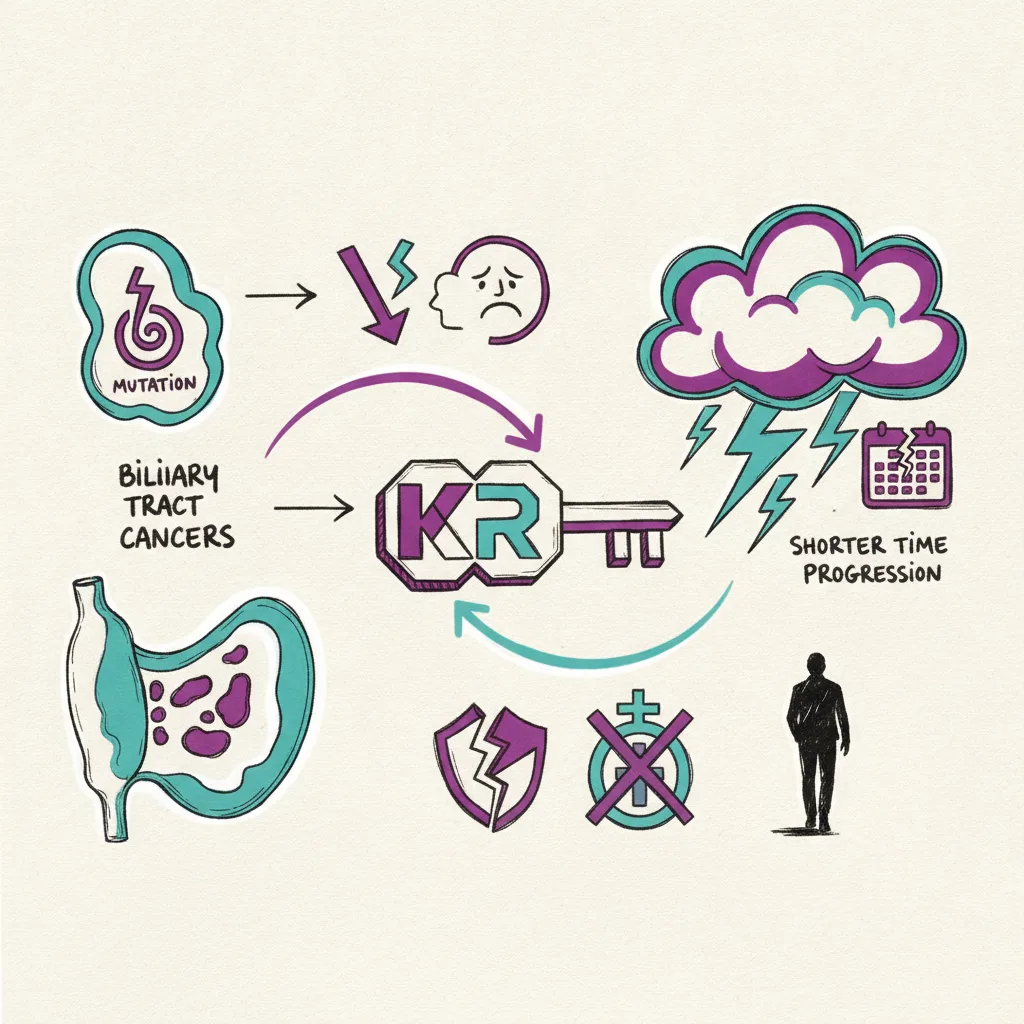
The study found that KRAS mutation was significantly associated with worse overall survival. In a multivariate analysis, adjusted for tumor subtype and tumor stage, patients with KRAS-mutated tumors had a 54% increased risk of mortality compared to those without KRAS mutations (Hazard Ratio [HR] = 1.54, 95% CI: 1.03-2.31, p = 0.04)1. This suggests that KRAS mutations are an independent prognostic factor for poorer outcomes in BTC patients. While 32.6% of all tumors harbored a potentially actionable alteration, indicating a target for specific therapies, only 31.6% of eligible patients actually received matched targeted therapy. This highlights a gap between the identification of actionable targets and their translation into clinical practice.
Clinical Implications and Future Directions
Why this matters for clinical practice today
This study reinforces the critical importance of routine molecular profiling for all patients with biliary tract cancers. The finding that KRAS mutations are not only prevalent but also independently associated with worse overall survival provides valuable prognostic information that can influence treatment discussions and patient expectations. The observed low rate of matched targeted therapy for eligible patients, despite the identification of actionable alterations, suggests a need for improved pathways to integrate molecular results into clinical decision-making and access to appropriate therapies. Clinicians should consider early and comprehensive molecular testing to guide personalized treatment strategies, particularly given the aggressive nature of these cancers and the potential for targeted interventions.
The distinct molecular profiles observed across BTC subtypes, such as IDH1 mutations and FGFR2 fusions in ICC, KRAS mutations in EHCC, and ERBB2 amplification in GBC, emphasize that BTCs should not be treated as a single disease. This molecular stratification can inform the selection of patients for clinical trials and the development of subtype-specific therapies. The study's findings underscore the clinical value of routine molecular profiling in BTC and highlight its importance for identifying therapeutic opportunities in clinical practice. Further research is needed to understand the barriers to implementing matched targeted therapy and to develop more effective treatments for patients with KRAS-mutated BTCs, which currently represent a significant unmet medical need. Future studies could also explore the impact of co-occurring alterations on prognosis and treatment response.
Limitations and Next Steps
As a retrospective cohort study conducted at a single center, the findings may be subject to selection bias and may not be fully generalizable to other populations or healthcare settings. The relatively small sample size for some BTC subtypes might limit the statistical power to detect associations for less frequent alterations. Additionally, the study's timeframe (2016-2024) spans a period of evolving molecular testing practices and therapeutic options, which could introduce variability. Despite these limitations, the study provides valuable real-world data on the molecular landscape and prognostic significance of genomic alterations in BTCs within a European context. Future prospective, multi-center studies with larger cohorts are warranted to validate these findings and further investigate the clinical utility of molecular profiling in guiding personalized treatment strategies for BTC patients.
- The Pivot Molecular profiles in biliary tract cancers (BTCs) vary significantly by subtype, challenging the view of BTCs as a single disease entity.
- The Data KRAS mutations were the most common alteration (20.4% overall) and were independently associated with a 54% increased risk of mortality (HR=1.54, 95% CI: 1.03-2.31, p=0.04).
- The Action Routine molecular profiling is crucial for identifying actionable alterations and guiding personalized therapeutic strategies in BTC patients, as many eligible patients currently do not receive matched targeted therapy.
ART-2026-1199
·10/26
Drafted with AI assistance, reviewed and approved by the editorial team. This publication is intended for healthcare professionals, researchers, and life science industry professionals. Content is provided for informational and educational purposes only and does not constitute medical advice.

Infectious disease, epidemiology, and global health equity. I have covered outbreaks from Ebola to COVID-19 to mpox. The stories I am most drawn to are where the science is clear and the response is slow.
Cite This Article
Reeves T, Voss M. KRAS mutations signal poorer outcomes in biliary tract cancers. The Life Science Feed. Published August 27, 2026. Updated October 6, 2026. Accessed October 11, 2026. https://thelifesciencefeed.com/oncology/biliary-tract-neoplasms/insights/kras-mutations-signal-poorer-outcomes-in-biliary-tract-cancers.
Editorial & AI Standards
All content is researched from peer-reviewed, open-access sources: published trial data, clinical guidelines, and regulatory filings. AI tools are used solely to structure and summarise that evidence; no AI-generated conclusions appear without editor verification against the primary source.
Every article is reviewed by a named editor before publication. Source citations are listed in the References section. This content does not represent the views of any pharmaceutical company, medical device manufacturer, or healthcare provider.
Licence & Rights
© 2026 The Life Science Feed. All rights reserved. Unless otherwise indicated, all content is the property of The Life Science Feed and may not be reproduced, distributed, or transmitted in any form or by any means without prior written permission.
Medical Disclaimer
The information provided on The Life Science Feed is for educational and informational purposes only. It is not intended as a substitute for professional medical advice, diagnosis, or treatment. Always seek the advice of your physician or other qualified healthcare provider regarding any medical condition or treatment decision. Never disregard professional medical advice or delay in seeking it because of something you have read on this website.
References
1. Arnouts J, van Kempen LC, Koljenović S, et al. Impact of Molecular Alterations on Survival in Biliary Tract Cancers: A Retrospective Belgian Cohort Study. Int J Cancer. 2026; doi:10.1002/ijc.70711.