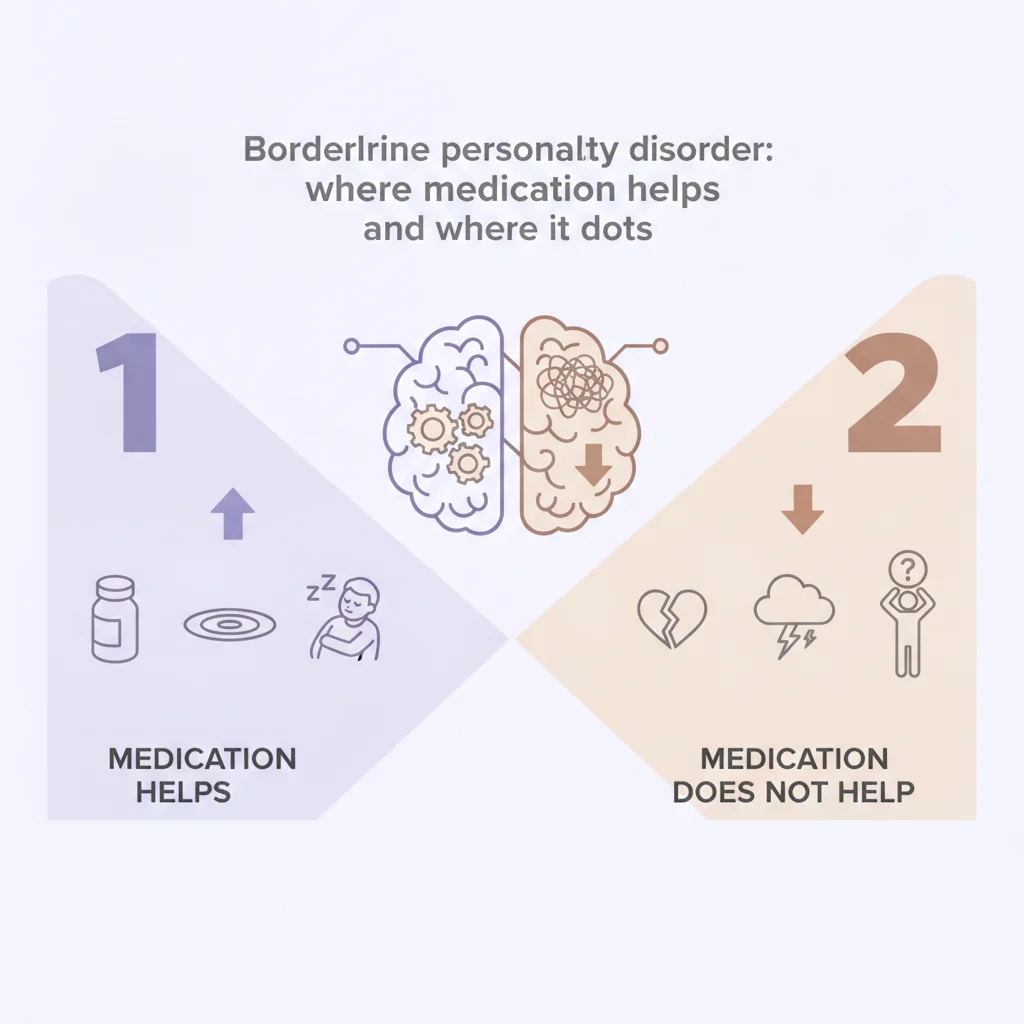

Borderline personality disorder (BPD) presents a complex clinical challenge, often characterised by emotional dysregulation, impulsivity, and unstable relationships. While psychotherapy, particularly dialectical behaviour therapy (DBT), remains the cornerstone of treatment, clinicians frequently turn to pharmacotherapy to manage distressing symptoms. But the evidence base for medication in BPD is often less clear-cut than for other psychiatric conditions, leading to widespread off-label prescribing.
A 2005 survey published in the Journal of Intellectual Disability Research examined the prevalence and nature of off-label psychotropic prescribing for inpatients with mild intellectual disability and co-occurring mental illness, a population often presenting with complex behavioural and emotional dysregulation that can overlap with BPD symptomatology.1 This study offers a window into the realities of psychiatric polypharmacy and the use of medicines beyond their licensed indications.
Managing patients with severe mental illness, especially those with co-occurring intellectual disability or personality disorders, often involves navigating a market where licensed treatment options are limited. Clinicians frequently find themselves in a position where they must use medications for indications not explicitly approved by regulatory bodies, a practice known as off-label prescribing. This approach, while sometimes clinically necessary, introduces complexities regarding efficacy, safety, and informed consent.
Haw and Stubbs conducted a survey to quantify the extent of off-label psychotropic prescribing in a specific inpatient population.1 The study focused on 100 inpatients with mild intellectual disability and mental illness residing in a large psychiatric hospital in the UK. The investigators aimed to determine the frequency of off-label use, identify the clinical indications for which drugs were prescribed off-label, and assess the documentation of consent and rationale in patient case notes. This population, while distinct from a pure BPD cohort, often exhibits similar challenges in symptom management, making the prescribing patterns observed highly relevant to broader discussions on complex psychiatric care. The average age of patients was 42.1 years (range 19-75 years), with 60% being male.1 The median length of stay was 10.5 years, indicating a chronic inpatient population with enduring mental health needs.1
The prevalence of off-label psychotropic use
The survey revealed that off-label prescribing was not merely an occasional occurrence but a pervasive practice within this inpatient setting. Of the 100 patients reviewed, 79% received at least one psychotropic medication off-label for an unlicensed indication.1 This high proportion underscores the reliance on medications beyond their approved labels to manage complex psychiatric presentations.
Patients received a median of 3 psychotropic medications each, with a range of 0 to 8.1 The total number of psychotropic prescriptions reviewed was 303, of which 159 (52.5%) were prescribed off-label.1 This means more than half of all psychotropic prescriptions in this cohort were for an unlicensed indication, highlighting a significant gap between regulatory approvals and clinical practice needs. The most common classes of psychotropics prescribed were antipsychotics (107 prescriptions), anxiolytics/hypnotics (63 prescriptions), and antidepressants (59 prescriptions).1
Specific indications and drug classes
The study detailed the specific off-label indications for which psychotropics were used. Behavioural disturbance was the most frequent off-label indication, accounting for 60 (37.7%) of all off-label prescriptions.1 This was followed by aggression (30; 18.9%), anxiety (21; 13.2%), and sleep disturbance (17; 10.7%).1 These symptoms are common in patients with BPD, where emotional dysregulation often manifests as aggression, impulsivity, and severe anxiety, driving clinicians to seek pharmacological interventions.
Antipsychotics were the most commonly prescribed class of psychotropics, with 65 (60.7%) of all antipsychotic prescriptions being off-label.1 Risperidone was the most frequently prescribed antipsychotic (39 prescriptions), with 25 (64.1%) of these being off-label, primarily for behavioural disturbance or aggression.1 Haloperidol, another antipsychotic, had 12 (63.2%) of its 19 prescriptions used off-label.1 This pattern suggests that antipsychotics are often employed for their sedative and behavioural control properties, even when a specific psychotic disorder is not the primary diagnosis. For a broader understanding of how medication burden impacts other chronic conditions, consider dialysis patients facing escalating medication burden.
Anxiolytics and hypnotics also saw substantial off-label use, with 36 (57.1%) of 63 prescriptions being off-label.1 Lorazepam, a benzodiazepine, was prescribed 20 times, with 12 (60%) of these for off-label indications such as anxiety or behavioural disturbance.1 Antidepressants, conversely, had a lower rate of off-label use, with only 16 (27.1%) of 59 prescriptions being off-label.1 This lower rate might reflect clearer guidelines and more established evidence for antidepressant use in mood and anxiety disorders, even in complex populations.
Documentation and consent: a critical gap
The study also highlighted significant deficiencies in the documentation of off-label prescribing. For 159 off-label prescriptions, the rationale for using the drug off-label was documented in the case notes for only 100 (62.9%).1 This leaves a substantial proportion where the clinical justification was not explicitly recorded, raising questions about transparency and accountability in prescribing decisions.
Even more concerning was the documentation of patient consent. For 159 off-label prescriptions, evidence of patient consent for off-label use was recorded in only 23 (14.5%) instances.1 This is a critical ethical and legal failing, particularly in a population with intellectual disability, where capacity for consent must be carefully assessed and documented. The absence of documented consent for such a high proportion of off-label prescriptions indicates a systemic issue that requires urgent attention. Clinicians often rely on comprehensive resources like the Oxford Handbook of Psychiatry for guidance on complex cases, but even these cannot substitute for proper documentation of individual patient discussions.
The implications for borderline personality disorder
While this study specifically examined inpatients with intellectual disability, its findings resonate deeply with the challenges of prescribing for BPD. Patients with BPD often present with a constellation of symptoms including affective instability, impulsivity, anger, and anxiety, for which specific, licensed pharmacological treatments are scarce. As a result, clinicians frequently employ medications off-label, mirroring the patterns observed by Haw and Stubbs. The use of antipsychotics for aggression or behavioural disturbance, anxiolytics for acute distress, and mood stabilisers for emotional lability are common practices in BPD management, often without a clear licensed indication.
The lack of robust evidence for many psychotropic medications in BPD means that prescribing decisions are often based on clinical experience, symptom clusters, and a process of trial and error. This can lead to polypharmacy, increased risk of side effects, and suboptimal outcomes. The documentation issues identified in the study, particularly the absence of recorded consent for off-label use, are equally pertinent in BPD, where patients may have fluctuating capacity or complex relationships with healthcare providers. Ensuring that patients understand the rationale for off-label prescribing and provide informed consent is paramount, regardless of the specific diagnosis.
Where the data falls short
The study's primary limitation is its focus on a specific inpatient population with mild intellectual disability and mental illness. While there are symptomatic overlaps with BPD, the direct generalisability to a broader BPD population without intellectual disability is not absolute. The study was also a survey of prescribing practices, not an intervention trial, meaning it cannot speak to the efficacy or safety of these off-label uses. It merely describes the prevalence of the practice. The data is also from 2005, and prescribing patterns and guidelines may have evolved since then, though the fundamental challenges of off-label use in complex psychiatry remain.
Still, the study provides a stark illustration of the reliance on off-label prescribing in challenging psychiatric contexts. It highlights the need for more research into effective, licensed pharmacological treatments for conditions like BPD and for clearer guidelines on the ethical and legal responsibilities associated with off-label use. The absence of documented consent, in particular, represents a significant area for improvement in clinical practice. The complexities of diagnosing and managing personality disorders are further explored in our article on the shift from categorical to dimensional diagnosis.
The prevalence of off-label psychotropic prescribing in complex psychiatric populations, as demonstrated by Haw and Stubbs, is a stark reminder of the unmet needs in mental health care. Clinicians are often left to manage severe symptoms with tools not specifically designed or approved for the task. This necessitates a pragmatic approach, but one that must be anchored in rigorous ethical and legal considerations.
The lack of documented consent for off-label use is particularly troubling. It is not enough to simply prescribe; the rationale, potential benefits, and risks of using a drug outside its marketing authorisation must be clearly communicated and recorded. This is especially true for vulnerable populations, where the capacity for informed consent may be variable and requires careful assessment. The onus is on the prescriber to ensure this transparency.
For pharmaceutical companies, this widespread off-label use signals a clear market need for targeted research and development. The fact that antipsychotics are so frequently used for behavioural disturbance and aggression in populations like those with BPD or intellectual disability suggests a demand for agents with specific indications for these challenging symptoms. Until such evidence emerges, clinicians will continue to navigate this grey area, making the need for robust documentation and patient-centred discussions all the more critical.
- The Pivot Off-label prescribing of psychotropic medications is a common practice in psychiatric inpatient settings, particularly for complex patient populations.
- The Data 79% of inpatients with mild intellectual disability and mental illness received at least one psychotropic medication off-label for an unlicensed indication.1
- The Action Clinicians should ensure thorough documentation of off-label prescribing, including the rationale and patient consent, to uphold ethical and legal standards.
ART-2026-1489
·10/26
Drafted with AI assistance, reviewed and approved by the editorial team. This publication is intended for healthcare professionals, researchers, and life science industry professionals. Content is provided for informational and educational purposes only and does not constitute medical advice.

Science writer covering the frontier between basic research and clinical practice. I am interested in the moment a mechanism becomes a therapy, and everything that can go wrong in between.
Cite This Article
Aldrich M, Lopes W. Borderline personality disorder: where medication helps and where it does not. The Life Science Feed. Published August 27, 2026. Updated October 5, 2026. Accessed October 12, 2026. https://thelifesciencefeed.com/psychiatry/personality-disorders/practice/borderline-personality-disorder-medication-efficacy.
Editorial & AI Standards
All content is researched from peer-reviewed, open-access sources: published trial data, clinical guidelines, and regulatory filings. AI tools are used solely to structure and summarise that evidence; no AI-generated conclusions appear without editor verification against the primary source.
Every article is reviewed by a named editor before publication. Source citations are listed in the References section. This content does not represent the views of any pharmaceutical company, medical device manufacturer, or healthcare provider.
Licence & Rights
© 2026 The Life Science Feed. All rights reserved. Unless otherwise indicated, all content is the property of The Life Science Feed and may not be reproduced, distributed, or transmitted in any form or by any means without prior written permission.
Medical Disclaimer
The information provided on The Life Science Feed is for educational and informational purposes only. It is not intended as a substitute for professional medical advice, diagnosis, or treatment. Always seek the advice of your physician or other qualified healthcare provider regarding any medical condition or treatment decision. Never disregard professional medical advice or delay in seeking it because of something you have read on this website.
References
1. Haw C, Stubbs J. A survey of off-label prescribing for inpatients with mild intellectual disability and mental illness. J Intellect Disabil Res. 2005;49(Pt 10):774-782. doi:10.1111/j.1365-2788.2005.00713.x