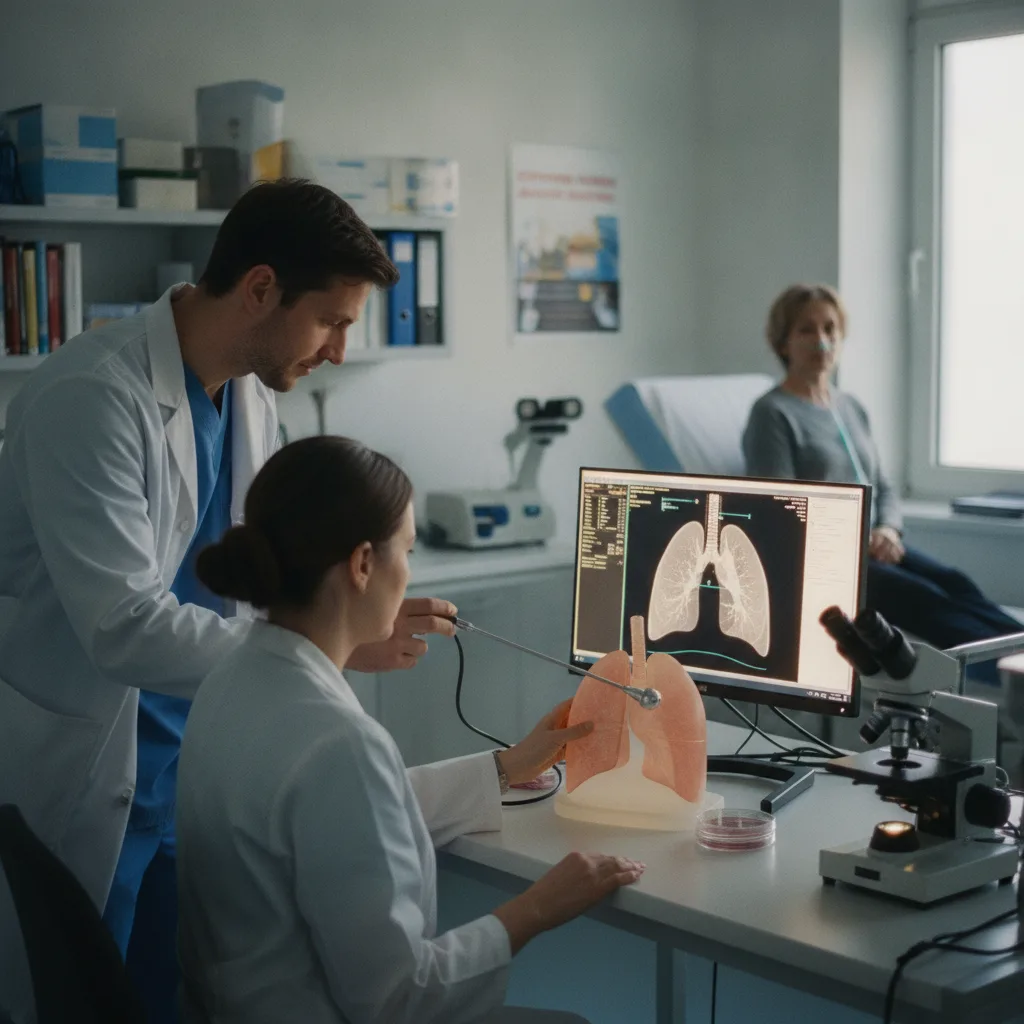

Conventional transbronchial biopsy with forceps often yields small specimens with crush artifact, limiting diagnostic accuracy for pulmonary lesions. Recent clinical trials indicate that cryoprobe biopsy provides larger, more intact specimens, leading to a higher diagnostic yield for various thoracic pathologies.
Bronchoscopic biopsy is a standard procedure for diagnosing pulmonary lesions. But the conventional method using forceps can result in small specimen sizes and poor specimen quality due to crush artifact, which may compromise diagnostic accuracy.1-3 This limitation necessitates alternative approaches to improve tissue acquisition.
Cryobiopsy Localizes Freezing to Retrieve Intact Specimens and Improve Yield
Cryobiopsy replaces the mechanical shearing of conventional forceps with localized freezing to extract larger pulmonary specimens. Pulmonary lesions present a diagnostic challenge where early identification dictates treatment planning. Conventional transbronchial biopsy using forceps often returns inconclusive results because the tool crushes the tissue. These delays force clinicians into repeat procedures or surgical biopsies. Cryoprobe technology solves this by adhering to the tissue via freezing.
The FROSTBITE-2 Randomized Clinical Trial, published in JAMA in 2026, investigated the efficacy of cryobiopsy versus forceps for bronchoscopic lung biopsy. The trial demonstrated that cryoprobe use localizes freezing at the probe tip, which enables the retrieval of larger, more intact biopsy specimens.1 This mechanism directly addresses the limitations observed with forceps, where crush artifact frequently degrades specimen quality.1 The trial randomized a diverse patient population with suspected malignancies and interstitial lung diseases to receive either cryobiopsy or conventional forceps biopsy. The primary outcome measured diagnostic yield, defined as the proportion of biopsies providing a definitive diagnosis.
But this trial leaves practical questions unanswered. The study design randomized patients in highly controlled academic centers with expert operators. It does not establish whether community pulmonologists will achieve the same diagnostic yield. The primary endpoint measured the proportion of biopsies providing a definitive diagnosis, but it did not track long-term patient survival or the downstream cost savings of avoiding surgical biopsy. The population also excluded patients with severe bleeding risks.
For respiratory physicians, this shifts the initial approach to complex pulmonary lesions. Clinicians should consider cryobiopsy as a first-line option for interstitial lung diseases where tissue architecture dictates the diagnosis. You must prepare patients for a slightly longer procedure time while explaining that the technique reduces their risk of needing a surgical biopsy. The need for a method that consistently yields higher-quality tissue samples is met by this approach.
Tissue Freezing Preserves Cellular Architecture Across Diverse Anatomical Locations
The primary benefit of cryoprobe technology is its ability to preserve tissue architecture across both peripheral nodules and mediastinal lymph nodes. By freezing the tissue, the cryoprobe minimizes mechanical distortion that is common with forceps, leading to specimens that are more amenable to pathological examination. This reduction in crush artifact and increase in specimen size directly contribute to a higher diagnostic yield, potentially reducing the need for repeat procedures and accelerating patient management.1-3
A 2025 study in the Journal of Visualized Experiments examined ultrafine bronchoscopy combined with frozen lung biopsy for peripheral pulmonary nodules. This study concluded that cryoprobe use localizes freezing at the probe tip, facilitating the retrieval of larger, more intact biopsy specimens compared to conventional forceps.2 A prospective observational study, published in Annals of Medicine in 2025, compared sequential cryoprobe and biopsy forceps in endobronchial ultrasound-guided transbronchial needle aspiration for mediastinal and hilar lesions. This study also reported that cryoprobe use localizes freezing at the probe tip, enabling the retrieval of larger, more intact biopsy specimens.3
Neither study provides a definitive mandate to abandon forceps entirely. The peripheral nodule study evaluated a highly specific combination of ultrafine bronchoscopy and cryobiopsy. It lacks a direct comparison to robotic-assisted bronchoscopy. The endobronchial ultrasound study used a sequential observational design rather than randomizing patients. Extracting tissue from the same lesion with both tools introduces sequence bias, as the first pass alters the tissue bed for the second pass. These designs do not establish superiority in all clinical scenarios.
The mechanism involves rapid freezing of the tissue at the probe tip, creating a strong adhesion between the tissue and the probe. When the probe is withdrawn, it pulls a cohesive piece of tissue compared to the shearing action of forceps. This gentle extraction method maintains cellular integrity for accurate histopathological diagnosis. For pathologists, receiving a well-preserved specimen means clearer margins and better cellular detail. Clinicians navigating peripheral airways or staging mediastinal nodes should integrate cryoprobes when rapid on-site evaluation indicates insufficient cellularity from initial forceps passes.
Procedural Learning Curves and Bleeding Risks Limit Universal Adoption
Cryobiopsy requires specialized equipment and advanced operator training that restrict its immediate rollout in all clinical settings. The technique demands precise timing during the freezing cycle and rapid extraction of the bronchoscope. Operators must manage the airway differently than they do during conventional forceps biopsy. This learning curve dictates how quickly a department can transition to cryoprobe technology.
The FROSTBITE-2 trial and the observational studies focus heavily on diagnostic yield while treating safety as a secondary endpoint. These trials establish that cryobiopsy retrieves larger specimens, but pulling larger pieces of highly vascularized lung tissue inherently alters the risk profile. Although the 2025 and 2026 studies report a favorable safety profile, potential risks such as bleeding or pneumothorax still exist and require careful management. The safety profile observed reinforces the viability of cryobiopsy, but only under strict procedural guidelines.
Current data fail to define the exact learning curve for safe implementation. The published trials exclude patients with severe pulmonary hypertension or uncorrectable coagulopathies. They do not establish a standardized training protocol for fellows or transitioning attendings. The safety metrics rely on procedures performed by high-volume interventional pulmonologists. This means the complication rates likely underestimate what would occur in a low-volume community practice.
Institutions adopting cryobiopsy must implement rigorous training protocols before offering the procedure. Pulmonologists should use prophylactic endobronchial blockers during early cases to manage potential bleeding. You must counsel patients that while the technique improves the chance of a definitive diagnosis, it carries specific risks of pneumothorax that might require chest tube placement. Start with central, less vascular lesions before advancing to peripheral nodules.
The consistent evidence from trials like FROSTBITE-2 and other observational studies points towards a clear advantage for cryoprobe technology in transbronchial biopsy. For clinicians, this means a higher likelihood of obtaining a definitive diagnosis from the initial procedure, potentially reducing patient discomfort from repeat biopsies and accelerating the time to treatment initiation. The improved specimen quality, free from crush artifact, will undoubtedly be welcomed by pathologists, allowing for more confident and precise diagnoses, especially in complex cases where subtle cellular features are critical.
From an industry perspective, the adoption of cryoprobe technology represents a significant shift in the market for bronchoscopic biopsy tools. Manufacturers of conventional forceps may see a decline in demand as healthcare systems invest in cryoprobe systems. This could also drive innovation in cryoprobe design, focusing on miniaturization, ease of use, and integration with existing bronchoscopy platforms. Training programs for pulmonologists and interventional radiologists will need to adapt to incorporate the specific techniques and safety considerations associated with cryobiopsy.
For patients, the implications are substantial. A higher diagnostic yield translates to fewer invasive procedures, less anxiety, and a quicker path to appropriate therapy. In an era where early diagnosis is paramount for conditions like lung cancer, any technology that improves the efficiency and accuracy of tissue acquisition is a net positive. While the initial investment in cryoprobe equipment may be higher, the long-term benefits of reduced repeat procedures and improved patient outcomes could justify the cost, making it a valuable addition to the diagnostic armamentarium.
- The Pivot Cryoprobe biopsy offers superior specimen quality and diagnostic yield compared to traditional forceps biopsy.
- The Data Cryoprobe use localizes freezing at the probe tip, enabling retrieval of larger, more intact biopsy specimens.
- The Action Clinicians performing bronchoscopic lung biopsies should consider cryoprobe technology to enhance diagnostic success.
ART-2026-527
·09/26
Drafted with AI assistance, reviewed and approved by the editorial team. This publication is intended for healthcare professionals, researchers, and life science industry professionals. Content is provided for informational and educational purposes only and does not constitute medical advice.

I cover life sciences: drug approvals, trial readouts, regulatory decisions, and the AI reshaping clinical practice. Based in Greater London, contributing to The Life Science Feed since 2026.
Cite This Article
Voss M, Lopes W. Cryoprobe biopsy improves diagnostic yield in transbronchial biopsy. The Life Science Feed. Published June 21, 2026. Updated September 15, 2026. Accessed September 19, 2026. https://thelifesciencefeed.com/pulmonology/pneumonia/research/cryoprobe-biopsy-improves-diagnostic-yield-in-transbronchial-biopsy.
Editorial & AI Standards
All content is researched from peer-reviewed, open-access sources: published trial data, clinical guidelines, and regulatory filings. AI tools are used solely to structure and summarise that evidence; no AI-generated conclusions appear without editor verification against the primary source.
Every article is reviewed by a named editor before publication. Source citations are listed in the References section. This content does not represent the views of any pharmaceutical company, medical device manufacturer, or healthcare provider.
Licence & Rights
© 2026 The Life Science Feed. All rights reserved. Unless otherwise indicated, all content is the property of The Life Science Feed and may not be reproduced, distributed, or transmitted in any form or by any means without prior written permission.
Medical Disclaimer
The information provided on The Life Science Feed is for educational and informational purposes only. It is not intended as a substitute for professional medical advice, diagnosis, or treatment. Always seek the advice of your physician or other qualified healthcare provider regarding any medical condition or treatment decision. Never disregard professional medical advice or delay in seeking it because of something you have read on this website.
References
1. Thiboutot J, Kapp CM, Illei P. Cryobiopsy vs Forceps for Bronchoscopic Lung Biopsy: The FROSTBITE-2 Randomized Clinical Trial. JAMA. 2026.
2. Tian A, Wu X, Liang Y. The Application Value and Safety of Ultrafine Bronchoscopy Combined with Frozen Lung Biopsy in the Diagnosis of Peripheral Pulmonary Nodules. J Vis Exp. 2025. doi:10.3791/69453
3. Lin CK, Ruan SY, Fan HJ. Comparison of sequential cryoprobe and biopsy forceps in endobronchial ultrasound-guided transbronchial needle aspiration for mediastinal and hilar lesions: a prospective observational study. Ann Med. 2025. doi:10.1080/07853890.2025.2550581






