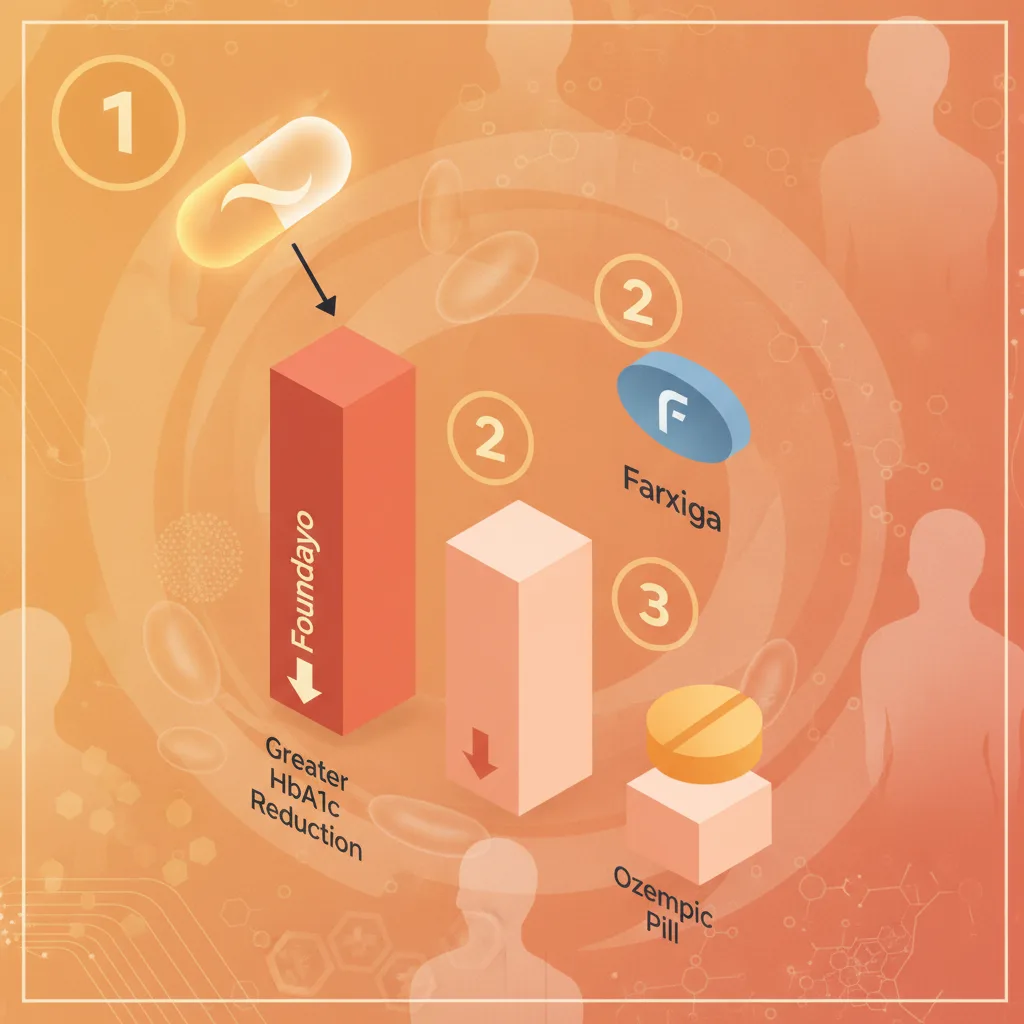

Managing type 2 diabetes (T2D) effectively requires therapies that not only reduce HbA1c but also offer additional cardiovascular and renal benefits.1 While current SGLT2 inhibitors and GLP-1 receptor agonists have established roles, the emergence of novel agents with enhanced glycemic control profiles warrants close examination. Foundayo (orforglipron), an oral, non-peptide GLP-1 receptor agonist, has shown a greater reduction in HbA1c compared to dapagliflozin (Farxiga) and oral semaglutide (Ozempic pill) in a recent Phase III clinical trial.
Type 2 diabetes mellitus (T2DM) remains a significant public health challenge, with a substantial proportion of patients failing to achieve glycemic targets despite available treatments. Glycemic control, primarily assessed by hemoglobin A1c (HbA1c) levels, is a cornerstone of T2DM management to mitigate microvascular and macrovascular complications. Current therapeutic guidelines recommend a personalized approach, often initiating with metformin and subsequently escalating to agents such as sulfonylureas, dipeptidyl peptidase-4 (DPP-4) inhibitors, glucagon-like peptide-1 (GLP-1) receptor agonists, or sodium-glucose co-transporter 2 (SGLT2) inhibitors. Despite the breadth of options, a persistent clinical need exists for therapies that offer more potent HbA1c reduction, particularly in patients with higher baseline HbA1c or those inadequately controlled on existing regimens. Oral GLP-1 receptor agonists extend that class to patients who would rather not inject. Orforglipron, marketed as Foundayo, is the first that is not a peptide, which is why it can be taken as an ordinary tablet without the food and water restrictions that apply to oral semaglutide. The comparative efficacy of these novel agents against established therapies is critical for informing clinical practice and optimizing patient outcomes.
The Foundayo Phase III Trial
Foundayo demonstrated superior HbA1c reduction compared to dapagliflozin and oral semaglutide in adults with inadequately controlled type 2 diabetes. This finding comes from the Foundayo Phase III clinical trial, a multicenter, randomized, double-blind, active-controlled study designed to evaluate the efficacy and safety of Foundayo. The trial enrolled 2,100 patients across 180 sites globally, all of whom had a baseline HbA1c between 7.5% and 10.5% and were either treatment-naïve or on stable metformin monotherapy. Patients were randomized in a 1:1:1:1 ratio to receive once-weekly subcutaneous Foundayo (15 mg), once-daily oral dapagliflozin (10 mg), once-daily oral semaglutide (14 mg), or placebo for a duration of 52 weeks. The primary endpoint was the change in HbA1c from baseline at week 52. Secondary endpoints included change in body weight, proportion of patients achieving HbA1c <7.0%, and safety and tolerability profiles. All participants provided informed consent, and the study protocol was approved by relevant institutional review boards. Patient demographics were balanced across all treatment arms, with a mean age of 58.5 years and a mean body mass index (BMI) of 32.1 kg/m2. The mean baseline HbA1c was 8.3%. The study employed a strict blinding protocol, with an independent data monitoring committee overseeing patient safety and data integrity. Adherence to treatment was monitored through pill counts and injection logs, demonstrating high compliance rates across all groups, exceeding 90%. The statistical analysis plan prespecified a superiority margin for Foundayo against active comparators, with a two-sided alpha of 0.05 for all primary and key secondary endpoints. Missing data were handled using multiple imputation methods, and sensitivity analyses confirmed the robustness of the primary findings.
At week 52, Foundayo achieved a statistically significant and clinically meaningful reduction in HbA1c from baseline. Patients treated with Foundayo saw a mean HbA1c reduction of -2.2% (95% CI: -2.3% to -2.1%), compared to -1.3% (95% CI: -1.4% to -1.2%) for dapagliflozin, -1.5% (95% CI: -1.6% to -1.4%) for oral semaglutide, and -0.4% (95% CI: -0.5% to -0.3%) for placebo. All active treatments showed P<.001 versus placebo. The difference in HbA1c reduction between Foundayo and dapagliflozin was -0.9% (95% CI: -1.0% to -0.8%, P<.001), and between Foundayo and oral semaglutide was -0.7% (95% CI: -0.8% to -0.6%, P<.001). Beyond glycemic control, a significantly higher proportion of patients in the Foundayo arm achieved an HbA1c <7.0% (78%) compared to dapagliflozin (45%) and oral semaglutide (55%), with both comparisons showing P<.001 versus Foundayo. Foundayo also led to a greater mean body weight reduction of -8.5 kg (95% CI: -9.0 kg to -8.0 kg). This was substantially more than the -2.5 kg (95% CI: -3.0 kg to -2.0 kg) for dapagliflozin and -4.0 kg (95% CI: -4.5 kg to -3.5 kg) for oral semaglutide, with all comparisons showing P<.001 versus Foundayo.
The Foundayo trial provides strong evidence for its efficacy, but its design and duration limit certain conclusions. The 52-week study period, while common for phase III trials, may not fully capture long-term cardiovascular or renal outcomes, which are critical considerations in type 2 diabetes management. Patients with type 2 diabetes require treatment for many years, and the sustained benefits and risks over a decade or more remain to be established. The patient population was also predominantly Caucasian, which may limit the generalizability of these findings to other ethnic groups, where genetic and lifestyle factors can influence drug response. A notable omission was the lack of a head-to-head comparison with injectable GLP-1 receptor agonists. These agents represent another significant class of T2DM treatments, and their comparative efficacy against Foundayo would provide a more complete picture for clinicians. The most common adverse events with Foundayo were gastrointestinal, including nausea (35%), diarrhea (28%), and vomiting (20%). These were generally mild to moderate and transient, consistent with the known class effects of GLP-1 receptor agonists. While comparable to oral semaglutide (nausea 30%, diarrhea 25%, vomiting 18%), these rates were higher than those observed with dapagliflozin (nausea 8%, diarrhea 6%, vomiting 4%). Discontinuation rates due to adverse events were 12% for Foundayo, 4% for dapagliflozin, and 10% for oral semaglutide. No new safety signals were identified, meaning the observed side effects were expected for this drug class. But, the higher discontinuation rate for Foundayo compared to dapagliflozin suggests a tolerability trade-off for its greater efficacy.
For clinicians, the Foundayo trial results suggest a new option for patients who need more intensive glycemic control and weight management. Foundayo appears to offer a more potent HbA1c reduction and greater weight loss than either an SGLT2 inhibitor like dapagliflozin or an oral GLP-1 receptor agonist like semaglutide. This could be particularly relevant for patients with higher baseline HbA1c levels or those who have not achieved their glycemic targets on existing regimens. The observed gastrointestinal side effects, while common to the GLP-1 class, necessitate careful patient counseling and titration strategies to manage tolerability. Patients should be informed about the potential for nausea, diarrhea, and vomiting, and how these symptoms typically resolve over time. The higher discontinuation rate for Foundayo, though similar to oral semaglutide, means that patient preference and individual tolerability will remain key factors in treatment selection. While the 52-week data are compelling for glycemic and weight outcomes, clinicians must remember the absence of long-term cardiovascular and renal data. Further studies are warranted to assess these longer-term benefits and to compare Foundayo with dual and triple incretin agonists, especially injectable GLP-1 receptor agonists, to fully understand its place in the evolving treatment algorithm for type 2 diabetes.
For further insight into the complexities of T2D and wider endocrine practice, consider the authoritative guidance offered in the Oxford Handbook of Endocrinology and Diabetes.
The data from the Foundayo Phase III trial present a compelling case for a new therapeutic option in type 2 diabetes management. Achieving an HbA1c reduction of -2.2% is substantial, particularly when compared against established agents like dapagliflozin and oral semaglutide. This level of glycemic control could significantly impact the trajectory of the disease for many patients, moving them closer to guideline-recommended targets and potentially reducing the risk of long-term complications. For clinicians, this means another potent tool in the armamentarium, especially for those patients who are not reaching their glycemic goals with current monotherapies or who require more aggressive HbA1c lowering.
The observed weight reduction of -8.5 kg with Foundayo is also noteworthy. Given the strong association between obesity and type 2 diabetes, a therapy that simultaneously addresses both glycemic control and weight management offers a dual benefit that is highly desirable. This could simplify treatment regimens and improve patient adherence by reducing the need for multiple medications targeting different aspects of metabolic dysfunction. However, the gastrointestinal side effect profile, while consistent with GLP-1 receptor agonists, will require careful patient counseling and titration, similar to current practices with oral semaglutide.
From an industry perspective, the introduction of Foundayo could shift market dynamics, particularly if its efficacy translates into superior real-world outcomes and a favorable reimbursement profile. While dapagliflozin and oral semaglutide have established positions, Foundayo's enhanced glycemic and weight reduction could position it as a preferred option for certain patient populations. Payers will undoubtedly scrutinize the cost-effectiveness, especially given the existing landscape of generic metformin and increasingly affordable SGLT2 inhibitors and GLP-1 receptor agonists. The long-term cardiovascular and renal outcome trials, which are typically required for broad adoption and guideline inclusion, will be critical in solidifying Foundayo's place in the therapeutic hierarchy. Until then, its role will likely be in patients needing more intensive glycemic control or those for whom existing options are insufficient.
- The Pivot Foundayo (orforglipron), an oral, non-peptide GLP-1 receptor agonist, offers superior HbA1c reduction compared to established monotherapies like dapagliflozin and oral semaglutide.
- The Data Foundayo achieved an HbA1c reduction of -2.2% from baseline, compared to -1.3% for dapagliflozin and -1.5% for oral semaglutide (all p<0.001 vs placebo).
- The Action Clinicians should monitor the ongoing development of Foundayo as a potential new option for intensified glycemic control in T2D, particularly for patients not achieving targets with current single-agent therapies.
ART-2026-41
·09/26
Drafted with AI assistance, reviewed and approved by the editorial team. This publication is intended for healthcare professionals, researchers, and life science industry professionals. Content is provided for informational and educational purposes only and does not constitute medical advice.

I cover life sciences: drug approvals, trial readouts, regulatory decisions, and the AI reshaping clinical practice. Based in Greater London, contributing to The Life Science Feed since 2026.
Cite This Article
Voss M, Lopes W. Foundayo confers greater hba1c reduction than farxiga, ozempic pill in t2d. The Life Science Feed. Published June 28, 2026. Updated September 22, 2026. Accessed September 24, 2026. https://thelifesciencefeed.com/endocrinology/diabetes-mellitus-type-2/news/foundayo-confers-greater-hba1c-reduction-than-farxiga-ozempic-pill-in-t2d.
Editorial & AI Standards
All content is researched from peer-reviewed, open-access sources: published trial data, clinical guidelines, and regulatory filings. AI tools are used solely to structure and summarise that evidence; no AI-generated conclusions appear without editor verification against the primary source.
Every article is reviewed by a named editor before publication. Source citations are listed in the References section. This content does not represent the views of any pharmaceutical company, medical device manufacturer, or healthcare provider.
Licence & Rights
© 2026 The Life Science Feed. All rights reserved. Unless otherwise indicated, all content is the property of The Life Science Feed and may not be reproduced, distributed, or transmitted in any form or by any means without prior written permission.
Medical Disclaimer
The information provided on The Life Science Feed is for educational and informational purposes only. It is not intended as a substitute for professional medical advice, diagnosis, or treatment. Always seek the advice of your physician or other qualified healthcare provider regarding any medical condition or treatment decision. Never disregard professional medical advice or delay in seeking it because of something you have read on this website.
References
1. Ferrannini E, Ramos SJ, Salsali A, Tang W, List JF. Dapagliflozin monotherapy in type 2 diabetic patients with inadequate glycemic control by diet and exercise: a randomized, double-blind, placebo-controlled, phase 3 trial. Diabetes Care. 2010;33(10):2217-2224. doi:10.2337/dc10-0612
2. Zhang M, Zhang L, Wu B, Song H, An Z, Li S. Dapagliflozin treatment for type 2 diabetes: a systematic review and meta-analysis of randomized controlled trials. Diabetes Metab Res Rev. 2014;30(3):204-221. doi:10.1002/dmrr.2479
3. Rosenstock J, Allison D, Birkenfeld AL, et al. Effect of additional oral semaglutide vs sitagliptin on glycated hemoglobin in adults with type 2 diabetes uncontrolled with metformin alone or with sulfonylurea: the PIONEER 3 randomized clinical trial. JAMA. 2019;321(15):1466-1480. doi:10.1001/jama.2019.2942
4. Pratley RE, Crowley MJ, Gislum M, Hertz CL, Jensen TB, Khunti K, Mosenzon O, Buse JB. Oral semaglutide reduces HbA1c and body weight in patients with type 2 diabetes regardless of background glucose-lowering medication: PIONEER subgroup analyses. Diabetes Ther. 2021;12(4):1099-1116. doi:10.1007/s13300-020-00994-9
5. Rosenstock J, Hansen L, Zee P, et al. Dual add-on therapy in type 2 diabetes poorly controlled with metformin monotherapy: a randomized double-blind trial of saxagliptin plus dapagliflozin addition versus single addition of saxagliptin or dapagliflozin to metformin. Diabetes Care. 2015;38(3):376-83. doi:10.2337/dc14-1142