

Hosted by Sarah Mitchell & James Carter
Show Notes
More than 80% of HFpEF patients are overweight or obese. STEP-HFpEF showed semaglutide 2.4mg improved symptoms by 16 points on the KCCQ and reduced weight by 13.3% - now a Class IIa ESC recommendation. Sarah Mitchell and James Carter explore why treating the metabolic environment is the new paradigm for HFpEF.
Transcription
Yeah, and there's a very good chance you, the listener, know someone exactly like this.
CO-HOST: Right. So they are older and they are carrying extra weight. Clinically speaking, they are obese.
Right. But here's the interesting part. Their blood pressure is totally under control, and if you look at their arteries, there's no significant coronary disease.
CO-HOST: Yeah, no major blockages at all.
None.
CO-HOST: On paper, looking at the traditional markers we usually worry about, their heart looks like it should be functioning just fine. The pipes are clear.
The pipes are clear. On paper, they should be okay. But in reality, they can't even walk to the end of their street without having to stop.
CO-HOST: Yeah, they're constantly breathless.
Exactly. They are dealing with this crushing deep fatigue. Their body is retaining fluid in their legs, in their lungs. And for years, if you were this patient, you would sit in a doctor's office and the medical community really only had like one answer for you.
CO-HOST: Yeah, the old advice, you need to lose weight. That was the directive.
Which is so frustrating.
CO-HOST: It is an incredibly frustrating and almost impossible directive for a patient who is physically too exhausted and breathless to even walk, let alone maintain some rigorous exercise routine.
Right, obviously.
CO-HOST: We were essentially telling them to fix a complex systemic problem with sheer willpower. Mainly because, well, we simply did not have a medical tool that could meaningfully achieve that necessary weight loss while simultaneously improving their cardiac outcomes.
But that era of blaming the patient's willpower has officially ended. Today, our deep dive is taking us into a massive paradigm shift in the world of cardiology.
CO-HOST: A completely new way of looking at the body, really.
Yeah. We are looking at a stack of incredibly fascinating medical insights that detail a completely new understanding of the connection between obesity and heart failure.
CO-HOST: Right.
Specifically, we are going to look at how GLP-1 receptor agonist drugs, you have definitely been hearing about in the news, are completely rewriting the rules for treating a condition known as HFPEF.
CO-HOST: That stands for heart failure with preserved ejection fraction. And it is a profound shift in how we practice medicine. I mean, we are moving away from just trying to manage symptoms with water pills to fundamentally rethinking the entire root cause of this specific type of heart failure.
Okay, let's unpack this, because to understand the cure, we really have to understand the crime scene.
CO-HOST: I like that.
Why is obesity causing this very specific type of heart failure? For the longest time, I think most of us, uh, doctors included, viewed body fat as just a storage locker.
CO-HOST: Right, just extra baggage, inert energy waiting to be used.
Yeah, exactly. But to understand this paradigm shift, you have to completely throw that image away.
CO-HOST: Yeah.
I want you to imagine that fat is not a storage locker.
CO-HOST: Okay.
It is an active, highly toxic chemical plant, and it is physically wrapped right around your heart.
CO-HOST: Yeah, that analogy perfectly reflects the modern shift in medical understanding. Obesity is no longer being viewed as just a comorbidity.
Meaning a condition that just happens to quietly exist alongside the heart failure.
CO-HOST: Exactly.
Yeah.
CO-HOST: It is now viewed as causal.
Yeah.
CO-HOST: It is the active engine driving the disease. If you look at HF patients in developed countries, roughly 80% of them are overweight or obese.
80%? That is a staggering majority.
CO-HOST: It really is.
I mean, that implies a direct biological link, not a coincidence.
CO-HOST: And it comes back to your chemical plant analogy.
Yeah.
CO-HOST: We are specifically talking about visceral fat and an anatomical depot called epicardial fat.
Okay.
CO-HOST: This is the fat situated directly between the visceral pericardium and the myocardium. So it is literally hugging the heart muscle itself.
Wow.
CO-HOST: And it is highly metabolically active.
Wait, I want to pause right there, because metabolically active sounds like clinical jargon. If it's not just sitting there, what exactly is this chemical plant pumping out into the heart?
CO-HOST: Well, it is continuously secreting pro-inflammatory adipokines, free fatty acids, and reactive oxygen species directly into the heart tissue.
Wait, reactive oxygen species, that sounds like something leaking out of a nuclear reactor. What is that actually doing to my heart cells? And what are adkines? Break those down for me.
CO-HOST: Fair point. Think of adkines as chemical distress beacons.
Distress beacons, okay.
CO-HOST: Yeah, they're signaling molecules that essentially call in an immune system response. They're constantly telling the body, we're under attack, trigger inflammation.
Oh, wow.
CO-HOST: And as for reactive oxygen species, those are unstable molecules that damage cells. Imagine them as microscopic rust.
Rust?
CO-HOST: Yeah, they are basically rusting the heart cells from the inside out, creating this massive oxidative stress.
So this fat layer is essentially bathing the heart in an inflammatory soup while literally rusting the cells.
CO-HOST: Exactly. And that chronic exposure has severe mechanical consequences. It drives systemic inflammation. It causes endothelial dysfunction.
Which means what? Exactly.
CO-HOST: It means the blood vessels lining the heart lose their elasticity. They can't expand and contract properly to regulate blood flow.
That sounds bad.
CO-HOST: It is, and it also triggers fibrosis. The heart muscle literally becomes scarred, thick, and stiff.
Yeah.
CO-HOST: And on top of all that chemical damage, there is a physical component. That thick layer of fat is physically compressing the pericardium, you know, the sack around the heart.
So it's getting squeezed.
CO-HOST: Right. The heart is trying to beat, trying to relax and fill with blood, while being squeezed in a literal vice grip of inflamed tissue.
It makes so much sense why the patient in our opening example is so breathless.
CO-HOST: Yeah.
The heart's plumbing might be clear of blockages, but the pump itself is stiff, scarred, and being physically and chemically suffocated. It just can't relax enough to fill up with blood.
CO-HOST: Which has led to the identification of a completely distinct patient type.
Hmm.
CO-HOST: Barry Borlog and his colleagues at the Mayo Clinic have done brilliant work detailing this.
Yeah, their work is incredible.
CO-HOST: They've shown that obese HF isn't just regular heart failure happening in a larger person. It is a distinct, unique condition.
How so?
CO-HOST: Well, these patients have much higher filling pressures in the heart. They experience severe hemodynamic impairment the second they try to exercise. I mean, their system just can't adapt to the demand.
Right.
CO-HOST: They have a totally distinct metabolic signature. And interestingly, this demographic tends to be a bit younger than traditional heart failure patients and predominantly female.
Here's where it gets really interesting. Because if we follow the logic we've just laid out, if this toxic active fat is the root cause of the scarring and the stiffness.
CO-HOST: Yes.
Then aggressively targeting and shrinking that specific fat should theoretically heal the heart, right?
CO-HOST: Right.
But theory is one thing. I want to know what happens in the real world. Did shrinking the fat actually result in a clinically meaningful difference for the heart? Or did it just, you know, change the number on the scale?
CO-HOST: That is the pivotal question the medical community needed answered, and we got the definitive proof in 2023.
The step HF trial.
CO-HOST: Exactly. A landmark trial published in the New England Journal of Medicine. They tracked 529 patients who had this specific obesity-related HF.
And what were the criteria?
CO-HOST: To qualify, you had to have a body mass index of 30 or above and an ejection fraction of 45% or above.
Okay, let me quickly clarify ejection fraction for you the listener, because preserved sounds like healthy, but it's deceptive.
CO-HOST: Very deceptive.
Ejection fraction is the percentage of blood the heart pumps out with each beat. If it's over 45%, the squeezing mechanism is technically normal.
CO-HOST: Right.
But if the heart is super stiff and small from all that scarring we talked about, it might only fill up with a tiny amount of blood to begin with.
CO-HOST: Yes.
So it's pumping out a normal percentage of an abnormally small amount of blood. You still end up breathless.
CO-HOST: That is the perfect distinction. The squeeze is fine, but the filling is broken.
Yeah.
CO-HOST: So they took these patients and randomized them into two groups.
Okay.
CO-HOST: Half received a weekly subcutaneous injection of semiglutide at a 2.4 milligram dose. That's a GLP-1 agonist.
Right.
CO-HOST: And the other half received a placebo.
So one group gets the drug, one gets a dummy shot. Walk me through the results. Let's look at the symptoms first, because ultimately, that's what matters most to the patient's daily life.
CO-HOST: So, they used something called the KCCQ symptom score.
Okay.
CO-HOST: It's a comprehensive questionnaire that measures physical limitations, social limitations, and overall quality of life. In cardiology, a five-point improvement on this scale is considered the threshold to be clinically meaningful.
And anyone who has worked in a clinic knows how hard it is to get a patient's KCCQ score to move even a single point with just diet and lifestyle advice.
CO-HOST: Oh, absolutely.
So five points is the holy grail where a patient actually says, I feel noticeably better today.
CO-HOST: Right. So the patients on the placebo improved by eight points. Which is common in trials just from the placebo effect and receiving regular high-quality medical attention.
Sure.
CO-HOST: But the patients on semiglutide, their scores improved by roughly 16 points.
Wow. 16 points.
CO-HOST: Yeah. That's more than triple the threshold for a meaningful difference. That's a patient suddenly being able to play with their grandchildren or walk up a flight of stairs without gasping for air.
CO-HOST: It is life-altering, truly. And the weight loss was equally dramatic. The semiglutide group dropped 13.3% of their body weight, compared to just 2.6% in the placebo group.
That's massive.
CO-HOST: Plus, their six-minute walk distance, which is a standard clinical test to measure physical endurance,
Right.
CO-HOST: It improved by an additional 21 meters compared to the placebo. And their CRP levels fell substantially.
Wait, CRP is C-reactive protein, right? Basically, the body's smoke alarm for systemic inflammation.
CO-HOST: Yes, exactly. It's a primary biomarker for inflammation in the blood.
Hmm.
CO-HOST: Seeing that drop means the systemic fire is cooling down.
That's incredible.
CO-HOST: And I should add, they ran a parallel trial alongside this called Step HFPF-DM that was specifically for patients who also had type two diabetes.
Yeah.
CO-HOST: The results there were nearly identical and completely consistent.
Okay, wait, let me push back a little here. I'm trying to wrap my head around whether this is a miracle heart drug or just basic physics.
CO-HOST: Okay, let's hear it.
Let me throw a thought experiment your way. If you take a person and you strap a heavy 40-lb backpack onto them, and you ask them to walk, they are going to get breathless very quickly.
CO-HOST: Right, obviously.
If you take that heavy backpack off, naturally, they can walk further, their joints hurt less, and they just feel better.
CO-HOST: Sure.
So my question is this, is semaglutide just taking the heavy backpack off the patient?
Ah, I see what you're saying.
CO-HOST: Are they just feeling better because they are carrying 13% less physical weight? Or is this drug actually fundamentally rewiring the biology of the heart itself?
What's fascinating here is how difficult that is to fully disentangle, precisely because the backpack effect is very real.
CO-HOST: Right.
Weight loss alone physically reduces filling pressures in the heart. But the evidence points strongly to direct cardiac effects that go far beyond just dropping pounds.
CO-HOST: Oh, really?
Yeah. This drug is communicating directly with the cardiovascular system.
CO-HOST: Direct effects, meaning the GLP-1 receptors aren't just in the brain telling us we are full, they are actually in the heart.
Yes, exactly. The specific receptors this drug targets are physically present on cardiac macrophages.
CO-HOST: Which are immune cells, right?
Right. Immune cells residing in the heart tissue. And they are also on endothelial cells, which line the blood vessels.
CO-HOST: Okay, but how does a drug binding to an immune cell stop the heart from failing?
Think of macrophages as the construction and cleanup crew of the tissue.
CO-HOST: Okay.
When the heart is under stress from that toxic fat we talked about, macrophages get the signal to start laying down fibrous tissue to protect the area.
Oh, that's the scarring we mentioned earlier.
CO-HOST: Exactly. But when semiglutide binds to the GLP-1 receptors on those macrophages, it appears to tell them to stand down.
Wow.
CO-HOST: It halts the inflammatory signaling and reduces the drive to create that stiff scar tissue. At the same time, binding to the endothelial cells helps the blood vessels relax and improve blood flow.
So it's actively stopping the stiffening process at a cellular level.
CO-HOST: Yes. Furthermore, there is evidence showing it improves mitochondrial function in the cardiomyocytes.
The heart muscle cells themselves.
CO-HOST: So it's basically tuning up the microscopic power plants in the cells, so the heart doesn't have to work as hard to generate energy.
Exactly.
CO-HOST: And we also have visual evidence of this targeted effect. In the Step trials, researchers used cardiac MRIs to look inside the patients.
And what did they see?
CO-HOST: They found that semiglutide didn't just cause general uniform weight loss across the body. It caused a highly significant reduction, specifically, in visceral and epicardial fat mass.
No way. It went straight for the toxic fat, right?
CO-HOST: It really did. It cleaned up the exact tissue that was bathing the heart in that inflammatory soup. Because of that direct anatomical relationship, shrinking that specific fat depot may be central to why the drug is so wildly successful at reducing symptoms.
That makes total sense.
CO-HOST: It's removing the physical vice grip and the chemical poison simultaneously. And while the Step trials weren't specifically powered, meaning they weren't large enough or long enough to definitively prove a reduction in hard outcomes like death or worsening heart failure hospitalization,
Right, that's take huge, long study.
CO-HOST: Exactly. But the numbers still numerically favored the semiglutide group. The trend lines point to profound protection.
So what does this all mean for the listener who is trying to understand modern medical strategy? We've established that GLP-1s are incredibly powerful for this condition.
CO-HOST: Very powerful.
But we also already have existing very effective drugs for heart failure. Are doctors now looking at doubling up on therapies? Are we just throwing everything at the wall to see what sticks? How does this actually look in the real world?
CO-HOST: If we connect this to the bigger picture,
Yeah.
CO-HOST: It changes the entire treatment algorithm. It is not just throwing things at the wall, it is a highly targeted synergistic approach.
Okay, synergistic how?
CO-HOST: Well, we already rely heavily on a class of drugs called SGLT2 inhibitors.
Yeah.
CO-HOST: They were historically used for diabetes, but they've become an absolute cornerstone of heart failure treatment.
All right.
CO-HOST: What we're seeing now is the emergence of a powerful complementary combination. SGLT2 inhibitors and GLP-1 agonists working together in the same patient.
I'm trying to picture how those two work together, because SGLT2 inhibitors, which stands for sodium-glucose cotransporter-2 inhibitors, they work primarily through the kidneys, right?
CO-HOST: Right.
They force your body to pee out excess sugar and sodium.
CO-HOST: Exactly. They act primarily through decongestion.
Yeah.
CO-HOST: They help the body efficiently clear out that excess fluid building up in the lungs and legs, which instantly lowers the pressure inside the heart.
Okay, let me try an analogy here to see if I'm understanding the synergy. Tell me if this works.
CO-HOST: Let's hear it.
Imagine the failing heart is a stiff, dried-out, crusty sponge that has been soaked in dirty, toxic water.
CO-HOST: Okay.
The SGLT2 inhibitor acts by ringing out the sponge. It drains the dirty fluid and reduces the immediate swelling.
CO-HOST: Right.
But the sponge is still chemically stiff. So then the GLP-1 comes in, cleans up the toxic fat wrapped around it, and changes the chemical environment so the sponge regains its soft, bouncy, elasticity.
CO-HOST: That is an excellent way to visualize the mechanics, truly. The SGLT2 inhibitor handles the immediate hemodynamic stress, the fluid and pressure overload.
Right.
CO-HOST: Meanwhile, the GLP-1 agonist provides aggressive weight reduction, massive systemic anti-inflammatory signaling, and those direct cellular effects on the macrophages and mitochondria we discussed.
It's a one-two punch.
CO-HOST: They are tackling the disease from two completely different but complementary biological pathways. For a patient who has type two diabetes and HF, combining an SGLT2 inhibitor and semiglutide makes total mechanistic sense and it is quickly becoming the ultimate medical strategy.
And what about the official guidelines? Because medicine can be notoriously slow to adopt new paradigms. Are the big medical societies officially endorsing this approach?
CO-HOST: They are actually moving faster than usual because the data is so compelling. In the 2024 guidelines from the European Society of Cardiology, the ESC semiglutide earned a class 30 recommendation specifically for obese HF patients.
Okay, to improve symptoms?
CO-HOST: Yes, to improve their symptoms and exercise function.
Class IIIA. That essentially means the weight of evidence says the benefits far outweigh the risks and doctors should strongly consider doing this.
CO-HOST: It's a major endorsement. It needs those massive hard outcomes trials to reach the absolute highest level, class one, proving it prevents death over a 10-year span.
Sure, that just takes time.
CO-HOST: Right. But the broader cardiovascular benefits are undeniable right now, especially when you factor in other studies like the select trial.
Oh, the select trial.
CO-HOST: Yeah, which showed GLP-1s broadly reduce overall cardiovascular events like heart attacks and strokes in overweight patients.
This feels like more than just a new drug hitting the market. I mean, it feels like a fundamental change in how we perceive the human body.
CO-HOST: It really is.
We used to look at heart failure as purely a localized plumbing issue. The pipes are clogged or the pump is mechanically weak. But what you're describing is entirely different.
CO-HOST: The medical community is adopting a new concept to describe exactly this. It's called metabolic cardiomyopathy.
Metabolic cardiomyopathy. Break that down for us.
CO-HOST: It means we are completely abandoning the idea that this type of heart failure is just an isolated problem happening inside the chest cavity.
Right.
CO-HOST: HF is increasingly being recognized as a systemic, full-body metabolic disease. It is driven by excessive adipose tissue, by insulin resistance, by chronic system-wide inflammation. It is a metabolic fire burning throughout the entire body. It just so happens that the heart is the organ where the symptoms are currently expressing themselves most visibly.
Wow. So for decades, treating the heart with blood pressure meds or diuretics was essentially just putting a band-aid on the localized symptom, while the systemic metabolic fire kept raging in the background.
CO-HOST: Which is exactly why patients continued to struggle. If the disease is systemic, the treatment must be systemic. You have to treat the entire metabolic environment.
Right.
CO-HOST: You have to fix the soil rather than just pruning the dying branches. That is exactly what this new combination of SGLT2 inhibitors and GLP-1 agonists achieves.
That is an incredible way to frame it. Let's quickly recap the big aha moments we've uncovered today, because we've weighted through a lot of complex biology that fundamentally alters how we view health.
CO-HOST: It's a lot to take in.
First, if you or someone you love is dealing with obesity-related heart failure, know that the obesity isn't just a passive bystander, it is the active engine of the disease.
CO-HOST: Okay, that's important.
That epicardial fat is a toxic factory causing mechanical squeezing and chemical rusting of the heart.
CO-HOST: Yes.
Second, semiglutide and the GLP-1 class as a whole is profoundly improving symptoms. And it's not just by changing the number on the scale like taking off a heavy backpack.
CO-HOST: Right, that's more than that.
It is actively targeting both the fat and the biology of the heart muscle itself, telling the immune cells to stop scarring the tissue. The Step HF trials proved it gives patients their daily lives back.
CO-HOST: It really does.
And finally, modern cardiology has shifted. The new paradigm is metabolic cardiomyopathy. The future isn't treating a stiff heart in isolation, it is treating the entire metabolic environment to put out the systemic fire.
CO-HOST: It's a completely new frontier in medicine. And as we map this frontier, I want to leave you with a final thought to mull over long after this deep dive ends.
Hmm.
CO-HOST: We've just spent this time discussing how a breathless patient, diagnosed with a localized heart failure, was actually suffering from a full-body metabolic condition fueled by systemic inflammation and active fat tissue.
Right.
CO-HOST: It begs an enormous question. What other chronic diseases are we currently treating as isolated organ problems, whether in the kidneys, the liver, or even the brain, that are actually just symptoms of a broader metabolic crisis hiding in plain sight?
Think about that older, breathless patient we talked about at the very beginning. For years, they were blamed for a failure of willpower. But it turns out the failure wasn't theirs at all. It was our failure to see the whole picture. And now that we can finally see it, everything changes.
Free Clinical Resources
Episode Infographic
Key data, mechanisms, and clinical takeaways distilled into a single shareable page. Save it for reference or use it in your next team discussion.
Clinical Flashcards
Core concepts from this episode in flashcard format, structured for spaced repetition, pre-consultation review, or CPD reflection with your team.
ART-2026-241
·08/26
This podcast episode is produced with AI assistance, reviewed and approved by the editorial team. This publication is intended for healthcare professionals, researchers, and life science industry professionals. Content is provided for informational and educational purposes only and does not constitute medical advice.
I cover women's health, reproductive medicine, and the persistent gaps in how conditions that primarily affect women get studied and funded. The evidence base is thinner than it should be. I write about why.
Cite This Podcast
Mitchell S, Carter J. Semaglutide for obese heart failure patients. The Life Science Feed. Published June 1, 2026. Updated August 3, 2026. Accessed October 8, 2026. https://thelifesciencefeed.com/podcast/2026-06-01/semaglutide-for-obese-heart-failure-patients.
Editorial & AI Standards
All content is researched from peer-reviewed, open-access sources: published trial data, clinical guidelines, and regulatory filings. AI tools are used solely to structure and summarise that evidence; no AI-generated conclusions appear without editor verification against the primary source.
Every article is reviewed by a named editor before publication. Source citations are listed in the References section. This content does not represent the views of any pharmaceutical company, medical device manufacturer, or healthcare provider.
Licence & Rights
© 2026 The Life Science Feed. All rights reserved. Unless otherwise indicated, all content is the property of The Life Science Feed and may not be reproduced, distributed, or transmitted in any form or by any means without prior written permission.
Podcast Disclaimer
This podcast is produced for educational and informational purposes only. The conversation between hosts represents a discussion of published clinical evidence and is not intended as clinical advice, a substitute for professional medical judgment, or a recommendation for any specific treatment. Healthcare professionals should rely on their own clinical training, current guidelines, and individual patient assessment when making treatment decisions. The views expressed are those of the hosts and do not constitute endorsement of any specific therapy, product, or manufacturer.
References
Borlaug BA et al. Heart Failure. 2023;11:1339-1356
Kosiborod MN et al. STEP-HFpEF-DM. N Engl J Med. 2023;389:1085-1098
Kosiborod MN et al. STEP-HFpEF. N Engl J Med. 2023;389:1069-1084
Lehrke M et al. SELECT. N Engl J Med. 2023;389:2221-2232

Safe caffeine intake does not harm heart health
Established guidelines for safe caffeine intake do not pose a risk to cardiovascular health, despite the expanding market of caffeine-containing products.

Heart Failure Treatment in 2026: A Clinical Overview
Heart failure management has changed substantially over the past decade. This clinical overview covers the four pillars of guideline-directed medical therapy, the role of device therapy, and emerging treatments entering practice in 2026.
More from: Heart Failure Deep Dive Series

Four drug classes (ARNi, beta-blocker, MRA, SGLT2 inhibitor) have together produced a 73% reduction in cardiovascular death and hospitalisation versus placebo in HFrEF. Sarah Mitchell and James Carter unpack why each drug works, what the landmark trials showed, and why clinical inertia is still the biggest barrier to optimal care.
James Carter & Sarah Mitchell

Heart failure with preserved ejection fraction accounts for more than half of all HF diagnoses. For two decades every major drug trial failed. Then SGLT2 inhibitors changed everything - twice. Sarah Mitchell and James Carter explain why HFpEF was so hard, and what finally worked.
Sarah Mitchell & James Carter
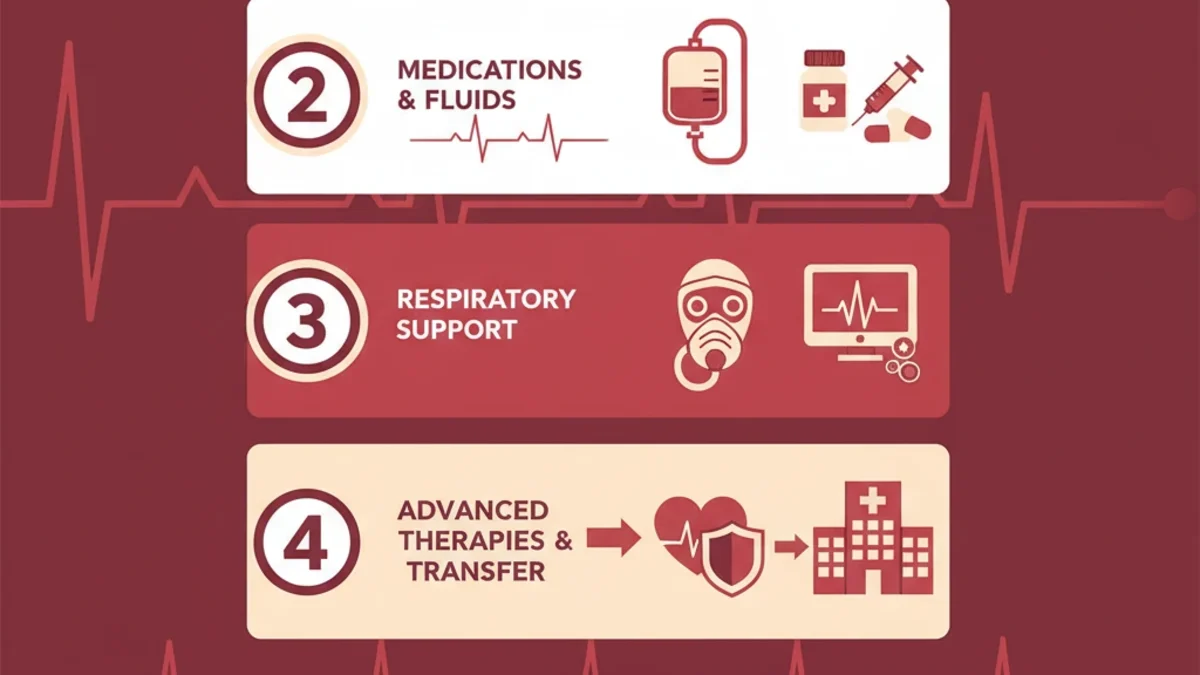
Acute decompensated heart failure drives over one million hospital admissions annually. 30-day readmission rates are 25%. When the heart cannot compensate, the tools change entirely - IV diuretics, inotropes, mechanical circulatory support. Sarah Mitchell and James Carter cover ADHF management, cardiogenic shock, and how to prevent the revolving door.
Sarah Mitchell & James Carter





