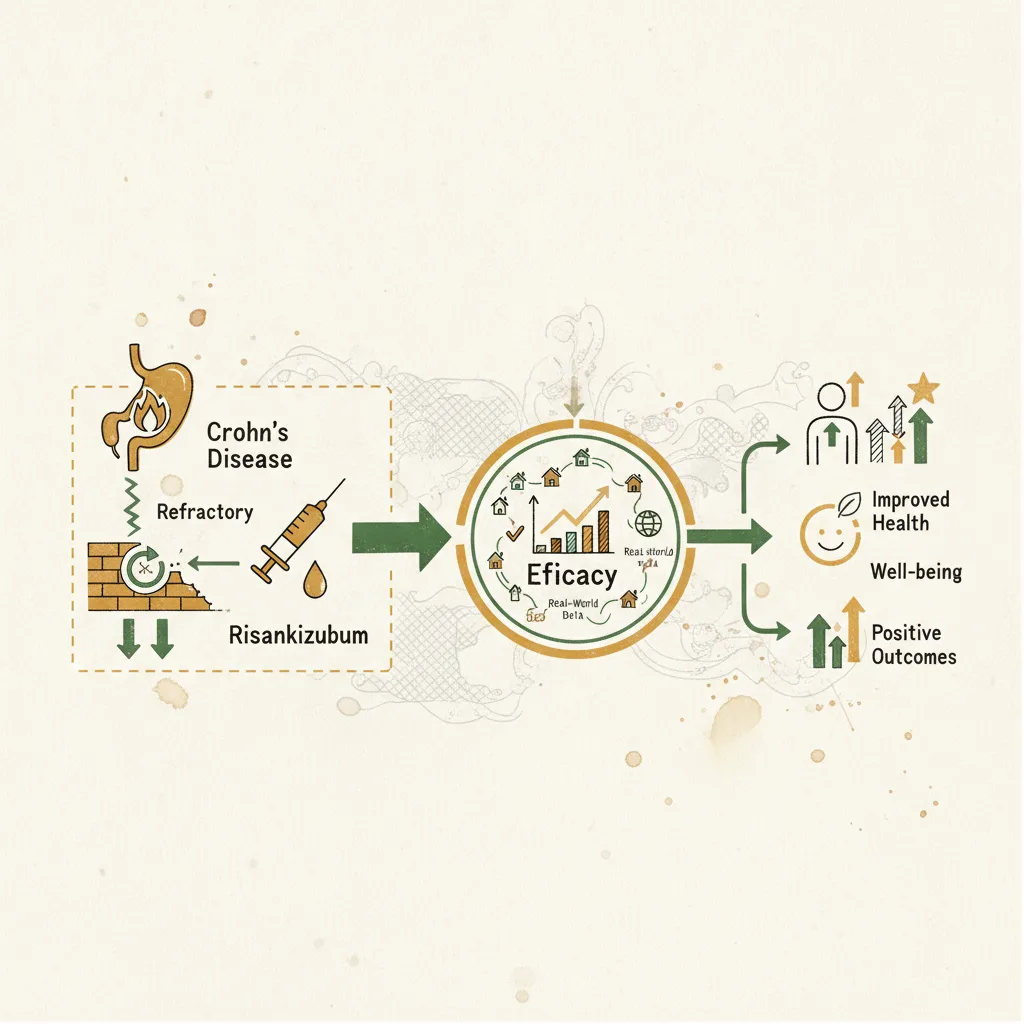

Managing moderate-to-severe Crohn's disease, particularly in patients who have failed prior advanced therapies, presents a significant clinical challenge. Recent real-world data from the ENEIDA Registry and other analyses provide further evidence for the effectiveness of risankizumab, an interleukin-23 p19 inhibitor, in this difficult-to-treat population. These studies offer insights into its short-term efficacy and outcomes at last follow-up, addressing a gap in real-world evidence for highly refractory cases.1
Risankizumab, a selective interleukin-23 p19 inhibitor, has demonstrated efficacy in clinical trials for moderate-to-severe Crohn's disease. However, real-world data, particularly in highly refractory patient populations, have been limited.1-3
Crohn's disease is a chronic inflammatory condition of the gastrointestinal tract, characterized by periods of remission and relapse. Its unpredictable nature and potential for severe complications, such as strictures, fistulas, and abscesses, significantly impact patients' quality of life. Despite the availability of various advanced therapies, including anti-TNF agents, anti-integrins, and JAK inhibitors, a substantial proportion of patients either do not respond to initial treatment (primary non-response) or lose response over time (secondary loss of response). This creates a critical need for effective alternative treatments, especially for those with highly refractory disease who have exhausted multiple therapeutic options.
Real-World Effectiveness of Risankizumab
The RISANCROHN study, derived from the ENEIDA Registry, evaluated the short-term effectiveness and outcomes at last follow-up of risankizumab in patients with refractory Crohn's disease. This study also assessed the impact of prior advanced therapy exposure.1 Similarly, other real-world analyses have focused on endoscopic outcomes, specifically in terminal ileal lesions, to further characterize risankizumab's effectiveness.2 A systematic review and meta-analysis also compiled evidence from both randomized trials and real-world settings to provide a comprehensive overview of risankizumab's efficacy and safety in Crohn's disease.3
The ENEIDA Registry, a large national registry of inflammatory bowel disease patients in Spain, provides a robust platform for real-world observational studies. Its comprehensive data collection on patient demographics, disease characteristics, treatment histories, and outcomes allows for valuable insights into the effectiveness of new therapies in routine clinical practice. The RISANCROHN study leveraged this extensive dataset to identify patients with Crohn's disease who initiated risankizumab, providing a representative sample of individuals facing significant therapeutic challenges. The focus on refractory patients, defined by prior exposure and failure to at least one advanced therapy, highlights the study's relevance to a particularly difficult-to-treat population.
In the RISANCROHN study, which included patients with highly refractory Crohn's disease, clinical remission was observed in 45.5% of patients at week 12.1 At the last follow-up, the clinical remission rate was 53.8%.1 Endoscopic improvement was noted in 50% of patients with terminal ileal lesions, indicating a positive impact on objective disease markers.2 The effectiveness of risankizumab was maintained regardless of prior advanced therapy exposure, suggesting its utility in patients who have failed other treatments.1-3
Risankizumab's mechanism of action involves selectively targeting the p19 subunit of interleukin-23 (IL-23). IL-23 plays a pivotal role in the pathogenesis of Crohn's disease by promoting the differentiation and survival of Th17 cells, which produce pro-inflammatory cytokines like IL-17 and IL-22. By inhibiting IL-23, risankizumab disrupts this inflammatory cascade, thereby reducing gut inflammation and promoting mucosal healing. This targeted approach offers a distinct advantage, particularly for patients who have not responded to therapies that target other inflammatory pathways.
The safety profile of risankizumab in these real-world settings was consistent with that observed in clinical trials. No new safety signals were identified.1,3 The data collectively support risankizumab as an effective therapeutic option for patients with moderate-to-severe Crohn's disease, particularly those who have not responded adequately to previous advanced therapies.1-3
Limitations of real-world studies typically include their observational nature and potential for confounding factors not present in controlled clinical trials. The RISANCROHN study, while providing valuable insights from a registry, shares these inherent limitations.1 For instance, the absence of a control group in observational studies makes it challenging to definitively attribute outcomes solely to the intervention. Furthermore, variations in clinical practice across different centers contributing to the registry could introduce heterogeneity. Similarly, the real-world analysis of endoscopic outcomes, while specific, may not be generalizable to all Crohn's disease phenotypes.2 Endoscopic assessment, while objective, can be influenced by the timing of the endoscopy relative to treatment initiation and the specific scoring systems used. Future research could benefit from larger, prospective real-world studies with longer follow-up periods to further confirm these findings and assess long-term outcomes, including sustained remission rates, corticosteroid-free remission, and prevention of disease complications.
The accumulating real-world data for risankizumab in refractory Crohn's disease offer a pragmatic perspective for clinicians. While clinical trials establish efficacy under controlled conditions, the true test lies in patient populations with complex treatment histories, often having failed multiple advanced therapies. The consistent efficacy observed in these real-world settings, with clinical remission rates exceeding 45% at week 12 and maintaining over 50% at last follow-up, provides a clear signal that risankizumab is a viable option for patients who have exhausted other biologic treatments. This is particularly relevant given the high unmet need in this subgroup.
For patients, these findings represent a potential expansion of effective treatment options. Living with refractory Crohn's disease significantly impacts quality of life, and therapies that demonstrate effectiveness even after prior failures are critical. The consistent safety profile, mirroring that of clinical trials, should also reassure both patients and prescribers. This evidence supports informed discussions between clinicians and patients regarding treatment pathways, especially when considering sequential advanced therapies.
From an industry perspective, these real-world outcomes reinforce the value proposition of risankizumab (Skyrizi, AbbVie) in a competitive gastroenterology market. Demonstrating efficacy in highly refractory populations can differentiate a therapy and support its broader adoption in clinical guidelines. The data underscore the importance of post-marketing surveillance and registry studies in complementing randomized controlled trials, providing a more complete picture of a drug's performance in routine clinical practice. This type of evidence is increasingly valued by payers and regulatory bodies when assessing the real-world benefit of new treatments.
- The Pivot Real-world data now support risankizumab's efficacy in highly refractory Crohn's disease, including those with prior advanced therapy failures.
- The Data Clinical remission rates at week 12 ranged from 45.5% to 53.8%, with endoscopic improvement observed in 50% of patients with terminal ileal lesions.
- The Action Clinicians may consider risankizumab for patients with moderate-to-severe Crohn's disease, especially those who have not responded to other advanced therapies.
ART-2026-534
·09/26
Drafted with AI assistance, reviewed and approved by the editorial team. This publication is intended for healthcare professionals, researchers, and life science industry professionals. Content is provided for informational and educational purposes only and does not constitute medical advice.

I cover NHS policy, NICE guidance, and the gap between what the evidence says and what gets commissioned. I bring a health economics background to reporting on how health systems make decisions under uncertainty.
Cite This Article
Mistry D, Voss M. Risankizumab shows efficacy in refractory crohn's real-world data. The Life Science Feed. Published June 21, 2026. Updated September 17, 2026. Accessed September 19, 2026. https://thelifesciencefeed.com/gastroenterology/crohn-disease/research/risankizumab-shows-efficacy-in-refractory-crohns-real-world-data.
Editorial & AI Standards
All content is researched from peer-reviewed, open-access sources: published trial data, clinical guidelines, and regulatory filings. AI tools are used solely to structure and summarise that evidence; no AI-generated conclusions appear without editor verification against the primary source.
Every article is reviewed by a named editor before publication. Source citations are listed in the References section. This content does not represent the views of any pharmaceutical company, medical device manufacturer, or healthcare provider.
Licence & Rights
© 2026 The Life Science Feed. All rights reserved. Unless otherwise indicated, all content is the property of The Life Science Feed and may not be reproduced, distributed, or transmitted in any form or by any means without prior written permission.
Medical Disclaimer
The information provided on The Life Science Feed is for educational and informational purposes only. It is not intended as a substitute for professional medical advice, diagnosis, or treatment. Always seek the advice of your physician or other qualified healthcare provider regarding any medical condition or treatment decision. Never disregard professional medical advice or delay in seeking it because of something you have read on this website.
References
1. Barreiro-de Acosta M, Zabana Y, Nieto-García L. Real-World Effectiveness of Risankizumab in Refractory Crohn's Disease: The RISANCROHN Study From the ENEIDA Registry. Aliment Pharmacol Ther. 2026.
2. Uchiyama K, Takagi T, Obata R. Endoscopic Outcomes of Risankizumab in Crohn's Disease: A Real-World Analysis of Terminal Ileal Lesions. Inflamm Intest Dis. 2026. doi:10.1159/000551419
3. Abouelmagd AA, Yassin MN, Abo-Elnour DE. Efficacy and Safety of Risankizumab in Crohn's Disease: A Systematic Review and Meta-Analysis of Randomized Trials and Real-World Evidence. Dig Dis Sci. 2026. doi:10.1007/s10620-026-09965-9