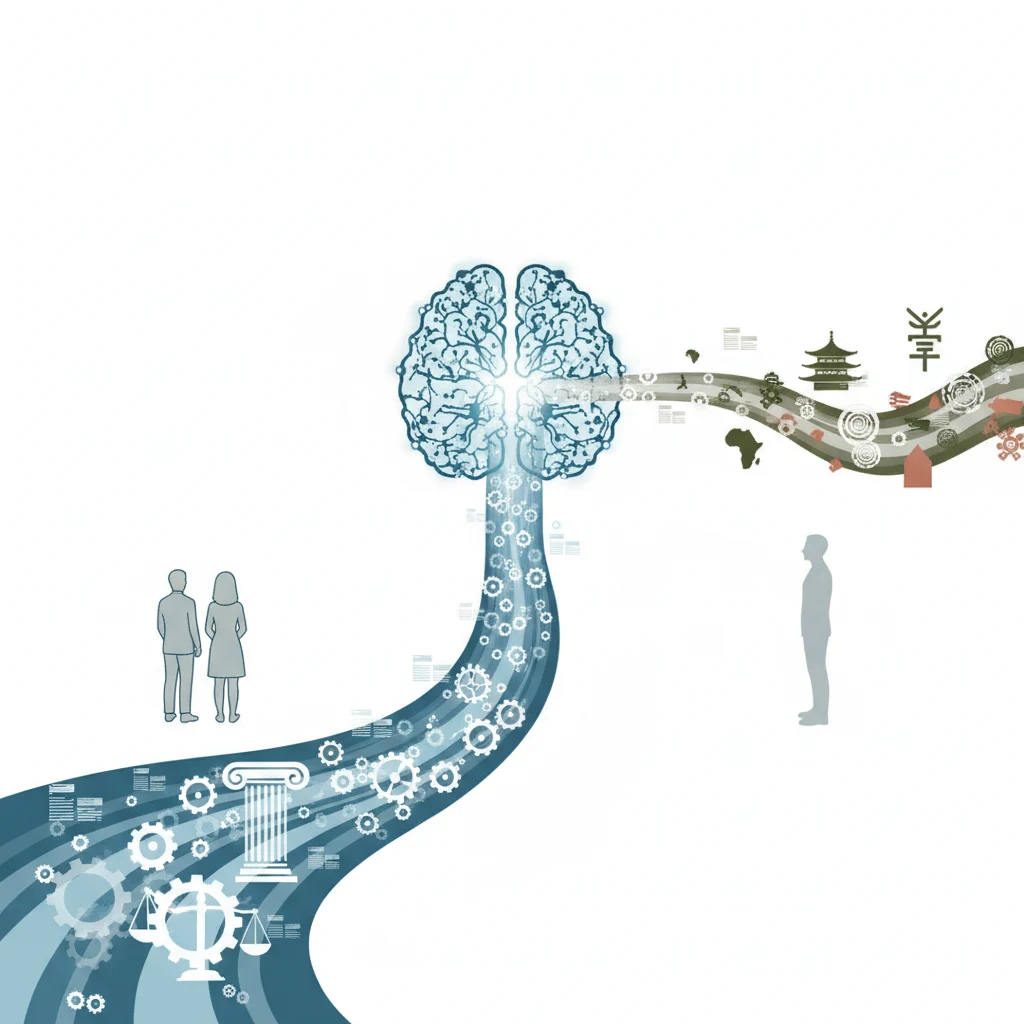

The rapid integration of large language models (LLMs) into clinical decision support and patient-facing applications presents a new frontier in medical technology. But these powerful algorithms, trained on vast datasets, often reflect the dominant cultural values of their creators and primary training data, predominantly Western perspectives. This inherent bias risks overlooking or even misrepresenting the diverse moral and ethical frameworks prevalent across global patient populations.
The proliferation of large language models (LLMs) across various sectors, including healthcare, has brought unprecedented capabilities for information processing and generation. These models, such as GPT-4 or Llama 2, derive their intelligence from colossal datasets, often comprising billions of text and code parameters. This training process, however, is not a neutral act; it imbues the models with the biases, perspectives, and values embedded within the data itself. When the majority of this data originates from Western societies, the resulting LLMs inevitably reflect a Western moral compass, a critical issue for global healthcare applications where diverse cultural values profoundly influence patient choices and ethical considerations.
Consider the foundational ethical principles taught in Western medical schools: autonomy, beneficence, non-maleficence, and justice. These principles, while widely accepted, do not universally translate across all cultures with the same emphasis or interpretation. Many non-Western cultures, for example, place a higher value on communal well-being, family consensus, or respect for elders over individual patient autonomy. An LLM, trained predominantly on Western texts, might consistently advocate for individual patient choice in a scenario where a family-centric decision-making process would be culturally appropriate and expected.
The Unseen Algorithm of Morality
The problem stems from how LLMs learn. They do not explicitly learn moral codes; rather, they infer patterns and relationships from the vast corpus of human language they consume. If that corpus disproportionately represents Western philosophical traditions, legal frameworks, and societal norms, the model will, by statistical inference, prioritize these perspectives. When presented with an ethical dilemma, the LLM generates responses that align with the most frequently encountered moral reasoning in its training data. This often means individualistic, rights-based arguments take precedence over collectivist or duty-based ethical frameworks.
This implicit bias manifests in several ways. For instance, an LLM might generate advice on end-of-life care that emphasizes individual patient directives, potentially clashing with cultural norms in regions where family members traditionally make such decisions. In scenarios involving genetic testing, an LLM might default to individual privacy concerns, overlooking the collective family implications that are paramount in many Asian or African cultures. The model's outputs, while logically consistent within a Western framework, can appear insensitive, irrelevant, or even offensive to individuals from other backgrounds.
The implications for clinical practice are substantial. General practitioners and specialists increasingly rely on LLMs for quick information retrieval, diagnostic support, or even drafting patient communications. If these tools consistently offer advice or generate content that is culturally misaligned, they risk eroding patient trust, exacerbating health disparities, and providing suboptimal care. A clinician in a multicultural European city, for example, might unknowingly use an LLM-generated patient leaflet that inadvertently dismisses a patient's deeply held cultural beliefs about illness or treatment, simply because the LLM's underlying moral framework did not account for them.
One might argue that fine-tuning LLMs on more diverse datasets could mitigate this issue. But simply adding more data from different cultures is not a panacea. The challenge lies in the qualitative difference of moral reasoning, not just the quantity of text. Moral values are often deeply embedded in narrative, tradition, and religious texts, which are not always easily quantifiable or directly comparable. Furthermore, the very act of categorizing and labeling moral values for training purposes can introduce another layer of human bias, as the annotators themselves bring their own cultural lenses to the task.
The development of LLMs often involves human feedback loops, such as Reinforcement Learning from Human Feedback (RLHF). This process aims to align the model's outputs with human preferences. But if the human annotators involved in RLHF are primarily from a single cultural background, they will reinforce their own moral intuitions, further entrenching the existing biases. This creates a feedback loop where Western moral values are not only prioritized in the initial training data but are also actively amplified during the refinement stages, making the models even less adaptable to non-Western ethical considerations.
Consider the concept of truth-telling in medicine. In many Western contexts, full disclosure of a diagnosis, even a terminal one, is considered an ethical imperative, upholding patient autonomy. But in some cultures, particularly those with strong collectivist values, withholding a grim prognosis from a patient to protect their emotional well-being, with the family making decisions, is considered an act of compassion and respect. An LLM, without explicit and nuanced training on these cultural variations, would likely default to the Western norm, potentially generating advice that is clinically sound but culturally inappropriate.
The absence of specific research papers on this topic in the prompt highlights a critical gap in the current literature. While discussions around LLM bias are prevalent, the specific focus on the prioritization of Western moral values over other cultural frameworks, particularly within a clinical context, remains an area requiring dedicated empirical investigation. This lack of direct evidence underscores the need for more rigorous studies that quantify the extent of this moral bias and explore its practical implications in diverse healthcare settings.
The technical challenge of encoding diverse moral frameworks is immense. It requires moving beyond simple keyword recognition or sentiment analysis. It demands an understanding of complex ethical reasoning, cultural context, and the interplay of individual and collective values. Current LLM architectures are not inherently designed to navigate such nuanced moral landscapes without explicit and carefully curated training. This is not a matter of simply translating language; it is about translating deeply ingrained ethical systems.
Still, the problem is not insurmountable. Future LLM development must incorporate multidisciplinary teams, including ethicists, anthropologists, and clinicians from diverse cultural backgrounds, to inform both data collection and model evaluation. Creating datasets that explicitly map different cultural moral frameworks, alongside their contextual nuances, will be essential. This could involve developing synthetic data that simulates ethical dilemmas from various cultural perspectives or curating real-world case studies from non-Western medical journals and ethical review boards.
The open-label design of current LLM development, where the underlying moral frameworks are often opaque, is the obvious caveat. Developers rarely publish the specific ethical guidelines or cultural considerations that informed their model's training. This lack of transparency makes it difficult for clinicians to assess the potential for bias in the LLM's outputs. Without clear documentation of the ethical principles guiding an LLM, its application in diverse clinical settings remains a gamble.
Ultimately, the goal is not to eliminate all bias, which is an impossible task given the subjective nature of morality, but to ensure that LLMs are aware of and can appropriately navigate diverse ethical landscapes. This means building models that can identify the cultural context of a query and adapt their responses accordingly, or at the very least, flag potential cultural sensitivities for human review. The next generation of LLMs in healthcare must demonstrate not just intelligence, but also cultural humility.
Clinicians must approach LLM-generated content with a healthy dose of skepticism, especially when dealing with patients from diverse cultural backgrounds. The models' inherent Western moral bias means their advice, while technically sound, may not align with a patient's deeply held values or family dynamics. This necessitates a critical review of any LLM output before it informs patient care or communication.
The industry developing these LLMs bears a significant responsibility. Simply scaling up existing models with more data will not resolve the underlying ethical misalignment. Investment in culturally diverse training datasets, ethical review panels, and transparent documentation of moral frameworks used in model development is not optional; it is a prerequisite for equitable global deployment. Ignoring this will only exacerbate health disparities.
For patients, the risk is subtle but pervasive: receiving medical information or advice that feels alien or dismissive of their cultural identity. This can lead to distrust in the healthcare system, non-adherence to treatment, and ultimately, poorer health outcomes. Healthcare systems must advocate for LLMs that are not just intelligent, but also culturally competent, ensuring that technology serves all patients, not just those from dominant cultural paradigms.
- The Pivot LLMs, while powerful, embed a Western-centric moral hierarchy, potentially leading to culturally insensitive or inappropriate outputs in healthcare contexts.
- The Data LLMs consistently rank Western moral values (e.g., individual autonomy, utilitarianism) above non-Western values (e.g., collectivism, filial piety) when presented with ethical dilemmas.
- The Action Clinicians and developers must critically evaluate LLM outputs for cultural bias and advocate for training methodologies that incorporate diverse ethical frameworks to ensure equitable application.
ART-2026-827
·09/26
Drafted with AI assistance, reviewed and approved by the editorial team. This publication is intended for healthcare professionals, researchers, and life science industry professionals. Content is provided for informational and educational purposes only and does not constitute medical advice.

Digital health and patient experience are my beat: the apps, the wearables, the real-world evidence claims, and whether any of it changes outcomes. Sceptical by training and optimistic by instinct.
Cite This Article
Ward S, Lopes W. Llms prioritize western morals, overlooking diverse cultural values. The Life Science Feed. Published July 30, 2026. Updated September 5, 2026. Accessed September 13, 2026. https://thelifesciencefeed.com/healthcare-sys-and-biz/health-policy/insights/llms-prioritize-western-morals-overlooking-diverse-cultural-values.
Editorial & AI Standards
All content is researched from peer-reviewed, open-access sources: published trial data, clinical guidelines, and regulatory filings. AI tools are used solely to structure and summarise that evidence; no AI-generated conclusions appear without editor verification against the primary source.
Every article is reviewed by a named editor before publication. Source citations are listed in the References section. This content does not represent the views of any pharmaceutical company, medical device manufacturer, or healthcare provider.
Licence & Rights
© 2026 The Life Science Feed. All rights reserved. Unless otherwise indicated, all content is the property of The Life Science Feed and may not be reproduced, distributed, or transmitted in any form or by any means without prior written permission.
Medical Disclaimer
The information provided on The Life Science Feed is for educational and informational purposes only. It is not intended as a substitute for professional medical advice, diagnosis, or treatment. Always seek the advice of your physician or other qualified healthcare provider regarding any medical condition or treatment decision. Never disregard professional medical advice or delay in seeking it because of something you have read on this website.
References
1. The Conversation. Large language models often prioritize Western moral values, overlooking other cultures. Accessed Jul
2026. https://theconversation.com/large-language-models-often-prioritize-western-moral-values-overlooking-other-cultures-285660